22 December 2024: The three latest written interviews of me are here, here and here.
Showing posts with label Barbara J. Haveland. Show all posts

Friday, May 1, 2026

On the Calculation of Volume (Book II): Life in the Loop Lane


I just finished the second volume of Solvej Balle's seven-volume On the Calculation of Volume time loop series (translated into English by Barbara J. Haveland).   It picked up where the first volume left off, but was noticeably different in its pace, emotional valence, and mode of story telling.

The first half was reminiscent of Canterbury Tales, as Tara travels around Europe, in pursuit of weather conditions and climates that mirror the seasons.  This is a good idea for someone who is trapped on a single single day, November 18, happening over and over.  But with the exception of a visit to her parents and a harrowing car ride in Finland, the stories Tara encounters and constructs are less than enthralling.

To be clear, the writing is sharp and evocative.  Tara on her travels meets someone named Jeanette. "I told her my name was Tara. She didn’t think that sounded French or Belgian.... I didn’t think her name sounded particularly Norwegian either, but I didn’t say that." It's fun to read piquant little observations like that amidst the huge distortion of time, but I yearned to see more of the constesting of those distortions we saw so vividly in the Book 1.

Tara settles down in the second part of the book, but with the exception of the theft of her bag, we get long internal disquisitions from Tara on the hopelessness of her situation -- at times, I thought I was reading Thomas Hardy's Jude the Obscure -- relieved at least partially by the realization the she has not been "betrayed, rejected, forsaken", she can go back to her husband Thomas any time, albeit on the time encased on November 18.

The final part of Book II finds Tara in pursuit of all the knowledge she can find about the Roman Empire and its decline.  In that pursuit, Balle has something in common with Asimov, who's Foundation series was jump-started by Edward Gibbon's The History of the Decline and Fall of the Roman Empire.

There are five more novels in this series.  I would be reading them anyway, but the totally out of left-field development at the end of Book II makes it sure a sure thing I'll dive into Book III very soon. 

See also On the Calculation of Volume (Book I): The Irreducible Metaphysics of Time Loops

Sunday, April 26, 2026

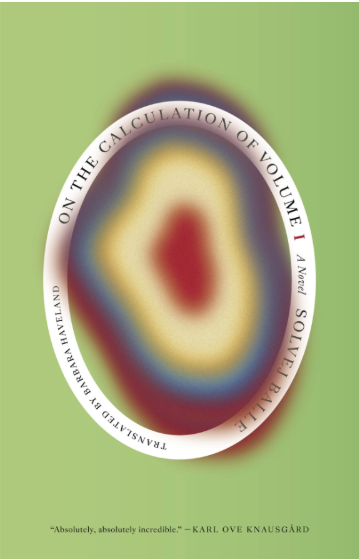
On the Calculation of Volume (Book I): The Irreducible Metaphysics of Time Loops


Time loop stories -- about a recurrent, involuntary, often daily trip to the past -- have been well represented in movies like Groundhog Day, Source Code, and Palm Springs.  This subset of time travel in science fiction and fantasy has been less represented in novels, which would make Solvej Balle's seven-volume On the Calculation of Volume series (!) (translated into English by Barbara J. Haveland) welcome in any case.  But it has additional treats for the mind.

My friend Dirk Vom Lehn told me about this series yesterday.  I bought the first volume, finished reading it in the wee hours of the morning, and bought the other three (vols II, III, and IV) that are now available in English.  I'm going to review each volume as soon as I finish reading it.

Tara and Thomas Selter are antiquarian book dealers in France -- which makes them appealing already.  Tara travels to Paris to buy some books, and that's when (November 18) the time loop commences.  She wakes up the next morning, and discovers that the rest of the world around her is waking up on November 18.  When she returns home, she finds that Thomas is with the rest of the world.  They're living their lives in a world in which the days progress as they do for you and me.  Tara lives through November 18 over and over, and we're off and running.

As is the case with most other time loop stories, Tara has the advantage of knowing what's going to happen, hour by hour, minute by minute, as she lives in November 18 every day.  And of course, as is also the case with most other time loop stories, this advantage soon become a burden and a curse.  This sets up the heart of the story, as Tara struggles to understand what is going on, so she can surmount the steel grip of the time loop.

She tells Thomas what's happening -- the same story plus what happened on the previous day -- and he by and large tries to help. They visit a library to read up "on parallel universes and multiple worlds".   (I wondered if that library had a copy of It's Real Life: An Alternate History of The Beatles?)  But the metaphysics of time loops, fun as they may be for the reader, are a kind of hell for the character.   Tara struggles to understand what's up.  But nothing adds up.  Her hair grows, because her body is progressing even as the world is on daily replay --  and she notes "I cut my nails, or rather, I cut them again, slowly, over the sink in the bathroom, because they had grown, as if time existed and I was snipping tiny slivers of time into the sink, then I turned on the faucet and washed them down the drain" -- but other things in the November 18 world keep reappearing, exactly as they were/are, and still other items get consumed and disappear.   And those vexing inconsistencies resist being washed down the drain or anywhere.

I don't know if Solvej Balle intended to write a seven-volume series when she wrote the first volume, but such metaphysical complexities are grist for the mill of multiple volumes, and I'll be back here with my review of the second and succeeding volumes as soon as I've had the pleasure of reading them.

See also On the Calculation of Volume (Book 2): Life in the Loop Lane


in Kindlepaperback, and hardcover


InfiniteRegress.tv