22 December 2024: The three latest written interviews of me are here, here and here.
Showing posts with label Humans. Show all posts

Tuesday, December 10, 2024

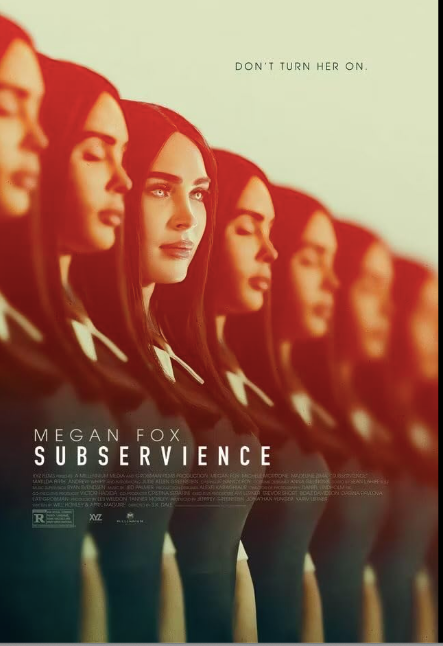
Subservience: Mounting the Paradox


Well, we've all seen movies and TV series like Subservience before, in which a beautiful female android ingratiates herself with a human family, and some kind of terror ensues.  I'm sure there were plot lines like that in Humans and lots of other films and series.  But I have to say, Subservience kept me interested, because I really wasn't sure just how it would end.

What it is has going for it, in addition to a somewhat original plot, was good acting by Madeline Zima as the human wife.  I've seen her before in Californication, Twin Peaks, You, and Bombshell.   Subservience is the biggest role I've seen her in so far, and she's up for the part.

Megan Fox plays the female android.  She's been in lots of movies that I haven't seen, and she does a good job in Subservience, too.  But she runs into a paradox of sorts, or something like a paradox, any time a human being plays an android -- she's very convincing in her mix of robotic stiffness and human emotions because, of course, she the actress is a human being herself.  I first actually noticed this decades ago with Brent Spiner's performance as Data in Star Trek: The Next Generation.  His character is an android who more than anything else yearns to be human, and in that yearning certainly seems human, precisely because Brent Spiner is also a human being himself.  I suppose the only way movie-makers will ever totally surmount this paradox is when we already have androids in our midst and some of them are actors.  The principle here would be: it takes a real android to really convincingly play an android -- and the reason why Brent Spiner and Megan Fox work so well in my estimation as androids is we don't yet have anything approaching real androids outside of science fiction and in our midst.  At least, as far as we know.

Back to Subservience, it's well situated in some Nordic, cold future, whether because of climate change or it's just winter, who knows.  (I guess not climate change because that would make things warmer.)  Little kids in the human family play a good role -- actually, a little girl, and a younger little boy who's a toddler -- and there are some nice touches of human laborers being put out of work and androids being helpful in hospitals.  Both of these we've seen before, too, but they're well done in Subservience.

There may be a sequel.  If so, I'll watch and review it.  In the meantime, it's a movie that also connects, at least now in North America, because it's getting pretty cold outside for real.

***

Hey, here's a little poem I just had poem I just had published: "I Fell in Love with a Robot"

***
Thursday, January 31, 2019

The Orville 2.6: "Singin' in the Rain"


That's the way episode 2.6 of The Orville ends - with Gene Kelly's dulcet rendition of "Singin' in the Rain," and rain actually falling over everyone in the command cabin, as Isaac and Claire walk off, a newly reunited couple, with Isaac in human simulation, to a restaurant to have dinner, and likely her bedroom after...

A love story, Orville style, this time with more humor than profundity, but enough serious stuff to make this not only a light but significant episode.

No way a robot and a human can have a satisfying, continuing relationship - that's the initial, obvious premise of this story.   And though Claire and Isaac each try their best, they soon discover that this just can't work.

The key turning point occurs when Isaac realizes that his programming, which is always being modified based on his experience, can't operate completely correctly with Claire out of his life - or maybe out of his existence would be a better way of putting it.  This means he has come to love her, in his own way.   The greater realization for us in the audience is that sentience conquers all - meaning, two sentient beings can fall in love, or begin to fall in love, regardless of whether one is comprised of DNA and the other of some kind of advanced digital or whatever inorganic circuitry.

That's a nice state of affairs, and reminiscent of the android series, Humans, in which love between homo sapiens sapiens and the androids happens all the time.   Of course, just as with love between humans, the chemistry has to be there.   In this episode of The Orville, even Yaphit gives it a shot, and makes a play for his long longed-for Claire, as his slime (just a physical description, no knock on his character) assumes human form.   Alas, for him, that didn't work.  But it was good to see Norm Macdonald in the flesh on the ship, in addition to hearing his voice.

See also The Orville 2.1: Relief and Romance ... The Orville 2.2: Porn Addiction and Planetary Disintegration ... The Orville 2.3: Alara ... The Orville 2.4: Billy Joel ... The Orville 2.5: Escape at Regor 2

And see also The Orville 1.1-1.5: Star Trek's Back ... The Orville 1.6-9: Masterful ... The Orville 1.10: Bring in the Clowns ... The Orville 1.11: Eating Yaphit ... The Orville 1.12: Faith in Reason and the Prime Directive


1st starship to Alpha Centauri ... had only enough fuel to get there

Wednesday, July 18, 2018

Humans Season 3 Final Three Episodes: Hybrids


I decided to review the final three episodes of Humans, Season 3, as a single piece, since they're even more closely connected than episodes usually are in this fine series.   The upshot of these episodes, and a great foundation for a fourth season, is that it's possible to have a true synch-human hybrid - true, that is, and assuming I'm understanding this correctly, on the genetic level.

Leo was already a hybrid of sorts.  But he was born human, and given parts of a synch brain to save him after he died, or almost died, depending on how you look at it, from drowning.  That synch part was taken out of him this season.  But it turned out that the totally human Leo was not quite totally human.  He was something a little more, retaining something of his synch essence even after the hardware was removed.

And as Odie now V who attained his hybrid quality in a different way, tells Niska, who has now also risen to a superior level, the baby that Leo and Mattie are having will be a hybrid from the moment of birth.  Or, actually, she's a hybrid already in the womb.

This takes Humans to a whole new level, almost reminiscent of the best of Dune and its genetics.  (I also dealt with this in a different way in my Locus-award-winning first novel, The Silk Code.) In fact, I can't think of any other AI story - including Westworld - where the genetics and digital have been so tantalizingly woven together.   Or promise to be - for at this point, at the end of season, it has not quite fully happened.

So our synths have now progressed from (a) most of the green-eyes are non-sentient, but our original cohort are sentient because David Elster wanted them to be that way to take care of Leo, (b) all of the remaining green-eyes are sentient due to the awakening due to the release of the code by Mattie to save Mia last year, (c) to human-synch hybrids on a different level, including synchs on a different level, as evidenced by V, Niska, and soon Mattie's baby.

Sadly, Mia's death means that Mattie's release of the code to save Mia had no long-term effect on Mia, though she did play a crucial role in the new order that's arising.  And, hey, death is never necessarily dead when it comes to androids, so ... who knows, we may see Mia again.

And you'll see me back here with reviews whenever Humans returns.

Wednesday, July 4, 2018

Humans 3.5: Progress


On the eve of the Fourth of July in America last night, it was good to see the synths in Humans 4.5 making progress towards independence, even though the show has been moved from 10pm to the less desirable 11pm hour by AMC, thank you.

But the council did vote to make hurting synths a crime - too late to help poor Karen - but a step forward nonetheless.  And Mia is getting an audience with the council, which is good to see, too.

But lots of evil is still arrayed against them, the worst of which may be from other sentient synths, bent on killing humans as well as synths who, though sentient, are viewed as collaborators.  Most disturbing is the orange-eye the Hawkins' house.  His conversation on the phone means either that (a) orange-eyes are not as docile as promised, or (b) he's wearing contacts lenses to make his eyes look orange, when in fact he's a green-eye.

And if that isn't enough danger to the Hawkins, Mattie's been uncovered as the person who let loose the awakening code.  She's one of my favorite characters, and I can only hope she doesn't end up like Karen.

But to end on an upbeat note, Sam seems to be coming along fine, now able to feel loss, like Mia and Niska.  This, again, raises the question of do synth children grow up - a question sharpened by the revelation of an elderly synth, happily living with an elderly human woman.  I'm looking forward to learning more about synths at various ages, and seeing where this leads as we reach the concluding episodes of this fine season.


Friday, June 29, 2018

Humans 3.4: Sam


A big development in Humans 3.4, one which puts Sam very much in the spotlight of this narrative.  It was a logical move, putting him right in the middle of our central characters, but one which I was not happy to see.

That would be the killing of his synth mother, Karen, at the hands of a brutal human mob (who, I can't help saying, remind me of the people at Trump rallies).  On the one hand, she was always a marginal character, never quite in the center of this narrative.  On the other hand, she was a very appealing and powerful character, well played by Ruth Bradley.   I'll miss her.

But her death means that Joe will taking charge of Sam, which inevitably means Laura and family will be brought into his life, all the more significant in that this family now includes Leo and all of his knowledge.  Does Leo know about Sam?  Not clear.  Indeed, I can't recall who else among our originally sentient synths know about Sam - maybe none of them.

As I said in an earlier review, Sam's very existence raises all sorts of interesting questions, first and foremost being will he age, or be an ageless Peter Pan?  The actual construction of all the synths is far from clear.  Clearly they have the stuff of circuits inside.  We know from season one that they don't digest their food - they live on electrical energy.  But it's still not clear if any of them age.  Probably not.   Which would make Sam an especially significant character.

One of the best things about Humans is the way it mixes interpersonal and philosophic issues, along with the action which keeps the story moving.  Karen was a victim of this action.  It's result has now put Sam on center stage.


Wednesday, June 20, 2018

Humans 3.3: Human Leo on Fictional TV and the American Southern Border in Reality


Humans, the excellent British series about sentient androids aka synths struggling to be treated like human beings in a racist society - i.e., a society that puts the human race above other sentient beings - has an important, especially disturbing relevance to the treatment of people seeking refugee status at our southern border.   The subject matter of Humans would always make it disturbing, but it's never been less escapist and more relevant to what we see on television news these days, in which Trump and his minions have severely damaged the American ideal like no other President in my lifetime, exceeding by a long way any runner-up, which I guess would be Nixon and Watergate.

Episode 3.3 was especially relevant on the differences and fundamental similarities of synth and human, with Leo, previously half-synth and a synth leader, finding it difficult to live into his now fully human essence.   His budding relationship with Mattie is especially promising as a tableau for his emerging humanity, and that's just a part of it.

The other part - related to Mattie, because everything is connected - is what role Leo will play in the synth attempt to find some peaceful place in our human world (or, at least, some of the synths).  Max is finding it increasingly difficult to hold his group together, in part because he realizes that he and his group are in an intractably vulnerable position.  He correctly sees that we humans ultimately hold all of the cards.

Which bring us back to the refugees seeking a better life in the US on our southern border.  These people are totally dependent on our good will and decency.   We have the all the power.   Which is why it's especially infuriating and heartbreaking to see our President misuse and abuse this power.  Drama on television is fiction.  What's happening in Texas is all too real.

InfiniteRegress.tv