22 December 2024: The three latest written interviews of me are here, here and here.
Showing posts with label Bladerunner. Show all posts

Friday, August 1, 2025

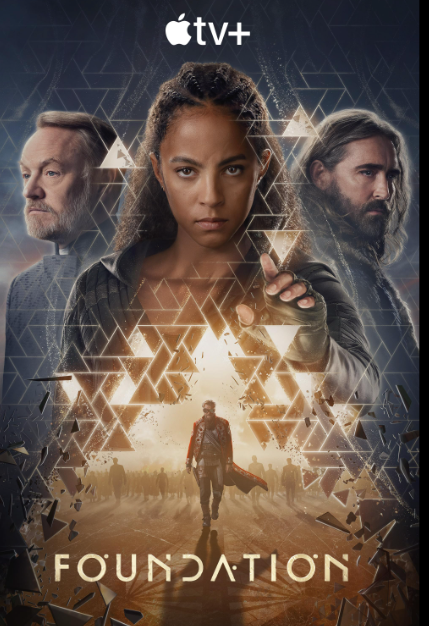
Foundation 3.4: Cleon Knows His PKD

Another superb episode in the third season of Foundation -- 3.4 -- in which the series continues to integrate the Cleon triumvirate story with Asimov's original Foundation trilogy, alternated in many ways but still ringing true enough to Asimov's vision to be expansive rather than smothering of what Asimov put on his pages.

My favorite sliver of a scene has Day chiding Demerzel with a question borrowed and transmuted from Philip K. Dick's 1968 novel, Do Androids Dream of Electric Sheep, brought to the movie screen in 1982 by Ridley Scott as Blade Runner.  Day concludes his testy conversation with Demerzel -- he's understandable uncomfortable with her -- with a question, "Do robots dream of wiping their own asses?" Not as elegant as Philip K. Dick, but, hey, a lot of years have passed since he came up with that title.

And it was good to hear Demerzel talk about Asimov's three laws of robotics, and then the zeroth law, as she struggles to understand how she has evolved, who and what she's become and must do.  She's an advanced piece of work, indeed.  Not only can she think and talk with her head physically detached from her body, she can navigate the complexities of the universe with the best of 'em -- e.g., Hari and Gaal -- and knows that the Second Foundation is the best way of stopping The Mule.

[Spoilers ahead ... ]

Speaking of which -- the Second Foundation and The Mule -- I actually like that Pricher wasn't converted by The Mule (who did manage to read his mind), and is literally in league with Gaal.  This is a significant departure from Asimov's story, and I think it's a good one.  I've always been at least slightly unhappy about Pricher's conversion to The Mule all those years before their story was streaming on Apple TV+, and it will be fun to see where this twist goes.

Gaal continues to play a vastly more important role in this rendition of the Foundation saga than her male counterpart in the trilogy.  Not only is she in bed with Pricher, she has intellectually seduced Dawn, and drawn him into the cause of the Second Foundation.  As I said in a previous review, this realignment of the major players in the story of The Mule, in which powerful elements of the Empire are joining the Foundations in their desperate looming war with that demon manipulator of minds, is refreshing and promises some major unexpected developments.  As became clear back in the days back when television was just being born as a mass medium, Seldon's psychohistory can only go so far.

See also Foundation 3.1: Now We're Talkin'! ... 3.2: "The Fault, Dear Brutus, Is Not in Our Stars" ... 3.3: Dawn and The Mule

And see also Foundation 2.1: Once Again, A Tale of Two Stories ... 2.2: Major Players ... 2.3: Bel Riose and Hari ... 2.5: The Original Cleon and the Robot ... 2.6: Hari and Evita ... 2.7: Is Demerzel Telling the Truth? ... 2.8: Major Revelations ... 2.9: Exceptional Alterations ... Season 2 Finale: Pros and Cons

And see also Foundation 1.1-2: Mathematician, Man of the People, and Cleon's Clones ... Foundation 1.3: Clonal Science Fiction, Hari Seldon as V. I. Lenin ... Foundation 1.4: Slow Hand, Long Half-Life, Flipped Coin ... Foundation 1.5: What We Learned in that Final Scene ... Foundation 1.6: Folded Variations ... Foundation 1.7: Alternate History/Future ... Foundation 1.8: Divergences and Convergences ... Foundation 1.9: Vindication and Questions ... Foundation Season 1 Finale: Right Up There


Tuesday, May 22, 2018

Mute - Cyberpunk Sound and Fury, and Light


Just saw Mute on Netflix, latest movie from director Duncan Jones, of Source Code fame, and starring mainly Alexander Skarsgård (True Blood, and Big Little Lies) with supporting acting by Paul Rudd and Justin Theroux. Wikipedia reports that Mute "drew unfavorable comparisons" to Bladerunner, but that's just dumb (the comparisons not the report), since there are no androids that I know of in Mute.  There are all kinds of cybernetic body enhancements and replacements going on - like in The Six Million Dollar Man - and the flavor is definitely LA cyberpunk, even though the action takes places in a future Germany.

Germany is no accident in Mute.  The hero, Leo, is Amish, and he's mute because his Amish mother didn't allow surgery on her son when his neck was injured in some kind of boating accident, or in some accident in the water.   (By the way, although I suppose a given Amish bishop could tell his followers not to accept modern medical care, that's not something that most Amish do.  It's a common misconception that the Amish say no to all technology, when in fact they carefully pick and choose - see my The Amish Get Wired - Wired? published in Wired way back in 1993 for more.)

But back to Mute, Leo's Amish heritage is a good touch, because it helps him fit into this brave new world in Germany (Amish are of German descent).  The movie is superb on detail in this future, including Leo not being able to order food - which could be delivered to his dwelling, when he gets home, via droid - because he's mute, and the ordering app can't respond to anything other than voice.  And the violence, though sometimes a little hard to take, makes some logical sense in this future, in which most body parts are as replaceable as the parts of your car.

The plot is a little obvious and slow at first, but tightens up with a strong wave of well-motivated developments at the end, and a dedication to Jones's father David Bowie and his childhood nanny Marion Skene.  Recommended for fans of Bladerunner, The Six-Million Dollar Man, and Banshee - and, hey, you can see it for free on Netflix if you're a subscriber.

                     more Amish in science fiction


            more science fiction with David Bowie

Sunday, February 4, 2018

Altered Carbon 1: Roads, Spit, and Immortality


Critics who've said that Altered Carbon, the 10-part series I just binged on Netflix (based on the 2002 novel by Richard K. Morgan, which I haven't read) is not as good as Bladerunner, which it strives to be, are myopic - or to put it bluntly, completely wrong.  That's because Altered Carbon is at least as good if not better than the two Bladerunner movies (certainly the second), which it not only exceeds in scope and variety, but plain-out doesn't resemble in crucial ways.

Both are hardboiled cyberpunk, to be sure.   Both therefore entail murder and sets that look like Tokyo on speed.  Both have have sardonic investigators who crack wise.  And both are about the extents and limits of human and human-like minds in human and human-like bodies.

And there the similarities, impressive as they are, end.  Bladerunner is about androids, or artificial, flesh-like beings, with artificially created minds.  Altered Carbon is about transferring human minds to "stacks," composed of a crystal-like substance found on an alien world somewhere out there in space.  These stacks can be put into bodies ("sleeves") that look nothing like the body that housed the original mind, including different genders, and even an adult stacked into a child.  They can also be put into an identical body - "double-sleeved" - or cloned, with the clones having completely identical consciousnesses until the moment of the sleeving and stacking.    The possibilities for love and death (sleeve death of just the body, so the stack can be implanted in some other body vs. "real death" when the stack is destroyed, too) are almost endless.  Freud would have loved it.  I did.

Planets far from Earth are not just a backdrop. Important parts of the narrative occur there.  The characters have a media ecological sense of how minds and bodies intersect (see Human Replay for what that means).  They also understand the pivotal role of media in human history.  Quellcrist (a central character) notes that Rome went from a city to one of the most powerful empires in ancient history because of its "roads" - an observation that comes right out of Harold Innis's Empire and Communications.

The stacks in effect make humans immortal, and in one of the main threads of the story, Quellcrist heads a team of rebels who want to return humans to their pre-stack mortality.   (I like the character, but disagree with her on this, btw.)  Takeshi Kovacs is one of the team, and he's the prime protagonist in this story, which includes solving a murder ("the dead can now accuse their murderers," he aptly says), fighting off potent villains of both genders, and wending, usually fighting, his way against all manner of physical and digital constructs - if he doesn't embrace them - including an AI hotel named the Raven with an Edgar Allan Poe as its concierge avatar.

Joel Kinnaman puts in his best performance on the screen so far - and it's fine indeed - in this role, sometimes even looking a little James Dean.  He spits on a sensor which expected to get his DNA in another package, and is compassionate and brutal as need be.  Convincing acting, too, by Martha Higareda as Ortega, Renée Elise Goldsberry as Quellcrist, Dichen Lachman as Rei, Chris Conner as the aforementioned Poe, and how could I not give a shout-out to Tamara Taylor from Bones.

Slight quibbles: the story is set hundred of years in the future, but the ambience on Earth seems more like just decades away.  And there's one scene in which someone tries to elude attackers by pretending to be dead amongst a group of corpses, but wouldn't the attackers in this far-future scenario be able to digitally scan the area for any signs of life?  But these quibbles are small indeed.

There's plenty of violence (which has received some criticism) as well as nudity of all kinds (I haven't seen any criticism of that) and I think both are right and work well for the series.  There's room for a sequel, which I hope is made (Morgan published two additional novels in this saga).  Laeta Kalogridis gets the "Created by" credit on Wikipedia, and there's a full house of directors, producers, and writers in this powerfully rendered series.  All deserve kudos.


Saturday, January 13, 2018

Philip K. Dick's Electric Dreams 1.2 Autofac: Human v Machine


Ok, one more review for the night - of the second standalone episode in Philip K. Dick's Electric Dreams, now streaming (that is, all ten episodes of this anthology) on Amazon Prime.   (See my review of the first episode for how I'll be reviewing these episodes, if you're interested.)

In Autofac, we have Dick addressing his perennial what's real and what's fantasy, dream, alternate whatever conundrum in a form likely best known these days, and for better than three decades: which one is more human, the android (robot) or the humans who made it/her/him.   This is the theme of Bladerunner, original movie and recent sequel, based on Dick's novel Do Androids Dream of Electric Sheep? - two words of which are part of the title of this 2018 streaming series.

Since Autofac is just the second episode I've seen of Electric Dreams, I can't tell you if it captures the essence of Dick's science fiction better than the other episodes.  But I will say it does an outstanding job of presenting the story of which is android and which is human - with the intensity that we might expect to find in HBO's Westworld.  Which in turn means that Amazon Prime in this series is playing on some high intellect/octane terrain indeed, as it did in its other Dick production, The Man in the High Castle.

One of the reasons that Dick has had more of his stories brought to the screen than has Asimov, Heinlein, Clarke, and all the masters of science fiction combined, is that he knew how to put twists and turns and surprises right in with the most complex philosophic puzzles.   Autofac has that, and manages to provide a narrative that is fresh and surprising even though its post-apocalyptic setting and artificial intelligence motifs are almost commonplace on the page and the screen.

Top-notch acting by Juno Temple, and it was good to see Revolution's David Lyons back.  Well written for television by Travis Beacham, and sharply directed by Peter Horton.

See also Philip K. Dick's Electric Dreams 1.1: Mutually Alternate Realities ... 1.3 Human Is: Compassionate or Alien? ... 1.4 Crazy Diamond: DNA Batteries ... 1.5 The Hood Maker: Telepathy and Police ... 1.6 Safe & Sound: This Isn't A Drill ... 1.7 The Father Thing: Dick from Space ... 1.8 Impossible Planet: Eye of the Beholder ... 1.9 The Commuter: Submitted for Your Approval ... 1.10: Kill All Others: Too Close for Comfort


more alternate realities ...

Tuesday, December 12, 2017

Advantageous: Shimmering Teardrop from the Future

For some reason, I missed Advantageous (Netflix, 2015), and just found it on Uproxx and saw it tonight after searching for the best science fiction movies on Netflix.  It's an apt description.  In fact, Advantageous is an excellent science fiction movie anywhere.

It's been compared to Seconds, the brilliant, pathbreaking 1966 movie, in which older personalities are transferred or cloned into younger bodies.  But Advantageous, though it's about the same theme, is much more hi-tech - in a quiet way - and thus bears resemblances to Blade Runner (original and sequel) and even The Matrix.

But Advantageous is different from all of those movies in that it's more personal.  Gwen wants to transfer her persona into a younger body not for vanity, nor because she's dying or sick or (like the character in Seconds) just bored with her existence.  She needs to transfer because she needs the money she'll receive from it.  She needs this to send her daughter Jules to a good school in this future world.  She'll otherwise lose her job, and her family has let her down.

Director Jennifer Phang does a deft job of portraying Gwen and her daughter close-up, against a backdrop something like Bladerunner and a phone system maybe a few decades into the future.  In addition or underneath or maybe overlay would be a better description there's a watercolor ambience that runs through a lot of this, including a scene that looks like a reflection of Monet's lily pond. Phang co-wrote this with Jacqueline Kim who gives a sensitive performance as Gwen.  Even Samantha Kim (I don't know if they're related) does a fine job as Jules, as does James Urbaniak as her boss and Freya Adams (New Amsterdam!) as Gwen2.

So what we have in Advantageous is a delicately rendered, highly intelligent and provocative science fiction movie.  It may be a minor classic already, on  its way to being just a softly focused, shimmering-like-a-teardrop classic, period.


It all started in the hot summer of 1960, when Marilyn Monroe walked off the set of The Misfits and began to hear a haunting song in her head, "Goodbye Norma Jean" ...

Saturday, October 28, 2017

Bladerunner 2049: The Only Better Movie of this Kind is Bladerunner, and Hey


I loved it.  So did my son Simon, who's now a father of his own.  We loved it almost as much as the original Bladerunner, which we saw more than once on videotape, before there even were DVDs for rent, back in the early 1990s.   That's high praise.  The only reason Bladerunner 2049 wasn't as good as Bladerunner circa 1982 was that the 1982 movie broke so much new ground.  Back in the mid-80s, when I was teaching in the MA in Media Studies Program at the New School, I asked Stephen Jacobs (who then was my student, and has long since become a professor himself, at the Rochester Institute of Technology) to give me an example of cyberpunk.  "Bladerunner" he replied.  It defined the field, at least in the movies.  It was and still is that good.  Not only that, it began Philip K Dick's run of stories made into great movies and TV series, with the current example of The Man in the High Castle on Amazon.  And it inspired me to write The Civil Right of Robots.

But Bladerunner 2049 did as outstanding a job as could be done in a sequel for that kind of movie - moreover, a sequel on the screen some 35 years later.  Rather than reviewing the plot, or even the acting - other than mentioning that both were excellent, and Ryan Gosling as "K" and Harrison Ford reprising his Deckard role were especially excellent - I'll go over certain points and questions which capture this visually and intellectually stunning film (and there will be spoilers):

  • Did you catch that "CCCP Soviet" sign on the building in LA?  How could the Soviets still have a sign on a building in 2049?  Maybe Putin managed to restore the Soviet Union?  Possibly.  But I think a better explanation is that Bladerunner 2049 and in turn Bladerunner are and were alternate realities from the outset.  Or, at least they are now.  The Bladerunner of 1982 took place in 2019, in a world that doesn't look much like our world does now, in 2017 (except insofar as Times Square has seemed increasingly Bladerunner-inspired in the past decade). So the makers of Bladerunner 2049 had to make a sequel in a world that looked 30 years later than the world of 2019 and how it was depicted in 1982.  That world has Japan much on its mind - Japan looked like it could become the dominant computer power back then - and, of course, the Soviet Union and Russian were in everyone's head, too.  Bladerunner 2049 has both Russian and Japanese all over the scenes. It could have not flashed Soviet at all,  and benefitted from the unexpected prominence of Russia in our popular culture in the past year.  But instead the sign says CCCP and Soviet - as a shorthand for saying this is the future of Bladerunner 1982/2019, not our future.  Very nice touch.
  • Did "K" die at the end?  The convention in movie-making is that if (a) you're very badly wounded, and (b) you're lying motionless with your eyes open, then (c) you're dead.  On the other hand, we've learned that the replicants can only be killed when their brains are destroyed, by a bullet, or, in the case of Niander's evil, powerful, beautiful replicant apprentice, by deprivation of oxygen because K drowned her.  But nothing like that happened to K.  He's been badly wounded - but I'd put my money on his not dying.
  • So, is Deckard a replicant or not?  On the yes side, he has a pretty high survival quotient, too.  And he did father a replicant with Rachel, who definitely was a replicant.  But, wait, that's also evidence that he isn't a replicant, right?  I mean, isn't it more likely that human sperm and replicant ovum created a living being, than replicant sperm and replicant ovum?  I think so.  I am a little less sure that Deckard is human than K is alive, but I'd go with Deckard as human if push came to shove.
  • I enjoyed the Elvis in what's left of Las Vegas hologram, with a quick shot of Marilyn Monroe thrown in.   (I just published Marilyn and Monet, so I'm always glad to see her given screen time, or for that matter, stage time, as in Anthony Marinelli's Max & Domino which I reviewed here just last week.)  But Elvis belting it out on a stage is a fine homage to David Lynch, and there was a touch of Twin Peaks, somehow, in Bladerunner 2049.
Highly recommend, for the senses and brain.  Bladerunner 2049 is 2017 movie-making at top of its game.  Kudos to Ridley Scott and everyone involved in this movie.


It all started in the hot summer of 1960, when Marilyn Monroe walked off the set of The Misfits and began to hear a haunting song in her head, "Goodbye Norma Jean" ...

Sunday, October 30, 2016

Westworld 1.5: The Voice Inside Dolores

An altogether excellent Westworld 1.5, with real progress in our understanding of what's going, mostly from Dolores, and a little from the Man in Black.  In both cases, conversations with Ford elicit some of the best moments.

I should mention that the conversations with Ford are much better than the conversations with Bernard, which are pretty good, too.  But that's as it should be, since Ford is one of the two creators of Westworld - along with the ineffable Arnold - whereas Bernard is just the head programmer and a sensitive builder of individual models.

But this means that Dolores will say things to Ford that she wouldn't say to Bernard, and Ford knows how to elicit at least part of that.  The other part comes, of course, from Delores herself, and we see this tonight point blank when she lies to Ford about her continuing relationship with the voice inside her - presumably Arnold's - a voice that also tells her destiny is to leave Westworld, presumably with William, which is what she convincingly tells him.

Let's stop for a minute at "convincingly". William's convinced - no surprise, Dolores is fulfilling a very deep need of his - but so are we, the audience.  And here Westworld is ineluctably partaking of a paradox, or at least an insoluble puzzle, that afflict or animates or maybe just affects every story on screen about human-like androids.

The androids are all played by humans.  And this means that, no matter how well they act - I mean as actors and actresses on the screen, playing androids - their humanity, the humanness of the actor, will shine through.  So when we see Dolores behaving so humanly, part of that stems from the actress being human.  It was the same dynamic which made some of the androids in Bladerunner, for example, so appealing.

But back into the narrative - not the narratives that Ford has created, but the narrative of the series Westworld itself, based on the movie by Michael Crichton - an important question is: how much does Ford know or suspect that Delores is lying?

Ford, like the androids becoming human, knows a lot more than he tells us (and certainly more than he tells the hosts and guests he talks to).   He presumably does not have a bicameral mind - the source of the voice inside Dolores - but he has a lot more in common with his evolving creations than even he realizes, though who knows how much he realizes, which was the point of my question in the first place.

His conversation with the Man in Black is tantalizing, once again leaving us just a little short of knowing if the Man in Black is a special guest or a special host, though he moved a tiny bit more in the direction of being a guest, i.e., human.   Teddy stops him from stabbing Ford with a knife.  That knife presumably would have hurt Ford, even killed him, but only if the Man in Black was human himself, right?

Come to think of it, it's not quite clear what kind of real damage, if any, guests can do to guests in Westworld.  Well, that's as good a place as any to conclude this little disquisition. Each week grinds our lens of vision a little more clear, and I'm looking forward to more.


See also Westworld 1.1: Isaac Asimov and Philip K. Dick Served Up by Jonathan Nolan, Lisa Joy, and J. J. Abrams ... Westworld 1.2: Who Is the Man in Black? ... Westworld 1.3: Julian Jaynes and Arnold ... Westworld 1.4: Vacation, Connie Francis, and Kurt Vonnegut


more about Julian Jaynes

Thursday, September 3, 2015

Mr. Robot: Cyberpunk Triumph

Well, my number-one television guilty pleasure this summer was "Mr. Robot" on the USA Network - though it was so good, easily the best new show on TV this summer, indeed of the year, maybe even the past year or two, that there's nothing whatsoever to feel guilty about watching it.  It was just a pleasure, rare, keenly intelligent, and provocative.  I saw most of it in the past few weeks, and the finale tonight.

Hackers have appeared in all kinds of TV series, most of them obvious, a few like CBS's CSI-Cyber not half-bad, but Mr. Robot is something else, in a class all its own.  Impossibly suave and gritty at the same time, as lyrical as Rectify - the other out-of-left-field masterpiece to come along in the past few years - but hipper, with words like louche in  it, and with a heart and soul and slap-in-your face realism and cynicism that's not to be believed, but is plausible all the same, you disbelieve Mr. Robot at your peril.

Cyberpunk has attained impressive heights in writing - Sterling, Gibson, Varley - but not so much on the screen.   Mr. Robot takes its place right up there with its story - its only competition screenwise being Bladerunner, an utterly different kind of tale.

There are elements not only of Occupy Wall Street and V for Vendetta but Fight Club in Mr. Robot, but I won't say which ones or what, because I don't want to spoil your surprise and fun if you haven't yet seen it.  But unlike Fight Club and its progeny, in which the narrative is completely situated in the minds of the characters, in Mr. Robot we have a ratification or support of this in the very digital age we in fact inhabit, in which the difference between the fantasies on screens and realities in first-hand tangible experiences in hand have never been less.

Like many series, the next-to-last episode, and the one before that, packed more of a punch than the finale.  But that doesn't matter, because the story is continuing, the series will be back next year, which makes tonight's finale not a finale at all, but a bridge, and a short one at that.

I'll be here next year with more.

#SFWApro


Tuesday, November 26, 2013

Almost Human 1.3: Change of Face

You can tell a really good series from just an ok series by the way a non-game-changing episode plays:  if it provides a wallop and a jolt and a laugh even in a business-as-usual episode then it's a really good series, even a great series.   So I was pleased to see how good Almost Human 1.3 was tonight.

The decisive way the good guys get the drop on the bad guys is by Kennex using a change-of-face device, but there's lots more.   Dorian getting shot in the head and Kennex doing emergency work on Dorian's purple circuits - in all kinds of shades - and making it stick with a piece of what passes for chewing gum in this future ... Dorian asking Kennex if he's trying to put a woman almost a hostage to sleep as Kennex tries to calm her with a story how he got through a situation as a boy when his life was at stake ... talk of "New Tokyo" and all kinds of satisfying futuristic touches.

It's been suggested that Kennex may be an android himself, but I'm still thinking not, because (a) that would be too close a clone of Bladerunner indeed and (b) why make such a big deal of Kennex's cyberleg if the rest of Kennex was cyber or totally inorganic too?

But there are lots of other Bladerunner touches in Almost Human - and of Gibsonian cyberpunk in general - as well as Asimov's robots, who inevitably and enjoyably reside in any good robot story worth it's salt or circuitry.  Tonight we get a taste of Asimov when Dorian divulges that he doesn't eat, much as R. Daneel didn't eat in Asimov's robot stories, either.  Or, actually, Daneel did eat, for the sake of fitting in with humans, but he did not digest the food.

Which raises an interesting question: what is the mix of organic and inorganic in Dorian?  The issue of skin has already been addressed, but what about other functions and characteristics of human and, for that matter, living organisms?

Dorian confides to Kennex near the end of the episode, before singing "Benny and the Jets," that he doesn't want to die.   Is self-preservation a function of life rather than machines?   If my car said to me, stopping breaking so quickly, you're choking me, and you might make me crash, would my car be alive?

It's a measure of how good Almost Human is that it leads to such questions.

Monday, November 18, 2013

Almost Human 1.2: Sexbots

Almost Human was back for its second show tonight - about sexbots aka bangbots - and was as good as the first.  Lots of cool future tech on hand - from "DNA bombs" that bad guys use to erase all DNA evidence in a crime scene, to mechanical toy giraffes that move like the real living kind - all wrapped together in a story with heart and style.

Dorian, as we know, is capable of emotion.  He's attracted to a sexbot who is starting to bond with him - as per her programming - but has to be deactivated aka killed, because her skin is made of human DNA, and that's illegal.

The DNA from human skin is the centerpiece of the story and the police investigation, because the DNA is harvested from human woman who are kidnapped and eventually killed in the process.  One might think that, by the 2040s and with all of this tech savvy, human skin DNA could be rapidly grown from a few cells - which could be grabbed from people without they're even knowing - but that's ok. The destruction of the human hosts in suitably future creepy labs lends a Matrix atmosphere to show, a good combination with the Bladerunner vibe.

Apropos Freud and his thanatos and libido as the motivating forces of life, Almost Human also deals with Dorian's attempt to understand the nature of death, which, of course, Kennex doesn't completely get, either, because none of us humans ever do.   Kennex's view that the departed live on in the memories the living carry of them is as good as any view about how to transcend death, and it's better than most.   This helps Dorian come to terms with the death of the sexbot that he never got to make love to, and Kennex with the death of his partner four years ago, as he pays a visit to his partner's home to tell his son about his father.

But back to libido, there's clearly some ahead, at least for Kennex, with Detective Stahl.  And good humor - not one of Freud's basics, but still important - throughout the episode and, in particular, in the future tech guy, who looks and sounds like a young Ducky from NCIS.

I'll be back next week.

See also: Almost Human debuts: A Review


#SFWApro

Sunday, November 17, 2013

Almost Human debuts: A Review

Almost Human - the latest J. J. Abrams' offering on television - debuted on Fox tonight.   No Robocop this sophisticated, crackling story of androids and human police.   Rather, Almost Human has the ambience of Bladerunner, which is to say, really good.

Michael Ealy (Sleeper Cell) plays the android Dorian, teamed with the initially dyspeptic about androids John Kennex (played by Karl Urban), the human cop.  Urban plays Bones McCoy in the new Star Trek, never a fan of high-tech, so this is a good fit.  Beautiful Minka Kelly of Friday Night Lights fame is also on hand as police.

Kennex's been in a coma about two years, after the syndicate in this town some 30 years up the road from us (2048 Los Angeles) all but took out his unit.   He's saddled with an MX - the latest kind of cop android, considered a step forward in that they operate solely on logic, not emotion - but Kennex throws his MX out of the car into speeding traffic and android death when it figures out that Kennex's been visiting a black-market cyber-shrink to recover his memories - one of the reasons I said Almost Human harkens to Bladerunner.   Still obliged to be partnered with an android, Kennex pays a visit to the android shop. All that's available is a de-commissioned older model - phased out because these models feel emotions and are in that and other ways unreliable.  Meet Dorian, who's awakened from four years in android limbo.

So we've got a nice set up for a continuing story.  By the end of the premiere episode, Kennex has come to respect and appreciate Dorian, and Dorian appreciates this appreciation.   Kennex also discovers, in one last and dangerous dredge of his memories, that his former girlfriend betrayed him.

The police force is suitably diverse - other than the MXs - with Michael Irby (of The Unit) playing the typically skeptical cop who views both Dorian and Kennex as wrecks who came back to the force, and Lt. Maldonado (Lili Taylor) seeing them both as "special" i.e., much needed.   I like the mix, I like the style, I like the storyline, I like the action, and I'll back tomorrow.


#SFWApro

Friday, December 7, 2012

Fringe 5.8: Love Triumphant

Fringe continues its excruciatingly beautiful wind-up with another primo episode - 5.8 - in which Peter comes to a fork in the road.  And, unlike Yogi Berra's advice that, if you come to a fork in road, take it, Peter really does make a crucial either/or decision.

The Observer-transforming chip or diode in his brain is doing its job.  Peter is able to plot out futures, make subtle changes to influence them, and therein put the vicious, cold-blooded killer of Etta on a path, not of this Observer-Chief's making, but of Peter's making, and all for the purpose of Peter killing this emotionless bastard.

The problem is that, unsurprisingly, Peter's own humanity is dwindling.  Walter can see with the other diode he's implanted in a dead brain that the diode is causing the cerebral part of the brain to grow, and in that process eclipse the emotional part.   One weakness at this part of the story tonight is why Walter lets Peter out of the lab after Peter refuses to stop his quest.  Walter has explained that the effects may soon be irreversible - why wouldn't Walter then have taken matters into his own hands, and drugged Peter with a view towards getting the implant out of his head?

Well, Olivia does make a far more satisfying vehicle to make this proposition to Peter - which does Peter ultimately prefer, revenge for Etta or Olivia's love?  Olivia has an excellent episode herself, retrieving a magnet, getting captured by bounty hunters, and using one of Etta's bullets to shoot her way free.  She has a great reflection/exhortation about the wondrous things she's seen, universes ripped apart, that no human should see, that rang with the authority of Bladerunner.  And in the last scene, with Peter confirming that he will have The Observer just where Peter will want him tomorrow - in a one-on-one in which Peter will break his neck - Olivia puts her choice to Peter.

I must say I was happily surprised by Peter's choice.   In Fringe, characters in such crucial situations often make decisions unsatisfying to the heart.  Certainly Peter and Olivia have both made such painful decisions on the side of the heart being expendable, necessary to sacrifice, on behalf of a greater cosmic goal.

But, tonight, Peter goes with his heart and removes the implant.  It's a decision that will make me miss Fringe ever more when it's over.


See also Fringe 5.1: Paved Park and Shattered Memories ... Fringe 5.2: Saving Our Humanity ...Fringe 5.4: Ghosts of Fringes Past ... Fringe 5.5: "You Don't Even Know What You Don't Know ... Fringe 5.6: "Dad" ... Fringe 5.7: Father and Son

See also Fringe Returns for Season 4: Almost with Peter ... Fringe 4.2: Better and Worse Selves... Fringe 4.3: Sanity and Son ... Fringe 4.4: Peter's Back, Ectoplasm, and McLuhan ... Fringe 4.5: Double Return ... Fringe 4.6: Time Slips ... Fringe 4.7: The Invisible Man ... Fringe 4.8: The Ramifications of Transformed Alternate Realities ... Fringe 4.9: Elizabeth ... Fringe 4.10: Deceit and Future Vision ... Fringe 4.11: Alternate Astrid ... Fringe 4.12: Double Westfield / Single Olivia... Fringe 4.13: Tea and Telepathy ... Fringe 4.14: Palimpsest ... Fringe 4.15: I Knew It! ... Fringe 4.16: Walter Likes Yiddish ... Fringe 4.17:  Second Chances ... Fringe 4.18: Broyled on Both Sides ... Future Fringe 4.19 ... Fringe 4.20: Bridge ... Fringe 4.21: Shocks ... Fringe Season 4 Finale: Death and Life

See also
 Fringe 3.1: The Other Olivia ... Fringe 3.2: Bad Olivia and Peter ... Fringe 3.3: Our/Their Olivia on the Other Side ... Fringe 3.5: Back from Hiatus, Back from the Amber ... Fringe 3.7: Two Universes Still Nearing Collision ... Fringe 3.8: Long Voyages Home ... Fringe 3.10: The Return of the Eternal Bald Observers ... Flowers for Fringenon in Fringe 3.11 ... Fringe 3.12: The Wrong Coffee  ... Fringe 3.13: Alternate Fringe ... Fringe 3.14: Amber Here ... Fringe 3.15: Young Peter and Olivia ... Fringe 3.16: Walter and Yoko ... Fringe 3.17: Bell, Olivia, Lee, and the Cow ... Fringe 3.18: Clever Walternate ... Fringe 3.19 meets Inception, The Walking Dead, Tron ... Fringe 3.20: Countdown to Season 3 Finale 1 of 3 ... Fringe 3.21:  Ben Frankin, Rimbaldi, and the Future ...Fringe Season 3 Finale: Here's What Happened
 ... Death Not Death in Fringe  


See also reviews of Season 2: Top Notch Return of Fringe Second Season ... Fringe 2.2 and The Mole People ... Fringe 2.3 and the Human Body as Bomb ... Fringe 2.4 Unfolds and Takes Wing... Fringe 2.5: Peter in Alternate Reality and Wi-Fi for the Mind ... A Different Stripe of Fringe in 2.6... The Kid Who Changed Minds in Fringe 2.7 ... Fringe 2.8: The Eternal Bald Observers ... Fringe 2.9: Walter's Journey ... Fringe 2.10: Walter's Brain, Harry Potter, and Flowers for Algernon ... New Fringe on Monday Night: In Alternate Universe? ... Fringe 2.12: Classic Science Fiction Chiante ... Fringe 2.13: "I Can't Let Peter Die Again" ... Fringe 2.14: Walter's Health, Books, and Father ... Fringe 2.15: I'll Take 'Manhatan' ... Fringe 2.16: Peter's Story ... Fringe 2.17: Will Olivia Tell Peter? ... Fringe 2.18: Strangeness on a Train ... Fringe 2.19: Two Plus Infinity ... Fringe the Noir Musical ... Fringe 2.21: Bring on the Alternates ... Fringe 2.22:  Tin Soldiers and Nixon Coming ... Fringe Season 2 Finale: The Switch

See also reviews of Season One Fringe Begins ... Fringe 2 and 3: The Anthology Tightrope ... 4: The Eternal Bald Observer ... 7: A Bullet Can Scramble a Dead Brain's Transmission ... 8. Heroic Walter and Apple Through Steel ... 9. Razor-Tipped Butterflies of the Mind ... 10. Shattered Pieces Come Together Through Space and Times ... 11. A Traitor, a Crimimal, and a Lunatic ... 12, 13, 14: Fringe and Teleportation ... 15: Fringe is Back with Feral Child, Pheromones, and Bald Men ...17. Fringe in New York, with Oliva as Her Suspect ... 18. Heroes and Villains across Fringe ...Stephen King, Arthur C. Clarke, and Star Trek in Penultimate Fringe ... Fringe Alternate Reality Finale: Science Fiction At Its Best


InfiniteRegress.tv