22 December 2024: The three latest written interviews of me are here, here and here.
Showing posts with label Foundation. Show all posts

Friday, September 12, 2025

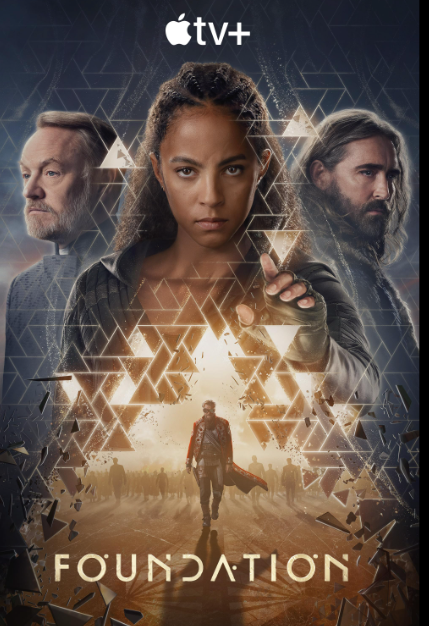
Foundation Season 3 Finale: Big Changes

Well, there were big changes indeed in the Season 3 finale of Foundation on Apple TV+.   Both from Asimov's original trilogy (as there have been throughout this streaming television series), and from this television series itself, up until now.

[And there will be big spoilers ahead .... ]

Here are some of the highlights of what I think I just saw:

1. Demerzel was destroyed in Dusk's rampage.  But I don't completely understand what the robots now have left.  We also see the head that Day brought back to Trantor flickering into life, and there apparently/presumably are other robots out there in the galaxy, so perhaps the Demerzel we've known and (at least for me) not especially loved, could conceivably be back.

2. The Cleonic clonal triumvirate isn't quite destroyed, but certainly disfigured or maybe fundamentally altered is a better way to put it.  Dusk can live forever, because he has his nanites intact and working.  Day is dead.  And Dawn is still alive, if not quite kickin'.  This new combination, combined with what happened to Demerzel, should make for a fascinating next season.

3. The man we thought was The Mule -- the older brother in that previous episode -- was killed by Gaal. But it turns out that Bayta is The Mule?  Or is The real Mule (Magnifico?) indeed controlling Bayta, in the same way he was controlling the older brother whom we first met on Rossom?   One thing is certain: Pritcher was indeed converted by The Mule (whoever he/she is), thus fulfilling what Asimov had in store for him.

4. The Second Foundation and Preem Palver are in the Library on Trantor, thus fulfilling another Asimovian detail.

5. And the Hari we've been seeing is indeed not alive.  But, as I've been saying, I think it's more correct to call him some kind on android, since holograms are reflections or representations, and have no independent agency.

I mentioned a "next" season above.  Today it was announced that Apple TV+ has indeed given a next season the green light.   See you back here when that 4th season begins streaming.  

And, if you'd like some more assessment of this season, check out the conversation I'll be having with Joel McKinnon and Cora Buhlert next week, as we continue our tradition of dissecting each season of this series.

Note added September 18, 2025:   Here's our conversation -- followed by earlier conversations about the first and second seasons of Foundation.


Joel McKinnon, Cora Buhlert, and I discuss the 3rd season of Foundation


Joel McKinnon, Cora Buhlert, and I discuss the 1st season of Foundation


Joel McKinnon, Cora Buhlert, and I discuss the 2nd season of Foundation


See also Foundation 3.1: Now We're Talkin'! ... 3.2: "The Fault, Dear Brutus, Is Not in Our Stars" ... 3.3: Dawn and The Mule ... 3.4: Cleon Knows His PKD ... 3.5: Cleaving Closer to Asimov's Trilogy ... 3.6: Finally! But ... 3.7: The Origin of The Mule ... 3.8: Deconstructing Concepts ... 3.9: Munn tracht un Gutt lacht

And see also Foundation 2.1: Once Again, A Tale of Two Stories ... 2.2: Major Players ... 2.3: Bel Riose and Hari ... 2.5: The Original Cleon and the Robot ... 2.6: Hari and Evita ... 2.7: Is Demerzel Telling the Truth? ... 2.8: Major Revelations ... 2.9: Exceptional Alterations ... Season 2 Finale: Pros and Cons

And see also Foundation 1.1-2: Mathematician, Man of the People, and Cleon's Clones ... Foundation 1.3: Clonal Science Fiction, Hari Seldon as V. I. Lenin ... Foundation 1.4: Slow Hand, Long Half-Life, Flipped Coin ... Foundation 1.5: What We Learned in that Final Scene ... Foundation 1.6: Folded Variations ... Foundation 1.7: Alternate History/Future ... Foundation 1.8: Divergences and Convergences ... Foundation 1.9: Vindication and Questions ... Foundation Season 1 Finale: Right Up There


Friday, September 5, 2025

Foundation 3.9: Mann tracht un Gott lacht


Well, there are two things I really liked in Foundation 3.9:

[And there are spoilers ahead ... ]

1. There's a Yiddish saying my grandmother used to tell me:  "Mann tracht un Gott lacht".  The usual English translation is "Man plans and God laughs," though the literal translation is ""Man tries and God laughs".  And we're treated to a rendering of this, when Quent lambasts Dusk for his "math" of destroying planets and billions of people, saying "that's your math, it's not the math I believe in," and Dusk responds, "Your math?  Or do you mean Hari Seldon's Plan, at which God is currently laughing." Now, Dusk might be a horrible human being, but he deserves credit for apparently knowing and riffing on this old Yiddish proverb (or, ok, actually the Foundation show's writers do), as well as having a pretty keen understanding of the peril that The laughing Mule (God) is currently posing to Seldon and humanity.

2. Speaking of which -- Hari and The Mule -- that was quite a conversation Hari and Gaal had about The Mule near the end, in which Hari wound up sounding like Data in Star Trek: The Next Generation, wanting a fully human body.  This Hari -- whom lots of viewers are sure is a hologram, but I think is indeed more like Data, an android (or for that matter, Demerzel/Daneel) -- says to Gaal two very important things: (a) "don't call me that" (i.e., don't call me Hari), and (b) "I want what he has".  So, the first likely means, don't call me Hari, because I'm not Hari (I'm some kind of android), and the second means, I want what The Mule has.  (I thought, maybe the "he" in the "I want what he has" was the original Hari, who did have a flesh-and-blood human body -- but the Hari talking to Gaal says "he mysteriously got a body", and as far as we know, there's nothing mysterious in the way the flesh-and-blood Hari Seldon got a body, right?)

We have some inching progress in comprehending what's going on.  And next week is this season's finale.


Enjoy Yiddish culture?  Check out this short story, just published.


See also
 Foundation 3.1: Now We're Talkin'! ... 3.2: "The Fault, Dear Brutus, Is Not in Our Stars" ... 3.3: Dawn and The Mule ... 3.4: Cleon Knows His PKD ... 3.5: Cleaving Closer to Asimov's Trilogy ... 3.6: Finally! But ... 3.7: The Origin of The Mule ... 3.8: Deconstructing Concepts

And see also Foundation 2.1: Once Again, A Tale of Two Stories ... 2.2: Major Players ... 2.3: Bel Riose and Hari ... 2.5: The Original Cleon and the Robot ... 2.6: Hari and Evita ... 2.7: Is Demerzel Telling the Truth? ... 2.8: Major Revelations ... 2.9: Exceptional Alterations ... Season 2 Finale: Pros and Cons

And see also Foundation 1.1-2: Mathematician, Man of the People, and Cleon's Clones ... Foundation 1.3: Clonal Science Fiction, Hari Seldon as V. I. Lenin ... Foundation 1.4: Slow Hand, Long Half-Life, Flipped Coin ... Foundation 1.5: What We Learned in that Final Scene ... Foundation 1.6: Folded Variations ... Foundation 1.7: Alternate History/Future ... Foundation 1.8: Divergences and Convergences ... Foundation 1.9: Vindication and Questions ... Foundation Season 1 Finale: Right Up There


Friday, August 29, 2025

Foundation 3.8: Deconstructing Constructs


I said last week that I thought episode 3.7 of Foundation might well have been the best episode of the entire series so far.   Episode 3.8 on Apple TV+ tonight was certainly not in that league.

Here's some of what I really didn't like about 3.8:

[Spoilers ahead ...]

1. The conversation between Hari and The Mule at the beginning, specifically when Hari says he's been dead 300 years.  So this Hari is a hologram?  That's what most people whose comments I have come across seem to think.  But what kind of hologram has the power over the physical world that this hologram has? Maybe this "hologram" is not a living being, but he's certainly not a hologram, either.  Or, more specifically, not an entity that warrants the categorization of hologram.  I've complained throughout my reviews of this series that I find it irritating that it has characters from Asimov's trilogy -- like Gaal -- who have the names of Asimov's characters, but are almost nothing like them.  So why use the names?  And now the series is doing the same with constructs like holograms.  

2. Of the three clonal Cleons, the only one I'm now finding interesting is Dusk.  Day's story is repulsive and verging on ridiculous, some kind of grotesque fantasy that barely deserves the term science fantasy, let alone science fiction.   Dawn's story started out full of intrigue and possibilities, and now it's headed the way of Day's.  What exactly is he doing in that same room with Bayta?   The Cleonal story was and still is a wonderful piece of original, non-Asimovian science fiction, but it's quickly losing its impact and relevance.

***

About the only part of 3.8 which worked for me was Demerzel -- the Daneel part of Day's story didn't -- but we need to see more action and less talk from her (like Elvis was talking about posthumously in "A Little Less Conversion).

But I still live hope about what the Foundation story on television can do.


See also
 Foundation 3.1: Now We're Talkin'! ... 3.2: "The Fault, Dear Brutus, Is Not in Our Stars" ... 3.3: Dawn and The Mule ... 3.4: Cleon Knows His PKD ... 3.5: Cleaving Closer to Asimov's Trilogy ... 3.6: Finally! But ... 3.7: The Origin of The Mule

And see also Foundation 2.1: Once Again, A Tale of Two Stories ... 2.2: Major Players ... 2.3: Bel Riose and Hari ... 2.5: The Original Cleon and the Robot ... 2.6: Hari and Evita ... 2.7: Is Demerzel Telling the Truth? ... 2.8: Major Revelations ... 2.9: Exceptional Alterations ... Season 2 Finale: Pros and Cons

And see also Foundation 1.1-2: Mathematician, Man of the People, and Cleon's Clones ... Foundation 1.3: Clonal Science Fiction, Hari Seldon as V. I. Lenin ... Foundation 1.4: Slow Hand, Long Half-Life, Flipped Coin ... Foundation 1.5: What We Learned in that Final Scene ... Foundation 1.6: Folded Variations ... Foundation 1.7: Alternate History/Future ... Foundation 1.8: Divergences and Convergences ... Foundation 1.9: Vindication and Questions ... Foundation Season 1 Finale: Right Up There


Friday, August 22, 2025

Foundation 3.7: The Origin of The Mule


Well, until the ending of Foundation 3.7 -- up on Apple TV+ today -- I was going to say it was a horrible episode, or maybe an episode about horrible things.   And it was.  Until it revealed to us the origin of a maniacal character, the arch enemy in Asimov's Foundation trilogy, and in this the third season of its adaptation on streaming television,

As I've been saying in all of my reviews of this season so far, it adheres to enough essential elements of Asimov's trilogy, and its sequels and prequels, to be immensely enjoyable, at least to me.  And it's been doing this while deepening and broadening the original story, as it's been doing and did again in 3.7 to our understanding of Demerzel.

[Spoilers ahead ... ]

But 3.7 did something that Asimov never did.  In his narrative, The Mule was a power-hungry mutant, who had the power to literally change people's minds.  We readers were supposed to assume, I guess, that the Mule was just born that way.  But episode 3.7 has finally given us a much narratively better explanation, by telling us The Mule's backstory.

The Foundation preyed upon The Mule's parents, by allowing them just one child.  The Mule's parents had two, and the Foundation representative gave them until its next soon-to-come visit to divest themselves of one of their children.  The father decided to save their baby and kill their son, I guess about 11 or 12 years old.  As the father was attempting to drown him, the boy discovered that he had the power to mentally direct his parents to drown themselves.

The whole scene was revolting to see. (Seeing or reading a  science fiction story in which children are hurt, or worse, is something I never want to do.*)  But the whole scene did raise the profound ethical quandary: if you could travel back in time, and eliminate Hitler as a baby, would you do it?

And now, after all these years, we have an answer as to how The Mule arose.  Had he not been nearly a victim of the worst kind of violence as a boy, perhaps his mental power would not have arisen.  Or, if it had, perhaps he would have used it for good, not evil.

And one last spoiler: the brief conversation The Mule has with Hari in the last moments of the episode -- that's with live Hari not his hologram, since we saw last week that the hologram has no knowledge of The Mule.  In a way, that's a happy ending.  It's good to see Hari Seldon alive.

*I guess a partial exception is the movie adaptation of Ray Bradbury's "The Last Night of the World" in The Illustrated Man.

Note added August 26, 2025:  I discussed this episode in depth the other evening on the Stars End Podcast:


See also
 Foundation 3.1: Now We're Talkin'! ... 3.2: "The Fault, Dear Brutus, Is Not in Our Stars" ... 3.3: Dawn and The Mule ... 3.4: Cleon Knows His PKD ... 3.5: Cleaving Closer to Asimov's Trilogy ... 3.6: Finally! But ... 

And see also Foundation 2.1: Once Again, A Tale of Two Stories ... 2.2: Major Players ... 2.3: Bel Riose and Hari ... 2.5: The Original Cleon and the Robot ... 2.6: Hari and Evita ... 2.7: Is Demerzel Telling the Truth? ... 2.8: Major Revelations ... 2.9: Exceptional Alterations ... Season 2 Finale: Pros and Cons

And see also Foundation 1.1-2: Mathematician, Man of the People, and Cleon's Clones ... Foundation 1.3: Clonal Science Fiction, Hari Seldon as V. I. Lenin ... Foundation 1.4: Slow Hand, Long Half-Life, Flipped Coin ... Foundation 1.5: What We Learned in that Final Scene ... Foundation 1.6: Folded Variations ... Foundation 1.7: Alternate History/Future ... Foundation 1.8: Divergences and Convergences ... Foundation 1.9: Vindication and Questions ... Foundation Season 1 Finale: Right Up There


Friday, August 15, 2025

Foundation 3.6: Finally! But ...

Well, we finally got to see my favorite scene in the whole Foundation saga by Asimov, the three Bs, and others -- the scene that made me a fan of science fiction for life -- we finally got to see, in Foundation 3.6 on Apple TV+, Hari's hologram talking to the First Foundation about some crisis involving the Traders or whomever, with no mention of The Mule, when The Mule's armada appears in the sky.

It's a brilliant pivotal quintessential scene, as only Asimov could write it.  Seldon's Plan earlier proved to be right when, in the face of the overwhelming forces of General Bel Riose, the First Foundation survives and succeeds when the General is called back to Trantor by an insecure Emperor.   So we readers of course expected this to happen again, and Asimov fooled us.  Exactly the kind of surprise you relish in a novel.

So why didn't it work as well on streaming TV?  Several reasons:

1. The Empire, though struggling, is not in such deep disrepair.  That's in part because of Demerzel, and in part because the clonal triumvirate, despite their internecine squabbling, are impressive.

2. The Second Foundation is already a major player.  So much so, that the destruction of the First Foundation doesn't seem so serious.  I mean, I wasn't happy to see Bayta knocked unconscious but it wasn't a major blow, because the First Foundation has already seen its much better days.

3. I think the writers of this episode overplayed their hand when they had Hari's hologram explicitly voice his ignorance of The Mule.  Asimov's scene was much stronger with Hari's hologram not speaking of The Mule at all.

But I'm very glad to see the story moving along, and I'll be back with more next week.

See also Foundation 3.1: Now We're Talkin'! ... 3.2: "The Fault, Dear Brutus, Is Not in Our Stars" ... 3.3: Dawn and The Mule ... 3.4: Cleon Knows His PKD ... 3.5: Cleaving Closer to Asimov's Trilogy

And see also Foundation 2.1: Once Again, A Tale of Two Stories ... 2.2: Major Players ... 2.3: Bel Riose and Hari ... 2.5: The Original Cleon and the Robot ... 2.6: Hari and Evita ... 2.7: Is Demerzel Telling the Truth? ... 2.8: Major Revelations ... 2.9: Exceptional Alterations ... Season 2 Finale: Pros and Cons

And see also Foundation 1.1-2: Mathematician, Man of the People, and Cleon's Clones ... Foundation 1.3: Clonal Science Fiction, Hari Seldon as V. I. Lenin ... Foundation 1.4: Slow Hand, Long Half-Life, Flipped Coin ... Foundation 1.5: What We Learned in that Final Scene ... Foundation 1.6: Folded Variations ... Foundation 1.7: Alternate History/Future ... Foundation 1.8: Divergences and Convergences ... Foundation 1.9: Vindication and Questions ... Foundation Season 1 Finale: Right Up There


Friday, August 8, 2025

Foundation 3.5: Cleaving Closer to Asimov's Trilogy

Gaal's words to Dawn near the end of Foundation 3.5 say it all:

[Spoilers ahead ... ]

Hari Seldon's Plan did not account for such a strong Empire at this stage of Galactic evolution.  Meta-note: Of course it didn't.  There was no Cleonic triumvirate DNA-enabled clonal rule of the Empire in Asmov's trilogy or its sequels.  So, in effect, Gaal is speaking for Asimov here.

And we can see at this point of the third season of this television adaptation of Asimov's masterwork now playing out on Apple TV+,  that the forces of television, Asimov, and narrative logic are giving the clonal triumvirate quite a beating at this point: Dawn has been cast out in a space suit into outer space, unkempt Day who has already all but abdicated has fled the Trantor scene, and back home on Tranter, Dusk is just about set to move into death to keep the Empiric rotation going.

Now, of course, not only is none of this written in Seldon's Plan, none of it is written in stone.  As I often say in my reviews, unless you see a character's head blown off or body blasted to smithereens, there's a chance he or she is still alive (see 24 for many examples).  Someone or some force could rescue Dawn from deep space; Day could get homesick and come home; Demerzel could decide to give the current Dusk more time for existence.   But the movement towards a weakened Empire, as called for in Seldon's Plan, is undeniable.

Meanwhile ...  in episode 3.5 we learn that Magnifico's music may be a weapon used in the Mule's capturing and control of people's emotions.   My friend Joel McKinnon thinks Magnifico may actually be The Mule, and Magnifico is controlling the cardboard villain who has announced himself as The Mule.  This is an interesting theory, but it would have to account for what we saw when the villainess Mule -- that is, The Mule with hair -- actually did his palpably fatal damage on Kalgan.

One thing is sure:  there'll be some powerful, game-changing events ahead in this third season of Foundation.

See also Foundation 3.1: Now We're Talkin'! ... 3.2: "The Fault, Dear Brutus, Is Not in Our Stars" ... 3.3: Dawn and The Mule ... 3.4: Cleon Knows His PKD

And see also Foundation 2.1: Once Again, A Tale of Two Stories ... 2.2: Major Players ... 2.3: Bel Riose and Hari ... 2.5: The Original Cleon and the Robot ... 2.6: Hari and Evita ... 2.7: Is Demerzel Telling the Truth? ... 2.8: Major Revelations ... 2.9: Exceptional Alterations ... Season 2 Finale: Pros and Cons

And see also Foundation 1.1-2: Mathematician, Man of the People, and Cleon's Clones ... Foundation 1.3: Clonal Science Fiction, Hari Seldon as V. I. Lenin ... Foundation 1.4: Slow Hand, Long Half-Life, Flipped Coin ... Foundation 1.5: What We Learned in that Final Scene ... Foundation 1.6: Folded Variations ... Foundation 1.7: Alternate History/Future ... Foundation 1.8: Divergences and Convergences ... Foundation 1.9: Vindication and Questions ... Foundation Season 1 Finale: Right Up There


Friday, August 1, 2025

Foundation 3.4: Cleon Knows His PKD

Another superb episode in the third season of Foundation -- 3.4 -- in which the series continues to integrate the Cleon triumvirate story with Asimov's original Foundation trilogy, alternated in many ways but still ringing true enough to Asimov's vision to be expansive rather than smothering of what Asimov put on his pages.

My favorite sliver of a scene has Day chiding Demerzel with a question borrowed and transmuted from Philip K. Dick's 1968 novel, Do Androids Dream of Electric Sheep, brought to the movie screen in 1982 by Ridley Scott as Blade Runner.  Day concludes his testy conversation with Demerzel -- he's understandable uncomfortable with her -- with a question, "Do robots dream of wiping their own asses?" Not as elegant as Philip K. Dick, but, hey, a lot of years have passed since he came up with that title.

And it was good to hear Demerzel talk about Asimov's three laws of robotics, and then the zeroth law, as she struggles to understand how she has evolved, who and what she's become and must do.  She's an advanced piece of work, indeed.  Not only can she think and talk with her head physically detached from her body, she can navigate the complexities of the universe with the best of 'em -- e.g., Hari and Gaal -- and knows that the Second Foundation is the best way of stopping The Mule.

[Spoilers ahead ... ]

Speaking of which -- the Second Foundation and The Mule -- I actually like that Pricher wasn't converted by The Mule (who did manage to read his mind), and is literally in league with Gaal.  This is a significant departure from Asimov's story, and I think it's a good one.  I've always been at least slightly unhappy about Pricher's conversion to The Mule all those years before their story was streaming on Apple TV+, and it will be fun to see where this twist goes.

Gaal continues to play a vastly more important role in this rendition of the Foundation saga than her male counterpart in the trilogy.  Not only is she in bed with Pricher, she has intellectually seduced Dawn, and drawn him into the cause of the Second Foundation.  As I said in a previous review, this realignment of the major players in the story of The Mule, in which powerful elements of the Empire are joining the Foundations in their desperate looming war with that demon manipulator of minds, is refreshing and promises some major unexpected developments.  As became clear back in the days back when television was just being born as a mass medium, Seldon's psychohistory can only go so far.

See also Foundation 3.1: Now We're Talkin'! ... 3.2: "The Fault, Dear Brutus, Is Not in Our Stars" ... 3.3: Dawn and The Mule

And see also Foundation 2.1: Once Again, A Tale of Two Stories ... 2.2: Major Players ... 2.3: Bel Riose and Hari ... 2.5: The Original Cleon and the Robot ... 2.6: Hari and Evita ... 2.7: Is Demerzel Telling the Truth? ... 2.8: Major Revelations ... 2.9: Exceptional Alterations ... Season 2 Finale: Pros and Cons

And see also Foundation 1.1-2: Mathematician, Man of the People, and Cleon's Clones ... Foundation 1.3: Clonal Science Fiction, Hari Seldon as V. I. Lenin ... Foundation 1.4: Slow Hand, Long Half-Life, Flipped Coin ... Foundation 1.5: What We Learned in that Final Scene ... Foundation 1.6: Folded Variations ... Foundation 1.7: Alternate History/Future ... Foundation 1.8: Divergences and Convergences ... Foundation 1.9: Vindication and Questions ... Foundation Season 1 Finale: Right Up There


Friday, July 25, 2025

Foundation 3.3: Dawn and the Mule

Foundation 3.3 on Apple TV+ continues to very much please, as the TV series progresses on its course of being much closer to Asimov's trilogy, with the addition of the clonal Cleon triumvirate, now aka Empire.

[Spoilers ahead ... ]

Dawn's role is especially pivotal and powerful this season.  His meetings with Gaal and his growing interest in The Mule are beginning to point to some very exciting possibilities.  One of the weakest parts of the otherwise masterful Second Foundation in Asimov's trilogy is the hokus pokus way Preem Palver beats The Mule, distracting the arch manipulator so Palver could turn the tables and manipulate The Mule himself.  I'm thinking Dawn could play a crucial role in ultimately bringing down The Mule, either with or without Palver.

Speaking of The Mule, in addition to being able to rearrange people's minds, he's a sadistic piece of work, isn't he, on the screen.  Which gets me to another divergence from the trilogy, which could be significant.  In Asimov's books, Magnifico the clown was The Mule in disguise.  On the screen, Magnifico and The Mule are clearly two people.  The Mule of course could easily manipulate Magnifico, but could The Mule in effect teleport his mind into Magnifico, so the "clown" could do the damage he does in the Asimov trilogy?

What I'm also very much continuing to really enjoy is the ambience and the pacing of the third season Foundation on the screen.  The first twos seasons just didn't feel to me like I was watching anything approaching an enactment of what I've read three times already in my life on paper pages.  But watching episode 3.3 on my laptop last night, I really felt like I was in Asimov's universe, watching his story play out -- albeit in a different way than Asimov had it -- and that was a fine nearly hour to savor, indeed.

See you back here next week.

See also Foundation 3.1: Now We're Talkin'! ... 3.2: "The Fault, Dear Brutus, Is Not in Our Stars"

And see also Foundation 2.1: Once Again, A Tale of Two Stories ... 2.2: Major Players ... 2.3: Bel Riose and Hari ... 2.5: The Original Cleon and the Robot ... 2.6: Hari and Evita ... 2.7: Is Demerzel Telling the Truth? ... 2.8: Major Revelations ... 2.9: Exceptional Alterations ... Season 2 Finale: Pros and Cons

And see also Foundation 1.1-2: Mathematician, Man of the People, and Cleon's Clones ... Foundation 1.3: Clonal Science Fiction, Hari Seldon as V. I. Lenin ... Foundation 1.4: Slow Hand, Long Half-Life, Flipped Coin ... Foundation 1.5: What We Learned in that Final Scene ... Foundation 1.6: Folded Variations ... Foundation 1.7: Alternate History/Future ... Foundation 1.8: Divergences and Convergences ... Foundation 1.9: Vindication and Questions ... Foundation Season 1 Finale: Right Up There


Friday, July 18, 2025

Foundation 3.2: "The Fault, Dear Brutus, Is Not in Our Stars"

Well, as I said last week, this third season of Foundation on Apple TV+ is a much leaner, tauter, truer telling than the first two seasons of Isaac Asimov's indelible, incredible trilogy, and thus -- though it still is markedly different from the trilogy in all kinds of ways, though the triad Cleon "Empire" would be more than enough to make the screen version very different from Asimov's -- much more fun, at least for me, to see.

[Spoilers ahead ... ]

I couldn't help but chuckle when Hari Seldon, not quite alive, but much more alive than Seldon as hologram in the trilogy, remarks to Gaal that, other than the Mule, Gaal and Hari brought the evolution of the galaxy pretty much back on track after it had veered far off course.  And whose fault was that, that humankind had gone so far astray?   Well, not Hari's and not the Mule's, not any character in the narrative on the screen.  No, the blame resides with the writers and people who dreamed up this retelling of the Foundation story on television.

But now they're working hard to get it straight.  A significant part of Asimov's story of The Mule and The Second Foundation's attempt to stop him -- in Asimov's telling of his story -- concerns the planet Tazenda, which name sounds like Star's End, where rumor has it that the Second Foundation is headquartered, wherever exactly that may really be.  The Mule, misled into thinking he's wiping out the Second Foundation, blasts the planet Tazenda out of existence with his fleet.  That Star's End business was so important, there's even a superb podcast with that name, where I was fortunate to be a guest some two years ago.  And if I remember correctly, someone wrote a piece in some academic journal decades ago which argued that Asimov was immoral to have his Second Foundation set up an innocent planet to be destroyed in its fight against the Mule.  But I'm mentioning the destruction of a whole planet in this review of Foundation 3.2 because one of its most significant elements has Empire Dusk planning on giving Dawn a way to erase a planet, a weapon to use in his battle with Foundation (and as Dawn in beginning to recognize, The Mule).

The Dawn-Day-Dusk triumvirate has been the best part of the first two seasons of Foundation on TV, and its good to see their story continuing so well as the rest of the galaxy veers ever more significantly back to the story Asimov and Hari wanted to tell.  Including, I would add, hearing the name Bayta!

See also Foundation 3.1: Now We're Talkin'!

And see also Foundation 2.1: Once Again, A Tale of Two Stories ... 2.2: Major Players ... 2.3: Bel Riose and Hari ... 2.5: The Original Cleon and the Robot ... 2.6: Hari and Evita ... 2.7: Is Demerzel Telling the Truth? ... 2.8: Major Revelations ... 2.9: Exceptional Alterations ... Season 2 Finale: Pros and Cons

And see also Foundation 1.1-2: Mathematician, Man of the People, and Cleon's Clones ... Foundation 1.3: Clonal Science Fiction, Hari Seldon as V. I. Lenin ... Foundation 1.4: Slow Hand, Long Half-Life, Flipped Coin ... Foundation 1.5: What We Learned in that Final Scene ... Foundation 1.6: Folded Variations ... Foundation 1.7: Alternate History/Future ... Foundation 1.8: Divergences and Convergences ... Foundation 1.9: Vindication and Questions ... Foundation Season 1 Finale: Right Up There


Friday, July 11, 2025

Foundation 3.1: Now We're Talkin'!


At last, in Foundation 3.1, up on Apple TV+ today, an episode worthy of the greatest science fiction trilogy ever written -- the one by Isaac Asimov.  To be sure, the story on the screen continues to be very different than the one of the page, but this beginning of third season of Foundation on streaming TV has recognizable characters and pieces doing what they're supposed to do, none more so than The Mule.

[Spoilers ahead ... ]

First, it was also very satisfying to hear Demerzel tell us she is a positronic robot, and recite the Three Laws of Robotics, plus the Zeroth Law, so clearly.  Given all the current concern about AI being so dangerous for humanity, it's good to hear that first law cited at the outset of this promising season.

It was also good to see another crucial trilogy character up on the screen.  Ebling Mis not only has a great name, but has always been one of my favorite characters in the series.  He does look a lot younger than Mis in the original trilogy, but that's ok.  It was also good to see Pritcher in evidence, given his importance in the ascension of The Mule.

Whose takeover of Kalgan on the screen was done just perfectly, bringing into play all the sadistic sway of The Mule. Indeed, though this Mule looks much better than the mutant described by Asimov, he has all the frightening flash and power of Asimov's pivotal character, and I'm looking forward to seeing how this all plays out in the TV series.

And speaking of what characters look like, it was refreshing to see how the latest versions of the Empire's ruling triumvirate look.   Unlike the trilogy, which did not have the clonal trio, there now are four players on the screen, vying for control of the galaxy:  the First and the Second Foundations, the Mule, and Empire. I'll see you back here next week with my take on how this develops in the next episode.

See also Foundation 2.1: Once Again, A Tale of Two Stories ... 2.2: Major Players ... 2.3: Bel Riose and Hari ... 2.5: The Original Cleon and the Robot ... 2.6: Hari and Evita ... 2.7: Is Demerzel Telling the Truth? ... 2.8: Major Revelations ... 2.9: Exceptional Alterations ... Season 2 Finale: Pros and Cons

And see also Foundation 1.1-2: Mathematician, Man of the People, and Cleon's Clones ... Foundation 1.3: Clonal Science Fiction, Hari Seldon as V. I. Lenin ... Foundation 1.4: Slow Hand, Long Half-Life, Flipped Coin ... Foundation 1.5: What We Learned in that Final Scene ... Foundation 1.6: Folded Variations ... Foundation 1.7: Alternate History/Future ... Foundation 1.8: Divergences and Convergences ... Foundation 1.9: Vindication and Questions ... Foundation Season 1 Finale: Right Up There


Tuesday, April 30, 2024

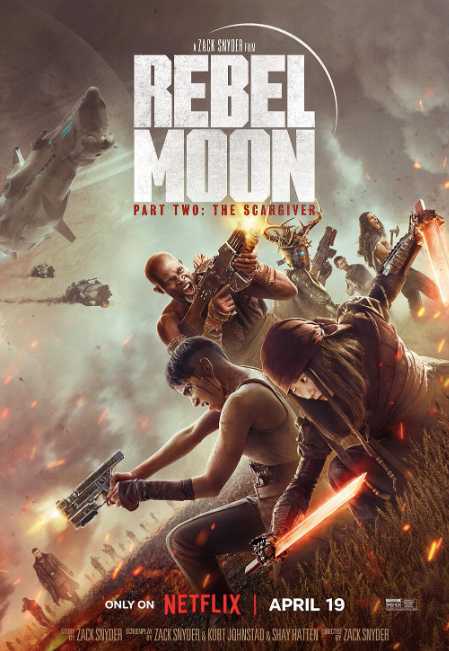
Rebel Moon, Part 2: The Robot and the Freshness


Just saw Rebel Moon, Part 2, on Netflix the other night.  I enjoyed it.  For some reason, my favorite character was the robot, JC-1435, aka James or Jimmy.

I'm not sure what that says about this second part of the movie (which, based on the ending, may well be the beginning of a series of two-part or one-part movies in a saga that now feels to me much more like Dune than Star Wars).  Maybe it's the antlers on Jimmy's head.  Maybe it's the voice -- you can't go wrong with Anthony Hopkins doing the voicing of anything.  But all in all, James conveyed a sensitivity that's rarely seen in robots or androids in movies or TV series, and which in its own way had a subtlety that even Data in Star Trek: TNG seldom quite achieved.

The battles were good and exciting, strong edge-of-your seat stuff.  The villains, however, often verged on cartoonish.   The heroes had more subtlety, and maybe that's because there were more of them than the villains.  I won't warn you about spoilers, because there won't be anything specific in this review, but I will say that this part of the movie which I hope will be a series concluded with fewer heroes than it had at the beginning.

Yeah, I hope we'll see more.  I like looking at the state of the human species at times like these, when we've gone way out into the cosmos, and met other intelligent beings, some of them now deadly foes, others of them loyal friends.  The problem with both Star Wars and Dune, and we can add Foundation to this list,  is that if we've done any reading or watching, we already know who the major characters are and who they will be.  Sometimes we even care about them so much, we don't like it if they're substantially changed in the new treatment (or at least, I feel that way).  But Rebel Moon, even though it deals with very well worn tropes, has a winning freshness and relevance to it.  The heroes in Rebel Moon, when they're not fighting Nazis, are harvesting grain.  Just like they do in Ukraine.

And that's why I'm totally aboard to see more.

See also: Red Moon, Part 1: Galactic Heroes and Villains


InfiniteRegress.tv