22 December 2024: The three latest written interviews of me are here, here and here.
Showing posts with label Primer. Show all posts

Saturday, April 13, 2024

Quantum Suicide: Beholding the Eye of the Storm


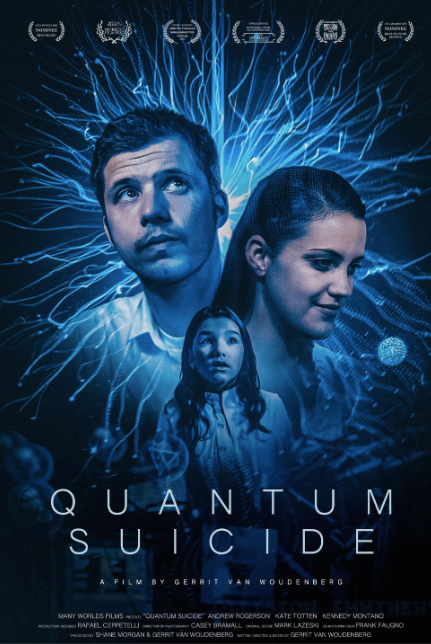
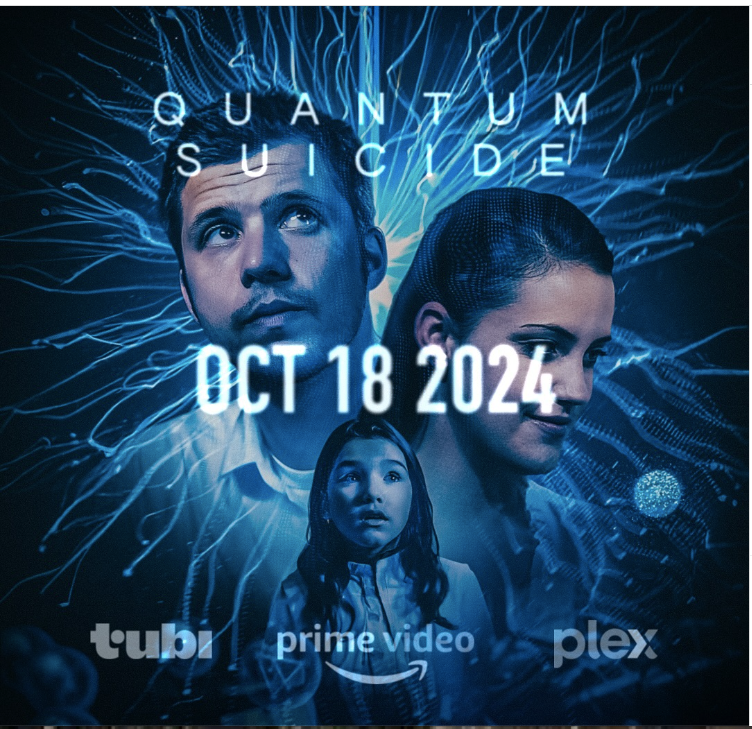
Gerrit Van Woudenberg's Quantum Suicide movie (which he wrote, directed, and -- with Shane Morgan - co-produced) won the Best Sci-Fi Dramatic Feature award at the Philip K. Dick Film Festival last week in New York.  I was at the Festival, and moderated a panel with Van Woudenberg, but I had another appointment when the movie was shown at the Festival.  Van Woudenberg was good enough to give me the URL for a screener, which I just saw and greatly enjoyed.  Herewith a non-spoiler review.

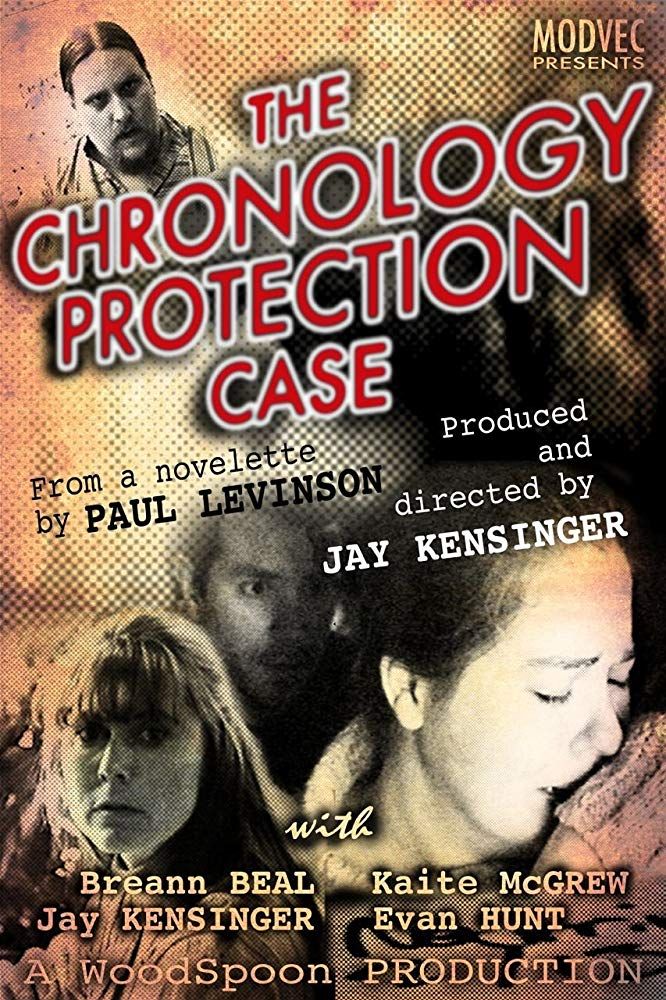
The clockwork of the movie is quantum mechanics, something which will be familiar to readers of my novelette, The Chronology Protection Case, and viewers of the short film that Jay Kensinger made from my story. The multifaceted gist of QM is that is that mere observation of quantum particles affects their location, speed, and existence; that when two particles collide and go off in opposite directions, anything that happens to one instantly influences the other, regardless of how far apart they are, and because this "quantum entanglement" happens regardless of the distance between the particles, it contradicts the widely held notion that speed of light is the ultimate speed in the universe.  Further, particles in themselves exist in either/or states, and observation of a particle determines which state the particle is in, and can even destroy it -- much like, I always think, what trying to fathom the texture of a snowflake with your fingers does to the snowflake.

Quantum Suicide takes this one crucial step further, drawing on the quantum suicide thought-experiment -- in which a gun pointed at the observer can either be shot at the observer's head or not -- and hypothesizing and weaving a story around the premise that therefore the observation of a subatomic particle can also destroy the observer.  Or, more precisely, the experimenter in the eyes of the observer.

But don't think you need to be a quantum physicist to understand and really enjoy this movie.  I'm not, at least in this universe  If you have been a big admirer of Primer -- the now classic 2004 time travel movie -- or any movie that features the scientist or scientists doing concept-bending and earth-shattering work in their spare bedroom or garage, you'll love Quantum Suicide.  Like Kensinger's The Chronology Protection Case, Quantum Suicide features detailed scientific explanations woven into the action, which always feel to me to be something Hugo Gernsback would've greatly appreciated.   And as for work-at-home science, the movie not only features the scientist and his significant other, but their next-door-neighbor, a little girl who also spends her time building radios and ant farms. 

Kennedy Montano does a good job as that precocious girl, Emily, as does Andrew Rogerson as the work-at-home experimenter Cayman with a penchant for self-destruction, and Kate Totten as his life partner Gen who observes Cayman with increasing misgiving. The music in Quantum Suicide, an original score by Mark Lazeski, is suitably pitched between anxiety and terror producing. The movie is currently making the film festival rounds, nominated for six awards and winning another. It will likely be on one of the streaming services this Fall*.  If you crave a little hard science in your science fiction you can't go wrong with Quantum Suicide, and if you don't, you don't know what you're missing.

More information about Quantum Suicide here, including a synopsis of the plot and a trailer.

*Note added 13 October 2024: And in fact it will be debuting on Amazon Prime video October 18, 2024. Watch also for my podcast interview with Gerrit Van Woudenberg which will be up here and everywhere you listen to podcasts in the next few days.


watch the movie on Amazon Prime Video


Wednesday, December 20, 2017

Synchronicity: Primer meets Predestination

There's something about the end of the year that gets me especially in the mood for time travel.  Fortunately Netflix came along to feed that urge.

I'd say Synchronicity, on iTunes since January 2016 and then Netflix - i.e., for almost two years, so how did I miss it? maybe I was in a parallel universe? - has elements of two classic time travel movies, Primer and Predestination (well, I'm not sure Predestination is yet a classic, but it's based on a stone classic of a science fiction story, Robert Heinlein's "All You Zombies," which makes it based on his earlier "By His Bootstraps," too).  Synchronicity starts out and for a bit and here and there captures that college-kids-build-a-time-machine ambience of Primer, but goes on to pretty decently and with sufficient tension and intellectual complexity get that time-traveler-chasing-his-own-tail story of Predestination.   And just for good measure, there's also something of the time-traveler-chasing-his-own-tale, too.  Really.  (I also have to mention that there's a little tale called Synchronicity which I know well because I wrote it - Buzzymag published in 2014 - but it has nothing to do with time travel.)

Now one of the things about chasing your own tail/tale through time - even just accidentally running into yourself - is you have to be careful when telling the story (making the movie) to sooner or later account for everything the time-traveler encounters in the early and middle parts of the story.  Jacob Gentry (who directed, and also co-wrote this with Alex Orr) did an excellent job of this.  There's a good romantic element, and a bad guy played by Michael Ironside, whom you can't go wrong with in these kinds of stories.

One thing I wasn't wild about was the meme that meeting yourself in the past or the future is bad for your health and even worse.  Obviously, that could and should cause what could be severe psychological trauma, as new memories suddenly start pouring into your later version's head.  But the idea that such meetings are physically destructive is a trope that the 12 Monkeys TV series as well as Synchronicity the movie use as a given, without much real explanation.

All in all, though, I enjoyed Synchronicity, and give it credit for presenting time travel seriously and entertainingly.  Give it a shot if you're a time traveler in fiction like me.


It started in the hot summer of 1960, when Marilyn Monroe walked off the set of The Misfits and began to hear a haunting song in her head, "Goodbye Norma Jean" ...


watch The Chronology Protection Case FREE on Amazon Prime


read time travel stories FREE on Amazon Prime

Saturday, February 25, 2017

Upstream Color: Upscale Biological Science Fiction

I finally got around to streaming Upstream Color, the 2013 and second movie by Primer (2004) creator Shane Carruth, who, as Wikipedia aptly puts it, also wrote, directed, produced, edited and scored the movie, and stars in the main role, as well.

The two movies therefore, unsurprisingly, have a lot in common, including brilliantly, carefully plotted, complex stories, minimal exposition in dialogue, and a low-key ambience that goes far below and deeper than just low-budget.  But the two are also very different - not only because Primer is about time-travel, and Upstream Color is about, well, I'll get to that in a moment, but because Upstream Color has a much richer emotional current.

And, actually, that current gets to what Upstream Color is and is about.  It's a relative rarity in science fiction movies - unlike time travel - a highly literate, philosophical kind of biological science fiction. Biology in science fiction is common - we encounter it every time we see a movie about a mutation gone amok, and often in narratives about aliens.   In many cases, such movies are pulp-horror or superhero stories.

There is a horror in Upstream Color, but it's more quiet, under the surface, and therefore disconcerting if not viscerally frightening, though Upstream Color has some of that, too.  The story, in a nutshell, is a about a worm-like organism, whose life cycle entails orchids, pigs, and human beings. As in all parasitic life cycles - a real part of our natural world, not just science fiction - the hosts do their thing, live their lives, with little or no awareness that they're doing the parasite's biological bidding.    Upstream Color explores this, harrowingly, subtly, compellingly, for humans, including our two central characters (with good work by Amy Seimetz as Carruth's character's partner), who discover a powerful attraction to one another, and various people ranging from a swindler who's also a kidnapper to pig farmers and gardeners.

The result is an indelible Blue Velvet-like tableau of life under the surface, which feels incomplete, just as did Primer. But that's part of the power and charm of these movies.


a different kind of biological science fiction

Sunday, February 12, 2017

Project Almanac: Primer with Found Footage and Soul

With Frequency concluded, and Timeless soon to be - for the first seasons, I hope, but likely for good - I thought it was time to watch a good time-travel movie, as prep for the lean times ahead.  Project Almanac did not disappoint.

On the surface, it has the trappings of Primer - that is, a group of young friends invent a time travel machine.  Almanac has a lot of the close intensity, low-budget feel, and philosophic flavor of Primer, but in the end - and in the middle, too - it is a very different movie.   But it could well become in years to come a cult classic, too.

Project Almanac partakes of the found footage ala Blair Witch Project subgenre of movie.   The action starts when 17-year-old David sees himself in the mirror - as a 17-year-old - in a video taken of himself and his family at his 10th-birthday party.  David's a budding inventor, his father apparently already was one, and 17-year-old David and his friends and sister soon find his father's schema for a time-travel machine.  (He father died in a car accident right after the fateful party).  They build it and use it, and David falls in love with Jessie (played by Sofia Black-D'Elia, of The Night Of, which makes two for two good performances I've seen from her), a girl in high school who already has eyes for him and encourages him to push the envelope.

The time-travel manipulations take the low-key path.  No one attempts to stop any assassinations or any world-shaping events.  The device can't send anyone back more than a few years at first, though David works to get it to go back at least 10 years to that birthday party, for obvious reasons. The young time travelers focus on getting money, better grades and prestige in high school, and, in David's case, correcting a blunder he made with Jessie so they can be in each other's arms.

But as in all cases of time travel with any profundity, even those relatively minor adjustments in the recent past have big, unintended ripple effects, including a plane crash.   David has to figure out a way of getting what he wants without those unintended literally disastrous consequences.

I won't say more, in case you have seen the movie, except the that ending is in many ways the best part, with the found footage motif playing a decisive and satisfying role.


more low-budget time-travel on Amazon

Thursday, February 13, 2014

Dimensions: Watercolor Time Travel

 photo Dimensions_zps05deebab.jpgWith another winter storm howling on the doors of New York, I took refuge in Dimensions tonight, a lushly beautiful 2011 British time travel movie, recently made available on iTunes and Amazon Instant Video.

The director, Sloane U'Ren, has previous credits as a set designer in television shows ranging from Alias to Six Feet Under, and it shows in Dimensions.  The movie, which tells a close-up story of a young scientist in 1920s England obsessed with time travel, moves like an Impressionistic painting from scene to scene, with images and textures and lenses that brush the soul.

There is a palpable innocence in the movie, which almost makes it akin to Primer, though Dimensions is barely about paradox and time loops.   It is rather about love, sought and lost, accidental and deliberate.   The movie also resonates with Daniel Faraday and Lost, which also has the charm of the young man as scientist -- though, again, Dimensions is manifestly not about the world-changing implications of the time travel we find in Lost.

The first part of the movie is indeed so uncontrived - a rarity for any time travel story - it almost seems like a YA or younger tale.  As the movie progresses, we get a romantic triangle of characters in their twenties.  The acting in this section is very good -  the most memorable coming from Olivia Llewellyn and Camilla Rutherford's quietly powerful performances, and good work from Henry Lloyd-Hughes as the scientist, too - and this more than the storyline makes this part of the movie blossom.   Antony Neely, whose main previous movie credits are in music, wrote the screenplay for Dimensions, and the story indeed progresses like a song, with versus and repeated chorus and bridge - an apt form for a time travel tale - or maybe an etude from Debussy.

Watercolors and tears, a story that moves like Donovan's "Wear Your Love Like Heaven," make Dimensions an unusual and even remarkable time travel story, which not only takes place in the 1920s but almost feels as if it was written and filmed back then, had such evocative color cinematography been available.  See it if you'd like a compelling introduction to what time travel could be, or the sense of wonder you had when you encountered your first time travel story at 12 years of age.

Other reviews of off-the-beaten-track recent time travel movies95ers: Time Runners: Original and Entertaining and I'll Follow You Down: Excellent Time Travel Movie

                ~~~ +++ ~~~

Enjoy time travel stories? check out


"one of those extremely rare sequels that end up better than its predecessor ... worthy of the title, blockbuster, if this were a movie ... by far the best time travel story I've ever read" - Scott Sandridge, SpecMusicMuse 


"resonates with the current political climate . . . . heroine Sierra Waters is sexy as hell . . . . there's a bite to Levinson's wit" - Brian Charles Clark, Curled Up With A Good Book

#SFWApro


And The Chronology Protection Case movie


podcast review of Dimensions and two other time travel movies

Saturday, December 4, 2010

The Third - Three Minutes - on the Third

A shout out or Tweet-sized review of Emon Hassan's new webseries, The Third, which premiered, appropriately enough, on the 3rd of December (yesterday), with a 3-minute episode.  Lots of powerful things come in three's - Hegel's dialectic, the 3 pyramids of Giza, and Isaac Asimov's Foundation trilogy to name three (ok, I'll add in the Lord of the Rings trilogy, either Star Wars trilogy, and the Godfather trilogy, now that The Third's got me going on this). 

I'm not saying that The Third has anything in common with these other behemoth triads - certainly not in length -  but it does have something in the sparse, speechless, evocative 3-minutes of the premiere.   I can't say just what, as yet, except it conveys a sense of murky foreboding quite clearly.   Think, maybe, Primer, I don't know.

All right, this was a little longer than a Tweet.  But the premiere does follow below. 


The Third - Pilot from Emon Hassan on Vimeo.
Episode 1 of 4.

About The Third
New York City holds many mysteries and its inhabitants hide many secrets. Neil (Philip Willingham) is The Third. His job is to solve them.
InfiniteRegress.tv