reviewing Black Doves; Citadel; Cross; Dark Matter; Dept. Q; Dexter: Resurrection; Dune: Prophecy; For All Mankind; Foundation; Hijack; Memory of a Killer; MobLand; Outlander; Paradise; Presumed Innocent; Severance; Silo; Slow Horses; Smoke; Star Trek: Strange New Worlds; Tehran;The: Day of the Jackal, Diplomat, Last of Us, Night Agent; Your Friends & Neighbors +books, films, music, podcasts, politics
George Santayana had irrational faith in reason - I have irrational faith in TV.
22 December 2024: The three latest written interviews of me are here, here and here.
Here we go again. "F.C.C. orders a review of ABC’s broadcast licenses," The New York Times reports. Since ABC/Disney hasn't moved fast enough to fire Jimmy Kimmel because of his joke about Melania Trump being an "expectant widow" last week -- before the presumed assassination attempt on the President on Saturday -- the FCC is flexing is fascist muscles.
The Chair of the FCC threatened to do this in September 2025, if Disney didn't do its bidding and fire Kimmel because Trump and company were tired of Kimmel's delightful barbs at the President's expense. Back then, Disney complied, but correctly reversed itself after the popular outcry against getting rid of Kimmel.
Popular outcries -- they're in many ways the essence of democracy. So is the First Amendment and its insistence that the government keep its hands off speech and press. But Trump and his henchmen couldn't care less about such essential freedoms. The feelings of the President are much more important to them.
As I've been saying now for decades, the FCC, created in the Communications Act of 1934, was unconstitutional the moment it was created. In a major failure of our judicial system, it was never struck down as the blatant negation of our Constitution that the FCC was and is.
Someday, some enlightened Supreme Court will do that. Until then, the best we can do is resist the thuggish actions of this miscreant agency.
The firing of Jimmy Kimmel by ABC -- which is exactly what his "suspension" is -- is the latest step in the road to fascism being paved by the current President of the United States and his allies. It began with the hounding out of their jobs of FBI and other people who lawfully investigated Trump's instigation of the January 2021 attack on the Capitol, the pressure on universities to end DEI and other policies distasteful to MAGA Americans and their theorists, and of course the firing of another late-night host, Stephen Colbert, by another cowardly media operation, CBS. (William Paley must still be turning over in his grave.)
In the case of Kimmel, rumblings were being made about the FCC doing something about him. I've thought the FCC was blatantly unconstitutional as soon as I was old enough to think. It violated the First Amendment's clear proscription on the government "abridging the freedom of speech or of the press" -- what else would any honest person say a late-night comedian, ridiculing Trump and his policies, was doing? The only crime in that would be how easy it was to make those jokes, because the threat to our democratic way of life was so obviously no joke indeed.
FDR, certainly one of our greatest Presidents, jeopardized our democracy when he signed the Communications Act of 1934 into law. So did Felix Frankfurter in the 1943 Supreme Court decision "NBC v the US," which he wrote, which ratified the FCC's power to regulate broadcasting. Ironically, that was in the middle of our war with Nazi Germany which FDR was so instrumental in winning, not to mention that Frankfurter was a founder of the American Civil Liberties Union in 1920.
I started teaching at universities in the 1970s, and the danger of the FCC has always been a part of my courses about the media and their impact. My main point has always been: imagine the FCC under the control of a President bent on willfully superseding our democracy and its protections from dictatorship (see, for example, my 2005 Media Ecology conference Keynote address transcript and video The Flouting of the First Amendment). I take no satisfaction and indeed am saddened and deeply concerned to see this patent threat to our democracy so vividly realized by this President and the many people who support him.
Note added September 24, 2025: Last night: Jimmy Kimmel's sage, hilarious opening monologue
To the fascist enablers that prevented this show from being aired in 20% of its markets, I hope you go out of business soon; to fascist enabler Paramount/CBS: reverse your decision to end The Late Show w/ Stephen Colbert]; to everyone: I'll be recording a conversation w/ Frank LoBuono about this in a few hours for his Being Frank podcast
An excellent episode 7.14 of Outlander up on Starz this week. I won't warn you about spoilers because there will be none -- nothing too specific -- in this review. [But if you don't want any hint of a spoiler at all, be so advised.]
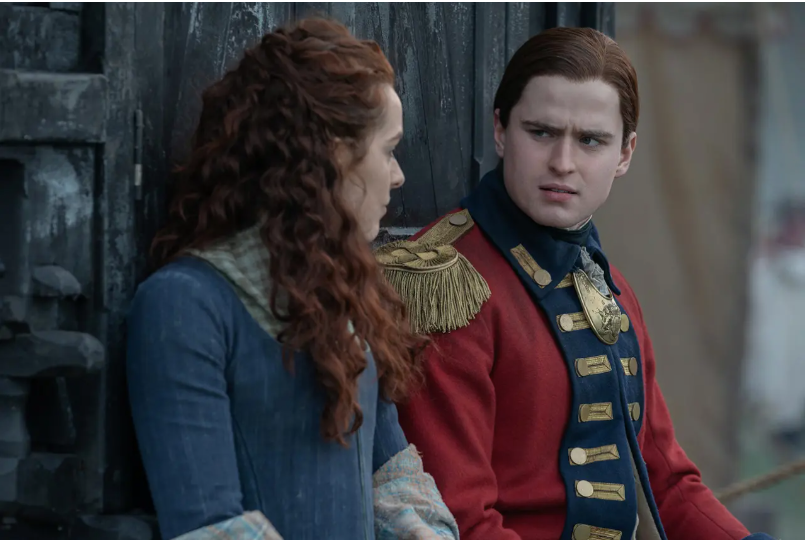
My favorite scene in this episode is when Arabella (Jane) explains to William how she charges as a prostitute, breaking down her services into three options. I don't recall hearing quite such salty language, certainly not in this context, before in the now long history of Outlander on Starz. There used to be a time in cable TV history when HBO and then Showtime were the leaders in these kinds of scenes with that kind of language. (Network TV, of course, is too frightened about FCC bans to include that language in their shows, however necessary for the story. Those FCC bans, and the FCC itself, are unconstitutional, in my view, because they blatantly violate our First Amendment. But don't get me started.)
Anyway, the scene between Arabella and William is not only frank, but surprisingly tender (with excellent acting by both Silvia Presente as Arabella and Charles Vandervaart as William). But maybe "surprisingly" is unfair to the series, certainly this season, where there has been a mix of violence, and brutal honesty, and tenderness, many times. The relationship between Claire and John Grey is a great example, played out over a few episodes. It was very good to see Claire tenderly -- and not so tenderly -- patch up John's eye, whose socket had been fractured by Jamie's outraged punch in episode 7.12. Patching up the eye, I think, is symbolic for patching up the relationship of Claire and John, and I hope the beginning of doing that for Jamie and John, too.
Meanwhile, over in Scotland, it looks like Brianna and Roger are on the verge of crossing paths through time, with Brianna going back in time to look for her husband, just as Roger has realized that Jem their son may no longer be in the past. I hope for that family's sake that they don't get those wires too crossed in the episodes ahead.
Something continues to be seriously wrong with our cable media. On Sunday, NBC bleeped Frances McDormand's speech at the Golden Globes, because they didn't like what "Fox Searchlight" may have sounded like. Today, MSNBC informed us that Trump referred to Haiti and unspecified African nations as "s-holes".
In fact, as The Washington Post and numerous other media reported, Trump called those countries "shit holes". So why is MSNBC afraid to report exactly that?
Do they think that their viewers are too young to hear such language? Do they think anyone who hears "s-holes" won't know it stands for "shitholes"?
I suppose there may be some people who don't get what "s-hole" means. As my wife astutely pointed out, some people might hear that as "asshole" countries.
But that's the point. Why should there be even the slightest confusion about what our vulgar, despicable President said about these countries? Whose feelings and sensitivities are being protected? The FCC's?
In times like this, with a President who as no one before him expresses such contempt for immigrants, women, the poor, Americans who don't look like him, don't the media owe us, owe America, the reporting of what he says as accurately as possible?
The time for euphemisms and abbreviations has long since ended. MSNBC ought to wake up, and realize what the year 2018 and Donald Trump in office calls for: complete, unabbreviated reporting.
*Note added a little after 10pm: Kudos to Rachel Maddow and Lawrence O'Donnell for speaking the word.
If you were watching the Golden Globes Awards on NBC tonight, you got a bizarre few minutes from Frances McDormand, as she delivered her acceptance speech for Best Actress in a Motion Picture. Though, actually, the bizarre performance was not McDormand's but the NBC censors'.
They apparently thought she was saying "for fuck's sake" when in fact she was saying "Fox Searchlight". And they thought she was saying something about "shit" when she said "tectonic shift". So they bleeped her, and also when she said "shyte," which is the way they say shit in some parts of the U. K... but so what?
As is usually the case with these censors, you don't know whether to laugh or cry at their gall and ineptitude. What right do they have to bleep out anyone's speech? True, they're not the government, so their bleeping technically does not violate the First Amendment, but it certainly violates the spirit of the First Amendment, not to mention our sense of decency and courtesy.
And a part of the reason there are network censors in the first place is that the networks are afraid that the FCC will fine them, as it did CBS after Janet Jackson's nipple was exposed for a spit-second in some Super Bowl around the turn of the century, or when Fox was fined for exposing a baby's backside - in a cartoon - around the same time. And the FCC, as a government agency, is ipso facto straight up a blatant violation of the First Amendment.
The other motive for censorship is network concern that bad language might antagonize sponsors. The rigors of commercial sponsors are one of the reasons that viewers have for two decades now been leaving the networks to watch cable, and, more recently, streaming services. In their concern for pleasing their sponsors, TV networks have bored their audiences and devolved into a weak shadow of what they were in the early and middle decades of network television.
There was one ad, though, that was welcome in the Golden Globes Awards. That would be The New York Times' quietly powerful "he said/she said" ad on behalf of journalism and truth. In this age of Trump more than ever, we need to support the broadcasting of truth, which includes letting people speak when on camera without censorship.
Entertainment Weekly has done the good thing of putting up McDormand's acceptance speech with no bleeps. Here it is. NBC owes McDormand and Americans and the world an apology.
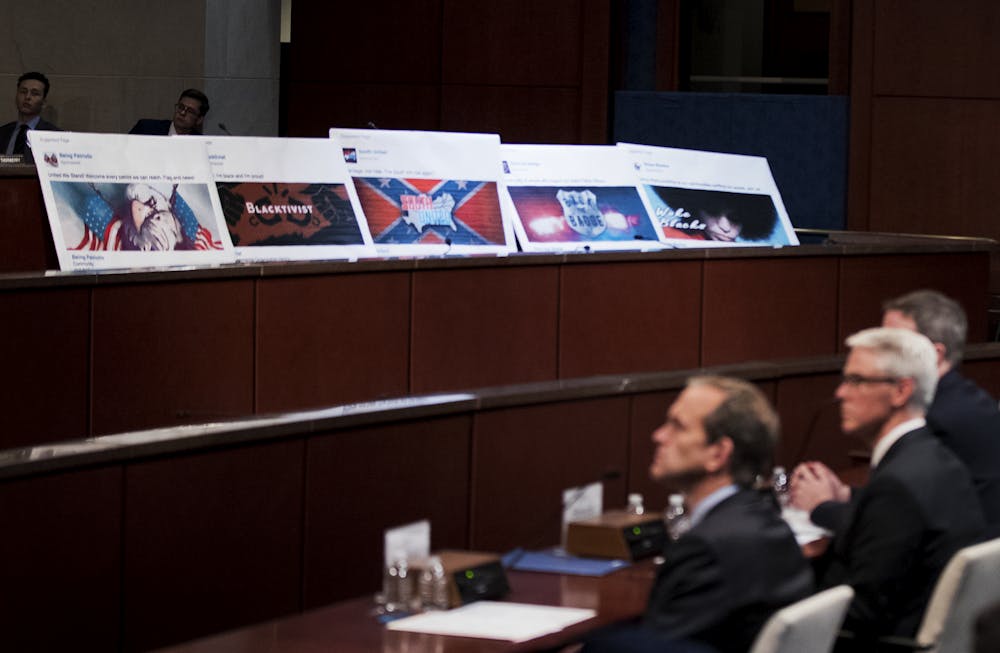
In recent weeks, Congress has grilled Twitter, Facebook and Google about their role in allowing foreign interests to place ads and articles intended to divide the electorate and spread false information during the 2016 election.
Now a number of people in and out of government are calling for federal regulation of social media. Lay down some rules, the thinking goes, and we would be able to prevent the infestation of bots and fake news from our news feeds and ads. Democracy would be saved – or, at least, foreign interference in our elections kept in check.
However, as someone who has studied and taught the First Amendment for decades, I would argue that if such regulations were enacted, the main victims would be not the purveyors of fake news, but our freedom of expression. In my view, the result would do far more damage to our democracy than any foreign misinformation campaign ever could.
Free speech being attacked from all sides
The First Amendment is under a lot of duress.
Arguably, it’s been that way since the Supreme Court’s “clear and present danger” decision in 1919, which spelled out when limits on free speech could be lawful. It not only held that the government had an obligation to stop someone from “falsely shouting fire in a theater,” but also opened the gates to all manner of government violations of the First Amendment injunction that “Congress shall make no law…abridging the freedom of speech, or of the press.”
Indeed, with the exception of Supreme Court decisions in the Pentagon Papers case in 1971 and the Communications Decency Act in 1997, the American government has systematically increased its control of media.
The situation has gotten much worse over the past year. President Trump has tweeted about withholding the licenses of NBC affiliates and lashed out at other media not to his liking.
Although Trump’s bluster about limiting and punishing media may be easy enough to deride, the fact that he is in the White House – and has the ability to appoint FCC commissioners – means his threats must be taken seriously.
Meanwhile, a theory of philosopher Karl Popper – the “paradox of tolerance” – is being widely cited as a justification for outlawing hate speech, notwithstanding the First Amendment. From his 1945 book “The Open Society and its Enemies,” it says that tolerance defeats itself when it permits intolerant speech.
I studied Popper extensively while researching my first book, an anthology of essays about Popper’s work. There are many aspects of Popper’s philosophy to admire, but I don’t believe the “paradox of tolerance” is among them.
To ban hate speech could turn our tolerant, democratic society into precisely the kind of state that hate speech is calling for: It could open up an opportunity for all sorts of speech to be dubbed “hate speech.”
A slippery slope
When regulating fake news on social media sites, there’s the danger of the same sort of phenomenon taking place. And it’s exactly why the well-meaning hue-and-cry that the government needs to intervene and forbid social media sites from disseminating fake news or allowing accounts that are actually bots is so dangerous.
Fake news is nothing new. Centuries ago, anti-Semitic publications spread rumors that Jews murdered Christian children and drank their blood on holidays.
Over the past two years, social media have increased the amplitude and reach of fake news. But there’s also been the ascension of a political figure – Trump – who has turned the tables by labeling any unwelcome news as “fake.”
Facebook ads linked to a Russian effort to disrupt the American political process are displayed as representatives from Google, Facebook and Twittertestify before the House Intelligence Committee on Nov. 1.Manuel Balce Ceneta/AP Photo
The latter should be more than enough reason to reject calls for government censorship of fake news. After all, who’s to say a government that determines what’s “fake” won’t simply follow Trump’s lead, and suppress critical and truthful content under the guise that it’s fake?
Instead, social media networks could develop and implement algorithms for identifying and removing fake news by marshaling the same engines that spread fake news in the first place. These algorithms would not be administered by the government; rather, Facebook and other social media would be responsible.
Twitter has already made considerable progress flagging and removing accounts that spread Islamic State propaganda. There’s no reason to think that the same process can’t be applied to Russian bots seeking to inflame political discord and therein damage America’s political system.
Such self-regulation is in the best interest of these media companies. It would increase the confidence of their users in what they encounter online. It would also have the added benefit of keeping government regulators at bay.
In the end, the ultimate antidote to fake news and bots is the rationality of the human mind.
As John Milton famously urged in his “Areopagitica,” if you let truth and falsity fight it out in the marketplace of ideas, human rationality will most likely choose the truth. Regulating what can enter that marketplace could impair or destroy this process, by inadvertently keeping truth from public awareness.
Rational thinking’s ability to identify fake news is more than a Miltonian ideal: It’s been demonstrated in a carefully conducted 2015 experiment. When given a small financial incentive, the subjects were able to identify fake news as fake, even if the fake news supported the political views of the subjects.
Indeed, rationality is deeply implicit in democracy itself. You can’t have the latter without the former.
The key in combating fake news and kindred attacks on our body politic is to give our rationality maximum access to all information, including the truth. And in my view, this means resisting any attempts by government to limit the information that reaches us.
I think it's time to mention again why net neutrality should be repealed, and for that matter, the FCC should be put out of business. Both are violations of the First Amendment and its proscriptions on government regulation of media ("Congress shall make no law").
I've been making this point for a few years, already, but it never has had more relevance than in this day and age, with someone in the White House who would love carte blanche control over all media.
How much more evidence of the danger of government controlled media do we need? Trump almost daily rants about how real media such as CNN are purveyors of "fake news," which, in Trump-speak, amounts to anything he finds unwelcome. He just this week moved to prevent the merger of Time Warner and AT&T, unless Time Warner divested itself of CNN, which could well put the pioneering all-news cable network out of business, or at least hinder its operation.
The notion that if net neutrality is abolished, all of us will be prevented from reading and writing and watching what we want online is not true, anyway. Everyone was doing just fine before net neutrality was adopted by the FCC just a few years ago, under Barack Obama's urging. That was in June 2015. Were any of deleterious consequences of no net neutrality - individuals or small companies being locked out of the Internet, or crippled by glacially slow service - in effect then? They weren't, and that's because the anti-trust laws - collusion of huge corporations to the detriment of individuals - were in full effect, then, administered by the FTC (Federal Trade Commission, not unconstitutional like the FCC), and the FTC will continue to do that job if net neutrality is eliminated.
But even if net neutrality were desirable, the price we would pay by weakening the First Amendment would be far too high. Our freedom of expression, and thereby our freedom, has never been under greater attack. Now is the time to get keep governmental regulation as far away as possible from our essential media lifelines. We shouldn't let the fact that Trump wants to do away with net neutrality blind us to the fact that such an action would be a good way of limiting his attempts to punish media not to his liking.
I've called many times for the abolition of the FCC. Its very existence is a blatant violation of the First Amendment, and its insistence that "Congress shall make no law ... abridging the freedom of speech, or of press".
And now we have another reason: the FCC plans to "investigate" Stephen Colbert's comment on The Late Show that Donald Trump is Vladimir Putin's "cock holster".
Over the years, there's has been general agreement, even among those who (wrongly) believe that some Federal regulation of communication is necessary, that political criticism, including satire and hyperbole, is precisely what the First Amendment was most intended and designed to protect. How else can a democracy run, if comedians cannot take their best shots against government officials, including Presidents? Does it matter in the slightest if such comedic sallies are crude or vulgar? Of course not - crudity and vulgarity are ever in the eyes and ears of the beholder. And the First Amendment makes no exceptions, period.
But we now have a President who, as evidenced in so many ways, is not interested in protecting our democracy and its democratic traditions. We have a President who has denounced the New York Times and CNN as "fake news," due to their honest reporting of facts he does not like to see. We have a President who is constitutionally illiterate - indeed, apparently illiterate in most uses of our language.
Should I be investigated because I wrote that? If you believe that, then you're no better than Trump, and you have no understanding of democracy and its necessities.
We should not be surprised that the FCC in Trump's administration wants to go after a late-night comedian. But we should staunchly oppose that. If ever there was a reason to abolish this unconstitutional agency, we have it now, before it becomes - in addition to all the damage it's done and attempted to do over the years - another weapon in Trump's hands.
President Obama expressed his strong support for net neutrality during his visit to China the other day. Here, briefly, is why I disagree.
First of all, I see any attempt to regulate non-criminal communication in the United States, via the FCC or otherwise, as a violation of the First Amendment, which says "Congress shall make no law ... abridging freedom of speech or press". I think this prohibition must be taken seriously, lest we slide into societies such as the one in China, where media are controlled by the government. This means the FCC should keep its hands off media even when their actions would support or enable good things.
But I don't think net neutrality is a good thing. How many people watch movies and television shows on Netflix? These statistics say 36 million Americans use Netflix in one way or another, and 63 percent of Americans use Netflix to stream. How do you feel, when you're streaming a movie or television show on Netflix, when the movie freezes or the connection is lost? Smoother streaming is what favored access on the Internet is all about. Note that it would not lock out any person or IP. It would just give better service to organizations like Netflix and Amazon, which serve millions and millions of people.
Favored, smoother streaming would also help mega-Internet providers such as Verizon and Comcast, which has led some people to say that unless we have net neutrality, big corporations will further dominate communication and media, and thereby American life. But in our current configuration, huge corporations already dominate our media - traditional media, whether Viacom or Comcast, already have massive power and control over what we're able to see, and when we see it. Streaming gives people another option - a greater choice over what they see, with more specific options - and, certainly, competition is good for the consumer of television and movies. Net neutrality would weaken this competition, by making Netflix and Amazon less effective. The result would serve not consumers, but traditional media giants.
Just to be clear: I would vigorously oppose any attempt to block anyone's access to the Internet, including charging people for that access. But net neutrality is not needed to maintain those freedoms - and, indeed, it could impede them, by bolstering the corporations that emerged well before the current Internet, don't yet completely understand it, and therefore still stand in the way of the democratization of media that the Internet brings.
Netflix and Amazon may well say they are in favor of net neutrality, because they would like to have smoother streaming - favored positioning in the Internet - without having to pay for it. That makes sense in the short run, for any business - keep your expenses down. But, in the long run, the revolution that Netflix and Amazon are spearheading will benefit from the advantage their programming gives consumers - in comparison to what consumers get from content on the cable providers - whatever Netflix and Amazon have to pay for this. Net neutrality might save Netflix and Amazon some money today, but it will hinder their growth in the future - as well as other potential content providers such as Google and Apple - by keeping their streaming and content provision at speeds that could be faster and more reliable, and thus more attractive to consumers.
The Supreme Court's Aereo decision today was a tough one - pitting the people's right to view television that is already free, versus the networks' right to control and profit from their content. By finding that Aereo violates the Copyright Act, the Supreme Court sided with the networks. But the decision does not mean that the viewing of network content on smartphones, tablets, etc will not be easily available. Indeed, the networks themselves and cable carriers are already making their programs available on digital devices via all kinds of apps. The future of television on mobile devices looks bright, even if independent companies such as Aereo may not be a part of it.
By and large, and indeed with one big exception, the Supreme Court has done well by television viewers over the years. Especially significant was the Court's 1984 ruling in the "Betamax case" (Sony v. Universal City) against the networks, which held that home recording of television programs by viewers for their personal use did not violate the Copyright Act. This opened the golden age of on-demand television viewing that we're now enjoying.
The exception to the Supreme Court's good rulings about television has been its failure to strike down once and for all the FCC's unconstitutional fining of television stations that broadcast "objectionable" content. The Court correctly struck down fines for "fleeting expletives" in 2009 (FCC v. Fox), which was an important step in the right direction. But it needs to yank the FCC 100% out of its meddling with television content, and the serious violation that entails of the First Amendment.
As for Aereo, it might have been better off to work out some kind of deal with the networks and cable, perhaps allowing itself to be purchased by one or more of them, as Google and Facebook have done with some of their competitors. As powerful as the digital revolution is, it has not overturned copyright and the power of the networks, and at least some of that is a good thing.
Hey, I like erudite pirate stories. So I took a look at Crossbones, which debuted on NBC last Friday. It seems to have a lot in common with Black Sails on Starz, except no nudity, no frank language - casualties of being on a broadcast network, unconstitutionally regulated by the FCC - and not much sex, either, explicit or otherwise. Still, those absences are not necessarily fatal to a TV series, and indeed network series still garner millions of viewers without those cable accoutrements.
But Crossbones directly stole a major part of the Black Sails plot - the ingenious idea to memorize vital information, after destroying its printed source, to make the memorizer's life safe from the dangerous crew seeking said information. Now, I know there's been theft of ideas going in Hollywood since the days of D. W. Griffith, so, for all I know, the Crossbones writers had this idea first. But in terms of the presentations of the two stories on television, Black Sails was definitely there first.
Crossbones does have a few things going for it, though. The dialogue is indeed as intelligent as the talk on Black Sails, and both are still rarities on television. John Malkovich is a great actor, and his performance as Blackbeard on Crossbones is good to see. Richard Coyle as Tom Lowe - apparently a doctor as well as an operative for the British crown with a license to kill - is also pretty good. And Claire Foy's Kate Balfour has some potential, too - as a romantic interest of Lowe, even though she's married, and as an intriguing character with unclear and complex loyalties in her own right.
There's also a pretty good twist at the end, as Lowe seeks to complete his mission to kill Blackbeard, which we know cannot succeed, since eliminating Malkovich from the show at the beginning would be insane. But the swift, surprising developments at the end show that Crossbones has the capacity to engage our interest, and mine is at least engaged enough to watch the next episode.
more ancient than Crossbones, and even more erudite
As I noted last week, Black Sails turns out to be an astonishingly literate series, literally. Previously, the erudite Captain Flint cited Homer to good effect. Last night, he brings Miranda - with whom he has a long term stable relationship - a copy of a book by John Milton. Later, Miranda in turn recommends a tract by the stoic philosopher and Roman emperor Marcus Aurelius.
It's tempting to suppose Flint's gift to Miranda was Paradise Lost, given that all of the action is, after all, taking place in a paradise, which, moreover, is ever on the verge of being lost to libertine violence, personal and social, and which was again in high profile last night. But given the politically libertarian philosophy of Flint and the better of the pirates, not to mention my own devotion to the First Amendment (to the point of thinking the FCC should be abolished), I'm going to go with the Milton being his Areopagitica, the brilliant polemic in favor of free speech and press which says that truth and falsity should be left to fight it out in the marketplace of ideas, where, given the rationality of human beings, truth will eventually win. In this sage schema, the worst thing a government or anyone can do is censor, which might be well hobble the expression of truth and prevent it from entering the marketplace of ideas for its contest with falsity.
Indeed, Milton's Areopagitica was read by both Thomas Jefferson and John Madison, and undoubtedly figured in the very construction of our First Amendment. So what better place to situate Milton's political masterpiece than in the new world, in colonial America, in the stirrings of what would become the U.S.A.
Aurelius's Mediations and his tenure as Roman Empire tells a related story. A sage philosopher, the epitome of Plato's philosopher king, Aurelius tragically inserted his personal feelings as father into his philosophy about how to best serve, and named his son as Roman Emperor, ending the excellent tradition of picking the best person as successor. The lesson, that power corrupts, and absolute power corrupts absolutely, is also one which we as well as our pirates would do well to keep in mind.
What makes Black Sails so remarkable is that it mixes this heady and powerful philosophy with lots of good and bad loving and action. The series so far has mostly resisted the cliches of pirates in fiction, and we see that again in 1.3 with Flint's devoted relationship with Miranda, and Eleanor's strong sense of self and purpose.
After watching Black Sails last night, my wife and I saw Captain Phillips, the movie detailing what actually happened off the coast of Somalia in 2009, when pirates attacked Phillips' ship. Superb acting by Tom Hanks as Phillips and everyone else in this movie. But, whew, pirates have fallen a long way down since those halcyon, fictional days of Black Sails.
The Good Wife has been having a fabulous year - not only because of Alicia leaving Lockhart Gardner now LG and all the emotional dynamite that set loose - but because of its fearless, irrelevant tackling of of major new new media aka social media issues. The fictional mega search engine Chumhum is the center piece of most of this, but the egregiously nonfictitious NSA also figured in a major episode, and this past Sunday Reddit got its turn in the barrel.
Not Reddit by name, but the pejoratively named Scabbit is the bad guy in an important suit that LG and Florrick-Agos are locking horns over in court. In our reality, Reddit is the self-proclaimed "front page of the Internet," which it to some extent is. It works in the same way the almost late, lamented Digg used to work: users can posts links to anything on the web, in appropriate categories (subreddits). Other uses can then vote the links up or down, and comment on them. The links with the greatest number of votes make the front pages - the master front page of Reddit, and the front pages of the subreddits.
Also in our reality, Reddit came in for its fair share of criticism earlier this year with its well-meaning attempt to identify the Boston bombers. Pictures were posted on Reddit, and readers were encouraged to identify the presumed bomber. Unfortunately, this crowd-sourcing produced a wrong ID, showing that democracy has its limits in the apprehension of criminals.
On Sunday night, a Florrick-Agos client is the victim of a similar problem. He's wrongly accused of a bombing at a food festival, and his pictures continue to be posted on Scabbit even after he's legally cleared. As these postings begin to ruin his life, Lockhart and Gardner defend Scabbit against Florrick and Agos's attempt to get the court to insist that Scabbit not allow any more of these damaging postings on its site. Scabbit's reply is that they'll take down any postings after they occur, but committing not to allow any postings beforehand would constitute "prior restraint," or a violation of the First Amendment.
It's valuable to see this issue treated on television. I'm an absolutist regarding the First Amendment when it comes to the government getting in the way of any speech or publication or peaceable demonstration - meaning, I think FCC fines for "objectionable" broadcasting and NYC Mayor Bloomberg's interference with the press during Occupy Wall Street are equally unconstitutional - but the First Amendment should protect neither traditional nor social media from libel and slander suits, when they act irresponsibly in publishing defamatory information. Crowd-sourcing, in other words, has its limits, and we need to work a little harder to decide what they are and promote them.
I caught the first season of Defiance over the past few nights. The new SyFy post-apocalyptic drama joins The Walking Dead, Falling Skies, and more in this now flourishing television genre. But Defiance has a few special facets going for it:
The music is just fantastic, starting with the Johnny Cash - June Carter "We Got Married in a Fever" (aka "Jackson") in the first episode to Raya Yarbrough's outstanding cover of Cindi Lauper's "Time after Time" near the end - and even a fine cover by Yarbrough of The Five Stairsteps' "Ooh Child" somewhere in the middle. Bear McCreary, of Battlestar Galactica fame, has done his customarily brilliant job with the music throughout.
Speaking of BSG, there's a lot of its flavor and feel in Defiance, which I take as a good thing.
There's even a kid in a radio station in Defiance - making a pair with the DJ in Under the Dome - but in Defiance the kid is an alien. Anything that harkens to Alan Freed, Murray the K, and Wolfman Jack is a plus in my book.
But speaking of aliens, there's a tad too many of them - seven different alien species, that is, which came to Earth as part of the Votan collective. I'd be happy with just the three major brands, Irathient, Castithan, and Imogen. The additional species, including Earth mutants which add to the seven, give Defiance the ambience of a Star Wars bar scene, and an everything-but-the-kitchen sink effect, which has the unintentional consequence of giving Defiance a slight touch of parody.
The sex, though, is pretty good - between Castithan Datak Tarr and his wife, and Irathient Irisa and Tommy, her human lover. Thanks to our childish, unconstitutional FCC, we see no real skin - and the Castithan custom of bathing privately in bathing suits is inconsistent with their otherwise hedonistic culture. But expecting our television networks to stand up to the FCC is a hopeless case, even if the FCC has never tried to exercise power over cable television.
The plot works well, with a good mix of unexpected heroes and villains, and characters you can care about. I'm looking forward to season 2.
An excellent, really satisfying Awake 1.9 last night, which moves the plot nicely, powerfully along.
In yellow world, Britten is going along with wife Hannah's desire to move to Oregon, and get away from their painful past. This move would have dramatically changed the basis of the series, and I knew that something had to happen to stop the move from happening.
Britten finds the reason in blue world, where Rex his son is broken up about his girlfriend Emma breaking up with him. Britten provides good fatherly advice to Rex, who talks to Emma, and finds out that she was pregnant with his baby (but lost it). When Rex tells this to Britten - in another fine father/son scene - and Britten discovers that the conception occurred right before the crash-up that took Hannah's life in blue world and Rex's in yellow world. (Kudos to the script writer for the adept way this conversation was handled - giving us the precise information, without being likely to ruffle any FCC feathers.)
Back in yellow world, Britten realizes that the same conception must have occurred - before the car crash - and there's a chance that Emma didn't lose the baby. We and Britten had already seen in this episode that given events can be reversed in the yellow and blue worlds - such as a single event in a sporting game that can change the outcome of the game. And, sure enough, Britten discovers that Emma is still pregnant with his grandchild in yellow world.
So now Britten and his wife have a wonderful reason to stay. And we also know that this will put Britten's life in danger, removing Captain Harper's best argument to the villains to leave Britten alone - that he's leaving town. All of which gives us more than reason that ever to stay with fine, intellectually provocative series.
"Sierra Waters is sexy as hell" - curled up with a good book
Enjoy listening to audio books? Get a free audio book copy of The Plot to Save Socrates - or any one of 85,000 other titles - with a 14-day trial membership at Audible.com
Nervous NBC, never one to stay with a series that shows any signs of weakness, has canceled The Playboy Club after three episodes.
The series did have plenty of weaknesses -
no nudity - NBC, like all networks, still marches in lockstep to the FCC's unconstitutional restrictions - The Playboy Club would have done better on a premium cable station, with no restrictions on dress or language
no great acting from most of the bunnies, who tended to rattle off their lines
a gay story that made no sense (unlike the way it was treated on Mad Men)
On the other hand, the music was appropriate and fabulous. The third episode featured someone who sounded and looked like Leslie Gore singing "It's My Party" (probably the singer and the actress were two different people). You don't see or hear Leslie too often these days.
And the political story - the lead male running for State Attorney, and having his sights on higher office - was pretty good. As was the mobster story.
But the Parents Television Council - self-appointed guardians of our welfare - launched a campaign against the show. And with ratings not the greatest to start with, advertisers were happy to leave the show, and NBC, as per usual, almost eager to admit to poor judgment in programming (not poor moral judgment, but mistaken programming because the show was floundering in the ratings).
And so it goes. The course of true television programming never did run smooth.
"Sierra Waters is sexy as hell" - curled up with a good book
Enjoy listening to audio books? Get a free audio book copy of The Plot to Save Socrates - or any one of 85,000 other titles - with a 14-day trial membership at Audible.com ...
Good for the FCC for formally eliminating the Fairness Doctrine, which it wisely hadn't been enforcing anyway for twenty years. The last thing we need is the government having any say whatsoever in the political content of radio and television broadcasts.
As a case in point, consider the advent and growth of cable TV news. Without any FCC supervision, we have conservative Fox, progressive MSNBC, and down the middle (if usually boring) CNN. In other words, the marketplaces of ideas and money brought about a very well balanced system of news delivery and commentary.
The next thing the FCC should do it is eliminate itself - or, at very least, the fines it has been levying against broadcasters it deems to be putting out "objectionable" content. Like the Fairness Doctrine and just about everything the FCC does other than keeping track of broadcast frequencies - increasingly unnecessary in our age of Internet streaming - the FCC is in principle and practice a blatant violation of the First Amendment.
Well, CBS exceeded last year's regrettable performance of censoring artists on its Grammy Awards broadcast, earlier this evening bleeping (dead silencing) phrases from Arcade Fire, Dr. Dre, Eminem, Cee Lo, and Lady Gaga - five artists in comparison to three (Lil Wayne, Eminem, Drake) bleeped last year.
It's getting to the point - as I mentioned in one of my Tweets during the Grammys broadcast - that CBS should start calling its show "Holes in the Music". Afraid to stand up to the FCC and its unconstitutional fines on behalf of the rights of artists and writers to say what they please ("Congress shall make no law ... abridging freedom of speech"), CBS also deprives people in America and around the world the right to enjoy performances of their favorite artists. CBS' cowardice is especially unfortunate in a world which is daily standing up for its freedom from government repression in memorable ways.
The Grammys need to move to another station, which is willing to let the music and words flow freely.
In the meantime, here are my Tweets pointing out the acts of censorship on CBS earlier this evening, in reverse order. I look forward to the time that I can just Tweet about how much I'm enjoying the artists and their performances.






 Hey, I like erudite pirate stories. So I took a look at Crossbones, which debuted on NBC last Friday. It seems to have a lot in common with Black Sails on Starz, except no nudity, no frank language - casualties of being on a broadcast network, unconstitutionally regulated by the FCC - and not much sex, either, explicit or otherwise. Still, those absences are not necessarily fatal to a TV series, and indeed network series still garner millions of viewers without those cable accoutrements.
 As I noted last week, Black Sails turns out to be an astonishingly literate series, literally. Previously, the erudite Captain Flint cited Homer to good effect. Last night, he brings Miranda - with whom he has a long term stable relationship - a copy of a book by John Milton. Later, Miranda in turn recommends a tract by the stoic philosopher and Roman emperor Marcus Aurelius.


 The Good Wife has been having a fabulous year - not only because of Alicia leaving Lockhart Gardner now LG and all the emotional dynamite that set loose - but because of its fearless, irrelevant tackling of of major new new media aka social media issues. The fictional mega search engine Chumhum is the center piece of most of this, but the egregiously nonfictitious NSA also figured in a major episode, and this past Sunday Reddit got its turn in the barrel.


