reviewing Black Doves; Citadel; Cross; Dark Matter; Dept. Q; Dexter: Resurrection; Dune: Prophecy; For All Mankind; Foundation; Hijack; Memory of a Killer; MobLand; Outlander; Paradise; Presumed Innocent; Severance; Silo; Slow Horses; Smoke; Star Trek: Strange New Worlds; Tehran;The: Day of the Jackal, Diplomat, Last of Us, Night Agent; Your Friends & Neighbors +books, films, music, podcasts, politics
George Santayana had irrational faith in reason - I have irrational faith in TV.
22 December 2024: The three latest written interviews of me are here, here and here.
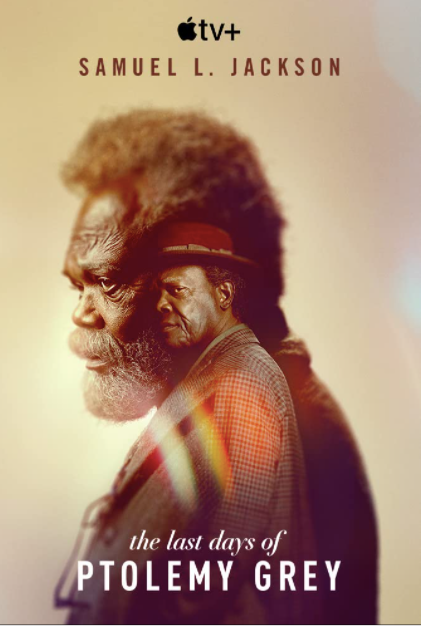
I figured I'd catch up with the first three episodes of The Last Days of Ptolemy Grey on Apple TV+, and I'm very glad I did. I mean, how you can you go wrong with a Walter Mosley novel (which I haven't read), adapted to the screen by him too, and starring Samuel L. Jackson in the title role? You can't.
So, how good is this series, which tells the story of Ptolemy Grey, suffering from progressing dementia, given an antidote (science fictional, we don't really have that at present) which allows him to recover all of his memories, but not permanently? Well, the high watermark of that kind of story is of course Daniel Keyes' 1959 "Flowers for Algernon," which I read as a kid shortly after it was published and still think is one of the best things I've ever read. And, based on these first three of six episodes of The Last Days of Ptolemy Grey -- I wish there were more -- I'd say it's certainly in same ballpark as "Flowers for Algernon".
In addition to the emotionally wrenching story of getting one's mind back only to lose it, The Last Days of Ptolemy Grey is also a murder mystery. One of Ptolemy's main motives is find out who killed his nephew, the clues to whom being buried in his mind. And there's also remembering what happened to the love of his life, a new romantic possibility, and other puzzles for Ptolemy.
In addition to Jackson, there's fine acting all around, including Dominique Fishback as Robyn (who takes care of Ptolemy after his nephew is killed) and Walter Goggins as the scientist who administers the magic potion. There's so much going on here it's a good bet that the concluding three episodes will be as packed with memorable scenes as the first three.
I'll be reviewing each of them after I see them. See you back here with my review of episode #4 after I see it this Friday.
I introduce Daniel Keyes at the 2000 Nebula convention in NYC
I didn't think about November 22, 1963 much yesterday, as I usually do on one of the worst anniversaries of my and maybe your lifetime, because I was busy with all kinds of other things, including doing a little virtual concert at Philcon (a science fiction convention) of songs from my new album, Welcome Up: Songs of Space and Time, my first new album in almost 50 years.
But I was on my son Simon's Tumblr page today, scrolling back through his posts, and came upon this one from back in March. The world has been so crazy since then and now, with Covid and the election, and I've been so immersed teaching online classes, writing, doing podcasts, and the like, that I didn't get a chance to listen to Dylan's "Murder Most Foul" until today.
It's the best Dylan lyric -- as in emotive power, tear up the street and rip up your soul, but maybe you can put it back together -- since, I don't know, "Hurricane"? -- and, no, actually, "Murder Most Foul" is a lot more than that. Because of its subject. The story of our lives, or everyone's who was alive and cognizant in 1963 and all these years since. The song is almost a couplet with Dylan's 2012 Roll On John, about another unfathomably unacceptable assassination, but a much shorter song, and almost a warm-up for "Murder Most Foul," which joins Phil Ochs' masterwork, The Crucifixion, as an extraordinarily insightful song about the event which in a single moment changed the course of history, inextricably and unalterably, for the worst. But "The Crucifixion" was at the moment, written back then. And "Murder Most Foul" is about then, and now, and all time time in between. About the end of the joy and innocence and optimism for the future that surged through the early 1960s, an extinction that the world has manifestly still not recovered from.
I know I haven't. I think about it often. Even write about it in my science fiction. It's reassuring that Dylan hasn't either. "Murder Most Foul" captures all of this and more with a lyric which, if you want to know where I'd place it, it would be among the best lyrics Dylan, the greatest lyricist of the 20th century, ever wrote. Plays upon words about playing songs and playing parts. I may teach a course about this song someday. It even has a recondite reference to Daniel Keyes' "Flowers for Algernon," one of my all-time favorite science fiction stories. But the killing of John F. Kennedy was too terrible to be fiction. And Dylan caught it all. In a gruff, plaintiff voice that floats halfway between speech and song, over a piano played by Fiona Apple that will pierce your heart. And here in the 21st century, with a fifth of it almost gone, this song could well be one of the greatest of this century, too.
On a lesser but still significant note -- at least to me -- Dylan's song also scratches an itch I have had about songs about DJs that also goes back to the 1960s. I even wrote a short story about that -- Sam's Requests -- and just a month or two ago created a Spotify songs-about-DJs playlist with that theme. Dylan's song eminently belongs there, containing a series of requests, that in some arcane, nearly endearingly inscrutable way reflect Dylan's commentary on the times, to Wolfman Jack, whom I actually worked with. I just added Dylan's song to the playlist. Yeah it belongs there, and in a permanent place in the thoughts of those of us who lived through that era-shattering day.
No, we never made it to the New Frontier, but we'll never stop trying.
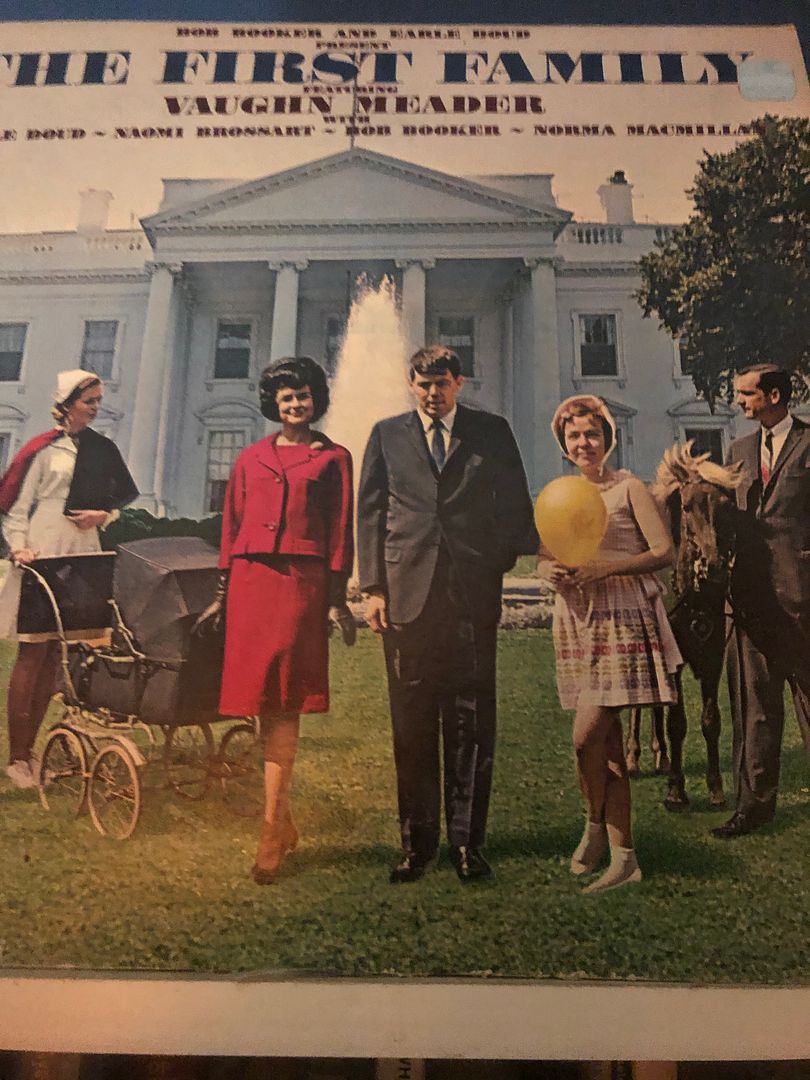
a happier time
Further reading:
Here are the lyrics -- or here with the song -- more insights than you'll find in a dozen of the best books on the subject
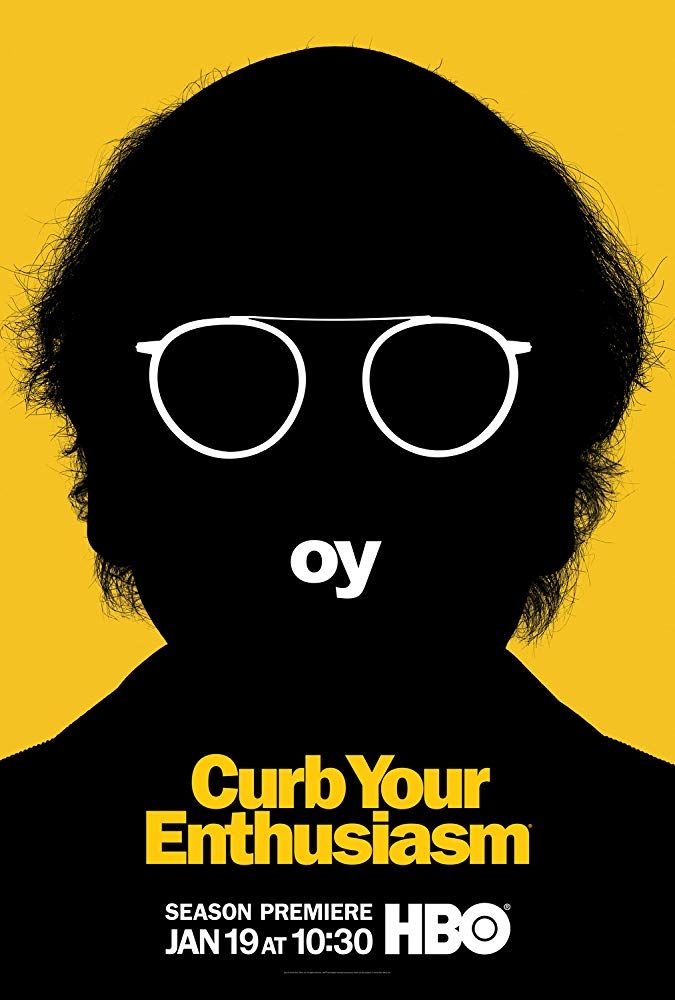
A rare Curb Your Enthusiasm - 10.9 - tonight, in which science fiction figures in a semi-major way.
First, in a conversation with Freddy Funkhouser (Vince Vaughn), Jeff, and Richard Lewis, the subject of a car moving without a driver comes up, and the danger that it might hit a stroller with a baby comes up. One of them says if the baby were a future Hitler, that might change everything, but that's dismissed as "science fiction".
I wouldn't say that qualifies as a "semi-major way," but it turns out Richard is staring in a theatrical presentation of Flowers for Algernon. Now that's science fiction. In fact, I consider Daniel Keyes's 1959 novelette (later expanded into a novel and then made into a movie) the best science fiction novelette ever written. That's why, when I President of the Science Fiction and Fantasy Writers of America in 2000, I named Keyes our Author Emeritus at our New York Nebula Awards Celebration. My wife, two kids, and I had dinner with Keyes and his wife after the award presentation, and it was one of best dinners my family and I ever had.
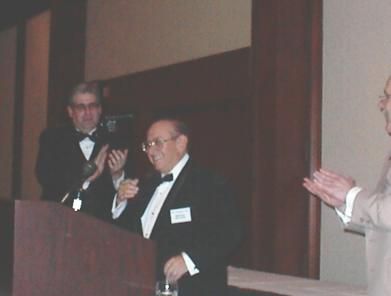
Scott Edelman (toastmaster, left); Daniel Keyes; my hands clapping (right), at Nebula Awards, New York City, 2000
Anyway, the rest of this Curb was, let us say, not on such a literary level. So I'll leave it there, and see you here after the season finale next week.
I finally got around to seeing Luc Besson's Lucy last night, starring Scarlet Johansson in the title role. Parts of it were just high-tech, drug-dealing shoot 'em up, on a par with John Wick, which is to say, nothing really special in retrospect. But parts of it were pretty good high-concept science fiction, in the tradition of Daniel Keyes' "Flowers for Algernon" and Isaac Asimov's "The Last Question".
In both cases, I'm talking about the short written fiction versions first published in the 1950s. In "Flowers," a contender for the best science fiction story ever written, in my opinion, we're told the heartbreaking tale of a man with below-average intelligence who receives a medical treatment that makes him a genius. Why is this heartbreaking? Because the fix is only temporary, and the genius must witness the beginning of his own intellectual decline, to where he was at at the start. In "The Last Question," work on a computer over centuries finally gives an answer to the question of if there's a God - it's that very super-perfected computer.
Lucy gets her trigger to genius from a bag of powerful drugs that breaks in her stomach after she's beaten, which in turn happens after she's forced against her will to carry to the drugs (this is the uninspired part of the story). How the drugs make her so smart is only slightly spelled out - it's based on a hormone that ignites growth in fetuses - but the interesting part of this is that Lucy becomes much more than a genius. Her astonishing intellect is able to read minds and move matter, for example.
There's no reason at all in our current science that this would or should happen with an enormous increase in our intellect - except, I suppose, if we wanted to postulate a macro-quantum-mechanical mind-over-matter (this is not clearly suggested in the movie) - but it's still fun to see enacted on the screen, and Johansson puts in a good performance as Lucy, as does Morgan Freeman as the sage scientist. My favorite scene is when our Lucy, already close to God-hood, travels back in time, and touches the original Lucy in prehistoric Africa, to get our whole human race going in the first place. In the immortal words of Desi Arnaz, "Lucy, Lucy, Lucy!" Or maybe the Beatles' "Lucy in the Sky with Diamonds" should have been playing in the background.
Hey, I'm sucker for time travel in just about any form, so I'd recommend Lucy for that reason alone, as well as its contribution to the Keyes and Asimov themes.
I was very saddened to hear about Daniel Keyes' passing yesterday. He was 86 years old.
One of the most satisfying things I did as President of the Science Fiction and Fantasy Writers of America (1998-2001), was to choose and honor Daniel Keyes as our "Author Emeritus" at our Nebula Awards ceremony in New York City in 2000. The night after the ceremony, my wife, two kids, and I had a wonderful, quiet dinner with Keyes and his wife.
All four us in my family had read Keyes' masterwork, "Flowers for Algernon" - I in the 1950s, my wife in the 1960s, and our kids in the 1990s, when the story had become required reading in many a school. All of us loved the story.
Sometimes all it takes is one. Many writers work over a lifetime, producing an encyclopedia full of novels and short stories, but all of them put together don't have the impact of another author's single shorter work. Keyes wrote more than "Flowers for Algernon," but, if he hadn't, that haunting, sage story would have established his place not only in the history of science fiction, but in writing itself, putting him right up there in the pantheon with O'Henry and de Maupassant.
To get to talk and dine with such an author, after reading his masterwork as a kid and being moved out of my mind was also a pleasure unique in this world. Daniel, thank you for the story and your generous conversation. Your story will be read for millennia to come.
My favorite part of Fringe 3.11 tonight is Walter trying to recover the intelligence that Bell took from him - not intelligence as in information, but intelligence, literally, as in our brain cells. Bell took out parts of Walter's brain at Walter's request, so Walter would not turn into Walternate. Now Walter wants the intelligence back, so he can figure out all and exactly what Walternate is doing.
Just as in Daniel Keyes' classic "Flowers for Algernon" - probably the best standalone science fiction short fiction ever written - it ain't easy. Walter does a little better than the mouse and the protagonist in "Flowers for Algernon," but he doesn't get his lost intelligence back yet either. He's taken the chimp DNA that Bell had experimented with, not Walter's own.
Still, Walter's sharp enough to come up with a good name for alternate, bad Olivia on the other side - Fauxlivia. So we now have a nice evil pair over there - Walternate and Fauxlivia.
The other part of the story tonight concerns Peter and the ultimate weapon, and shape-shifter soldiers from the other side, over here, who are getting snuffed. The shape-shifters were never my favorite part of Fringe - they're poor man's Terminators - and neither is the ancient, ultimate weapon. Not that I don't like mining ancient vastly advanced civilizations - see a little of my 1999 novel, The Silk Code - but their involvement in this all-powerful weapon threatening us now is a little comic-bookish.
On the other hand, Peter's role in bringing forth this weapon is much more intriguing. We see, tonight, that it's turning him into a different kind of person - especially ironic and compelling, since Olivia seems to have gotten over Peter and Fauxlivia, and all but tells him she's ready to resume their relationship....
Fringe 2.10 went Harry Potter's "pensieve" one big, science fictional step better this week, with a story about crucial pieces of Walter's memory being literally sliced out of his brain, and placed for safekeeping in the brains of others.
One part of this excellent story featured the impact of the implanted slivers of brain on the recipients: they went crazy. This impelled the people who did the extracts and the implants - our "friends" from the alternate reality that was once our Peter's home, and is now William Bell's - to remove the slivers from the hosts, and put them back in Walter's brain.
Like any fine piece of science fiction, this story followed through with logical results. The hosts became cured as soon as the piece of Walter's brain was removed. And Walter became complete, sane, when the missing pieces were hooked up again (not reinserted - there wasn't time) to his brain.
And, like Charlie in Daniel Keyes' masterpiece Flowers for Algernon, Walter of course becomes a little crazy once more - the Walter we have come to know and love - when the connections to the missing pieces of his brain are removed. A tour de force sensitive performance by John Noble - a little crazy, clear and sane, a little crazy again - brought this all home.
Interestingly, this is the second time in this Fall 2009 television season that I've noticed a powerful connection to Flowers for Algernoon - see my House 6.8 and the Reverse of Flowers for Algernon. It's a real pleasure to see good television resonate with such a science fictional and deeply moving classic.
The people from Bell's world wanted Walter's knowledge of how he built a doorway to their world. They're getting ever closer to building the portal that could leave our world in ruins - we should at least be ok until the series resumes in 2010.
"Flowers for Algernon," correctly thought by many to be one of the best novelettes ever written, turned into a novel and movies and soon a movie starring Will Smith, tells the story of mentally disadvantaged Charley, given an operation that turns him into a genius, only to slip excruciatingly back to his lower intelligence, when he and we learn that the treatment doesn't last. Daniel Keyes's 1959 masterpiece tugs at every heart string known to humanity, and leaves you gasping for air at the end. There's not a better depiction of what it feels like to understand something very important one day, one minute, and just lose it the next, at first knowing that you lost it, and then forgeting that too.
House the television show, never shy about taking on a profound or dangerous subject, in effect told the reverse of "Flowers for Algernon" in tonight's episode 6.8. A genius is discovered in a state far less intelligent. Turns out he's been drugging himself to be that way - he wants to be stupid, so he can relate to his wife, who is no genius (though she didn't seem that stupid to me).
Gregory House is of course a genius, too. But he's someone who exults in his lofty intellect and wields it to stay on top of the world, and get the things he wants. He's so bright, that sometimes he even talks himself into believing, somewhat, that he wanted for things to work out not the way he originally wanted.
What he wants most this season is Cuddy. But she's not cooperating one bit. Can he get her to allow herself to love him by acting less intelligent, or less like House? I don't think so. Should he forget her and move on to someone else? Not likely. Will he get her just by doing what he's doing? I can't quite see that, either.
But moving back to a lesser state is something House would never do. It will be fun seeing how he manages to get what he wants this season - or convinces himself that he never really wanted that, either. Nah, I can't see that, either.
No flowers for Algernon (the name of the mouse who's first given Charley's treatment, and then slides downhill right in front of Charley's eyes, and gives him the first indication that his own treatment won't last). No flowers for House. I expect we'll see him brilliantly brandishing his brain for a long time...
I'm usually trumpeting The Plot to Save Socrates when I talk here about my science fiction novels - which is pretty often - but today I'm pleased to announce that the podiobook of my 1999 novel, The Silk Code - as read by my good friend Shaun Farrell - has made the Top 20 Most Popular Podiobooks of 2007.
The list is in alphabetic order, so I have no idea how high it placed in the Top 20, but given my ego and imagination...
The nice thing about podiobooks is they're free! And Shaun gave this a good reading. You can get all of the chapters right here.
The Silk Code won the Locus Award for Best First Science Fiction of 1999, and it was also the first appearance in novel of Dr. Phil D'Amato - my NYPD forensic detective.
Phil appeared in the novelettes The Chronology Protection Case, The Copyright Notice Case, and The Mendelian Lamp Case earlier in 1990s, and the novels The Consciousness Plague and The Pixel Eye, published after The Silk Code. See the links below, and/or here for further details.
Three powerhouses of science fiction across the decades comment in 10+ seconds each on my novel, The Silk Code ...
David Hartwell, senior editor at Tor Books, and editor of my science fiction novels from The Silk Code through The Plot to Save Socrates...
Cory Doctorow, of Boing-Boing, and author of Down and Out in the Magic Kingdom, etc…
Daniel Keyes, author of "Flowers for Algernon" ...
David Hartwell, Cory Doctorow, Daniel Keyes on The Silk Code
more on The Silk Code, winner of the Locus Award for Best First Science Fiction novel of 1999:
“As a genre-bending blend of police procedural and science fiction, The Silk Code delivers on its promises.”—Gerald Jonas, The New York Times Book Review
“As twisted as a double helix. ”—Wired
“D’Amato is an appealingly savvy character, and Levinson brings a great deal of invention to the endeavor.”—San Francisco Chronicle
“It is hard to put down, easy to pick up again, and an interesting read.”—San Diego Union-Tribune
“Mixes up-to-the-minute biotechnology with ancient myth, science fiction with police procedure, and prehistory with the near future. It’s an impressive debut.”—Joe Haldeman
“Forensic detective Phil D’Amato is one of my favorite characters, and the puzzles he solves are always imaginative, ingenious, and addictive, but Paul Levinson really outdoes himself this time in a mystery involving murders, moths, mummies, the Silk Road, poisons, fireflies, and forensics, all woven into a mystery only D’Amato could solve! A marvelous book!”—Connie Willis
“This damn book has everything: interesting science, suspense, characters that live on the page – and that we like! – and it debuts a new series hero, Dr. Phil D’Amato, forensic detective. I couldn’t put The Silk Code down. I’ll wager you won’t be able to either. Oh, and this is the kicker: The Silk Code is Paul Levinson’s first novel. ”—Jack Dann
“At last we get Paul Levinson’s superb forensic sleuth, Phil D’Amato, in a full-length novel. If you know Phil from his previous appearances, I need say no more. If you don’t, kick back and enjoy a mystery that spans the ages.”—Jack McDevitt
“The Silk Code is an intriguing story refreshingly rich not only in action but in ideas. Seldom have I seen a story so engagingly weave together so many seemingly disparate (dare I say it?) threads.”—Stanley Schmidt, editor of Analog
“Paul Levinson is an exceptional new writer, behind whose work stands an impressive body of knowledge and a great deal of human understanding. His first novel signals a writer to watch for the provocation and pleasure that he will bring to thoughtful readers. The Silk Code is smoothly written, evocative, and spicy! Highly recommended.”—George Zebrowski
“The Silk Code is a splendidly imaginative novel that explores worlds of ideas both scientific and philosophical, while carrying the reader effortlessly across countries, times, and cultures.”—Charles Sheffield
“The Silk Code is science fiction in the classic style, with an innovative mystery that breaks new ground. Acclaimed for his short fiction and insightful writing on the computer age, Paul Levinson now brings his many talents to a complex novel that will keep you guessing until the last page. ”—Catherine Asaro
”...cerebral but gripping”—Booklist
“Combining Neanderthals and mechanical looms, cantaloupes and coded butterflies, Levinson’s debut novel…offers a flurry of amazing prehistoric technologies, demonstrating that the mysteries of our past can be just as fruitful as those of our future… Levinson creatively explain gaps in both ancient history and biology… providing more wonders than many a futuristic epic.”—Publishers Weekly
”...well-informed and imaginative”—Kirkus Reviews
”...spins an ingenious web of genetic manipulation and anthropological evidence”—Library Journal
“A fascinating concept that pulls together a wide and varied array of ideas and recent discoveries.”—The Magazine of Fantasy and Science Fiction
“A rare thriller that actually achieves its goals as a detective tale and a work of boldly speculative sf.”—Gary K. Wolfe, Locus Magazine
============================================= buy the paperback for a penny on Amazon! (e-mail me for details on how to get autographed copy at no additional cost)





 I finally got around to seeing Luc Besson's Lucy last night, starring Scarlet Johansson in the title role. Parts of it were just high-tech, drug-dealing shoot 'em up, on a par with John Wick, which is to say, nothing really special in retrospect. But parts of it were pretty good high-concept science fiction, in the tradition of Daniel Keyes' "Flowers for Algernon" and Isaac Asimov's "The Last Question".


