22 December 2024: The three latest written interviews of me are here, here and here.
Showing posts with label Chernobyl. Show all posts

Friday, May 12, 2023

Silo 1.3: Like Chernobyl, Repaired


A thrilling edge-of-your seat episode 1.3 of Silo, that felt a lot like Chernobyl, except the damaged generator is ... repaired.

And, of course it had to be, because if it wasn't back up and running, it would have killed everyone pretty quickly, and that would have been the end of the series right there.

[And there are spoilers ahead ... ]

Which would have been a shame, because Silo is shaping up as one riveting series.  Juliet not only comes through on the faulty generator -- along with her crack team -- but she's agreed to be the new sheriff, after the mayor gives Juliet the sheriff's badge, and Juliet turns it over to find her predecessor, Sheriff Holston, left her a one-word message: "truth".  There's definitely something vital going on here.

And then there's that big shocker at the end: Mayor Jahns is dying or dead. And she apparently knew she was dying, that's why she excused herself and asked Marnes to choose a dusty bottle of wine.  At least, I think so.  But if she knew she was dying, how long did she know that?  And was she dying because someone poisoned her, and she knew that?  Other possibilities are she took her own life, or she died of natural causes.

One thing is clear so far in the first three episodes of Silo:  life is pretty expendable, in this haven, or prison, or whatever this silo is.  It's pretty clear, now, that anyone and everyone can die, with little or no warning, at any time.  An excellent state for a drama to be in.

See also Silo 1.1-1.2: A Unique Story, Inside and Out

Monday, July 22, 2019

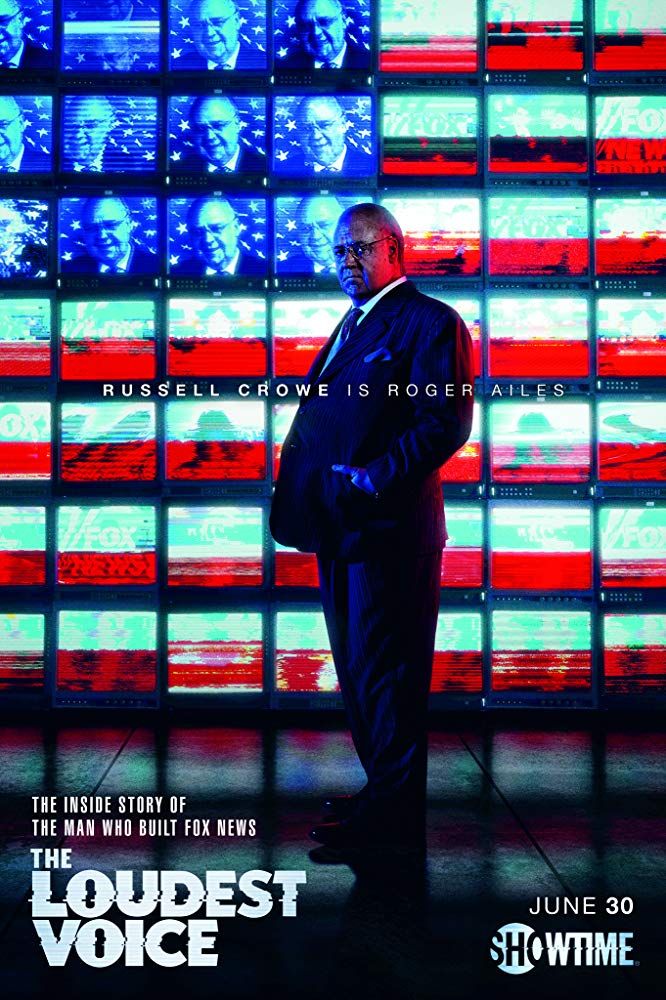
The Loudest Voice 1.4: "We Create the News"


Another powerful episode of The Loudest Voice tonight - 1.4 - in which Roger Ailes lays bare the basis of fake news: "we create the news'.  I should say, the basis of real fake news - that is, news that is fake.  We need to make this distinction because Trump now daily bashes our legitimate news media as fake news - which would be fake fake news -  a tactic that comes right out of Hitler's denunciation of the press in 1930s Germany as the Lügenpresse (the lying press).  When you're trying to replace democracy with a totalitarian regime, it's wise to discredit and get rid of the people who can call you out on that and let the rest of the country know - the press.  (See my short book, Fake News in Real Context, for more.)

Speaking of Trump, we also hear on The Loudest Voice tonight that it was Aisles and Fox who gave the Trump the idea that Obama was not really born in America.  I have no idea if Trump got that paranoid right-wing notion from Fox or not.  And here it might be a good idea to mention, as I always do, that there's a big difference between documentaries and docu-dramas.   Even documentaries are not necessarily entirely truthful - they may leave out important facts.  But docu-dramas go even further - they actually make conversations up, conflate events, etc, to tell a more effective narrative.  (The excellent docu-drama Chernobyl, which I reviewed here in May-June, did a lot of that.)

The Loudest Voice certainly focuses only on selected Fox News luminaries - selected for whatever reason.   Tonight we saw a lot of attention to Glenn Beck.  A few weeks ago, it was Sean Hannity.  Both of these Fox News hosts are portrayed in detail by actors.  In contrast, Bill O'Reilly, who had Fox New's leading show for years, is mentioned as such, and shown (the real O'Reilly) briefly on the The Loudest Voice, but no actor portrays him and we see nothing of his back story.  Why not?

I guess all of this adds up to taking The Loudest Voice with a grain of salt, as we should with any docu-drama.  It tells a crucially important story, and is therefore worth watching, even if something less than the complete truth and only the truth shows up on our screens.

See also:  The Loudest Voice 1.1: Fox Launch ... The Loudest Voice 1.2: September 11 and After ... The Loudest Voice 1.3: Prelude to Trump


Monday, June 3, 2019

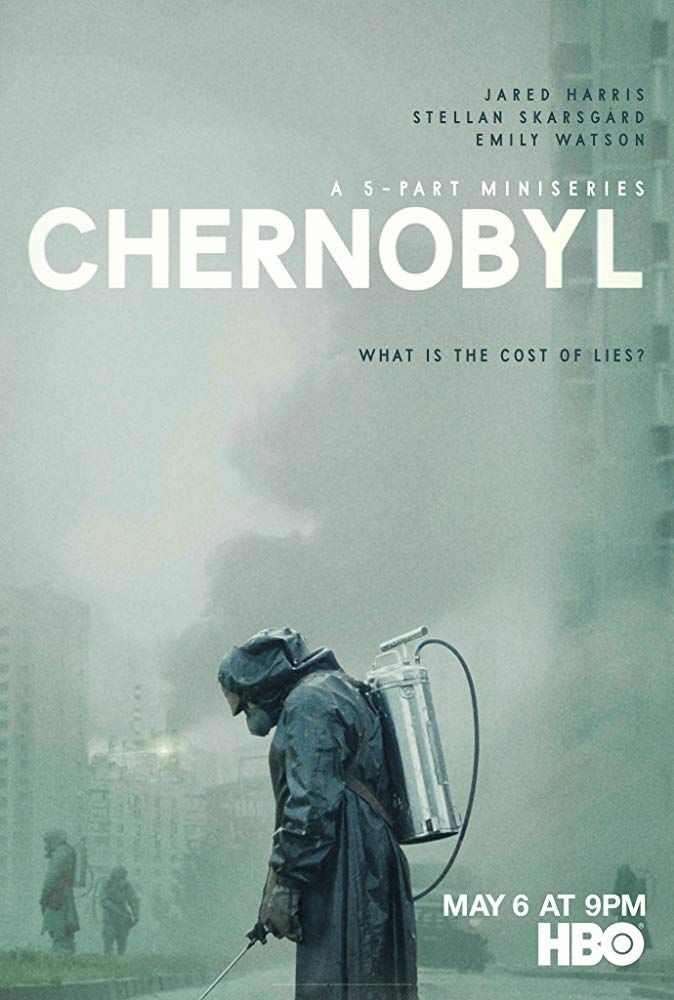
Chernobyl 1.5: "What Is the Cost of Lies?": Chernobyl and Trump


Chernobyl 1.5, the finale of this crucially instructive docudrama, ended with the last words we heard from Legasov's recording: "What is the cost of lies?"

But it's a question that could be put to Donald Trump, and his constant assault on the truth from The White House.   And that makes Chernobyl not only a cautionary true story on the hazards of nuclear energy, but, just as importantly, on the dangers of suppressing the truth, whether on behalf of a misguided state such as in the Soviet Union, or unbridled personal ego as with Donald Trump.

The truth that the Soviets suppressed led to the final straw that broke the nuclear reactor and made it explode: the tips of the rods that were meant, when inserted, to be the failsafe of a nuclear explosion in fact had just the opposite effect.  They made the reactor explode.   The Soviets knew this before Chernobyl, but kept it secret out of fear of seeming ignorant or incompetent about nuclear energy.  Which was in fact exactly what they were.   And then the Soviet regime tried to stop Legasov (given an Emmy-worthy performance by Jared Harris) from letting the world know about this.  (And speaking of Emmy-worthy, the same eminently applies to the whole series - hats off to creator Craig Mazin.)

According to Gorbachev, it was Chernobyl that brought the Soviet Union down, the blatant example it gave of the arrogance and blindness of the Soviet regime.   There were many other reasons that the Soviet regime deserved to fail.  It's tragic, however, that what brought it down was the death of so many innocent people.

We here in the United States who value freedom can only hope that it takes something far less costly - either impeachment and conviction, or loss of the next Presidential election - to bring down the liar in The White House.

See also: Chernobyl 1.1: The Errors of Arrogance ... Chernobyl 1.2: The Horror Movie ... Chernobyl 1.3: The Reasons ... Chernobyl 1.4 Bio-Robots


Monday, May 27, 2019

Chernobyl 1.4: "Bio-Robots"


When Shcherbina and Legasov discover that the Soviet robots designed to move on the Moon couldn't do the job of cleaning up the worst of the rubble at Chernobyl - because the high radiation fried the robot circuity - Legasov suggests "bio-robots," a clever name for human beings.

This was the highpoint of Chernobyl 1.4 - high in the sense that at least it got the job done, though who knows how many of the soldiers died, sooner or later after their work.  In contrast, the slaughter of animals in the radioactive zone was nothing but horrible.   As was the story of the firefighter's wife, who survived the radiation only because her unborn child absorbed it, and died hours after birth.

On the fate of the dogs and cats in the "exclusion" i.e. evacuated because lethally radiated zone, it's worth mentioning the discovery early this year that wildlife is thriving now, in 2019, in that same zone. As one wit and scientist observed, apparently humans were more injurious to animal life than has been the radiation from Chernobyl.

And the true villains in this harrowing, sobering docu-drama are human beings not atoms.  Humans who thought splitting the atom could be safely harnessed to make energy in the first place.  Humans, more specifically the KGB, who covered up a flaw or problem with the Chernobyl type of reactor back in the 1970s, a decade before the explosion, when a similar reactor exhibited the bizarre, counter-intuitive effect of superheating immediately after it was shut down.  As Shcherbina observed, the public relations of the Soviet state, the maintenance of the myth of Soviet superiority, came before disseminating information about this effect, information which could have prevented Chernobyl.

But lest we think that only the Soviet Union was afflicted with placing image before safety, this is something that most nations and institutions can suffer from.   Next week, in the finale of this important docu-drama, we'll learn how our principals were able to get at least some of the truth out to the world.

See also: Chernobyl 1.1: The Errors of Arrogance ... Chernobyl 1.2: The Horror Movie ... Chernobyl 1.3: The Reasons


Tuesday, May 21, 2019

Chernobyl 1.3: The Reasons


The reason that Chernobyl happened is, as in most catastrophes, actually many interlocking reasons.  Had any of them not been in play, the explosion likely wouldn't have occurred.  You can read all about them, for starters, on Wikipedia, if you're interested.  Tonight on Chernobyl 1.3 Ulana Khomyuk begins to explore them.   As is always the case with these complex, cascading causes, nothing makes sense or seems possible at first as the cause of the accident.   And in Khomyuk's case, it's not helped either by two of the three main managers dying after her initial interview with them, and the third unwilling to talk to her, at least at present.

The greater truth is that, whatever the causes, splitting the atom is just not a safe way to generate energy.   That's why Three Mile Island, Chernobyl, and Fukushima all happened for different reasons.  It's not that almost anything can go with generation of energy from fission.  It's that there are so many parts that have to be operating, if not perfectly, at least within margins of error, that sooner or later something will go wrong, at a very wrong time, or an external event like an earthquake will set in motion that cascade of destructive events, as happened at Fukushima.

The ensuing tragedy extends to all sorts of loss of human life, including heroes who knowingly sacrifice their lives to stave off a greater disaster.  That was well shown tonight with the Soviet miners who had to shed their clothes, it was so hot, to stop the concrete floor from melting.  The lack of clothes didn't really matter, as Legasov has to admit, because the clothes offered no protection against the deadly radiation.  This made a grim and harrowing counterpoint to Lyudmilla Ignatenko not only seeing but hugging her stricken husband Vasily in the Moscow hospital.   Her love for her husband was so strong that she what was not only willing to put her own life in jeopardy, but that of their unborn baby.   Exposure to radiation and its horrors scrambles every human equation.

This mini-series is not easy to watch, to say the least.  But it is vitally important for everyone to see.

See also: Chernobyl 1.1: The Errors of Arrogance ... Chernobyl 1.2: The Horror Movie


Tuesday, May 14, 2019

Chernobyl 1.2: The Horror Movie


If I hadn't seen last week's first episode of Chernobyl, and had fallen asleep before the beginning of the second episode on HBO last night, and had woken up a few minutes into the episode, I'd have thought that I was watching a horror movie, or maybe a new apocalyptic series on AMC.

The second episode had all of the trimmings.  Almost all the powers-that-be misunderstanding and downplaying the grave threat.  A scientist or two, here and there, getting what was happening, urgently trying to alert everyone around them to the danger, being largely ignored.  And when they're finally listened to, at least some of the vulnerable populace is evacuated, but not everyone, including a dog running in vain after a departing bus.   And with a far worse, more monstrous catastrophe about to happen, three brave souls stepping up.

Except all of this really happened.  And it could happen again, since understanding one accident can never preclude another happening, for slightly different reasons.  I'm usually a champion of technology.  But I turned against nuclear power after Three Mile Island in 1979 near Harrisburg, Pennsylvania.  That was a partial meltdown.  And I wasn't surprised when the far worse accident happened at Chernobyl in 1986.

This mini-series is a stark reminder that we have take nature and our technologies which seek to harness it very seriously.  Because the truth is there is no complete harnessing of the natural world - not of atoms, not of genes, not of bacteria, not of you name it.  The best we can be is, yes, bold with technology in trying to improve out lot, but always wary of its unforeseen consequences.

See also: Chernobyl 1.1: The Errors of Arrogance


Friday, May 10, 2019

Chernobyl 1.1: The Errors of Arrogance


Tampering with Mother Nature has its risks, and there's probably no greater tampering than messing with the atom.   The stark dangers are paramount not only in the use of nuclear weapons, but, unfortunately, in the attempt to harness the power of the atom for peaceful purposes, such as the production of energy.   Three Mile Island in the US, Chernobyl in the Soviet Union, and Fukushima Daiishi in Japan are examples of what can go very wrong at a nuclear power plant.  Chernobyl, with anywhere from 4000 to 200,000 deaths resulting for the explosion of its core, is far and away the worst.

Its story is therefore manifestly right for docu-drama treatment.   And it's about much more than what can go wrong at a nuclear power plant.  It's about how a totalitarian regime is singularly unfit to deal with the aftermath of a nuclear disaster, and in terms of ultimate loss of life, makes the consequences of the disaster much worse.

In the first episode of Chernobyl, we see this writ large.  All but a handful of people at various levels minimize the destruction of the core, even though they're repeatedly told by close observers that it no longer exists.   The level of roentgens (radiation) is said to be 3.2, even though administrators are repeatedly told that's the highest level on the small device making the measurement, meaning the device can't show a higher level.  And when a more sophisticated device is brought in, with an upper limit of 200 roentgens, the powers that be make the same mistake.

One of the administrators sitting around the table in a bunker says everyone in the area should be evacuated as fast as possible.  He's overruled by a higher up who sees the event as a great opportunity for the Soviet Union to demonstrate its capability of dealing with the accident and keeping the public calm.

Errors like this, self-inflicted, did far more damage that the explosion itself.   The question that all of us in 2019 must ask is:  are we better at avoiding those errors of arrogance now than the Soviet Union was in 1986?


InfiniteRegress.tv