22 December 2024: The three latest written interviews of me are here, here and here.
Showing posts with label DNA Nation. Show all posts

Friday, December 20, 2019

DNA Nation (Part 4, Chapters 18-24, Epilogue): Talkative Cookies


In the final chapters of his crucial and remarkable book, Sergio Pistoi observes that "Identical twins are the genetic equivalent of factory-made cookies: they have the same DNA ... They look very similar, and yet in many regards they are distinct" (p. 169).  He then adds, "With the advent of the familial search, your DNA talks for you and your family, regardless of what you would like do (p. 180). That pretty much captures the long and the short of  DNA Nation: How the Internet of Genes is Changing Your Lives:  DNA figures in a lot of our life experiences, but it by no means dictates everything.  And, as much as we might like to control who sees our genome and who does not, the revolution in consumer genomics has let that cat well out of the bag.

As we saw earlier in this book, some of the results of that DNA cat-at-large are beneficial.  DNA profiles of relatives have helped police nab serial killers who have committed their crimes decades earlier.  It's helpful to know we have a genetic propensity for an illness even if the likelihood of its finding expression in our lives is less than 20-percent.  It could be gratifying to find a relative we had no idea existed.  But the same garrulous DNA makes us vulnerable to a new kind of marketing based on knowledge of our genetic predispositions to this food or that, and anything we may buy.  And in the hands of a totalitarian government, well, when that combines with non-DNA data we may make public, the sky's the limit in terms what that government might do to anyone it deems an enemy of the state (a term, I would add, that Trump repeatedly uses to describe the free press in America).

Further, this situation will only get more perilous in the future, when, Pistoi notes, "All children will have their DNA sequenced at birth and will keep their genetic file during their entire lifetimes, as if it were a social security number" (p. 199).   The solution?  There is none, other than awareness that this revolution is already occurring.  Awareness is the necessary condition for taking whatever action we can to safeguard our privacy which, Pistoi aptly notes, "is a volume knob, not an on/off switch. Everyone has a level of privacy that suits their needs” (p. 196).

For example, I have a level of privacy that suits my need to acquaint more of the world with my science fiction, my scholarly writing, and my music.  You the reader of this review will likely have a level that's different.  The great virtue of DNA Nation is that it alerts us to be more careful and deliberate in deciding upon what level of privacy we need and want to pursue.

If some of this sounds like science fiction, that's because it currently is.  But Pistoi's book makes clear that the ratio of reality and science fiction regarding the potent mix of DNA and social media in our lives is daily moving further into the reality part of the dial.  Still, Pistoi observes that no science fiction author - "even the most daring writer - has envisaged a social network based on our genes" (p. 205).  He's right, and, given his zest for knowledge and talent as a writer, I urge him to write it.

See also: DNA Nation (Part 1, Chapters 1-5): Reconfiguring Your Human Family ... DNA Nation (Part 2, Chapters 6-13): The Extraordinary Revolution and Its Intrinsic Limitations ... DNA Nation (Part 3, Chapters 14-17): Two-Edged Swords


Saturday, December 14, 2019

DNA Nation (Part 3, Chapters 14-17): Two-Edged Swords


I've long held the obvious view that technology is a two-edged sword, ethically speaking: a knife can be used to cut food (good) or cut people (bad, unless the person wielding the knife is a surgeon) (see my "Guns, Knives, and Pillows" in On Behalf of Humanity: The Technological Edge for more).  In Part 3 of the excellent DNA Nation: How the Internet of Genes is Changing Your Lives, Sergio Pistoi looks at some of the dark sides of the revolution in genomics, while keeping his eyes on the astonishing benefits of opening the documents of our DNA that are beginning to come into play.

Pistoi explains that, in contrast to the relatively few deadly diseases (such as Huntington's) which are monogenic or caused by a single harmful mutation, most (including cancers) are multifactorial, "with thick and elaborate plots, where a criminal network of genetic and non-genetic factors conspire to develop the pathology. Think of Breaking Bad, Narcos and The Wire combined – but way more complicated" (p. 121).  Although I and no doubt Pistoi loved those series, the upshot for prevention and control of such illnesses is that identification of a complicit gene tells far less than the whole story.   Pistoi reports on a man who had what was mostly likely unnecessary extensive prostate surgery, after a suspect genetic mutation was flagged in his DNA.

But Pistoi goes on to detail some of the treasure-trove of benefits of DNA testing that are becoming available so fast that Pistoi may need to update his book on at least a yearly basis.  Via "a technique called Pre-implantation Genetic Diagnostic ... embryos are obtained in vitro from the egg and sperm of the couple, and DNA tested to select the ones without the mutation” (pp. 123-4).  I still have a book on our shelves called A Fortune in the Junk Pile - about finding valuable antiques in tag sales and flea markets - and Pistoi delves into the value of what was labeled "junk DNA" because it seemed to have no connection to somatic traits.   In fact, this DNA is now known to have the crucial "epigenetic" function of regulating the performance of genes, which allows the "reprogramming" of normal adult cells into stem cells (p. 147).  (As a science fiction author, I was especially glad to see this redemption of junk DNA - my April 1996 novelette in Analog, "The Copyright Notice Case," situated an ancient copyright in our DNA in the junk DNA we all carry; the story is in my 1999 Bestseller anthology).

And, just for good measure, Pistoi tells us that “Our bodies host ten times more microorganisms than our own cells" and "there is evidence that gut bacteria can protect or predispose us to pathologies ranging from inflammation to diabetes and obesity" (p. 149).   I was especially glad to see this, just as with the junk DNA, since my novel The Consciousness Plague hypothesizes that our very consciousness is made possible by communicative bacteria that live in our brains.  Outside of the realm of science fiction, Pistoi notes that bacteria and fungi in our biome add an important dimension to our DNA unveiling.

And I'll be back soon with my concluding review of this book which has updated my knowledge of DNA more than anything else I've read in the past twenty years.  Its overarching message: no food, no medication, can be deemed to be good or right for you, until it's matched to your DNA, a process which is still in its toddlership.

See also: DNA Nation (Part 1, Chapters 1-5): Reconfiguring Your Human Family ... DNA Nation (Part 2, Chapters 6-13): The Extraordinary Revolution and Its Intrinsic Limitations .... DNA Nation (Part 4, Chapters 18-24, Epilogue): Talkative Cookies


                                                    The Consciousness Plague

Thursday, December 12, 2019

DNA Nation (Part 2, Chapters 6-13): The Extraordinary Revolution and Its Intrinsic Limitations


In the April 1, 1993 issue of Wired, in my little article The Extinction of Extinction, I mused that, someday, "Heaven may well be a huge directory of DNA codes".  Although that date was April Fool's Day in many parts of the world, I wasn't kidding.  In Part 2 of the pathbreaking DNA Nation: How the Internet of Genes is Changing Your Life, Sergio Pistoi details exactly how that could come to be.

His tour, engagingly written and socially astute, just like Part 1 of this book, takes us from the mechanics of gene harvesting and analysis to the replacement of laboratories with crowdsourcing as the locus of DNA subjects.  As I pointed out in New New Media back in 2009, the same level of error in the expert-driven Encyclopedia Britannica and the crowd-sourced Wikipedia demonstrated as far back as 2005 that crowdsourcing was at least as effective as experts in the accumulation of knowledge.  Pistoi explains that, in the ongoing linking of genes to crucial and trivial aspects of our lives, the "democratization" of genetic research is already becoming far more effective than studies in labs. “I’m sitting on the couch, barefoot, holding a laptop and watching TV and someone tells me I am contributing to a genetic study," Pistoi notes. "Is that a joke?” (p. 104).  In his savvy, entertaining style, Pistoi shows us why it most certainly is not.

But Pistoi also repeatedly cautions and explains how so much our lives, at present, defy any genetic explication. He notes that "Predicting multigenic characteristics from DNA is like watching a party of people and guessing where they will choose to go for dinner" (p. 72), adding, as just one of many examples, that "sexual preferences are multifactorial traits involving many genetic and non-genetic factors, most of which are still unknown" (p. 99).  We, accordingly, need to beware of companies "selling digital snake oil" (p. 91).  The upshot, ranging from choice of sexual partners to food preferences, is that genetic causes, though now discoverable in ways totally unavailable for most of our history, are still poorly mapped, if known at all, for huge swaths of our daily lives. Including, for better or worse, frequency of "orgasms" in a typical sexual session.

And, speaking of sex, Pistoi brings a commendable moral gauge to his book.  He concludes his debunking of the "gay gene" - that homosexuality is a genetic predisposition - with an insistence that "people should not have to justify their sexual preferences for other consenting adults" (p. 102).  In addition to being a molecular biologist, science reporter, and chronicler of how genomic sites like 23andMe are "similar to social media like Facebook, Instagram and Google, which offer free services in exchange for the user’s data" (p. 107), Pistoi applies a keen moral sense, which enhances the pleasure of reading his book.

And I'll be back soon with one or two concluding reviews of the rest of this eye-opening new book.

See also DNA Nation (Part 1, Chapters 1-5): Reconfiguring the Human Family ... DNA Nation (Part 3, Chapters 14-17): Two-Edged Swords ... DNA Nation (Part 4, Chapters 18-24, Epilogue): Talkative Cookies


                      "DNA was the ultimate dossier"


Tuesday, December 10, 2019

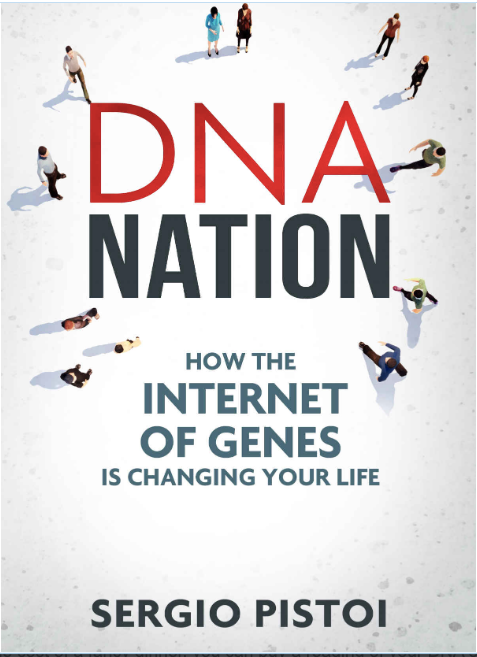
DNA Nation (Part 1, Chapters 1-5): Reconfiguring Your Human Family


I enjoy binge-watching television series.  I think it's a real break-through in our popular culture.  I occasionally run into myopic critics of technology in academia, who see bingeing as somehow a debasement of our culture.  I always reply that binge-watching a television series brings to the audio-visual screen the same options we have with the venerable medium of the book, which we can read as fast or slowly as we like.  And every once in while, I come across a book which indeed demands to be savored, not binge-read. DNA Nation: How the Internet of Genes Is Changing Your Life by Sergio Pistoi is such a book.  Accordingly, having read the first part (chapters 1-5) today, I'm going to post this review.  And I'll be back, likely more than once, with one or more reviews when I've read the succeeding four parts, like in the next few days  (See my reviews of Dreaming the Beatles and The Perversity of Things for two other sequential, much longer, book reviews.)

Pistoi is a molecular biologist, with a philosopher's understanding of human nature and a media theorist's instinct for understanding the evolution and impact of social media.  He brings these talents to be bear in a package at turns both sagely and delightfully written, a handbook as much as a book, explaining how the scientific revolution of analyzing our DNA - which can be done for $100 or less, by sending a sample of your saliva - is pulling the rug out from under many of our preconceptions, ranging from where in the world our ancestors came from to who really are our closest and not-so-close relatives?  Along the way, DNA Nation eradicates whatever shred of scientific support the 21st racist may cling to, pointing out that DNA mapping shows more differences within racial groups than between them: "you may be more similar genetically to someone you identify as belonging to a different 'race' than your neighbor who looks very much like you" (p. 44).

And Pistoi leavens such weighty lessons with continuous wit and humor. “A genetic profile is not just a biological test," he advises, "it’s a selfie taken from inside our cells” (p. 50).  And, "I could couch-surf for decades around the world visiting all my cousins. And if only half of them invited me to family celebrations, I could spend an entire, terrifying life attending marriages, baptisms, first communions, Thanksgiving days and graduations" (p. 18).

Sex, always a good thing to write about, of course figures prominently in this book.   Indeed, it's the reason all of us humans are so genetically alike.  And it may even extend across species, or does extend across disparate groups of our own species.  Did our ancestors actually sleep with Neanderthals?  Our current DNA proves it, Pistoi notes, and helpfully adds, "If you have seen a diorama of a Neanderthal you may doubt it, but DNA doesn’t lie, and humans have never been too choosy with sex anyway” (p. 36).

But the thrust of the first part of this essential book is not the several percentages of Neanderthal DNA that some of us carry, but the way knowledge of our genetic profile, combined with the ubiquity of the Internet, has created a new world in which everything from family and friends to ethnic identities are starting to radically change.   I'll be back soon with more reviews of this book as I read further about this upheaval in preconceptions in daily progress.

See also DNA Nation (Part 2, Chapters 6-13) The Extraordinary Revolution and Its Intrinsic Limitations ...  DNA Nation (Part 3, Chapters 14-17): Two-Edged Swords ... DNA Nation (Part 4, Chapters 18-24, Epilogue): Talkative Cookies


                   "DNA was the ultimate dossier"


InfiniteRegress.tv