22 December 2024: The three latest written interviews of me are here, here and here.
Showing posts with label outer space. Show all posts

Saturday, April 11, 2026

Which President Was Most Responsible for the Artemis Project?


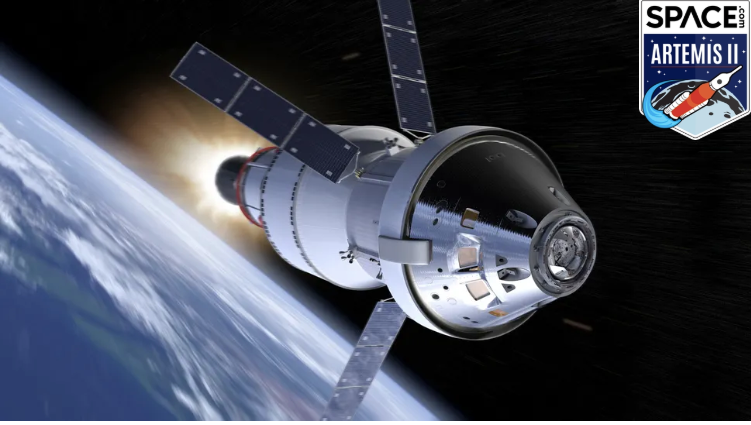
The Orion spacecraft during trans-lunar injection, to bring an Artemis mission to the moon. (Image credit: NASA)

The short answer, much as it pains me to say this, is that our current President, Donald Trump, is the President most responsible for the Artemis Project.  My readers will know how strongly I have opposed and criticized Trump's policies in his two administrations, on immigration, ICE, just talking about destroying Iranian civilization, and just about everything else.  But a key factor in Trump's policies is his disregard for the truth.  And the truth is that the Artemis Project was initiated in Trump's first administration, enacted with the uncrewed Artemis I in Joe Biden's administration, and furthered with the human trip around the Moon just completed by Artemis II, in the current second Trump administration.  The truth therefore is that Trump is the President who was most responsible for Artemis.

There's of course a history to all this.   As I outlined in several books -- Realspace: The Fate of Physical Presence On and Off Planet and Touching the Face of the Cosmos: On the Intersection of Space Travel and Religion -- Richard Nixon, a Republican, stopped trips to the Moon in the space program, dropped them like a hot potato, after the extraordinary success of the Apollo Program in 1961-1972, because it heralded the vision of John F. Kennedy, a Democrat, who beat Nixon in the 1960 election and ignited NASA and the US space program after its slow start in the 1950s under Republican Dwight Eisenhower.  By the time we got to the 1980s, Democrats like Walter Mondale were active opponents of spending money on space, and Ronald Reagan and the Republicans had become the champions of extending our species off this planet.  That reversal continued into the first Trump administration.  Democrat Bill Clinton did little for space.  Republican George W. Bush started the Vision for Space Program in 2004, which included the Constellation initiative, a vehicle aimed at returning astronauts to the Moon by 2020 as a stepping stone to Mars.  Democrat Barack Obama ended the Constellation in 2010, which almost made me sorry I voted for him.

This history is important, because it spotlights the significance of Joe Biden's strong support for Artemis in his one term in office.  That crucial support makes Biden the first Democratic President to fully support the space program -- specifically, getting human beings to actual moons and worlds beyond this planet -- since LBJ in the 1960s.   When the history of how the human species went out into the universe is someday written, it will show that we Americans, supported by both parties, led the way.  And if Donald Trump was a crucial factor and force in that success, so be it.   

That doesn't mean that we have to support Trump and his dangerous policies that threaten our very democracy.   But it does mean that we have to stand up for the truth, which in just about every other aspect of his presidency, Trump disdains.


Friday, November 10, 2023

For All Mankind 4.1: Back in Business and Alternate History


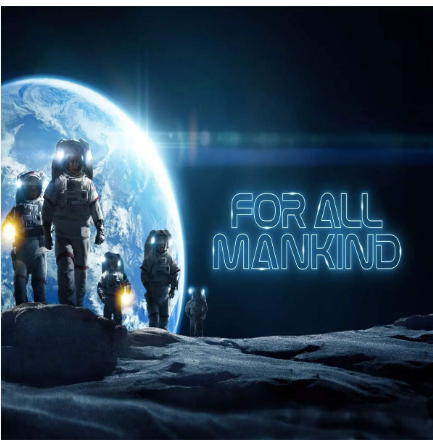
For All Mankind is back with the debut of its 4th season on Apple TV+ today, and it's excellent in all kinds of ways.

[Mild spoilers ahead ... ]

As readers of my reviews -- and for that matter, my novels and short stories -- will no doubt know, what I most like about this series are not its life-and-death adventures out in space and here on Earth, which are suitably staged and enacted, but the alternate history framework in which all of that is presented.

As the world turns into the 21st century in this new season, among my favorite alternate history highlights are Gore is elected President in 2000 (good), Gorbachev is still in power in the Soviet Union (better), and John Lennon's doing concerts (best of all).  I've written time-travel science fiction about the first (Ian's Ions and Eons), thought a lot about the second, and have an award-nominated novel (The Loose Ends Saga) and a short story (It's Real Life) that's won and been nominated for awards, made into a radio play, and I'm currently expanding into a novel, (a world in John Lennon is alive and The Beatles still together in 1996).   For All Mankind excels in this kind of stuff, which is catnip for alternate histories devotes like me.

Meanwhile, there is lots of adventure, ranging from political and personal intrigue down here on Earth, and life-and-death situations resulting in death out in space.  This is realistic, and has been part of this series since its first season.  When you're pressing the boundaries beyond this planet, accidents and misjudgements are bound to happen.

The keys to avoiding them, or making the best of them, of course reside in the personnel.  I miss all the characters who for one reason or another haven't made it into this fourth season.  And it's too soon for me to get to have confidence in the newcomers.  But I'm very glad this series is back on the air, and I'll be reviewing every episode.


Chuck Todd and Paul Levinson talk Alternate History, including For All Mankind

See also For All Mankind 3.1: The Alternate Reality Progresses ... 3.2: D-Mail ... 3.3-3.4: The Race

And see also For All Mankind, Season 1 and Episode 2.1: Alternate Space Race Reality ... For All Mankind 2.2: The Peanut Butter Sandwich ... For All Mankind 2.3: "Guns to the Moon" ... For All Mankind 2.4: Close to Reality ... For All Mankind 2.5: Johnny and the Wrath of Kahn ... For All Mankind 2.6: Couplings ... For All Mankind 2.7: Alternate History Surges ... For All Mankind 2.8: Really Lost in Translation ... For All Mankind 2.9: Relationships ... For All Mankind 2.10: Definitely Not the End

It's Real Life

get the paperback or Kindle of this alternate history here

or read the story FREE here

=========================

another alternate space travel history

The Loose Ends Saga 

=========================


Wednesday, December 30, 2020

Four Publications

I've had four publications in the past week, and since all are available FREE online, I thought I'd list them for you right here:

More Freebies from my science fiction, media theory, and music!

Friday, December 29, 2017

Europa Report: Stark Inspiration


I caught Europa Report (2013) on Netflix last night, a mixture of a stark, beautiful, and ultimately inspiring account of the first flight with people to one of Jupiter's moons, the one deemed most likely to have life, due to its water and heat signatures, both of which we knew (the water and heat, not life) in 2013 and at the end of 2017.

The movie pulls no punches, which makes its ending all the more awe-inspiring.  [Spoilers ahead ...]

Everyone of the voyage dies, in one heroic way or another.  But this first trip beyond the Moon (our Moon) by any human beings manages to get back communication to Earth, with an image of: a multi-celled organism!  Proof there's life out there in our solar system, more advanced than some ancient bacterium.

I've been arguing with people in science and science fiction for years about the need to send humans beyond this planet.  Why not send robots, these people ask, wouldn't they, in the Europa Report, have found the same life as did our human beings, without the loss of their life?  Europa Report makes vividly clear why that wouldn't work:  it's human ingenuity, unprogramable, that captured that extraordinary image of off-Earthly life.

There are also some people who don't and say they wouldn't find such a discovery amazing and Earth-shattering - in the best way possible - whether made by robot or human.  We need to spend the money needed to get us off this planet on such problems as reducing poverty, fighting disease, and other crucial things on Earth.   Although I agree completely that we need to spend more money on those pursuits, I believe even more strongly that those expenditures shouldn't be at the expense of space travel.  (And in the Europa Report, the mission is private financed.)  But to those people who don't get the inspiration of the Europa Report, I'd say: don't watch the movie.

But to everyone else: see it, if you haven't already.  It's a great way to ring in the New Year.  And even for those who don't find getting humans off this planet an essential way of learning more about what we're doing here in this cosmos - maybe see the movie, anyway, after all.  Optimist that I am, I believe every human being ultimately will be inspired by the possibility of finding life on other planets, and it's just a question of how long that truth takes to break through to your soul.

Friday, November 27, 2015

Religion as a Necessary Engine of Space Travel

Our anthology, Touching the Face of the Cosmos: On the Intersection of Space Travel and Religion, is being readied for publication as an ebook by Connected Editions in the next few weeks, and by Fordham University Press in paperback and hardcover in March 2016.  Contents are here.  The paper editions can be pre-ordered here.

In the meantime, here's a 15-minute talk I gave at the General Semantics Symposium in New York this past September in which I outline the raison d'ê·tre for the volume.


                            video camera Ben Hauck

Tuesday, September 29, 2015

Fordham University Press to Distribute Print Edition of Touching the Face of Cosmos; 1st Glimpse of Cover

Two very good pieces of news regarding Touching the Face of the Cosmos, the forthcoming anthology edited by Paul Levinson (me) and Michael Waltemathe:

1. Fordham University Press will be distributing the print editions of the book, which will appear in its Spring 2016 catalog, with a likely publication date in March.  Connected Editions will still be publishing all digital editions, with a likely publication date in November.   (A list of essays and stories can be found here.)   Paperback and hardcover editions now available for pre-order.

2.  Here's the cover - created by world-renown illustrator Joel Iskowitz.


And here's the catalog copy for the anthology -

Military advantage, scientific knowledge, and commerce have thus far been the main motives to human exploration of outer space. Touching the Face of the Cosmos explores what may be the best motive of all, largely untapped: the desire of every human being, essentially spiritual, to understand more about our place in the universe, how our lives on Earth are inextricably part of that bigger picture. Drawing on leading scientists, religious thinkers, and science fiction writers – including a new interview with John Glenn, and an essay by Director of the Vatican Observatory Guy Consolmagno, SJ – Paul Levinson and Michael Waltemathe have assembled a volume that puts space travel and religion on the map for anyone interested in outer space, theology, and philosophy. 
Paul Levinson, PhD, is Professor of Communication and Media Studies at Fordham University, and author of 16 scholarly books and novels, including Realspace: The Fate of Physical Presence in the Digital Age, On and Off Planet. 
Michael Waltemathe, PhD, is Senior Lecturer in Religious Education, Department of Protestant Theology, Ruhr-University Bochum, Germany, and author of Computer Worlds and Religion, and articles about science, religion, and outer space.

Tuesday, July 21, 2015

Touching the Face of the Cosmos


The following are the contents of our anthology, Touching the Face of the Cosmos: On the Intersection of Space Travel and Religion as of August 1, 2015, one month after our official deadline for receipt of essays and stories. There are several important points to keep in mind about what follows:

1. This is not the Table of Contents*.  My co-editor Michael Waltemathe and I have yet to decide on the specific order of nonfiction essays and science fiction stories.


2. This is not a final list of essays and stories.  We are still expecting a few additional essays.

3. But the following should give you an ample idea of what to expect in the anthology.  Look for further announcements as we get closer to our expected November 1, 2015 publication date.

*Note added 17 December 2015: the Kindle edition has just been published.  Click here and then on Look Inside, to see the Table of Contents and more.

Introduction

John Glenn interviewed by Paul Levinson, 30 July 2015

Essays
  • Joshua Ambrosius (Univ of Dayton) "Our Cosmic Future? How Religion Might Shape It"
  • David Brin (Arthur C. Clarke Center, Univ of California, San Diego) "So You Want to Make Gods"
  • Guy Consolmagno, SJ (Director, Vatican Observatory) "A Catholic in Space: Coming Home"
  • Peter M. J. Hess "Anticipating the Contours of Extraterrestrial Religion"
  • Wu Jianzhong (Sichuan International Studies Univ, China) "Sky One: The Universe and Human Beings are Unified"
  • Paul Levinson (Fordham Univ) "Religion as a Necessary Engine of Space Travel"
  • Juan Pablo Marrufo del Toro, SJ "Space Exploration as a Religious Pilgrimage"
  • Michael O'Neal (formerly NASA, Kennedy Space Center) "Faith in Space: A Christian Perspective"
  • Jeremy Saget (Mars One) "Faith to Face"
  • Barry Schwartz (Rabbi,  Congregation Adas Emuno) "One Earth"
  • Lance Strate (Fordham Univ) "The Touching Interface of the Cosmos"
  • Kathleen D. Toerpe (Astrosociological Research Institute and 100 Year Starship) "Shall the Sacred Heavens Be Cast Down"
  • Molly Vozick-Levinson (Director, Children's Learning Center) "Castles in the Air: Young Children Imagining Outer Space"
  • Michael Waltemathe (Ruhr-Universität Bochum) "The Heavens Declare the Glory of God: Religion in a Spacefaring Society"
  • Deana L. Weibel (Grand Valley State Univ) "Pennies from Heaven: Objects in the Use of Outer Space as Sacred Space"
  • Christian Weidemann (Ruhr-Universität Bochum) "Did Jesus Die for Klingons, Too? Christian Faith and Extraterrestrial Salvation"
Stories
  • Kyle Aisteach (author, science fiction) "Birth of a Pantheon"
  • Arlan Andrews, Sr. (founder, SIGMA, science fiction think-tank) "Epiphany"
  • Gregory Benford (Univ of California) "Winds of Mars"
  • Dave Creek (author, science fiction) "Kayonga's Decision"
  • Jack Dann (Nebula and World Fantasy Award winner) "Jumping the Road"
  • Marianne Dyson (former NASA Flight Controller) "The Right of Interference"
  • Philip Gibson (author, Hashtag Histories book series) "Christmas Message from the Moon"
  • James Heiser (Bishop, Evangelical Lutheran Diocese of North America) "Ecce Aqua"
  • Tom Klinkostein (Hofstra Univ) "The Universe Emerges from Information"
  • Paul Levinson (Fordham Univ) "The Seder in Space"
  • James F. McGrath (Butler Univ) "Biblical Literalism in the New Jerusalem"
  • Robert J. Sawyer (Hugo and Nebula Award winner) "Come All Ye Faithful"
  • Alex Shvartsman (WSFA Small Press for Short Fiction Award winner)"The Miracle on Tau Prime"
Cover art by Joel Iskowitz
Interior art by Brittany Miller

printed editions now available for order

reviews of the anthology: National Space Society  ...  The Jewish Standard  ...  Analog Magazine p. 1, p. 2 (August 2016)

video lectures and interviews with authors in the anthology


podcast of John Glenn interview

Wednesday, January 28, 2015

Touching the Face of the Cosmos: Call for Papers and Stories


Touching the Face of the Cosmos: On the Intersection of Space Travel and Religion

Call for papers, articles, short stories, for anthology edited by Paul Levinson and Michael Waltemathe

Short explanation:  Military advantage and scientific advances have been the main motivations for humans leaping out into space so far.  Commercial reasons have also become more important recently.   But there is a deeper reason that most human beings would want to see us get off and beyond our planet: we will never know who we truly are in the larger scheme of things, never understand our place in the cosmos, from just our vantage point here on Planet Earth.  Touching the Face of Cosmos will explore the intersection of space travel with religion and philosophy, with the goal of tapping into the public's latent but keen interest in this.  The anthology will consist of essays, short fiction, scenarios, and any form of writing which works best to delve into these issues.

Details:

Human spaceflight has always been closely connected to religion. There have been Bible readings and communion on the Moon, Christmas celebrations and Islamic prayer on the International Space Station, and Chanukah dreidels spun on the Space Shuttle.  Religious scholars have written treatises on how to uphold religious tradition in the new environment of space and rituals have been transformed to be valid in space.  Astronauts have spoken about their religious experiences during their time "out of this world".

But humans in space and religion have an even deeper connection. Themes and topics that have for centuries been recurring in religions all over the world are now represented in human spaceflight. There are saints and martyrs of spaceflight. Outer space itself can be described as sacred insofar as the destiny of humanity; it can be seen as a physical haven of salvation for the human race beyond the eventual possible extinction of our planet and solar system.   Although military advantage spurred the initial drive into space, and scientific dividends and knowledge  as well as potential profits from commercial ventures continue as powerful benefits of people in space,  humans beyond this planet may provide answers to some of the most fundamental questions in our existence – what are we doing here in this Universe – and such philosophic and spiritual insights may provide the ultimate motive, still as yet largely untapped,  for space exploration.

This anthology will address the connection between spaceflight and religion from different perspectives.  Examples of religion in contemporary space-activities are welcome, as is theoretical thought on the structural analogies between a space mission and a religious undertaking such as a pilgrimage or construction of a cathedral. We think it is high time to address ways in which religion and human presence in space can benefit each other.  Our goal is to motivate space exploration by drawing on the tradition of religious thought throughout history and explicating ways in which humans in space and religion profoundly coincide.

Papers from 500 to 5000 words. Style can be scholarly or more suited to the popular press. Science fiction scenarios and stories could also work. Atheistic and agnostic perspectives on these issues are also welcome. Due 1 July 2015.   Query with proposals first, or just send the paper. Terms: non-exclusive rights, for ebook and print publication. Authors receive a pro-rata share of 50% of the sales (e.g., if the anthology contains 10 papers, each author will receive a 5% royalty).   This anthology will be published as an ebook by Connected Editions shortly after all papers and stories have been received and accepted.

Contact: Levinson@Fordham.edu

====

Contents of anthology as of 1 August 2015

Saturday, April 19, 2014

Gravity: Exquisite Scale

I finally saw Gravity last night.  It's worth all the awards and nominations it's been receiving, including being on the just-announced finalist list for Best Dramatic Presentation, Long Form, for the Hugo, to be presented at the World Science Fiction Convention in London this coming August.

The scale was just right: two humans against the awe and peril of the cosmos.  The fact that it was two rather than more made all the difference, and gave us a chance to get into the thinking especially of Ryan Stone, the main character, well played by Sandra Bullock.   George Clooney's Lt. Matt Kowalski was also perfect in the crucial supporting role.

We're tragically accustomed to catastrophes in space travel, due to the Challenger and the Columbia space shuttle disasters.  But these actually were disasters of space travel not far off the Earth, and the only disaster the took place out in space was actually the close call, not disaster, of Apollo 13, made into a superb, realistic movie by Ron Howard back in 1995.

Gravity, a totally fictional story, is closer to Apollo 13 in taking place well off Earth, but with tragic circumstances for all but one of the crew.  All the icons of near-Earth orbit, old and new, are brought into play in this riveting story, including the US Space Shuttle, the Hubble telescope, the International Space Station, the Russian Soyez, and the Chinese Tiangong 1 space station, just launched in 2011. The interplay of these major players in near space - each has a significant role in the story - is one of the best parts of the movie.

Stone's struggle to survive and get back to Earth is also one of the more satisfyingly heroic stories to appear on the screen in some time.   This is due, in large part, to the sheer complex simplicity of the contest of one woman against the universe.   Although I guessed that Kowalski's return was a dream, his role in the story, including his sacrifice to give Stone a fighting chance, was also one fine piece of moving movie making.

Outer space in the movies has all too often been given over to military conflicts and vast battles.   These can be excellent, but also make a movie on the human scale of Gravity all the more inspiring.


#SFWApro

Saturday, August 25, 2012

Neil Armstrong, RIP: Lament for Space

Neil Armstrong's passing is sad not only for the man and his family, but for the whole human species, and, in particular, everyone who regrets how little we have progressed in space faring since Armstrong's steps on the Moon in 1969.

No further walks on the Moon since the end of the Apollo program a few years after Armtrong's walk.   No settlements.  No humans any place else in our solar system, and, no place beyond.

In July 1969, it seemed that all of that was possible.  I thought back then that by 2012 we certainly would have colonies on the Moon, and people on Mars, and on or around other planets and places in the solar system.

None of that happened.   The stand down from the most exciting and crucial adventure of humankind began with Richard Nixon.  And, indeed, no President since JFK, no Democrat or Republican, has ever inspired our nation to do more.   No Congress, either.

Europe and China have picked up some of the reins, but those space efforts haven't progressed very far yet, either.  Private enterprise is starting to do some space work, but those efforts have a long way to go to catch up to where NASA and Armstrong and humanity were in 1969.

It will happen, someday.  We humans are a part of the cosmos, and we'll get out there.   But unless something changes, it won't happen any time soon.

Thursday, January 26, 2012

Good for Gingrich Talking about the Moon

Newt Gingrich has received considerable ridicule and flack for his statement that we would have a permanent base on the Moon by the end of his second term as President, and when the Moon attained 13,000 permanent settlers, it could become another U.S. state.

I say, good for Gingrich for thinking so big.  We need more of that.  One of the reasons our efforts in space have stagnated is because no one after JFK had the requisite vision to see us get off this planet in a sustained way.

The fact is that we are citizens of the cosmos, not just this Earth.  We'll never truly understand who we are, what we're doing here, from a vantage point stuck down here on this planet.   Carl Sagan got this.  Isaac Asimov understood this.  Unfortunately, not enough politicians and Presidents.

Although I expect to vote for Barack Obama in this election, as I did in 2008, I was never happy with his weak position on space.  Obama has been no better on space than his predecessors after JFK, and in some ways worse.

Conversely, I'm not likely to vote for Gingrich (though, if I were a Republican, I would over Romney).  I get that he's presumtuous about the second term. I get that he's grandiose.   But sometimes, as in the grandeur of space, that could be a good thing.

Friday, January 14, 2011

V 2.2: Do Beings from other Planets Have Souls?

The most interesting part of V 2.2 this week was Diana's explanation of human emotion as arising in the soul, and her daughter Anna's consequent vow to seek it out and destroy it.

It's interesting and actually profound - one of the good things about V is how it flirts with profundity - because it raises the question of whether the Visitors have souls, and the larger, deeper question of whether sentient being from planets other than Earth can have souls.

Presumably the Visitors do not, otherwise Anna would not be bent on destroying human souls, as the best way of making sure the illness of emotion does not spread any further to her and her insect people.  But the fact that Anna and Diana are subject to human emotion - not to mention Ryan, who obviously is capable of deep, compassionate love - suggests that Visitors do have them after all.

Perhaps they're dormant in the Visitors, and their souls are awakened by contact with we humans and our emotions.   Father Jack certainly thinks so, and tells Ryan he just needs to find a way to get in touch with his soul.   Father Jack is one of my favorite characters on the show, and the search for soul should give him an even more central role in the story.

Back in our off-television reality, the question of whether beings from other planets have souls is one which we may need to investigate, should we ever come in contact with aliens.  James Blish did a good job in his 1950s novel (first a shorter novelette), A Case of Conscience.   The question of course gets to the fundamental question of what we are right here down on Earth.   If soul is just a word for the complex neurology based in our brains and bathed in hormones - otherwise known as the less metaphysical notion of "self" - then presumably any alien intelligent enough to build a star ship and get here would have one.   But if soul is something the Deity breathes into us - and not quite into other living organism - as a steering force for our intelligence, then why wouldn't other sentient beings from other planets also have them?   As I point out in my 2003 book Realspace: The Fate of Physical Presence in the World, On and Off Planet, the spiritual component will be as important as the scientific as we reach out into space.

See alsoV is Back and Badler

And reviews of Season 1:  V Returns to TV ... V 1.2: The Effects and The Characters ... V 1.3: Multiple Twists and Lizard Visions ... V 1.4: Good Medicine for Television ... V's Back in 1.5 ... V 1.6: Floating Witches ... V 1.7: Ryan's Story ... V 1.8: Is Lisa Becoming 5th Column? ... V 1.9: Moral Complexity and NonStop Action ... V 1.11:  Lisa's Loyalties ... V 1.12: Complex Chess and Red Cloud


                 Special Discount Coupons for Angie's List, Avis, Budget Car, eHarmony, eMusic, Mozy, Zazzle


The Plot to Save Socrates


"challenging fun" - Entertainment Weekly

"a Da Vinci-esque thriller" - New York Daily News

"Sierra Waters is sexy as hell" - curled up with a good book

Thursday, April 15, 2010

Armstrong, Lovell, and Cernan Are Right to Criticize Obama on Space

I heard Dylan Ratigan and Arianna Huffington blithely say, on Ratigan's show on MSNBC this afternoon, that they supported Obama's cutback of some of the space program, including the Orion, Constellation and Ares I and V projects.   Ratigan and Huffington cited the same tired reason - the money is better spent here on Earth - a reason which, if JFK had adhered to, would have resulted in no people on the Moon, and little of what we've accomplished in space.

Obama's plan would actually increase the NASA budget by 8 billion dollars - but the plan would end the current Moon initiative, and replace it with a mixed bag of endeavors in which Mars was the most prominent goal, and robots rather than human beings would take the initiative for us in space.

Neil Armstrong, James Lovell, and Eugene Cernan think this is a bad idea.  The three sent a powerful letter to Obama, urging that he reconsider his policy, and pointing out its dangers.  The letter focuses on the damage such cutbacks will have on America as a world leader.   I would go even further, and stress the damage such a policy could have for Planet Earth, and we, its sentient inhabitants - cutting back the American space program would hurt the entire human race.  The truth is that what little we have accomplished in space since the 1960s and 1970s, in getting beyond this world out into the cosmos, is precious little.  If we lose more of the opportunity we have failed to build upon since our voyages to the Moon, we could be sentenced forever to living on this planet, and no place else.  As I pointed out in my 2003 book, RealSpace, this could well mean that we'll never know much more than we do right now out who we are, what we are doing here, about our place and role in this Universe.  These reasons transcend political, military, and even scientific benefits.   The deepest reasons for the human species to get beyond this planet are closer to spiritual.

Obama wants to stimulate a commercial space program - getting out into space financed by private enterprise - which is something I'm all in favor of.    Capitalism is a powerful mechanism, and one of the problems our space program has had thus far is that it has failed to attract sufficient private and corporate investment.

But cutting back on NASA is not the way to do this.  My online friend MPAndonee put it well, in his comment on the Huffington Post: "I voted for Obama, and am a big supporter of Health Care and many of the things he has tried to accomplish [but] I strongly disagree with the cancellation of the Orion, Constellation and Ares I and V. A strong commercial space industry would be great. But, until we get it, NASA is the only game in town."

What about the emphasis on robots in the Obama plan?  There's nothing wrong with robots, and they're preferable to humans on interstellar voyages in which there is no hope of safe or any return to Earth.  But for our own solar system - when was the last time you saw a robot come up with an original theory, an unexpected insight, an unlikely but brilliant connection of ideas and experiences?

What's wrong with a focus on Mars?   That's fine, as long as Mars doesn't come before the Moon.  The reason is simple arithmetic.   The Moon is about 240,000 miles from Earth, which means we can reach it physically in a few days, and communicate back and forth to it in seconds.   Mars various from a minimum of about 36 million to as far away as 250 million miles from Earth.   You do the math for transport and communication time at even the minimal distance.

Look at the birth dates of Neil Armstrong, James Lovell, and Eugene Cernan - 1930, 1928, 1934.  That should tell us something about how fast our voyages to the Moon are receding into history.  We're running out of time.   The last thing we need now in our long journey to find our place in the universe is a cutback of the most feasible next step.


14-min podcast about astronauts vs. Obama on space

Sunday, July 19, 2009

Forty Years from the Moon, and Still Counting

Forty years since we humans walked on the Moon - on July 20, 1969.

I was thrilled at the time, and still am, but I already could tell then that it would be a long time before our species got much farther. Lots of people, even back then, didn't seem to care all that much about this extraordinary accomplishment - the most extraordinary, in many ways, in our history.

Some said, back then, that it was the Vietnam War - that it soured many people on anything connected with the military. But it was more than that. I think there are some people, many people, who just didn't and still don't see the big deal about getting off this planet and out into space.

For me, it's always seemed crystal and pressingly clear. And the reason is not just scientific, or economic, though they play a part.

But the main reason is simply this: we'll never know truly who we are from our vantage point down on this planet. We live on a planet that is part of an immensely larger universe. And until see some more of that, first hand, we'll be lacking a crucial piece of our self-awareness and discovery. To borrow from Socrates, we'll never be able to truly know ourselves from just on this planet.

And once, against all odds, we did make it off this planet, and more than once. But we followed up with missions, which though heroic and valuable, have not really pushed the human envelope beyond the Moon.

Where will we be 40 years from now?

I hope further than where we were 40 years ago, and where we still are today.


5-min podcast about the Moon

Thursday, October 9, 2008

Seder in Space

Hey, Expanded Horizons, a new online science fiction magazine, has just published an excerpt from my 2001 Borrowed Tides novel - "Seder in Space".

You'll find the table of contents to Expanded Horizons, with link to the excerpt, over here.

Hey - it's free!

Enjoy...

Thursday, June 26, 2008

Mars Soil Suitable for Asparagus - Can Humans Be Far Behind?

"It is the type of soil you would probably have in your back yard, you know, alkaline. You might be able to grow asparagus in it really well" - this from Sam Kounaves, lead scientist investigating the soil on Mars, via the Phoenix that landed there on May 25, after a 10-month journey from Earth.

Kounaves added that he was "flabbergasted" about the finding.

It's thrilling news indeed, even if you don't care for asparagus. Because even if there was no life on Mars in the past - and this finding certainly makes it more likely that there was - a soil hospitable to life is a big step towards the terraforming of Mars, or making it hospitable for current human life.

The Martian atmosphere is still too thin, the water picture not yet clear (ice may have been found, just beneath the surface), but the soil beneath our feet on Mars is an excellent foundation indeed for extending our world on Earth to our neighbor to the "north" in the solar system.


Sunday, September 30, 2007

Sputnik's 50th Anniversary: Sad That We Have Not Gone Further in Space

Sputnik celebrates its 50th anniversary on October 4 - the first artificial satellite to circle the planet. It was soon followed by Sputnik 2 (dogs in space, 1958), first human in space (Yuri Gagarin, 1961), Telstar (first telecom satellite, 1962), and then we walked on the Moon (Armstrong and Aldrin, 1969).

Notice that I didn't say Soviet or US above, because it doesn't really matter. Humans in space is what counts. But everyone of course knows that Sputnik - Russian for "fellow traveler" - set off the space race which we in the US eventually "won" in 1969. Prior to then, Telstar was our only first accomplishment.

And what did that victory get us? A space shuttle, with brave astronauts, some of whom lost their lives. But no one has gotten too far beyond this planet. We've sent robots to Mars, and that's exciting, but robots neither laugh nor cry - they're not human.

And so, as the 50th anniversary of Sputnik approaches, I can only hope that we start doing a little better. Civilization is filled with examples of major inventions that stayed dormant for centuries - even millennia. The Chinese invention of the printing press in 700 or 800 AD, and its failure to be used for a mass print and popular culture, is one of the most vivid examples. (I wrote about this way back in 1977, in my essay, "Toy, Mirror, and Art: The Metamorphosis of Technological Culture" - it was reprinted in my 1995 Learning Cyberspace - and I'll try to post the essay here in the next few weeks.)

Let's not wait 700 more years to really get out into space. The Universe awaits us...

========================
See also Realspace: The Fate of Physical Presence in the Digital Age, On and Off Planet


20-minute podcast: Celebrating Sputnik

Tuesday, August 21, 2007

Endeavor's Safely Home - On a Wing and a Pun

Space Shuttle Endeavor landed safely in Florida an hour ago. "You've given new meaning to higher education," Ground Control told the crew.

It's rare that a pun was so welcome. Barbara Morgan was the first teacher to fly in space since Christa McAuliffe perished with the crew of the Challenger. Usually wounds like this can never be redressed - we can't go back in a time machine and prevent tragedies from occurring.

But, every once in a while, we as a species manage to put in an aftermath which, while never being able to make up for the loss, seems to put us back on track, and rectify the cosmic wrong.

Teachers are special members of our species down here on Earth. It is in their hands, mostly, that the continuation of our culture and civilization is entrusted. When a teacher like Barbara Morgan goes out into space, she is not only continuing but extending the cutting edge of our culture, and providing a lesson not only to her students but the whole world.

The new fleet should be here in a few years. The shuttles still have some missions to go. Let this be the beginning of an end of the age of the shuttle that shines as brightly as this historic mission of the Endeavor.

And, as for rectifying cosmic injustices ... how about Al Gore and his global perspective getting the Democratic nomination for President...

Sunday, August 19, 2007

Endeavor's Headed Home

Now comes the scary part. The space shuttle Endeavor is headed home.

The voyage home was once the good part. We were accustomed to dangers in the liftoff from Earth, because of what happened to the Challenger. But the fate of Columbia changed that false sense of security, and now we know can happen when the shuttle comes back to Earth.

Lots of unsettling factors in this return voyage. NASA scientists concluded that the deep gouge on the underside of Endeavor should not get in the way of a safe re-entry. Are they right?

Hurricane Dean is about chew up the Gulf, Houston could be hit hard, so NASA's bringing Endeavor home a day early. The home of Earth is by no means safe and sound.

The basic design of the shuttle is so old that, were it a computer or a car, it would likely not be used or driven except at a show or convention. The technology still works, but we've got to take it off the leading edge of our efforts in space.

We'll have new space vehicles soon. Meanwhile, we're trying to eke out what we can with the old shuttles. We're in a race against time as well as for space, as teacher Barbara Morgan and her brave astronaut colleagues make their way back from the International Space Station above, on behalf of the whole human race and our yearnings for worlds beyond this home planet.

They'll be home on Tuesday.

See also Barbara Morgan Resumes Christa McAuliffe's Journey


InfiniteRegress.tv