reviewing Black Doves; Citadel; Cross; Dark Matter; Dept. Q; Dexter: Resurrection; Dune: Prophecy; For All Mankind; Foundation; Hijack; Memory of a Killer; MobLand; Outlander; Paradise; Presumed Innocent; Severance; Silo; Slow Horses; Smoke; Star Trek: Strange New Worlds; Tehran;The: Day of the Jackal, Diplomat, Last of Us, Night Agent; Your Friends & Neighbors +books, films, music, podcasts, politics
George Santayana had irrational faith in reason - I have irrational faith in TV.
22 December 2024: The three latest written interviews of me are here, here and here.
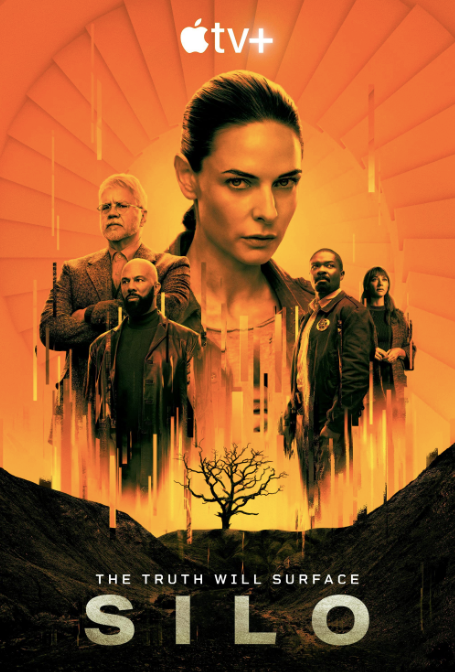
I'm reviewing episodes 1.6 and 1.7 of Silo together because they're very closely related, and revolve around two themes: the book and the water.
[Spoilers ahead ... ]
Episode 1.6 has Juliette discovering and devouring a relic that provides a key piece of the hidden truth: a book, with pictures of the outside world, including, especially, the ocean. Being on Cape Cod, this immediately resonated with me. There's truth indeed in any big body of water, and especially when the reader is living in a silo. And there's a whole tradition in our off-screen world of books being conveyors of repressed truths, ranging from Station Eleven to, of course, 1984. Silo has echos of 1984 already, and you can add that great dystopian novel to Westworld (listen to the music in Silo), a dystopian television triumph, until its final season.
And in episode 1.7 Juliet briefly rescues Gloria, who gave that book to George's mother, who in turn gave it to her son. The episode is entitled "The Flamekeepers," and that's who Gloria and George's mother were. And now -- as Gloria tells Juliette -- Juliet is their standard bearer.
The heroes and villains are this story are slowly coming into focus. In addition to everyone who went outside to clean, and now Juliet, there are few others willing to buck what we would today call this fascist regime. Bernard seems to be a good guy, and by and large, even Juliet's father, at least in things concerning his daughter's wellbeing. Billings could wind up being a good guy, but that's pretty much it. Sims, wherever his ultimate loyalties may reside, is so far a reliable agent of deceptive government.
But we still know precious little about that -- who they are, and what they ultimately want. I'm looking forward to more of that become clear in the concluding three episodes of this season, and in seasons ahead of this provocative series.
There couldn't be a better time to see The Man in the High Castle - actually, any time would be great - but recent events make this weekend an especially chilling and resonant time to see the 10-part television series on Amazon, based on the Philip K. Dick justifiably lionized novel of the same name. The United States and the civilized world are involved in a 21st century version of a world war, this time against DAESH aka ISIS, with the latest atrocity committed in France last week; Donald Trump is calling for registration of Muslims in the United States, a move that recalls how Nazis began their persecution of Jews; and DAESH regularly releases videos which show what they expect to be doing to the world in the near future.
The Man in the High Castle debuted its pilot in January of this year, and I thought it was superb. My review is here. I found the rest of the season in some ways better than the pilot, in a few ways not as good, but altogether also superb and deserving of being called a masterpiece.
Since this isn't a comparative media paper, I won't get into the differences and similarities between the novel and the television series,* other than to say there indeed significant differences and similarities, I liked most but not all of the changes, and you can 100% enjoy the television series without having read the novel, if that's what you'd like to do.
Germany and Japan winning World War II and splitting up the United States remains a brilliant alternate history tableau, as is the peek into the alternate reality of that alternate reality in which we won after all - i.e., the reality which you and I inhabit. The attention to alternate reality detail is riveting, ranging from 1962 American hit records sung in Japanese in San Francisco, to the Nazi celebration of "VA Day" as in a nightmarishly twisted 4th of July, firecrackers and all, at the Long Island home of Obergruppenführer John Smith, well played by Rufus Sewell (Alexa Davalos was also especially good as Juliana, as was Cary-Hiroyuki Tagawa as Tagomi - and Rupert Evans was strong as Frank, so was Luke Kleintank as Joe - there wasn't an off-key note in any performance, even the minor characters were memorable). The palpable impact of these details is more than enough to make you suspend your disbelief and contemplate how profoundly horrendous it would have been had we lost the war, and those words don't even scratch the surface. Any American who isn't shaken to the core by these details has ice water in his veins.
There are lots of unexpected but motivated twists in the plot, which works well on both the macro and micro levels. The tension between Germany and Japan - worried about the Nazis now dropping the a-bomb on them - provides a plausible backdrop to the narrative. Germany is more advanced than Japan - with not only atomic weapons but rocket passenger planes - and this flows logically out of the technological sophistication in our own reality.
But the ultimate backdrop and mystery is the source and content of the newsreels that everyone - including an aged Hitler (played by Wolf Muser, who looks an aged Peter Graves) - is intent on getting in their hands. The source is not revealed, and the content ...
Well, it starts off showing the Allies winning the war (what the book does in the novel - I'm making just this one comparison), with the implication that ours is the more prime reality, a very cool Philip K. Dick ingredient. But the newsreels morph into a selection of alternate realities - also interesting in its own way (and disturbingly reminiscent of what Donald Trump has been saying about seeing videos of Muslims in Jersey City cheering as the Twin Towers fell on 9/11, which didn't happen in our reality).
And, in the end of The Man in the High Castle-- well, that's the part - the very end - which I thought was not too good, and not really explained, and even could be interpreted as everything we've seen in the narrative being a given character's bad dream. But see it yourself. Whatever you think of the ending, you'll be treated to what has set a standard for alternate reality brought to television, in the same way the novel did that for alternate reality in writing.
Hats off not only to Philip K. Dick, but Frank Spotnitz, who created the series - and presented a visual tableau in many ways evocative of Hitchcock - and Ridley Scott, one of the executive producers, who even put in an origami-making character, a nice shout-out to his other masterwork, Bladerunner.
*Ok, here's a very significant difference between the novel and the television series - which is actually the second comparison I'm making, if you've read this far in the review and are keeping track. In the book, the alternate history which is our reality is told in a book - a secret book, like Goldstein's in 1984 (and this device in the Philip K. Dick novel was likely inspired by Orwell's). In the television series, however, the alternate histories which start as ours are in movie reels - news reels - and this gives them a chilling verisimilitude, especially when the characters themselves begin appearing in them near the end. Seeing yourself in a newsreel, doing things you didn't do, or didn't do yet, is the ultimately effective way of telling an alternate history narrative. (Read here for further analysis, with spoilers.)
What if the Soviet Union had survived into the 21st century
I was interested enough to see the first episode of Person of Interest. It's Minority Report (an operation identifies crimes before they're committed, and tries to stop them), Medium (sees the future), Mission Impossible (you know what that is), a bit of 1984, and a few other touches all its own. I liked it a lot.
Michael Emerson (Ben from Lost) is one of the major characters (Finch) who is so much like Ben (Finch even gets roughed up like Ben) that it could have been Ben, but that's ok, because Ben was one of the more fascinating, provocative characters on Lost. Here he plays a computer genius who built a device, in the aftermath of 9/11, that could track potential terrorist attacks, with a view towards our government's intercepting them. An unintended consequence is that this special super-computer could also ID potential non-terrorist crimes like individual murders and kidnappings. Ben - sorry, Finch - built a back-door to his program, and he's determined to stop as many of these one-on-one crimes as possible. Not as easy, of course, as it sounds, and complicated by the fact that the computer program cannot be sure whether the person of interest it identifies is the victim or the perpetrator.
Finch needs eyes in the field. Not only only eyes, but moves that can stop the crimes. He's not government, but he has plenty of money, he's off the grid, and he's in the market for a James Bond kind of agent. That's where Reese comes in, played by James Caviezel (who was excellent in another science fiction story, Frequency, one of the best communication-back-through-time movies ever made - in fact, the best). My Mission Impossible reference gets to the complexity of Reese's assignments, and 1984 points to our government still watching all of us through Finch's massive computer and its omnipresent lenses.
The premiere was good, the show has potential, and I'll keep watching it. I'm always a sucker for stories about the government watching me. And, hey, J. J. Abrams - one of the executive producers - has done some pretty good previous work with Felicity, Alias, Lost (except for the ending, which I don't think was his fault), and Fringe.
"Sierra Waters is sexy as hell" - curled up with a good book
Enjoy listening to audio books? Get a free audio book copy of The Plot to Save Socrates - or any one of 85,000 other titles - with a 14-day trial membership at Audible.com ...
My latest book, New New Media,
was published by Penguin Academics on September 5, 2009. As I point
out on the first page, the book is about media so new that some of them -
such as Twitter and YouTube - did not even exist five years ago. I
wrote the book as close to the bone of current events as possible. The
use of Twitter by protestors in Iran in June 2009, for example, is
prominently included in the book's Twitter chapter.
But I turned the book's final revisions into the publisher in July,
and the pace of important developments in the world of media has of
course not slackened in the slightest. This blog post is the first of a
running series I will be posting here, there, and everywhere about
these newest of new developments.
One of the most significant of such developments occurred in
mid-July, when Amazon abruptly reached into the Kindles of every Kindle
owner and removed George Orwell's 1984, which Amazon said it discovered
it did not have the legal right to sell. Kindle owners and the online
world at large were furious, especially because annotations which Kindle
owners had made on their purchased copies of 1984 were removed with the
book. If Amazon had wanted to demonstrate that the Big Brother
information control in 1984 was alive and kicking in our digital age, it
could not have put forth a better example.
Amazon founder and CEO Jeff Bezos soon apologized,
calling its solution to the copyright problem "stupid, thoughtless, and
painfully out of line with our principles." Amazon offered to either
refund the $30 which the Kindle edition cost, or re-delver the copy of
1984, along with any absconded annotations.
But this series of events provides an instructive example of the
difference between new media and new new media, which I discuss
throughout the book. "New" media exist on the Web, alongside of new new
media. But "new" media often operate in accordance with older,
top-down principles of information control. In the case of a newspaper
online, such as The New York Times, the older approach is manifest in
the selection of stories by editors. In true new new media, stories
are selected and even written by readers - that is the case in any
personal blog. In the case of iTunes and Amazon, consumers are charged
for the content. In new new media such as Twitter and YouTube, the
content is free.
Amazon took a huge step into the past by not only charging for its
Kindle books, but removing one of them after it had been purchased.
Its apology was certainly welcome. But the lesson endures that there
is a very big difference between older ways of doing business on the
web, and the newer more liberated ways of new new media.



 There couldn't be a better time to see The Man in the High Castle - actually, any time would be great - but recent events make this weekend an especially chilling and resonant time to see the 10-part television series on Amazon, based on the Philip K. Dick justifiably lionized novel of the same name. The United States and the civilized world are involved in a 21st century version of a world war, this time against DAESH aka ISIS, with the latest atrocity committed in France last week; Donald Trump is calling for registration of Muslims in the United States, a move that recalls how Nazis began their persecution of Jews; and DAESH regularly releases videos which show what they expect to be doing to the world in the near future.


