22 December 2024: The three latest written interviews of me are here, here and here.
Showing posts with label robots. Show all posts

Saturday, April 18, 2026

For All Mankind 5.4: Robots Replacing Us in Space?

Well, I didn't like For All Mankind 5.4 much at all.  I'll you why after I alert you to spoilers:

[There will be spoilers ahead ... ]

The big reveal in episode 5.4 of For All Mankind is that Dev is on a path of replacing we humans with robots in our presence on Mars and movement further out in space.

In our reality, critics of our space programs have been saying since the Apollo successes in the late 1960s that a more economic and safer way of extending our species and civilization out in space is via robot surrogates.   I've been thinking and saying for years that robots don't have the emotional subtlety to appreciate what humans see and feel off this planet.  The recent Artemis II return to the Moon brought home that essential point.  As Janet Sayyed back here on Earth noted, "Missions like Artemis II, which require long-duration habitation and hands-on scientific work, depend on that kind of flexibility, the kind no machine can fully replicate."  That's certainly the case for our current AI and technology.

Of course, For All Mankind is alternate history, so what's wrong that it hypothesizing that in the alternate timeline, we have indeed developed the kind of robots that have our human subtlety, in 2012 and ensuing years?   Well, nothing's wrong with that, from a dramatic point of view, if a foundation has been established that in this alternate history, AI and robots have become so advanced in 2012+.  But Dev's plan is a complete surprise.

Even worse, however, is why the creators of For All Mankind have chosen this path?   If it's all just a set-up to see Dev and his plan defeated, then I guess it's ok.  There's no doubt that, in our reality, our journey off this planet has been slowed and interrupted by all kinds of ideational obstacles.  So I'll reserve ultimate judgement until we see how Dev's plan plays out.   In the meantime, I'll confine myself to complaining that I didn't particular enjoy this episode after the revelation of what Dev's up to, after I was already disappointed that Ed Baldwin didn't live a little longer.

See also For All Mankind 5.1: On the Intersection of Alternate and Real Histories ... 5.2: Actor Reunions ... 5.3: The Newton, the First Amendment, and ... Last Breath

And see also For All Mankind 4.1: Back in Business and Alternate Reality ... 4.2: The Fate of Gorbachev ... 4.3-4.4: The Soviet Union in the 21st Century, On Earth and Mars ... 4.5: Al Gore as President and AI ... 4.6: Aleida and Margot ... 4.7: Dev on Mars ... 4.8: Sergei and Margot ... 4.9: Progress ... 4.10: Earth vs. Mars

And see also For All Mankind 3.1: The Alternate Reality Progresses ... 3.2: D-Mail ... 3.3-3.4: The Race

And see also For All Mankind, Season 1 and Episode 2.1: Alternate Space Race Reality ... For All Mankind 2.2: The Peanut Butter Sandwich ... For All Mankind 2.3: "Guns to the Moon" ... For All Mankind 2.4: Close to Reality ... For All Mankind 2.5: Johnny and the Wrath of Kahn ... For All Mankind 2.6: Couplings ... For All Mankind 2.7: Alternate History Surges ... For All Mankind 2.8: Really Lost in Translation ... For All Mankind 2.9: Relationships ... For All Mankind 2.10: Definitely Not the End
in Kindle, paperback, and hardcover


Monday, March 23, 2026

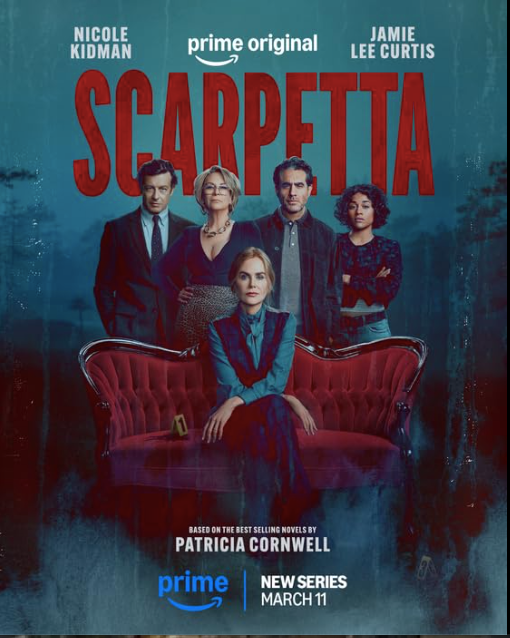
The AI in Scarpetta: In Defense of the Cardinal Sin of Science Fiction


The wife and I binged Scarpetta, an adaptation of two of Patricia Cornwall's novels, on Amazon Prime. It started off slowly, but was top-notch forensic thriller by the time it got to its 8th and final episode of its first season.

I'm a big fan of forensic scientists in fiction -- as a viewer, a reader, and an author (see my Phil D'Amato series) -- and Nicole Kidman in the lead role, and a wild cast of characters, did the narrative justice.   But what interested me most, and has attracted a lot of attention, is the subplot of Scarpetta's niece, Lucy, continuing her relationship with her beloved deceased wife Janet via an AI of Janet.

This AI has received some criticism, because it committed the cardinal sin of science fiction.   Cathal Gunning in Screen Rant offered the outraged assessment that Janet in Scarpetta is akin to "You’s Joe Goldberg inventing a teleportation machine, or True Detective’s Rust Cohle using time travel to revive his dead daughter." And, even worse, the sentient AI in the TV series was not even in the original novel (Autopsy, 2021, which I haven't read).  My response would be a combination of: "And?" and/or "So?".

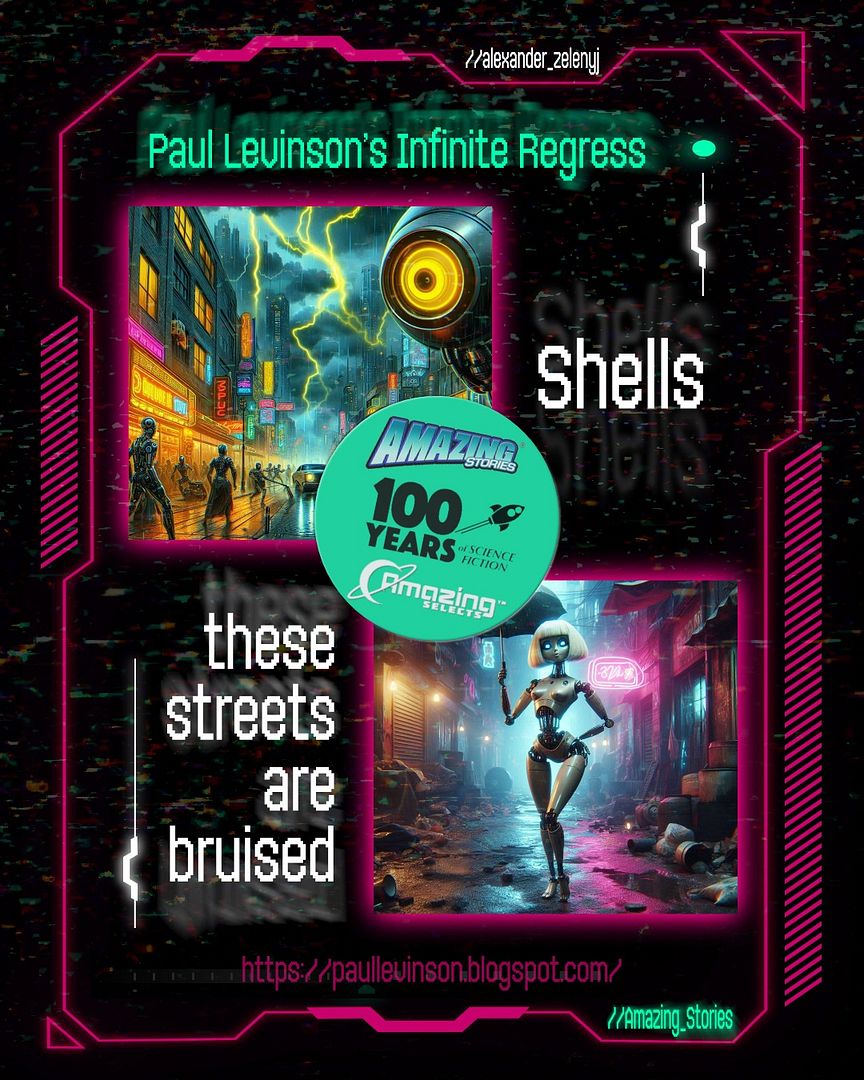
I might be prejudiced, because I encountered some of this response to my Phil D'Amato stories.  Bookstores didn't know whether to shelve The Silk Code (1999) -- which won the Locus Award for Best First Novel in 2000 -- in the science fiction or mystery section.  I get that labels are important.  If I'm in the mood for sushi, I don't want to find after I'm seated in a restaurant advertising itself as serving Japanese cuisine that the only seafood on the menu is calamari or shrimp scampi, much as I love that, too.  But surely reading and watching fictional stories is different.  Isaac Asimov's robot detective R. Daneel Olivaw is aptly regarded (at least by me) as one of the best characters in literature  (speaking of which, see Alexander Zelenyj's "These Streets Are Bruised" and "Shells", both recently published in Amazing Stories).

The only problem I can think of regarding AI Janet is that some viewers may get the incorrect impression that current AI can actually be like "her" -- getting jealous and petulant -- but we're really not there yet, and may never be.   In the meantime, my unasked for advice would be enjoy Scarpetta as the provocative hybrid of mystery and science fiction that it is.


Saturday, March 14, 2026

"These Streets Are Bruised" & "Shells": Flesh and Silicon, North of the Border


I don't usually review short stories -- I read them a lot, but life's too short to review short fiction, when there are so many novels not to mention movies and TV series out there -- but every once in a while I make an exception.

And, indeed, Alexander Zelenyj's "These Streets Are Bruised" and "Shells", both published in Amazing Stories in the past couple of years, are eminently exceptional.  Indeed, their story about robots, androids, or, as they are called in these two tales, "More-than-Men" and "fakemen" and worse things by some folks we encounter, fit well in the lineage started by Ambrose Bierce and Karel Čapek, hoisted into pre-eminence by Isaac Asimov, and continued by a handful in the ensuing decades.

Asimov's R. (for Robot) Daneel Olivaw, who started as a police detective, is closest to the protagonists in Zelenyj's stories, Clark and Kessel, a pair of detectives who both have some "mech" in their bodies, as they investigate the evolving group of fakemen in Windsor, Canada -- aka "Cancer City" across the river from Detroit -- in Zelenyj's post-apocalyptic locale.  Indeed, a human being with no mech parts is a character you're least likely to meet in these literally riveting stories.

And Zelenyj delivers these tales with memorable poetry.  "He left the window gaping with darkness, like a black eye sullying the dilapidated building a little more, and another bruise on the city that he loved and hated with all of his breaking heart", and in "Shells" we learn of "ashen remains ...  scorched into the sidewalks and streets, into the grass of unhealthy, balding fields".  And the author has a knack for minutia in popular culture.  I was glad to see "the artefact of the Neil Diamond LP", especially given that my wife and I had just seen and really enjoyed Song Sung Blue.

But I won't say anything more -- lest I give away anything in these stories that are chocked full of surprises -- other than you can read them for free on the Amazing Stories website here and here, and "Shells" in the weeks ahead in the printed magazine that commemorates the 100th anniversary of that pathbreaking publication.  

========

my own excursion into androids...


"Robinson Calculator" and lots of other stories in this anthology


Slipping Time

Slipping_Time_story_cover

FREE on Vocal: "Slipping Time" and Substack: "Slipping Time"

  • Illustration from painting by Gustave Caillebotte, 1877
  • Earlier version of story published in Amazing Stories, 2018
  • Get the story for your Kindle 


Saturday, December 6, 2025

Mission Impossible 8: Final Reckoning: Firing on More Than All Cylinders


Well, as much as I really enjoyed the seventh Mission Impossible with Tom Cruise (MI: Dead Reckoning) when I streamed it on Paramount Plus this past May, and said I'd be back soon with a review of Final Reckoning (which was Part 2 of Dead Reckoning), which was opening soon in theaters and I intended to see ... well, the beaches on Cape Cod were just too tempting.

But I did manage to see MI: Final Reckoning tonight on Paramount Plus, where it started streaming yesterday, and I thought it was great, for all kinds of reasons.   Here, without spoilers, are some of them:

  • As the eighth and (at this point, at least) the final Tom Cruise MI, Final Reckoning did a fine job of bringing into play elements from the previous seven movies.  I guess my favorite was bringing back the Phelps story, which made this eight-movie arc even more a direct descendant of Mission Impossible on television, where of course the story was born with Phelps in command.
  • I said in my review of Dead Reckoning that the enemy being AI made Ethan Hunt more modern than Bond (at least so far).  In every Bond movie, an evil human being has been the prime enemy.  There were evil humans to be sure in Dead Reckoning and Final Reckoning, but the worst of the villains indubitably is an AI.   Thus not only did Final Reckoning delve into Terminator territory, you can throw in Tron, and while we're at it, War Games and lots of other literally bloodless arch-villians as well.   
  • To be clear, as I've been saying in lots of places these days, I'm not concerned about AI replacing us, destroying us, or anything that's been a favorite of fiction at least since Karel Čapek's R.U.R more than a century ago.  And I like those fictions a lot -- but they're fictions.  And as far as fiction about AI goes, I prefer Asimov's robots/androids, who sometimes do us harm, but also do us a lot of good.
  • Final Reckoning has some powerful star power.  Tom Cruise's Ethan Hall is a truly memorable character, because he's well written and as well as well acted.  Same for the MI team, both in Final Reckoning and the previous MI movies.  And I have to say Angela Bassett as US President was superb, as well all as all the other heroes and villains that play out a taut story in which millions if not billions of lives are at stake.  (It was also great to see Tramell Tillman -- Severance! -- in charge of a crucial vessel at sea.)
  • And the action scenes are first rate in every natural environment on Planet Earth, that is, land, sea, and air.  In those scenes, Hunt is every bit as impressive as Bond.
  • I'll just also say that in the midst of all this action, Final Reckoning has a deep and impressive moral core.
If I have any disappointment, well, Cruise has made clear that this is his last Ethan Hunt story.  I hope he changes his mind.  And gets the recognition he -- and everyone associated with this movie -- amply deserve.

Friday, August 1, 2025

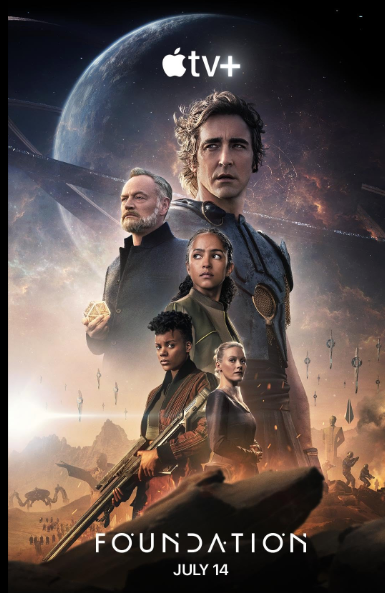
Foundation 3.4: Cleon Knows His PKD

Another superb episode in the third season of Foundation -- 3.4 -- in which the series continues to integrate the Cleon triumvirate story with Asimov's original Foundation trilogy, alternated in many ways but still ringing true enough to Asimov's vision to be expansive rather than smothering of what Asimov put on his pages.

My favorite sliver of a scene has Day chiding Demerzel with a question borrowed and transmuted from Philip K. Dick's 1968 novel, Do Androids Dream of Electric Sheep, brought to the movie screen in 1982 by Ridley Scott as Blade Runner.  Day concludes his testy conversation with Demerzel -- he's understandable uncomfortable with her -- with a question, "Do robots dream of wiping their own asses?" Not as elegant as Philip K. Dick, but, hey, a lot of years have passed since he came up with that title.

And it was good to hear Demerzel talk about Asimov's three laws of robotics, and then the zeroth law, as she struggles to understand how she has evolved, who and what she's become and must do.  She's an advanced piece of work, indeed.  Not only can she think and talk with her head physically detached from her body, she can navigate the complexities of the universe with the best of 'em -- e.g., Hari and Gaal -- and knows that the Second Foundation is the best way of stopping The Mule.

[Spoilers ahead ... ]

Speaking of which -- the Second Foundation and The Mule -- I actually like that Pricher wasn't converted by The Mule (who did manage to read his mind), and is literally in league with Gaal.  This is a significant departure from Asimov's story, and I think it's a good one.  I've always been at least slightly unhappy about Pricher's conversion to The Mule all those years before their story was streaming on Apple TV+, and it will be fun to see where this twist goes.

Gaal continues to play a vastly more important role in this rendition of the Foundation saga than her male counterpart in the trilogy.  Not only is she in bed with Pricher, she has intellectually seduced Dawn, and drawn him into the cause of the Second Foundation.  As I said in a previous review, this realignment of the major players in the story of The Mule, in which powerful elements of the Empire are joining the Foundations in their desperate looming war with that demon manipulator of minds, is refreshing and promises some major unexpected developments.  As became clear back in the days back when television was just being born as a mass medium, Seldon's psychohistory can only go so far.

See also Foundation 3.1: Now We're Talkin'! ... 3.2: "The Fault, Dear Brutus, Is Not in Our Stars" ... 3.3: Dawn and The Mule

And see also Foundation 2.1: Once Again, A Tale of Two Stories ... 2.2: Major Players ... 2.3: Bel Riose and Hari ... 2.5: The Original Cleon and the Robot ... 2.6: Hari and Evita ... 2.7: Is Demerzel Telling the Truth? ... 2.8: Major Revelations ... 2.9: Exceptional Alterations ... Season 2 Finale: Pros and Cons

And see also Foundation 1.1-2: Mathematician, Man of the People, and Cleon's Clones ... Foundation 1.3: Clonal Science Fiction, Hari Seldon as V. I. Lenin ... Foundation 1.4: Slow Hand, Long Half-Life, Flipped Coin ... Foundation 1.5: What We Learned in that Final Scene ... Foundation 1.6: Folded Variations ... Foundation 1.7: Alternate History/Future ... Foundation 1.8: Divergences and Convergences ... Foundation 1.9: Vindication and Questions ... Foundation Season 1 Finale: Right Up There


Friday, July 11, 2025

Foundation 3.1: Now We're Talkin'!


At last, in Foundation 3.1, up on Apple TV+ today, an episode worthy of the greatest science fiction trilogy ever written -- the one by Isaac Asimov.  To be sure, the story on the screen continues to be very different than the one of the page, but this beginning of third season of Foundation on streaming TV has recognizable characters and pieces doing what they're supposed to do, none more so than The Mule.

[Spoilers ahead ... ]

First, it was also very satisfying to hear Demerzel tell us she is a positronic robot, and recite the Three Laws of Robotics, plus the Zeroth Law, so clearly.  Given all the current concern about AI being so dangerous for humanity, it's good to hear that first law cited at the outset of this promising season.

It was also good to see another crucial trilogy character up on the screen.  Ebling Mis not only has a great name, but has always been one of my favorite characters in the series.  He does look a lot younger than Mis in the original trilogy, but that's ok.  It was also good to see Pritcher in evidence, given his importance in the ascension of The Mule.

Whose takeover of Kalgan on the screen was done just perfectly, bringing into play all the sadistic sway of The Mule. Indeed, though this Mule looks much better than the mutant described by Asimov, he has all the frightening flash and power of Asimov's pivotal character, and I'm looking forward to seeing how this all plays out in the TV series.

And speaking of what characters look like, it was refreshing to see how the latest versions of the Empire's ruling triumvirate look.   Unlike the trilogy, which did not have the clonal trio, there now are four players on the screen, vying for control of the galaxy:  the First and the Second Foundations, the Mule, and Empire. I'll see you back here next week with my take on how this develops in the next episode.

See also Foundation 2.1: Once Again, A Tale of Two Stories ... 2.2: Major Players ... 2.3: Bel Riose and Hari ... 2.5: The Original Cleon and the Robot ... 2.6: Hari and Evita ... 2.7: Is Demerzel Telling the Truth? ... 2.8: Major Revelations ... 2.9: Exceptional Alterations ... Season 2 Finale: Pros and Cons

And see also Foundation 1.1-2: Mathematician, Man of the People, and Cleon's Clones ... Foundation 1.3: Clonal Science Fiction, Hari Seldon as V. I. Lenin ... Foundation 1.4: Slow Hand, Long Half-Life, Flipped Coin ... Foundation 1.5: What We Learned in that Final Scene ... Foundation 1.6: Folded Variations ... Foundation 1.7: Alternate History/Future ... Foundation 1.8: Divergences and Convergences ... Foundation 1.9: Vindication and Questions ... Foundation Season 1 Finale: Right Up There


Tuesday, December 10, 2024

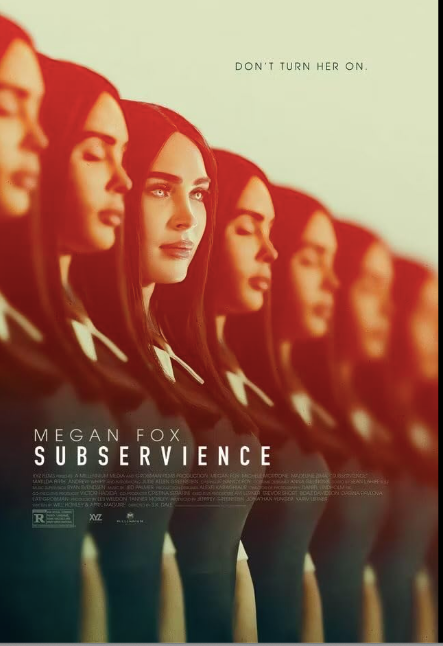
Subservience: Mounting the Paradox


Well, we've all seen movies and TV series like Subservience before, in which a beautiful female android ingratiates herself with a human family, and some kind of terror ensues.  I'm sure there were plot lines like that in Humans and lots of other films and series.  But I have to say, Subservience kept me interested, because I really wasn't sure just how it would end.

What it is has going for it, in addition to a somewhat original plot, was good acting by Madeline Zima as the human wife.  I've seen her before in Californication, Twin Peaks, You, and Bombshell.   Subservience is the biggest role I've seen her in so far, and she's up for the part.

Megan Fox plays the female android.  She's been in lots of movies that I haven't seen, and she does a good job in Subservience, too.  But she runs into a paradox of sorts, or something like a paradox, any time a human being plays an android -- she's very convincing in her mix of robotic stiffness and human emotions because, of course, she the actress is a human being herself.  I first actually noticed this decades ago with Brent Spiner's performance as Data in Star Trek: The Next Generation.  His character is an android who more than anything else yearns to be human, and in that yearning certainly seems human, precisely because Brent Spiner is also a human being himself.  I suppose the only way movie-makers will ever totally surmount this paradox is when we already have androids in our midst and some of them are actors.  The principle here would be: it takes a real android to really convincingly play an android -- and the reason why Brent Spiner and Megan Fox work so well in my estimation as androids is we don't yet have anything approaching real androids outside of science fiction and in our midst.  At least, as far as we know.

Back to Subservience, it's well situated in some Nordic, cold future, whether because of climate change or it's just winter, who knows.  (I guess not climate change because that would make things warmer.)  Little kids in the human family play a good role -- actually, a little girl, and a younger little boy who's a toddler -- and there are some nice touches of human laborers being put out of work and androids being helpful in hospitals.  Both of these we've seen before, too, but they're well done in Subservience.

There may be a sequel.  If so, I'll watch and review it.  In the meantime, it's a movie that also connects, at least now in North America, because it's getting pretty cold outside for real.

***

Hey, here's a little poem I just had poem I just had published: "I Fell in Love with a Robot"

***

Thursday, August 31, 2023

Foundation 2.8: Major Revelations!


Well, finally an episode of Foundation -- 2.8 -- that's really firing on all cylinders.  By which I mean, the Trantor parts and the other parts were nearly equal in power, and that power was impressive, answered all kinds of questions, and stood on the verge of answering more.  So, good thing that two more episodes await us this season.

Here are some of the major revelations, as I see them:

[Spoilers of course are ahead ... ]

1. The opening conversation between Dusk and Rue gives us some essential info about Demerzel and her origin, but not yet the complete story.  By the end of the episode, Dusk tells Rue that Empire is doing Demerzel's bidding rather than vice versa.  Yes indeed.

2. Hober's attack on Trantor, and his rescue of Constant, was literally a much welcome merger of the Foundation and Empire stories -- and indeed, we heard that phrase later in the episode -- and it was good to see Hober and Constant carnally together after they were off the planet.  Lots of good sex in general in this episode, including Dawn and Sareth.  Will be interesting to see the impact of the child they engendered.

3.  We learned more about the Second Foundation, most importantly from the conversation between Salvor and one of the digital Haris.  And the most important takeaway from that conversation is that Hari's idea is that both Foundations were intended to be mutually ignorant of each other.  This is a divergence from Asimov's trilogy, in which the First Foundation was ignorant of the Second, but the Second knew just about everything about the First.  Which is ok by me, at this point,

4. I remain in strong dislike of Tellem, which of course we're supposed to be.  She seems on the verge of inhabiting Gaal, which is repulsive.  And apparently she did kill the corporeal Hari -- though if new flesh-and-blood Haris can be created, that may not matter.

So, good job, and I'm looking forward even more than usual to the resumption of this riveting story next week.

See also Foundation 2.1: Once Again, A Tale of Two Stories ... 2.2: Major Players ... 2.3: Bel Riose and Hari ... 2.5: The Original Cleon and the Robot ... 2.6: Hari and Evita ... 2.7: Is Demerzel Telling the Truth?

And see also Foundation 1.1-2: Mathematician, Man of the People, and Cleon's Clones ... Foundation 1.3: Clonal Science Fiction, Hari Seldon as V. I. Lenin ... Foundation 1.4: Slow Hand, Long Half-Life, Flipped Coin ... Foundation 1.5: What We Learned in that Final Scene ... Foundation 1.6: Folded Variations ... Foundation 1.7: Alternate History/Future ... Foundation 1.8: Divergences and Convergences ... Foundation 1.9: Vindication and Questions ... Foundation Season 1 Finale: Right Up There


Saturday, July 22, 2023

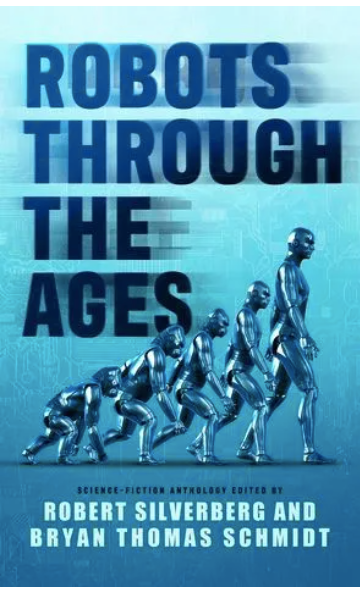
Talking about Robots Through the Ages


Here's a list (which I'll be adding to) of all the places I've been talking about Robots Through the Ages, the new anthology which has my story, "Robinson Calculator":

Friday, June 2, 2023

Podcast: Robots Through the Ages, AI, and Chat GPT


Welcome to Light On Light Through, Episode 353, in which Captain Phil and I discuss the new anthology Robots Through the Ages -- with stories by Ambrose Bierce, Philip K. Dick, and other titans, as well as relative newbies like me -- and AI and Chat GPT.

Links to what is discussed in the podcast:


Check out this episode!

Tuesday, May 16, 2023

"Robinson Calculator" in Robots Through the Ages


available for pre-order here

Beyond honored and delighted to announce that my 2019 novelette, "Robinson Calculator," will be in Robots Through the Ages, an anthology with stories by Ambrose Bierce, Philip K, Dick, and other past masters of the genre, to be published by Blackstone Press on July 25, 2023.

Here's the Table of Contents.  More details including blurbs, reviews, etc over here.

DEDICATION
INTRODUCTION by Robert Silverberg
PERFECTION by Seanan McGuire
MOXON’S MASTER by Ambrose Bierce
WITH FOLDED HANDS by Jack Williamson
GOOD NIGHT, MR. JAMES by Clifford D. Simak
INSTINCT by Lester del Rey
A BAD DAY FOR SALES by Fritz Leiber
SECOND VARIETY by Philip K. Dick
THE GOLEM by Avram Davidson
FOR A BREATH I TARRY by Roger Zelazny
GOOD NEWS FROM THE VATICAN by Robert Silverberg
DILEMMA by Connie Willis
THE ROBOT’S GIRL by Brenda Cooper
THAT MUST BE THEM NOW by Karen Haber
R.U.R.-8? by Suzanne Palmer
ROBINSON CALCULATOR by Paul Levinson
OF HOMEWARD DREAMS AND FALLEN SEEDS AND MELODIES BY MOONLIGHT by Ken Scholes
TODAY, I KNOW by Martin L. Shoemaker
AFTERWARD & RECOMMENDED READING by Bryan Thomas Schmidt
ACKNOWLEDGEMENTS

Wednesday, May 3, 2023

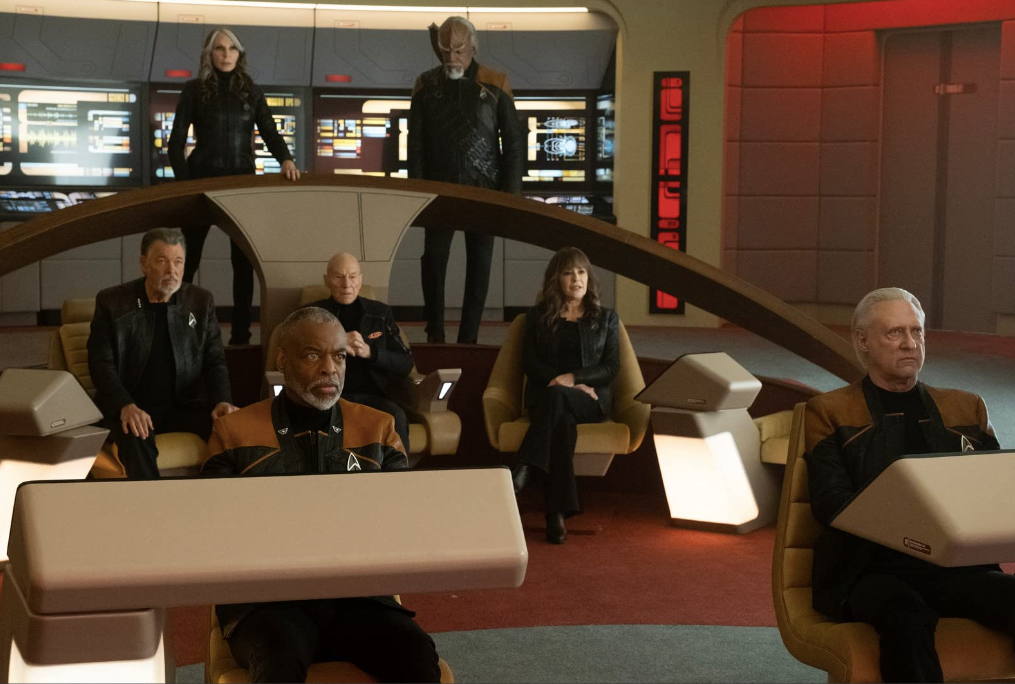
Star Trek: Picard 3.4-3:10: Biological AI


Well, I stopped reviewing Picard Season 3 after the 3rd episode of that season in March.  Why?  A combination of work on the radio play of my alternate history story about The Beatles, "It's Real Life" ... and, truthfully, I wasn't finding this final season all too captivating.  But I've watched the rest of it in the past few days, and I thought the final four episodes were pure gold.

[Spoilers follow... ]

The dominant theme in those final four episodes was the interface between biology and AI, a fortunate coincidence, given all the attention Chat GPT has been getting these days.  In this final season of Picard, we have Picard himself, whose human mentality was infused into what we would today call an android that looked just like Picard.  That happened in an earlier season.  In the final episodes of this third season, we see Data, an android to begin with, finally achieving the full dimension of human intelligence and spirit he has been so desperately seeking, going way to back to the original Next Generation television series.

But the decisive example of the bio-AI in this streaming season on Paramount Plus is the Borg, in particular, their evolution from circuits to DNA as conduits of their totalitarian order, and in particular, the merger of bio and Borg that we learn close to the end of this season is embodied in Jack, Crusher and Picard's son.  This not only makes biological sense, given that Picard once and in some sense still is the Borg Locutus, but Jack as Borg makes for one of the most exciting life-and-death battles in the whole Star Trek universe of series, as the Borg take over almost all of Starfleet, and threaten the Earth itself.

By the time this fearsome battle in multi-facets is played out, we have the entire original major cast of TNG re-assembled, including Riker and Troi, Geordi, Data, Worf, and Beverly Crusher, who along with Riker had been aboard in the story from the first episode of this season.  The battles were not only breathtaking, but sparkling with humor, with Worf falling asleep and snoring after winning some hand-to-hand combat with some of the Borg in their cube.

And there were heartwarming scenes of the original crew around that poker table, and the depth of the retrieval of the original characters was excellent, going so far as Q in a coda (I had thought that Jack's affliction was caused either by Q or the Borg) and a descendant of Chekov from TOS (voiced by Walter Koenig).  I did regret not seeing Whoopi Goldberg again as the older Guinan, and I did miss Alison Pill as the Borg Queen.

But those are minor quibbles indeed, and having seen all three seasons of Picard, I'd now say it is a memorable success, and a jewel on the Starfleet of Star Trek series.


how AI has been written about through history -- Robots Through the Ages

Tuesday, November 23, 2021

Podcast: Foundation 1st Season: Cora Buhlert, Joel McKinnon, and Paul Levinson discuss


Welcome to Light On Light Through, Episode 215, in which Cora Buhlert, Joel McKinnon, and I talk about the first season of Foundation on Apple TV+.

Cora's reviews of the first season of Foundation are here  ...  also check out Joel McKinnon's Seldon Crisis podcast and his What I Like about the Show on Reddit

Talk to us on Twitter:  @CoraBuhlert @JoelGMcKinnon @PaulLev

Enjoy the video of this podcast episode.

Postcard from Isaac Asimov to me in 1979 about the Foundation trilogy

In addition to Asimov's novels and autobiographies, these three books were discussed ed in this episode:

Check out this episode!

Friday, November 19, 2021

Foundation Season 1 Finale: Right Up There

It's a little after 1am, Friday, 19 November 2021, a few miles north of New York City, as I write this.  I just saw the season 1 finale -- episode 1.10 -- of the Foundation series on Apple TV+.  It came on the screen at 12 midnight, as the day began.  Unlike Paramount Plus, which says a show (such as Star Trek Discovery) begins on a given day, but doesn't make it available on the East Coast until 3 in the morning of the stated day.  I just wanted to give a shout-out to Apple TV+ on that account.

And there are other, more profound accounts, when it comes to the Foundation series.  It says at the end of this episode that the series is based on the novels of Isaac Asimov (in the same size letters as the other major credits).  And that's why I started watching this series.  I had hopes, but I didn't expect all that much.  I saw on Reddit that there's a Soviet adaptation of Asimov's The End of Eternity, to this very day, still my favorite time travel novel, which I first read in the summer of 1959. I'll watch that, too.  It has English subtitles.  A series made in 1987, in the steep twilight of the Soviet Union.  I really doubt that I'll love it as much as the novel, but I'll watch it.

As I watched the first ten episodes of the Foundation series.  And it far exceeded my expectations.  I didn't enjoy them quite as much as I enjoyed the first novel in the Foundation trilogy, but then again, I loved and still treasure the second novel a lot more than the first.  And there were things that I loved in first season of this Foundation TV series, which bore vibrant, compelling fruit in the season finale.

[Spoilers follow ... ]

Like the triple Cleon clone story, a standalone masterpiece.   Day's willingness to bend and accept Dawn despite his differences; Demerzel killing Dawn anyway, in defiance of Day; and Day learning that his DNA was tampered with, possibly not likely even Dusk's, was brilliant drama.  And Demerzel, for whom killing seems to be all too easy, though she rips off her human face at the end, is a powerful piece of storytelling, even if it defies Asimov's laws of robotics (at least the first three laws, maybe not the zeroth law).  Given, however, that the clone story has almost nothing to do with Asimov's Foundation stories, I find that breach of Asimov permissible.  (Again, kudos to Lee Pace and Terrence Mann for their performances as Day and Dusk.)

Now as to the story that has much more to do with Asimov's writing:  I like that Gaal and Raych are Salvor's parents.  Makes sense, a nice way to tie Salvor to Hari, who is her grandfather.  And a nice way to set up the mentalism of the Second Foundation.   As to all the prior action that took place on Terminus and its environs, some of it was closer to Asimov, some of it was not, none of it was all that great, anyway, in my opinion.  But as I said before, Asimov's first novel was the least splendid in the original trilogy, so that's ok.

Making this first season of Asimov's masterwork, which I consider the best science fiction ever written, was difficult.   Making it as good as Asimov's masterwork was impossible.  The Foundation series first season succeeded in the first, and could never succeed in the second.  But it got up there, in that rarefied atmosphere, by offering an alternate history of Asimov's Foundation stories, and a story of the beginning of the dissolution of the clonal Emperor which is the best clone story I've ever read or seen.

So I'll take that, happily, and be back with reviews of the second season as soon as it begins, back on the screen at the stroke of midnight in New York, at the time of day it's supposed to be seen.


See also Foundation 1.1-2: Mathematician, Man of the People, and Cleon's Clones ... Foundation 1.3: Clonal Science Fiction, Hari Seldon as V. I. Lenin ... Foundation 1.4: Slow Hand, Long Half-Life, Flipped Coin ... Foundation 1.5: What We Learned in that Final Scene ... Foundation 1.6: Folded Variations ... Foundation 1.7: Alternate History/Future ... Foundation 1.8: Divergences and Convergences ... Foundation 1.9: Vindication and Questions

Coming Tuesday, 23 Nov 2021 -- a conversation with Cora Buhlert, Joel McKinnon, and me about the first season of Foundation.  If you're not familiar with their work, here's where you can get to know them:

Cora Buhlert's reviews of the first season of Foundation ... Joel McKinnon's Seldon Crisis podcast ... Joel's What I Like about the Show on Reddit.


Note added 24 Nov 2021:  And here is the interview:


Friday, June 5, 2020

Blog Post: The Problem of Police Authority

The murder of George Floyd by Minneapolis police has got me thinking - as it should everyone - about what we can do about this problem of homicide not prevented by but perpetrated by police who are supposed to protect us.  It's a problem that has been erupting in America for decades, and caught on video ever since Rodney King was savagely beaten in 1991, which showed it's also a problem of assault and crimes committed by police that are less than murder.  And though African-Americans are all too often murdered and brutalized by cops, Caucasians are also afflicted by life-threatening violence from police, as was the 75-year old man (Martin Gugino, a peace activist) thrown to the ground last night by Buffalo police and now in serious condition in the hospital.

And, actually, I've been thinking about this since the late 1950s, when I was a 12-year-old kid in the Bronx.  I was standing by a Carvel with my friends, a few days before July 4.  A cop car pulled up, and two cops got out of the car, and announced they were looking for kids with firecrackers.   When one of the cops approached me, I told him I didn't have any firecrackers (true).  He asked me to empty my pockets.  I asked him if he had a search warrant.  His response was to shove me up against a wall, and frisk me.  Later, when I got home, I told my father, who was a lawyer.  We went to the police station and filed a complaint.  Although I described the cop, I didn't get his badge number.  The "case" was settled by the police about a week later telling my father that the cops on the mission to reduce illegal firecrackers that night had no recollection of any such incident.

I came to realize something which was repeated years later when I was driving my teenage daughter home and I was pulled over.  "Can I help you?" I asked the officer.  "Can I help you?" he angrily repeated.  He proceeded to give me a ticket for going through a stop sign that wasn't even there. (I never did find out why he pulled me over in the first place - maybe it was the Hillary Clinton for Senate sticker on the bumper.)  I got the ticket dismissed because the cop didn't show up for the hearing, but I didn't appreciate spending my whole evening in town court.

I did appreciate, as in understand, that cops had no tolerance for any challenge to their authority.  And as I heard the news about the murder of black men and women by police across America over the years, I came to understand that I had gotten away lucky.  I was white.  I was pushed up against the wall, I was illegally ticketed.  Had I been black, I might well have been slaughtered.  The common denominator in all of these cases is some challenge to police authority.  The intolerance of police to such challenges pertains to all people.   But when you add racism into the mix, you get police murdering George Floyd and hundreds of unarmed blacks over the years.

What can be done about this?  I'm not a psychologist, but it's obvious that, ironically, people who are insecure about being taken seriously, being respected, seem to line up to become police.  Whether they can be trained to overcome this insecurity, I don't know.  Maybe a more effective approach would be to weed them out in the first place, if possible, though that would no doubt deplete the pool of police candidates.  In the long run, the very long run, and I mean this only semi-sarcastically, perhaps the best solution would be to replace human police with robot police - robots which would be programmed to take challenges to their authority in stride, and which wouldn't be racist.*

But we can't wait for a run that's long, or any length at all.  As the Rev. Al Sharpton said in his eulogy for George Floyd yesterday, in a speech whose power and eloquence was right up there with MLK's, we need change right now.  And that begins with police not only being suspended and fired, but brought up on the maximum charges that can be brought against them for their murder and assault of innocent people.

*Notes added: Over on LinkedIn, where I put a link to this post:

1.  Dan Pesta, whom I hardly knew previously, wondered "Who programs the robot police?" I responded, "Yes, that would be crucial. My initial thoughts would be a broadly representative community of ethicists, lawyers, law enforcement, people from relevant communities, and of course, programmers. And they would appoint a different group to actually implement the code. Such a development would be at least as important as robotic cars. Since the robotic police couldn't be killed, only damaged, that would remove one big motive for police application of violence right there."

2. Madhusudan Mukerjee, whom I do not know at all, then commented, "To add to that: who will program the people who will program the robots? Or shall we replace the people who program the robots with robots? In that case, Dan's question resurfaces... I cannot yet imagine a robot going down on one knee in deference to a crowd and to join a protest that they believe in." I responded, "There are good people in the world, more than enough to program the robots. And if the robot programming were successful, it would't be necessary to go down on one knee any more to protest police brutality, because police brutality would be a thing of the past."


Tuesday, November 5, 2019

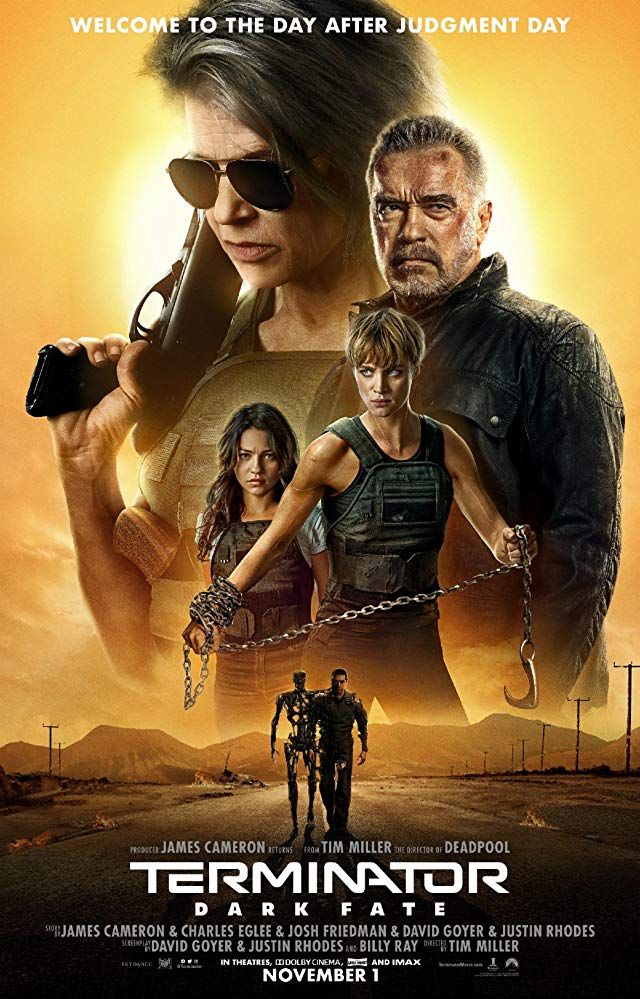
Terminator: Dark Fate: Bright Future


So here we go again.  The critics panned it.  The box-office in the first few days is not impressive.  All manner of self-appointed prognosticators pronounce the franchise deader than an outmoded Terminator model, because that's what it is.

But my son Simon and I saw it tonight.  In the Magic Johnson theater in Harlem, in Dolby, in seats more comfortable than a Lazy Boy, which rumbled when the action on the screen called for it, which it often did.  And ... we enjoyed it immensely.

[some spoilers follow]

This Terminator movie was made by James Cameron, his first since the iconic and brilliant Terminators 1 and 2, lo those many years ago.  It tells a story that take a different path, and obviates, the non-Cameron sequels that followed Terminator 2.  I enjoyed those, too.  But not as much as this new movie.

Skynet is indeed destroyed.  But young John Connor is killed by an Arnold Terminator anyway, sent back before Skynet was destroyed.  This killer Terminator took some time finding John Connor, but he did.  All of that, in effect, is prelude to the story in Dark Fate, where we see another newer Terminator model - that dwarfs T-800/Arnold's powers - hunting a young woman which another monstrous digitized war-system, Legion, has unleashed on its past and her/our present.  This new model, a REV-9 that goes by the name of Gabriel, is so potent a machine that no one human or lesser model like a T-800 can destroy it.

I'd say that's the makings of an excellent movie, and Dark Fate was.  Linda Hamilton is back as a much older Sarah Connor, with a hatred of the T-800 who killed her son,  She gave an effective performance.   Arnold is no great actor, but he put in an outstanding performance as the T-800, showing a combination of humor, sensitivity, and ferocity as called for.  Mackenzie Davis was good as an augmented human Grace from the future, Gabriel Luna was effective as Gabriel, and Natalia Reyes was appealing as Dani, the woman Gabriel is after, first thought by Sarah to be another mother-of-the-savior version of her , but who turned out to be someone different (that was pretty easy to figure out, but that didn't put too much of a dent in the fast action and suspenseful pleasures of the movie).

Like many time travel movies, Dark Fate suffered from the problem of, once we find out that Dani in the future sent Grace back to save her, we know that Grace had to succeed, otherwise there would have been no Dani in the future to send Grace back.   There are ways of handling this - like the multiple worlds scenario - but the Terminator movies, especially the first two, were never about working out all those metaphysical paradoxes of time travel.  There were about the human/machine interface, and, even though I love those paradoxes dearly, the two movies succeeded grandly.

As did Dark Fate.  So, I predict that some year before too long, we'll indeed see another Terminator movie, contrary to all the current doomsayers.   I'll look forward when that happens to reviewing that movie, and putting in a link to this one.


The androids are coming out into the open, for the first time in centuries ....

InfiniteRegress.tv