22 December 2024: The three latest written interviews of me are here, here and here.
Showing posts with label Adolf Hitler. Show all posts

Saturday, October 4, 2025

Applying Marshall McLuhan to Our Current Predicaments


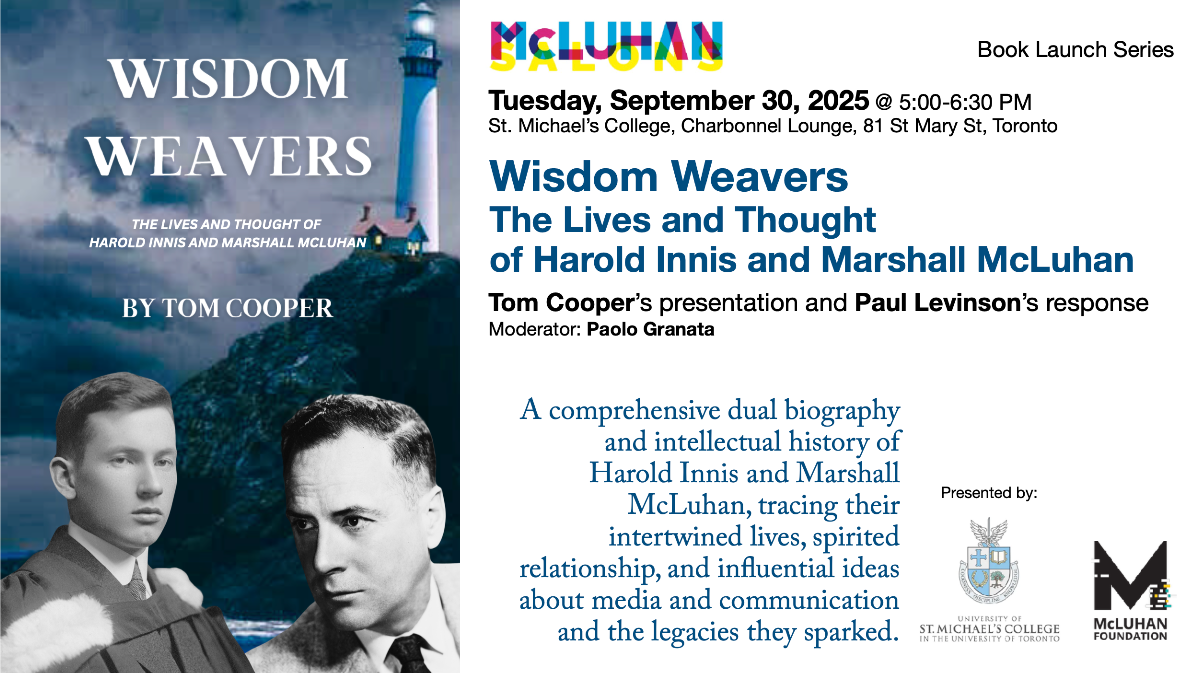
On September 30, 2025 I took part in a McLuhan Salon organized by Paolo Granata in Toronto.  The Salon was devoted to a consideration of some of the many issues Tom Cooper explored in his book Wisdom Weavers: The Lives and Thought of Harold Innis and Marshall McLuhan, published by Connected Editions on May 1, 2025.  The following is a slightly edited transcript of my responses to each of the three sections of Tom Cooper's presentation, in addition to my responses to two subsequent questions raised by members of the audience.  The audience in Toronto was present in-person with Paolo Granata at the event.  Tom Cooper and I attended via Zoom.

Part 1

I've been thinking increasingly in the last couple of years that the work of Marshall McLuhan and Harold Innis has never been more important to our world than it is now. As all of you up in Canada know all too well, the United States is being pulled apart by a President and his supporters, who seem to be happily marching increasingly towards a fascist government. And people who are upset and concerned about that are, among other things that they're doing, desperately struggling to understand how that happened, and what we can do, if we do understand how and why that happened, to stop and reverse that trend.

So, Tom Cooper contacted me in August of 2024 -- it seems now like about 10 years ago, because so much has happened since then -- to tell me about his book, Wisdom Weavers, an intellectual biography of Marshall McLuhan and Harold Innis, which he wanted to get published. By the way, it's worth noting that this book literally has been about half a century in the making, in the writing. And that's something that we all know, that books take a long time to write, and sometimes even longer to get published, but I think most of us can agree that 50 years is a very long time. But that's one of the great strengths of the book. And Tom had been working on this, and has been witness to all of the political upheavals in the United States.

And I have noticed, if you pay any attention at all to the news, in this struggle to understand how we got here -- we being we here in the United States, we being the United States and Canada, we being the whole world -- that increasingly, Marshall McLuhan's name comes up, because most people who understand anything about the history of communications and media, who at all have a sense that what we see and hear on television, listen to on the radio, talk about through our smartphones, and most importantly, what we do now through social media, are also aware that, well, there was this theorist Marshall McLuhan, who talked about a global village. Not in 2012, not in 2002, not in 1992, but way, way back in 1962.

And maybe some of the things that McLuhan talked about, and as we also know, when you delve into the history of Marshall McLuhan as a scholar and as a person, his awareness of and interaction with and reading the works of Harold Innis, maybe, maybe that has something that we can learn from and we can use to help us better contend with these momentous changes.

So when Tom contacted me and told me about his book, I immediately said, well, send it to me. And that very evening as I was reading it, I knew what a crucial gift this would be to our current world as we struggled to make sense of what was going on.

So I don't think that Harold Innis and Marshall McLuhan have ever been as important to the world as they are now, and I think we're very fortunate to have a book like Wisdom Weavers that can tell us so much about those two.

And I'm glad that I happen to have this publishing company, Connected Editions, that could publish this book. My wife Tina Vozick and I, back in the early 1980s, created an organization called Connected Education. Connect Ed or ConnectEd, for short, and what we were doing back then was offering online courses for academic credit. And we had arrangements with the New School for Social Research, with Bath Spa University, originally called Bath College over in England, with Pacific Oaks University out on the West Coast of the United States. And we had this program going for about a good 15 years -- before I got tired of teaching online and decided to go back to the classroom and teach in-person -- but one of the things that I thought our organization could benefit from was creating an online publishing company, and since we had Connected Education, I thought it would be good to have another Connect Ed company, in this case, Connected Editions.

That's how the publisher of Wisdom Weavers was created. And when we decided to wrap up Connected Education, we still kept Connected Editions going, because we'd published a few books, and we thought they were important books. But, Connected Editions was pretty much in the closet in 2024, so in addition to everything else, the timing was right, because when Tom and I had that conversation, and, I got off the phone, and Tina said who are you talking to? I said, well, you may recall Tom Cooper. And I immediately said, you know, maybe it's time to bring Connected Editions back into the forefront, back into the fight to not only get more people aware of the important things in the world, but in the fight that I think all of us who believe in freedom are now conscripted in the political army to fight.

Part 2

I'd like to talk about about the power of parasocial relationships. And here's a true story that concerns Marshall McLuhan.

It also concerns a very good friend of mine, someone who sat next to me in the Media Ecology Program at NYU, who completed his PhD, literally, in the same few months that I completed mine. His name may be familiar to some of you, Joshua Meyrowitz. And here is this true story which shows the power of parasocial relationships, which, by the way, Josh Meyerowitz, who's remains a very close friend of mine, investigated in his doctoral dissertation, No Sense of Place, which he eventually, I guess, 6 or 7 years after he finished his PhD, developed into the book No Sense of Place, which is on the verge of celebrating its 40th publication anniversary by Oxford University Press.

Anyway, as many of you, maybe all of you, know, December 1980 was a pretty grim time as far as the loss of people that many people in the world, for different reasons, regarded as absolutely essential to their understanding of the world.

One was Marshall McLuhan, who had suffered a stroke earlier in that year, but left us, finally, in December 1980. And at that point, I was pretty close friends with Eric McLuhan, Marshall's son. And with Corinne McLuhan, Marshall's wife -- and by the way, there's a lot about the women, who played such a big role in both Marshall's life and Harold Innis' life, in Tom's book.

But as soon as we heard about Marshall's passing, Tina and I knew that we were going to go up to Toronto to attend as much of his funeral and services as people who are not members of his family could attend. And that's what we did. And as we were getting ready to do this -- that is to go up to Toronto, Tina and I -- I called Josh, who at this point was teaching at the University of New Hampshire in Durham, New Hampshire. He was then married to Candy Leonard, who would go on to actually write a couple of books about the Beatles, a very significant author. And I said to Josh, by the way, are you and Candy going to come up to Toronto for Marshall's funeral?

But another tragedy had occurred in December. John Lennon was assassinated. And, as I've been telling people for a while, ever since I wrote a novel called It's Real Life, an Alternate History of the Beatles, in which John Lennon was not assassinated, that killing changed my life. The novel is fiction, science fiction. Which I enjoyed writing. But in our world, the reality is he was assassinated.

And so those two things happened in December 1980. And the point I'm getting to is that Josh said, no, we're not going to go up to Marshall's funeral much as we would want to.

And I said to Josh, well, why not?

And he said, well, there's an event in Manhattan. People are getting together to basically express their horror at what happened to John Lennon and their love of John Lennon and his music. And Candy and I decided that's what we're going to do. We're going to be traveling, but we're going to travel from New Hampshire to Manhattan, not from New Hampshire to Toronto.

And if you think about it, there you have a parasocial relationship so powerful, that even though Joshua Meyrowitz had met McLuhan -- in fact, one of the things that I was happy that Tom picked up on in Wisdom Weavers was the pot roast dinner that Tina made the night before the Tetrad conference that I organized at Fairleigh Dickinson University in the late 1970s, a dinner in which Marshall and Eric, Tina and I, were joined by Joshua Meyerowitz and Ed Wachtell, another media theorist -- but even though Josh had broken bread with McLuhan, sat across a dinner table with him, Josh and Candy decided to go to Manhattan because of their parasocial feelings for John Lennon.

So yes, Marshall was someone that Josh felt very close to. But the power of his parasocial relationship with John Lennon led him to attend that event in New York, even though he had never met John Lennon in person.  (By the way, I had met John Lennon in person once in a crowded elevator in a building in New York City.) So the parasocial is indeed an incredibly powerful force in all of our lives. We all interact with all kinds of media all the time. And we have very profound emotions about people who don't know us from Adam or Eve. And it's important to pay attention to that.

I wanted also to move to a slightly different topic to defend Marshall McLuhan and what he came up with, one of his most famous "probes," as he would call it. I would call it a concept, but it doesn't matter what the word is. But I'm talking about the "global village". And I think you have to give McLuhan enormous credit for that. In 1962, what got McLuhan to write about the global village, no doubt, was television. And if you think about it, there was nothing global about television back in 1962, and I'm old enough to remember that. And I can see, looking at the audience, that a few of you are old enough, too.

And, not only was it not global, what television created, it wasn't really a village either.

It was national in countries like the United States. Okay, that's a lot of territory, but TV did not create a village, because last time I checked, in a village, people could talk to each other, exchange ideas, across and throughout the village.

What television was ... well, it was basically a media environment of one-way wires. People watched television, but they couldn't communicate at all with the people who were on television. At most, they could communicate with people in their own families, and some friends, and maybe some business associates. At the proverbial water cooler.

So, in this environment, McLuhan talks about the global village. And the global village doesn't come into actual being until a good 30, 35 years later, when the Internet, the web, first came on the scene.

And obviously, the world we live in now is indeed a full-fledged global village, with all its benefits and all its dangers. So McLuhan may not have been entirely right about the global village, but you have to give him credit. You know, you talk about foresight, you talk about a perception that can span decades into the future. His understanding of human communication was so deep and rich that he was able to foresee -- not just predicting something, like some swami who might be able to say, I can predict the future, but no, McLuhan' notion of the global village was based on his insight into human communications, and I think that's one of his most signal accomplishments.

Last point I'll make, but very briefly, and maybe at some point in the future, at another conference, or maybe later at this event, I'll tell you more about it. Here it is: I'm not as worried about AI as many other people are. I think it's just another technology. Yes, it is going to have an enormous impact, it's going to have a good impact, it's going to have a bad impact, everything in between.

We do need to understand it better. But I'm not worried that as soon as this event is finished, there's gonna be a knock at my door, I'll open up the door, and I'll see Arnold Schwarzenegger saying, is Sarah Connor here? I'm not worried about that happening at all, at least not in our lifetimes.

Part 3

Let me pick up on what I was saying about artificial intelligence. It's done us, and is doing us, an enormous amount of good in areas like medicine, in areas like transportation, and this also relates to our health.

I'm old enough to remember, and again, I can see many people in our audience are old enough to remember, when, if you were going over a bridge or under a tunnel, you had to pay a toll. That's still the case, but there was usually some person in that toll booth, a collector, who was collecting your toll.

That person's job at least 8 hours a day, 5 days a week, was to sit there, collect tolls, and breathe in God knows how much carbon monoxide. You know, it's amazing that they lived long enough time to even get trained to be a toll collector. But, now, of course, we go over bridges, we go over tunnels, and we have an AI system keeping track of our tolls, and no one has to do that kind of job. And there are many other unhealthy jobs like that.

Yet I think it's a mistake, in many ways, to even call these systems, and AI in general, AI or artificial intelligence. I think a better word would be AS. And what I mean by that is artificial stupidity.

Because the systems are still not that bright. You know, I wrote a book, very small book, about 100 pages, called McLuhan in an Age of Social Media. I update it all the time. And I thought as I was preparing Tom's book for publication, I would get an idea of how adept an advanced AI program like ChatGPT, not the free version, but, even cheapskate that I am, I paid for a pretty sophisticated version. And so I figured I would do a test case. I would ask ChatGPT, could you prepare a name index for McLuhan in an Age of Social Media (like I might want you to do for Tom's book Wisdom Weavers).

And ChatGPT said, sure. And I uploaded the manuscript, and just a few hours later, it presented an index to me.

In which it missed about 30% of the names, and also included about 4 or 5 names that it pulled out of thin air. This is known as hallucinations in the AI field.

It did do one intelligent thing. I was talking about the billionaire who bought Twitter without mentioning Elon Musk's name, so to give the AI credit, it did put Musk's name in the index it prepared.

Anyway, I worked with that AI for about 2 weeks. It constantly promised that it was going to give me a better version.

Eventually, I said, look, enough is enough already. And I took what it gave me, went over the page by page with my own eyes, corrected the index, and now, finally, there is an index to that very short book. So, one of the reasons why I'm not too worried about AI is if it can't even do an index, a name-only index for a 100-page book. I don't see how much damage it can really do in the world.

And I know there are deep-fake videos and so on, but about that, I'll say, look, you know, we've been in that situation at least as long as since Abraham Lincoln was president. And if you take a look at another one of my books, Fake News in Real Context, you'll see a picture of Abraham Lincoln. It's actually a photograph of Abraham Lincoln. But it wasn't completely of Lincoln.

You see, the problem with Abraham Lincoln was -- he was a brave president, some people consider him America's greatest president -- but one of his problems was he didn't have very good posture. So, these photographers, these early photographers in the 1860s, took dozens of pictures of Lincoln. It was during the Civil War. They wanted to make those photos look as presidential as possible. But in every single picture, Lincoln was slouching. He didn't look comfortable.

So finally, what they did is, they came up with the brilliant idea, they lopped off Lincoln's head, and they took an older photograph of John Calhoun, an notorious Southern secessionist senator. And even though he believed in slavery, he did have one good thing about him, he had good posture.

So they took the photo of Lincoln's head and put it on top of a photo of John Calhoun's body, and that's the photograph of Lincoln that they circulated. And so Lincoln looked great.

In other words, that kind of hocus pocus of fake imagery began in the 1860s. That really is the beginning of fake news, you know, through imagery and videos, and now we have deep-fake videos. The solution to the problem is not to ban AI, or even denounce AI, it's just not to believe anything you see in a video, anything you see in a photograph. Don't believe it. You know, you just have to accept that it could be manipulated. And that pulls the fangs out deep-fake AI-manipulated videos.

And now a brief point about outer space, which Tom mentioned. Here's why I think going out into space beyond this planet is so important. A very simple, straightforward reason.

I'd like to know what the hell we're doing here.  That is what we as human beings, who can go out into space, who can communicate in the way we're doing right now, Tom in Honolulu, I'm up on Cape Cod, all of you are in Toronto, are all about. What is going on here? No other species can leave this planet. We marvel at the intelligence of great apes and dolphins. But last time I checked, none of them had an Isaac Asimov, none of them had a Niels Bohr or an Albert Einstein. Or a Marshall McLuhan. The great apes may be very intelligent, and all due respect to the great apes and other intelligent animals, but they don't have hold candle to our intelligence.

And not only that, we don't really know how everything was created, right? I mean, the Big Bang Theory doesn't explain it, because what created the Big Bang? What created the materials that made the Big Bang?

And as far as religions are concerned, okay, God created everything, but what created God? God created Him or Herself?

That's a clever, logical ploy, but it doesn't really answer our questions, does it? And I think the only way we're going to get a little bit better insight on what we're doing here in this world is to get beyond this pebble. Get beyond this planet where we happen to find ourselves, and see with our own eyes what is going on out there in the universe.

Obviously, not everyone agrees with me. I'll close with what my teacher, Neil Postman, probably the best teacher I ever had, but I disagreed with, like, 95% of his views, including what Neil Postman had to say about outer space. One day, when I made the same point to him that I just made to you about the need for human beings to go out into space, Neil turned to me and he said, "But Paul, you don't understand. There's no air out there."

So, you know, that was certainly true, but obviously we could travel in ships that give us air.

Part 4: Responses to Questions

(a) I think, by and large, that the only way we can improve our lives and our situations is through technology. Not only media, which are technology, but other technologies. So, one of the ways of dealing with not enough food to feed people is to have better agricultural technology -- or even, for example through genetic engineering, and I know that's very controversial in some places, but to make crops that are more resistant to natural ills, that can thrive in harsher temperatures, etc, etc.

And I see all of the concerns about the media need to be taken into a larger perspective of we're still a long way, as a species, from leading the lives we want to live. We, all of us, have disappointments that we see all around us, things which are not working well, and as I said, I can't think of any solution better than technologies which have extended our lives, have made parts of the world more conducive to human beings living there, and a whole series of other positive developments.

(b) Let me just say, I was already, before Trump became what he is today -- going back, actually,to the 1970s -- I was always very interested in the study of propaganda. How it's created and what it does. I studied it as a student in the Media Ecology program. It actually wasn't Neil Postman's specialty, it was Terry Moran's, somebody else in the NYU Media Ecology faculty, who doesn't get enough credit for his contribution to the program. And because of Terry Moran, I read the Institute for Propaganda Analysis, what that group did in their studies, which began in the late 1930s, continued into the early 1940s. And through that, and other research that I did, I became very well aware of what Joseph Goebbels and Adolf Hitler and his cronies did in Germany in the 1920s and 30s, and I became aware very early on that Joseph Goebbels was no dummy. It was Dr. Goebbels. The man had a PhD. He was a monster on an ethical basis, but he was highly intelligent, and he also understood human communication.

And the reason why I'm saying all this is it frightens me, and frighten is almost too weak a word, to see what's going on in the United States today, and in other parts of the world. Because, in many ways, it is following the exact same path that Hitler and Goebbels and their cronies followed in the Weimar Republic in the early 1930s, attacking comedians, rounding up immigrants and demonizing them. I mean, I could talk for an hour about all the things that are going on today in the United States, such as wanting to annex other neighboring countries. You know, one of the first things Trump said, after he was re-elected this second time, is, hey, he thinks Canada should become another state in the United States. I mean, this is, you know, like Hitler's Germany wanting to annex Austria, which he did, wanting to annex half of Czechoslovakia, which he did. And that finally led to World War II.

And so, this is a very real situation. And my best advice is, every single one of us needs to do whatever we can to stop that and fight that. I'm a professor, so fortunately, I have classrooms in which I can talk to my students about that. I have a blog in which I can write my head off about it. I have podcasts in which I can talk about it, I can talk about it even now to you, but every one of us who is concerned about this, well, the worst thing we can do is to keep quiet about it. We have to constantly oppose it and encourage other people to oppose it, and that was the mistake that people in Germany, well-meaning people in the 1930s, did. They didn't take Hitler seriously enough. They dismissed him as a clown. And all too often, I hear people dismiss Trump as a clown. Yes, he is, but he's far more dangerous than a clown, just as Hitler was.


in Kindlepaperback, and hardcover


================================================

Andrey Mir presented  Tom Cooper's talk as a written post on Mir's Media Determinism blog on Substack on October 2, 2025.

Tuesday, January 17, 2023

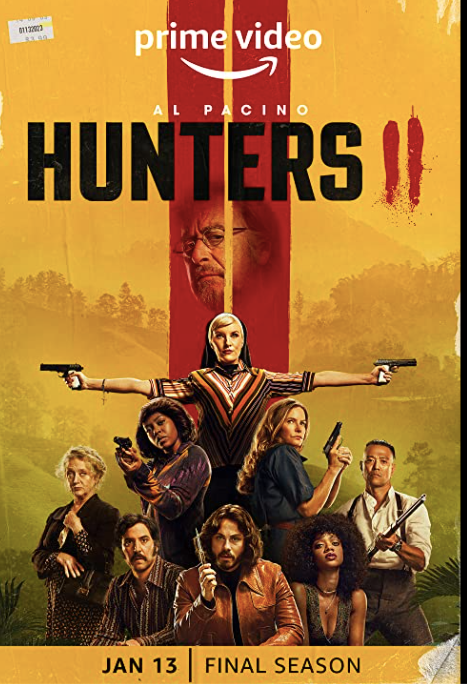
Hunters Season 2: Alternate History Hitler


I just binged the eight-episode second and final season of Hunters on Amazon Prime Video.  I liked it a lot more than the first season, and I liked the first season a lot, with some reservations.  Indeed, though the first season was an intensely personal story set in all-too real world, the second season was even more personal and managed also to be about the real world, our current real world, in fact.

[Spoilers ahead ... ]

The first season ends with the revelation that Hitler and Eva Braun are alive and well and planning to take over the world from their secret compound in Argentina.  That revelation comes after the upending unmasking of Nazi-hunter Meyer Offerman (Al Pacino) as the German concentration monster Wilhelm Zuchs aka The Wolf.   The second season picks up the backstory of Offerman/Zucks but shows its mettle in the Hitler/Braun story, and how our band of Hunters finally brings them to justice.

It does such a good job of this, on so many levels, that I'd say it lifts Hunters into The Man in the High Castle TV series territory, and lands just slightly behind it. The relationship between Hitler and Braun -- their mutual contempt, with Braun thinking she's the logical leader of the Fourth Reich and Hitler telling her at some point that the most important accomplishment of her life will be that she married him -- is both surprising and convincing.  The battles of the Hunters and Nazis are exciting and unpredictable.

But the biggest strength of the second season, right up there with its achievement as alternate history, is the way it links its 1979 story by strong implication to the resurgence of Naziism and white supremacy that grips our country and our world today.  The January 6, 2021 attack on Congress, the shootings of New Mexico Democrats by a Republican who lost the 2022 election, reported just in the past few days, show how looming and dangerous fascism is in the United States right now.  Putin says his savage attacks on Ukraine are to root out Nazis but he and his military are the ones employing Nazi tactics in their atrocities and propaganda.  In the very last scene of Hunters, Jonah looks across a table at an outdoor cafe at someone who looks like Hitler.  We last saw Hitler locked up in a high security prison in Europe, so there's no reason to think the man at that table was Hitler.  But there's every reason to think that the imprisonment of the real Hitler has not put much of a dent in the would-be Hitlers at large in 1979 -- and even more so today.

If I had one quibble with this powerful story, it is that too many of the characters on both sides seem to be able to easily survive being hit and even riddled by bullets.  I could accept this happening once.  But even twice is too much, in terms of stretching credibility.

But there were also some masterpieces of scenes and episodes in this second season.  I thought the seventh episode, nearly a standalone story of a German couple who give shelter to several families of Jewish people, could easily have been an Oscar-winning movie in itself.  And the battle scenes throughout the narrative were as good as they get.

Inevitably, the question arises of how about another season?  I thought Amazon cancelled The Man in the High Castle a little too quickly after four seasons, and that's certainly the case for Hunters after two seasons and the crucial story it's been telling.  Given the precarious condition of the world in which we now live, I have a feeling we'll be seeing a continuation of the Hunters story in some format and venue before too long.

See also Hunters: Praise and Reservations


my interview of Rufus Sewell about The Man in the High Castle


poems about the Holocaust ... my review


my interview with Grzegorz Kwiatkowski


It's Real Life

an alternate history short story -- get it on Kindle, or read it free on Vocal


Thursday, March 17, 2022

Hitler, Trump, and Putin: Sharpening the Comparisons

In the past few years, leaders ranging from Donald Trump to Vladimir Putin have been compared to Adolf Hitler.  I think the comparisons are valid.  But Hitler had more than a decade-long career as the leader of Germany, and it might be useful to sharpen the comparisons by specifying to what point in Hitler's career the comparisons apply.

Hitler at his worst was responsible for the murder of six million Jewish people and tens of thousands of Roma.   Putin has certainly not come close to that number as yet, and it is not clear at this point that Trump has been responsible for murder.  Where, then, do they currently correlate to Hitler's horrendous career?

Shortly before and leading to the onset of World War II, Hitler annexed pieces of the other countries around him.  In 1938, Hitler convinced Neville Chamberlain (Prime Minister of the United Kingdom) to allow Germany to annex the Sudetenland, a part of Czechoslovakia.  A year later, Hitler and Stalin's conquest of Poland ignited the Second World War.   Clearly, Putin's attempt to annex Ukraine is somewhere between Hitler's annexation of Sudetenland and Poland.   In that undeniable, tragic way, Putin is indeed like Hitler.

Trump's similarity to Hitler comes at a much earlier time.  Hitler rose to power condemning the press that truthfully reported on his activities as the Lugenpresse -- the lying press -- just as Trump labeled and still continues to call news organizations that truthfully report on his activities as fake news.  By 1932, Hitler's Nazi party received enough votes in the general election that the German President, von Hindenburg, appointed Hitler as Chancellor.  Successive elections resulted in Hitler going out of and back into power.  By 1933, Hitler was back as Chancellor, and before that year ended all political parties other than the Nazis were banned in Germany.  I would say Trump most accurately compares to Hitler circa 1932 to 1933.

The point of these comparisons, and the hope that resides in them, is that there is still time to prevent the further rise of Trump and Putin.  With the current and immensely destructive attack on Ukraine, Putin is the one who needs to be stopped most immediately.  The Ukrainian people are doing an heroic job of this, but they need even more help from U.S., NATO, and the free world, as Ukraine has repeatedly requested and experts ranging from U. S. Army lieutenant colonel (ret.) Alexander Vindman and former U. S. Ambassador to Russia Michael McFaul have repeatedly made clear.  Trump is not an immediate danger right now, but the Republicans need to nominate someone else for the 2024 election -- or, if they nominate Trump again, he needs to be soundly defeated again.

We the people in this world who believe in freedom have our work cut out for us.


Friday, January 21, 2022

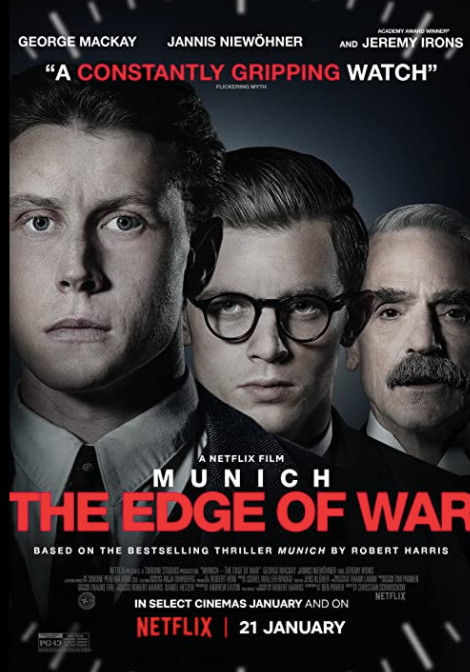
Munich: The Edge of War: A Brilliant Tinge of Alternate History


I guess this was a perfect night to watch Munich: The Edge of War on Netflix.  Russia is on the verge of invading Ukraine.  The Trumpists -- including Trump himself -- have still not been brought to justice for their insurrection and attack on our Capitol last January 6.   And the movie is based on the novel Munich by Robert Harris, author of the alternate-history masterpiece Fatherland, in which Germany won the Second World War. Not as much of a masterpiece as Philip K. Dick's The Man in the High Castle (made into an incandescent series on Amazon), for sure, but I'd watch a movie based on a Harris novel any time.

And Munich: The Edge of War is one memorable powerhouse of a movie.  As Neville Chamberlain goes to Munich to sign a deal with Hitler which gave Germany a piece of Czechoslovakia, which as we learned in school led to Chamberlain proclaiming "peace in our time" and Hitler to start gobbling up the rest of Europe less than a year later, two young diplomats, a Brit and a German, formerly classmates at Oxford, try to stop that deal from happening.

Their failure is a fact of history.   Their existence, I assume, is not.  What I'm not sure about is the way Chamberlain is portrayed in this brilliant film, in which he seems to really know what he's doing, deliberately delaying a hot war with Germany to give Britain and the United States crucial time to build up their forces.   That's what we get for watching a movie based on a novel by an author who is so deft at writing alternate histories.

But the movie, as I just said, is brilliant, and eminently worth seeing.  Historical dramas can be powerful and suspenseful even if we know the ending.   As a measure of how good this movie was, I felt bad that these two central characters -- the British and German friends -- didn't really exist.  That's probably because they are fiction, and where the rise of Hitler is concerned, fiction can often be better than reality -- unless we're talking about Fatherland or The Man in the High Castle.


Monday, May 4, 2020

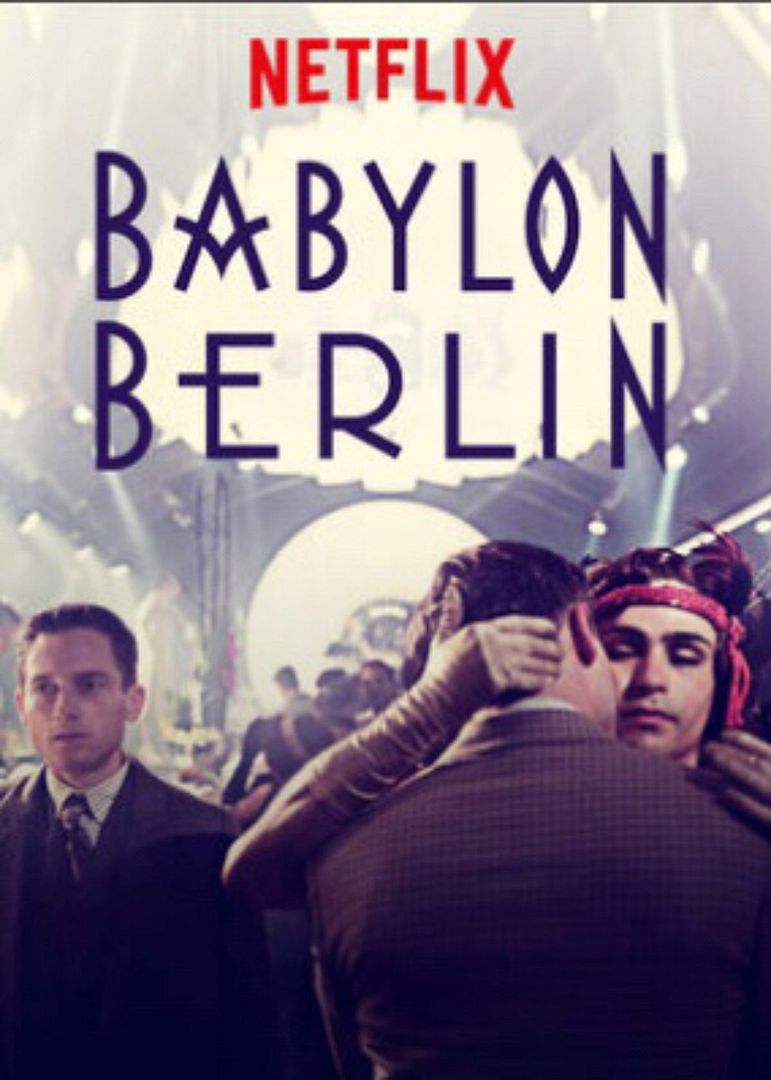
Babylon Berlin 3: Complex Pleasures and Inescapable Conclusions


I binged the third season of Babylon Berlin on Netflix the past few nights, having seen and immensely enjoyed the first two seasons two years ago, in May 2018.  Enjoyed doesn't do the series justice, because it taps all manner of emotions, including dread and disgust at the growing Nazi shadow on late-1920s Berlin, where the new reeds of democracy still held tenuous sway.  I felt the same way about the third season.  Enjoyed doesn't do it justice.  What I've been able to take away from this remarkable narrative is far more complex and valuable than mere enjoyment.

Babylon Berlin is really a variety of genres, rivetingly rolled into one.  It's historical drama, with pinpoint accuracy and all kinds of revelations, ranging from the brass dials of an instrument used to administer shock therapy to a device that records an in-person conversation, without one of the parties being aware.   It's a top-notch whodunnit homicide detective story, with all kinds surprises and unexpected turns.  It's in German, which offers a special pleasure for my Yiddish ears to hear (Yiddish is middle-German).  And it's pretty good romance, as well, with Volker Bruch and Liv Lisa Fries doing a fine job as detectives Gereon Rath and Charlotte Ritter.

But my two favorite threads in Babylon Berlin Season 3 are the focus on the making of a film, an early talkie, in 1929, and the political context, which I'll tell you about after the film.  The film intersects with the murder story, as the lead actress and her replacement get killed by a masked intruder ("If only she'd stuck with silent films," someone comments about one of the actresses, and her inability to hit the high notes).  Not only that, but the film mutates into a blend of science fiction and horror - science fiction about androids, and the human-machine interaction, making Babylon Berlin just ideal to watch before the Sunday-night conclusion of the third season of Westworld.  (The Weimar Republic made a great contribution to early science fiction movies in our reality, as Fritz Lang's silent movie Metropolis amply attests.) You can't ask for more than that.

But Babylon Berlin does deliver more, in the subtle way, with occasional bursts of raw violence, that the Nazi menace is intruding ever more prominently into life in Berlin, from lead detective Rath's son reading Mein Kampf and joining the Hitler Youth to Nazis blowing up buildings. I said in my review of the first two seasons that comparisons between what happened to the democracy of the Weimar Republic in the late 1920s and early 1930s, and Trump and his followers in America right now, is inescapable.  The third season of BB introduces yet another element in the decline and fall of the Republic: the stock market crash in New York City, which will ripple across the Atlantic and shake Germany, and therein provide another reason for German citizens to lose confidence in their democracy.

This is a crucial and sobering lesson.  Stay tuned.

See also Babylon Berlin (1 and 2): Eye-Opening History


They're coming out into the open, for the first time in centuries ....

Sunday, October 20, 2019

Peaky Blinders season 5: A New Window on Fascism


With fascism rearing its ugly heads around the world, including in the White House in the United States, it was timely, chilling, and good to see it front and center stage in Season 5 of Peaky Blinders on Netflix.

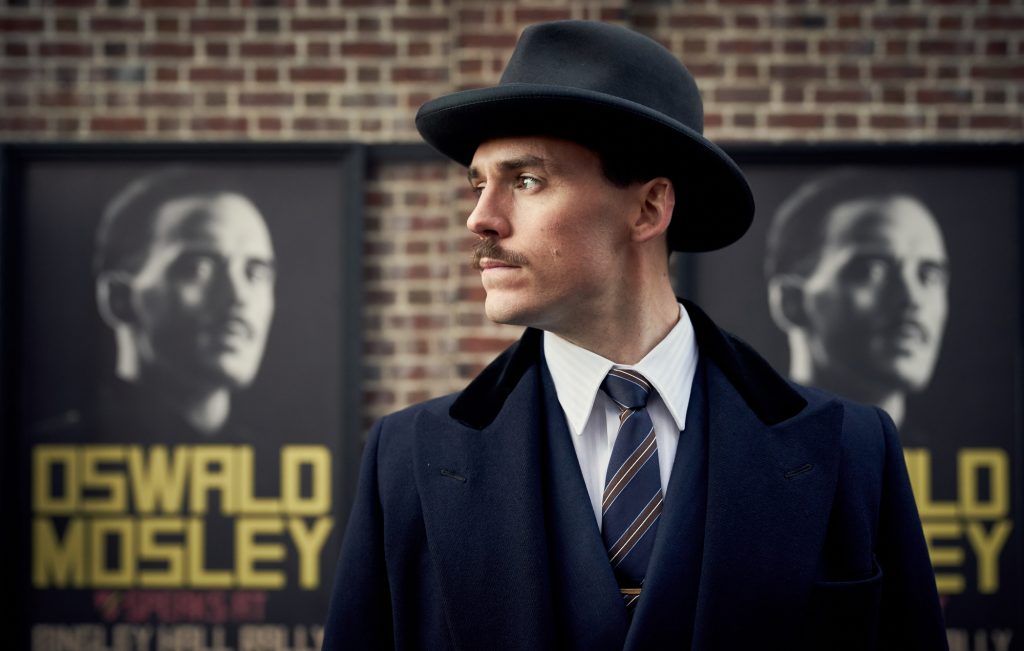
Thomas has intersected with British government in previous seasons.  But in Season 5 we see him an eloquent member of Parliament, soon befriended by Oswald Mosley, a real MP who was prominent in the 1930s as head of the British Union of Fascists.  I had heard of him, but didn't explicitly know his story, which worked well for watching Peaking Blinders, since the shocks were real shocks to me.

Mosley seeks to recruit Thomas as his second-in-command, or prime deputy.  Thomas accepts, but seeks to use this position to bring Mosley down, with the cooperation of the British government.  Thomas sees Mosley as "the devil," and he is, ranging from his treatment of women to his Hitlerian anti-semitism, and he's vividly portrayed by Sam Claflin (whom I don't recall seeing before, but will look out for now as a top-notch actor).

Fascism fed on the discontent and dislocations caused by the stock market crash of 1929.  The Shelbys lose tons of money, and Thomas blames his cousin Michael, who was repping the family in America.  The conflict between Thomas and Michael provides a trenchant secondary theme of tension in this season, and of course Polly is drawn into the imbroglio, since she's Michael's mother.  Thomas still seems young and not that old (to me), but Michael and his wife cast the conflict with Thomas as one of age, with Michael urging Thomas to give way to a new generation and its new ways of conducting business.  If you know anything about Thomas, you don't need to see this season to know how he will react to Michael's suggestions.

But you do need to see Season 5 for many other compelling reasons.  Arthur once against presents an unforgettable portrait of a decent man riven by and unable to control the inchoate violence that inhabits his soul.   Winston Churchill, who appeared earlier in the series, puts in another few captivating minutes (as MP - he was not yet Prime Minister).  And the sheer flavor of the cultures portrayed, from the Protestant Scots to the Peaky Blinders' Jewish allies, is indelible.

Bring on Season 6.

See also Peaky Blinders: Peak Television ... Peaky Blinders Season 3: Still Peak ... Peaky Blinders Season 4: Best So Far


Wednesday, August 28, 2019

Ejection of Breitbart Reporter from Beto Speech Is Inconsistent with Democracy

I just saw the news that a Breitbart reporter, Joel B. Pollak, who actually is Senior Editor-at-Large at Breitbart News, was ejected, apparently for no valid reason (he wasn't being disruptive, his mere presence was deemed as such) from a Beto O'Rourke speech at Benedict College.

Before I tell you why I think that was such a bad move, let me make two things clear:

1. I intensely disagree with Breitbart's political views.  The last and only time I voted Republican was for John Linsday for NYC Mayor in 1969 (because he was an early opponent of the Vietnam War).  He won, and two years later became a Democrat.

2.  I don't think what Beto's people did is literally a violation of the First Amendment.  A political candidate not currently in office is not a member of Congress ("Congress shall make no law ... abridging the freedom of speech, or of the press") or of any government (prohibited from abridging speech by the extension of the First Amendment in the Fourteenth Amendment).

But, the removal of any reporter on account of his or her political views is grievously in violation of the spirit of the First Amendment, and flies in the face of what the First Amendment is designed to protect, which is the public's right to information and opinions about people in office and people running for office.  How else can a democracy work, if we're not as thoroughly informed as possible, meaning exposed to the entire gamut of political views and actions?

Trump's daily denunciation of the press he finds unwelcome as fake news echos Hitler's attack on the press in 1930s Germany as the Lügenpresse or the lying press.  Trump's characterization of the press critical of him as "enemies of the people" picks up a favorite phrase of Stalin.  Further, Trump not only speaks these epithets, but acts upon them, recently revoking CNN political correspondent Brian Karem's press pass after an exchange between Karem and Trump supporter Sebastian Gorka.  Karem has taken this to court. (The White House backed down last year after taking away CNN correspondent Jim Acosta's pass, and Acosta filed suit.  Acosta and CNN were lambasted as "fake news" by Trump even back when he was President-elect, in January 2017.) 

In tossing out Pollak, Beto's campaign is joining Trump in his contempt for the press, and by extension the American people, which I assume is the last thing that Beto wants to do.  People on Twitter, typically seeking to justify any attack on the right, have sought to explain what happened to Pollak by saying he isn't really a reporter and Breitbart not a legitimate source of news.  That, alas, is a traditional fascist tactic, used to justify suppression and even killing of human beings by arguing that the victims are not fully or really human.

Beto O'Rourke and his campaign can do better than emulating Trump and his fascist tactics.  I hope they see the light and apologize to Pollak.  It would amount to an apology to our democracy.

Saturday, July 21, 2018

Trump and Putin = Hitler and Stalin, 1930s

I've been thinking more about my realization earlier this week (I'm sure many others have thought the same) that Trump and Putin are reminiscent of Hitler and Stalin, in the 1930s.   Let's flesh this out.

Putin is not a Communist by name, but he rules his Russia in much the same way as Stalin ruled Russia in the 1930s - by murder and intimidation.   He has the same attitude as did Stalin about Russia being taken advantage of by the world, and the consequent need to stand up to that by any and all means possible.   Part of that was an alliance with Hitler and the Nazis in the late 1930s.   During that alliance, Stalin and Hitler invaded Poland, and Stalin forcibly annexed or attacked the Baltic states, Finland, and Romania.   The similarities to Putin in Crimea and Georgia, unopposed by Trump, are undeniable.

Trump is not (yet) Hitler, but he shows many disturbing tendencies of going in that direction.  He has contempt for the press - he calls it "fake news," just as Hitler labeled the press Lügenpress or "the lying press" - and prefers communicating directly to his people via Twitter, without the intervention of the press, just as Hitler did with radio.   Trump is inhumane to minorities and immigrants, and preaches an American purity similar to Hitler's Aryan superiority.  He has contempt for the democratic process, as did Hitler, and embraces dictators such as Putin, and the autocratic leaders of China, North Korea, and Turkey, just as Hitler did with Mussolini and Tojo.

Obviously, neither Trump nor Putin have committed anything like the mass atrocities and genocides Hitler and Stalin would do in the 1940s.   But by then, the two allies of the 1930s - sometimes suspicious of one another, but more than willing to sign a non-aggression pact in 1939 - had broken and were engaged in a fierce, all-out war.

Trump says he wants peace with Putin and Russia, which is good.   But people who value freedom and democracy and its necessary bulwarks like the press must do all in our power to make sure the two don't eradicate democracy, as Hitler and Stalin did in their countries in the 1930s, and soon tried to do with the rest of the world.

Sunday, May 20, 2018

Fahrenheit 451: Updated for Fake News, Hate Speech, and DNA


I just saw the new Fahrenheit 451 - the HBO movie, based on Ray Bradbury's justly lionized 1953 novel of the same name, made into an excellent 1966 movie of the same name by François Truffaut.  The new HBO movie by Ramin Bahrani obviously had a lot to live up to with that kind of pedigree.  I'm here to tell you that it did - which puts me at odds with the numerous dyspeptic reviews it's already received on IMDb (at this point, 5.1/10), Rotten Tomatoes (32%), and Roger Ebert (2/4).  That's no surprise - I often find the established wisdom of professional and nonprofessional critics myopic.

But to the HBO movie - what I look for in a remake is something different, important, and if possible, more meaningfully current than in the original or earlier versions, while maintaining the best parts, including memorable details of the original.  Again, not an easy task.  But the new Fahrenheit 451 does it potently and beautifully.

The lie that Benjamin Franklin started fire brigades in America to burn rather than extinguish fires, with the truth that Franklin wanted fire fighters to put out fires being denounced as a lie, was one of the starkest parts of the original story.  It's in the new movie, too, but the truth is denounced as not just a lie but "fake" - a clear reference to our current crisis of fake news.

Another chillingly effective detail in the original is Captain Beatty extolling the "equality" of all books being burned, and holding up a copy of Mein Kampf as an example.  The scene is chilling because it tempts us to think that it's good if some books are burned - in this case, a book preaching hate, written by a monster who implemented that hate in the worst way. And the scene has special relevance to our struggle in 2018 with "hate speech" and what to do about it.  (See my The First Amendment in the Age of Post-Truth for my brief argument as to why we must not burn or censor it.)

But the new Fahreinheit also introduces something brand new to the story - which has gotten some critics crazy.  In the new ending ... wait, I won't tell you the ending, because I don't want to spoil it for you if haven't yet seen the movie.   But I can tell you the radically new element upon which the ending is predicated: our heroes do more than memorize books, so each person becomes a book, which is the inspiring, ennobling upshot of the original.   In the new movie, our heroes are also working on a plan to encode the text of every book, the digital code of every film, every piece of music, into DNA, where it can be stored and spread via biology. In other words, a good greater than any number of brave individuals.

Now I think that's a really cool departure from the original - and not just because I explored the biological potency and uses of information in my first novel, The Silk Code (reviewed here in The New York Times - one review I really liked).   But in the movie, this plan is brilliant and makes every sense.   After all, the villains are touting digital information (because it can be easily manipulated - another bow to fake news) over books, where the information is stable and reliable.  (The information in books has what I call "reliable locatability" - what's on page 77 of any book will be there on page 77 next week or next year or next century, as long as the book isn't burned.  See my New New Media, 2nd edition, p. 77 - not a novel - for more.)

Anyway - you needn't take my word for it.  See Fahrenheit 451 on HBO and see if you agree.


Saturday, May 12, 2018

Babylon Berlin (1 and 2): Eye Opening History


I can't think of a better time - or maybe worse time - to watch a 16-episode German series (streaming on Netflix) about the police in the Weimar Republic in 1929, just a few years before the Nazis won a plurality in the Reichstag, Hitler became Chancellor, and by 1934 had seized power, ended democracy, and declared himself Führer.   Weimar police detectives are comprised of people who would give their all to save democracy and people bent on destroying it.  Police on the street often react with deadly force to protests, unable to distinguish peaceful demonstrators from those with darker motives.  Politicians are much the same.   The parallels to our age of Trump, who has systematically attacked the press and other bulwarks of democracy, are obvious and chilling - more than chilling, given that we know how this battle turned out in Germany, and the impact of that result of the rest on the world.

But it turns out that what most people think happened in the Weimar Republic, its inescapable doom at the hands of the Nazis, is not the entire story, or is at very least vastly oversimplified.  In that difference between our casual understanding of history and what Babylon Berlin so vividly shows, may reside some real hope for us here in 2018.

That commonly accepted history shows the clever Nazis - not just Hitler, but Joseph Goebbels, who earned a PhD from the University of Heidelberg and was a master of propaganda - seizing on events, creating events, playing the people to get them to view democracy as weak and elect the Nazis to power.   That part is true is enough, but I always wondered why the Weimar Republic was such an easy target.  Babylon Berlin shows us in compelling detail that it wasn't just the Nazis that brought democracy down, or an aged President von Hindenburg who would appoint Hitler Chancellor after the Nazis gained democratically-elected power in the Reichstag.  It was, instead, the Nazis and a logically almost impossible array of powerful allies who beset the Weimar Republic and ultimately tore it to pieces.

The uneasy alliance between the Nazis and the Communists is well known, and was effectively portrayed in A French Village, another masterpiece about a slightly later period. But the full extent of this partnership between these two false champions of the workers is laid bare in Babylon Berlin, including a secret base in the Soviet Union where the German air force, outlawed in the Treaty of Versailles, is being rebuilt - not by the Weimar Republic but by German super-nationalists and rogue elements of the German military.

And even that was not the worst of it.  Joining the Nazis and the Communists in their hatred of democracy were a powerful group who never even pretended to be parties of the people: monarchists who yearned for a return of Kaiser Wilhelm II.   This was a group of generals and captains of industry (if they weren't already Nazis), and included some of the very police who were supposed to protect the Republic.  (Though we haven't gotten to the 1930s in Babylon Berlin yet, Wilhelm himself expressed both hatred and admiration of the Nazis, at times wrongly thinking that they were his ticket to restoration.)  With Nazis, Communists, and monarchists all attacking the institutions of democracy at various levels, each in their own interlocking ways, and the Weimar Republic not understanding, over-reacting, or not reacting to these dire threats at all, it didn't stand a chance.

And yet that's why I find this story ironically hopeful for those us in 2018.  Trump may be a pawn of white supremacists here in the United States.  He may have gotten some indirect support from the radical left who stayed away from the polls or didn't vote for Hillary Clinton in 2016.  But we have nothing even remotely like the monarchists in our country.  And, fortunately, we don't have a parliamentary form of government, where a democratically-elected plurality can aspire to seize power.

I haven't said anything about the specific stories and acting in Babylon Berlin, because I believe they're all secondary to these profound political lessons.   But they portray those lessons beautifully and unforgettably.  The heroes are Inspector Gereon Rath, haunted by his experience on the front in the Great War;  Charlotte Ritter, a flapper and part-time prostitute who does clerical work in the police department and wants to become a detective; and August Benda, head of the Weimar political police, Jewish, and the only person who glimpses the imminent future of Germany which we in 2018 know all too well.  (All three roles are impeccably played by Volker Bruch, Liv Lisa Fries - you may recall her from Counterpart - and Peter Kurth - and, while we're at it, hats off to series creators Henk Handloegten, Tom Tykwer, and Achim von Borries)  The action is non-stop, including a gun duel on top of a train (an homage to The Great Train Robbery), a breath-taking reconnaissance mission by air, and all kinds unexpected deaths, near-deaths, and suspense scenes that will keep you on the edge of your anxieties.

As an historian of technology, I should also mention that Babylon Berlin contains some significant details and lessons about the state of German technology in 1929, which was more advanced in some ways that ours in America at that time.  Their train system, their phone system, was just a little further along at that time than the rest of the world's, and gives yet another reason why the Nazis would do so well, so quickly, at the beginning of the Second World War.

See Babylon Berlin (from the novels by Volker Kutscher) for an indelible and instructive lesson in harrowing history that will stay with you for the rest of your life.


Sunday, March 11, 2018

Timeless 2.1: "Like Mein Kampf, by Philip K. Dick"

Tonight Timeless roared back from the jaws of oblivion - aka cancellation by the mothership, its network NBC - with a new episode that was far better than anything we saw the first season.  And it did most of this in its final few minutes.

And, indeed, there was one line which really struck me, which shows the high-intellect octane of time travel Timeless can achieve - it's when Rufus, looking at the megalomaniac writings on the smartphone crafted by their new worst arch-enemy, characterizes it as "like Mein Kampf, by Philip K. Dick".

Now I know he could have been speaking figuratively, or loosely, or just mistakenly, but the set-up in this new episode of Timeless and therefore the rest of the series is that history has already undergone changes that our heroes in 2018 don't know about.  Or, even more fun, maybe they do know about it, and it's we the audience on the other side of the screen who don't know about it, because we have a different history.

In our off-screen history, it's of course Adolf Hitler who wrote Mein Kampf.  Philip K. Dick does have some connection to this, because he wrote the alternate history The Man in the High Castle novel turned into an outstanding Amazon Prime series in which Hitler and Nazi Germany won the Second World War.  So what was Barrett referring to?

In the new history on Timeless, unknown to us but not its characters, was Philip K. Dick a Nazi monster who earlier wrote Mein Kampf?  Or was Dick maybe an American biographer of Hitler who titled his rambling bio Mein Kampf?

The possibilities are legion and intriguing.  Time travel and alternate history have always been closely related - I've always thought that behind every alternate history is an implied time travel, as the agent that brought the alternate history into being.   This first episode of the second season of Timeless, in that one statement about Philip K. Dick, promises all kinds of mind-boggling and intellect-puzzling adventures - or exactly what you'd want, or at very least I want, in a time travel story.

And see also Timeless 1.1: Threading the Needle ... Timeless 1.2: Small Change, Big Payoffs ... Timeless 1.3: Judith Campbell ... Timeless 1.4: Skyfall and Weapon of Choice ... Timeless 1.5: and Quantum Leap ... Timeless 1.6: Watergate and Rittenhouse ... Timeless 1.7: Stranded! ... Timeless 1.8: Time and Space ... Timeless 1.9: The Kiss and The Key ... Timeless 1.10: The End in the Middle ... Timeless 1.11: Edison, Ford, Morgan, Houdini, and Holmes (No, Not Sherlock)! ... Timeless 1.12: Incandescent West ... Timeless 1.13: Meeting, Mating, and Predictability ... Timeless 1.14: Paris in the 20s ... Timeless 1.15: Touched! .... Timeless 1.16: A Real Grandfather Paradox Story

-> and see also (evidence of original reality):  Time After Time, Timeless, and Frequency Now in the Dustbin of History (and the altered reality): NBC Reverses Decision and Renews Timeless: Lessons for Time Travel


Monday, January 29, 2018

Patti LuPone at 2018 Grammys: The Dark Message of this Incandescent Performance


[Note added 31 January 2018: YouTube has removed all the full-length (5mins+) videos of Patti LuPone's performance at the request of the Grammy people (The Recording Academy), ever on the edge of kicking public discourse in face.   You can find some shorter clips still on YouTube, and if I can find the complete performance on video anywhere online, I'll post it here.  In the meantime, here's a video of Patti singing "Don't Cry for Me Argentina" a few years ago.]

That's Patti LuPone singing "Don't Cry for Me Argentina" a few hours ago at 2018 Grammy Awards.  Tina and I missed her when we went to see Evita on Broadway in 1979 - she was off that night, though we did see Mandy Patinkin as Che - but we've always loved her performance as the very peak of peak in this musical, and, for that matter, in any other.

And here she was tonight, somehow, magically, better than ever.   Not only in the finest voice, pleading, tender, powerful - but acting to the hilt.   Look at what she does at the very end of the performance - at 4:27 into the song.   Evita beseeches the audience, sees she has them, raises her arms and flings back her head in vulnerable thanks and triumph, then puts her head down, possibly spent, modest, but raises it one more time in cool, powerful conquest, defiant and satisfied.  Soaking in the cheers and applause from the audience, both in Madison Square Garden tonight, and in Buenos Aeros, when the crowd was Evita's shirtless ones, all those years ago.   LuPone manages to convey all of this after singing her heart out and bringing herself - and anyone listening with a soul - to tears.

But there's a darker side to this - not in LuPone's incandescent performance and in Andrew Lloyd Webber and Tim Rice's incomparable song.  But in the message it conveys about propaganda, or deceitful appeals to the emotions that masquerade as logic.

I teach my classes at Fordham about this, and use this song as a searing example, every time I talk about propaganda.  The Institute for Propaganda Analysis, striving many years ago to understand how Hitler and the Nazis gained power in Germany, still then a democracy, called it "just plain folks".  Though the dictators have all the money and power, they tell their powerless subjects that they, the dictators, are just like the people - one of them.  Hitler was "the Leader" - der Führer - not the King.   Don't be jealous of me, Evita sings in "Don't Cry for Me Argentina" - I'm just like you.  I came from you, I am you, standing up here in my gleaming gown and jewels.  I'm you who has succeeded, so love me, as you should love yourselves.

This "just plain folks" is one of the prime ingredients of fascism.   It shouldn't matter, in a democracy, where the elected official came from in life.  FDR and JFK were both great Presidents, and swimming in wealth.  And maybe one of the reasons they were so good for our country is they didn't pretend to be something they weren't, someone just like us.

That's an important lesson to keep in mind, especially these days, with the President who tweets to be closer his supporters, as we're moved to tears along with Patti LuPone in her extraordinary performance.


Sunday, January 7, 2018

Media Ecology: A Cartesian Review of Lance Strate's Book

As a few of you may know, I got my PhD from New York University in 1979, in Neil Postman's "Media Ecology" (then new) program.  Postman likely got the name from Marshall McLuhan, who used it in the 1960s, and whom I met and came to know and work with after Postman asked me to write a preface to McLuhan's "Laws of the Media," an early, short presentation of his "laws of the media" that Postman published in the journal et cetera (that was the name of the journal - you can read the article with the preface here).  There's more about the tetrad in my Digital McLuhan and McLuhan in Age of Social Media, and in this talk I gave at Fordham University this past October.

People always wonder what "media ecology" is.   Lance Strate, who got his PhD in the Media Ecology program in 1991, about a decade after me, wrote a book in response, and I can't think of a person better suited to provide a knowledgeable answer.  Strate, my colleague at Fordham University and indeed the person who hired me in 1998, took up the "media ecology" banner when Postman was in his declining years.  Strate created the Media Ecology Association in 1998 and it's still going strong across the world with yearly conferences.  (If you think this makes me a biased reviewer of Strate's book, too bad - read the book, see if you agree, and, if not, tell me on Twitter or wherever where you think I'm wrong - I'm @PaulLev over at Twitter, by the way.)

When reviewing scholarly books - whether in proposal form for would-be publishers, or for a review like this after publication - I always apply a Cartesian test: how accurate is the book in describing theories, ideas, and facts that I know best?  Strate's book does an A-1 job of describing my work in media theory (I generally prefer theory to ecology, but that's just me), including delving into aspects of my work - like my Tetrad "Wheels" of Cultural Evolution - that are not widely known.   As a second indicator, Strate gets Josh Meyrowitz's work just right, too.  I sat next to Josh in our PhD seminars at NYU, and I know more about Josh's work than just anyone else's other than mine.

But Media Ecology does much more.  It situates the field in the larger areas of human scholarship and discourse, connects it to dozens of scholars in addition to Meyrowitz and me, addresses the synapse of communication in everything from the universe at large to the smallest mark on a page.   So, yes, it will tell you, eminently, vividly, clearly, and compellingly what media ecology is all about.

Which I'm not going to tell you here.  Read the book.

Ok, here's a very short answer:  media ecology is about how communication in one form or another, interconnected like living organisms (hence "ecology") makes things happen in our history and our world, because communication is essential to human life.  Or, to borrow from McLuhan, the way I like to put it nowadays is:  media ecology is about how without radio, there would have been no Hitler, and without Twitter, no Trump.

All right, McLuhan, who left us in 1980, was responsible only for the radio part of that.   All I did was apply it to the present.  But that's the point about media ecology:  its principles, which as Strate abundantly shows, predate McLuhan and Postman, and now extend far beyond them, are even more relevant today than when we sat in those seminars at New York University.

To be clear, Strate and I by no means are in agreement about the impact of all or any given media on our lives.  I tend to be more optimistic than Strate, on technologies ranging from space travel to social media (notwithstanding what I think about Twitter and Trump).  But this field has always been about mastering the principles and formulating your own views.   If you'd like a handbook on how to do this, and maximize your understanding of what's going on, get a copy of Media Ecology.


InfiniteRegress.tv