reviewing Black Doves; Citadel; Cross; Dark Matter; Dept. Q; Dexter: Resurrection; Dune: Prophecy; For All Mankind; Foundation; Hijack; Memory of a Killer; MobLand; Outlander; Paradise; Presumed Innocent; Severance; Silo; Slow Horses; Smoke; Star Trek: Strange New Worlds; Tehran;The: Day of the Jackal, Diplomat, Last of Us, Night Agent; Your Friends & Neighbors +books, films, music, podcasts, politics
George Santayana had irrational faith in reason - I have irrational faith in TV.
22 December 2024: The three latest written interviews of me are here, here and here.
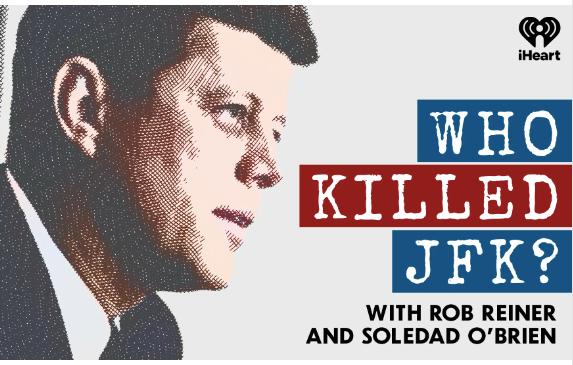
Episode 6 of the Who Killed JFK? podcast with Rob Reiner and Soledad O'Brien really hit paydirt with an account of Richard Case Nagell, given to Dick Russell, which provides the most convincing evidence I've heard so far that Lee Harvey was indeed a patsy, set up to take the fall for the assassination of JFK on November 22, 1963.
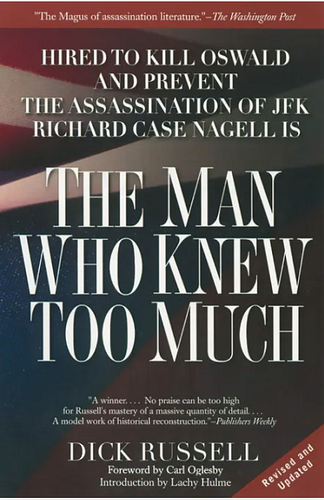
Who was Nagel? He was a CIA double agent -- same as Oswald (according to Russell and this podcast), tasked by the Soviets, whom he wasn't really working for, to kill Oswald. Why? Reiner and Russell explain that the Soviets knew of the CIA plan to kill Kennedy and blame it on them (the Soviets), as a pretext for the U. S. to then invade Cuba and once and for all get Castro out of power. Extensively interviewed by Russell over a period 20 years before Nagell's death from a "heart attack" in 1995, Russell tells us in the podcast (and in his 2003 book about Nagell, The Man Who Knew Too Much) that Nagell was ordered by the Soviets to kill Oswald to prevent the assassination of JFK. This put Nagell "between a rock and a hard place," as O'Brien aptly puts it. If he follows the Soviet orders and kills Oswald, the CIA will likely kill him. If he doesn't follow those orders, the Soviets will do the same. Nagell tries to let Oswald know he's being set up, without being too specific, because Nagell doesn't want to bring CIA down on him. Oswald shrugs him off. So in a move that seems crazy if you don't know any of this background, Nagell walks into a bank in Dallas two months before JFK's assassination, and fires a gun in the air, twice. He wants to get arrested, because he figures that prison is the safest place to be, with potentially CIA and Soviet assassins both apt to kill him.
The CIA does eventually get Nagell with a "heart attack gun" (not science fiction, check it out online) in 1995, one day after the Assassinations Records Review Board (established by Congress in the President John F. Kennedy Assassination Records Collection Act of 1992) sent Nagell a request for information. Fortunately for the truth, Nagell had already talked extensively with Russell in the preceding decades.
So where does this leave us? Well, as I said in reviews of earlier episodes of this podcast, it convinced me early on that, at very least, Lee Harvey Oswald was not the sole shooter in Dallas on November 22, 1963. I'm now convinced that Oswald was far more than not the only shooter that day: he was indeed the "patsy," as Oswald after the assassination said he was, in the murder intricately plotted and carried out by the CIA to punish JFK for his failure to provide support for the Bay of Pigs invasion, prevent him from furthering detente with the Soviet Union, and we can now add to provide a pretext for a US all-out attack on Cuba.
I'm looking forward more than ever to the next episodes in this crucially important podcast.
Wikipedia says "sheep dipping is the immersion of sheep in water containing insecticides and fungicide." On another Wiki page, we learn that sheep dipping in military idiom is"to formally, and usually temporarily, transfer military equipment or personnel to non-military ownership for the purpose of its employment in covert action with less risk of triggering armed conflict."
Guess which kind of sheep dipping Episode 5 of Who Killed JFK? tells us the CIA did to Lee Harvey Oswald, to set him up as the "patsy" in their assassination of JFK? The answer is: all that sheep have to do with this is the American people and the world were led like sheep to believe that Oswald was the sole assassin in this horrendous history-changing crime.
Rob Reiner, Soledad O'Brien, and their experts give us painstaking details of how the CIA did this, making him look like a supporter of Fidel Castro and his Soviet-allied Cuba when actually Oswald was just the opposite. And who do Reiner et al claim came up with this ingenuously devious plan? None other than James Angleton, aka the Poet Spy, the erudite, brilliant Chief of Counterintelligence at the CIA.
I have to say that this part of the incredible story the podcast is carefully telling is a bit less convincing than the forensic evidence laid out in prior episodes. The fact that at least one of the bullets came from the front not the back of JFK as he and Jackie and Connally and wife rode through Dallas that day seems unimpeachable, unless all the experts talking in podcast are blatantly lying, which seems very unlikely. And if there was more than one shooter, that means 100% that the Warren Commission was lying, and at very least there was more than one person shooting at JFK.
But the CIA piece is important, because it seeks to establish or at least further demonstrate not only its motive in killing the President (anger over the Bay of Pigs and fury at the detente JFK was pursuing with Khrushchev) but the specific way they expressed that motive, and made his assassination actually happen, and in a way that didn't implicate the CIA.
Even as I write that, it seems like one tall order. I'm not completely convinced that Angleton was smart enough and powerful to pull that off (I certainly didn't know the man personally). But the evidence is piling up in this and the previous episode, and I'm 100-percent up to being further convinced.
Rob Reiner and I have a lot in common regarding the assassination of John F. Kennedy on November 22, 1963 -- the awful anniversary of which is tomorrow, as I write this. Reiner first learns about the assassination, as he tells us in the podcast he's doing with Soledad O'Brien, in his high school physics class, when he was 16. I first found out about the assassination in my calculus class, which I was taking as a freshman in the City College of New York, when I too was 16. (In fact, we were both born in March 1947 in The Bronx. I was in the "SP"s, which New Yorkers might recall meant that you skipped 8th grade, which would explain why I was a year ahead of Reiner.) We both read and were very impressed by Mark Lane's Rush to Judgement, the 1966 book that attacked the Warren Commission's conclusion that one man, Lee Harvey Oswald, had been responsible for killing JFK. And most important, Reiner and I both felt and feel to this very day that the Warren Commission and the American government has been lying to us all these years about who killed JFK.
To be clear about the impact that assassination had on me, Reiner, and who knows how many more Americans and people around the world, that assassination was "the end of the innocence," to quote one of Don Henley's best songs, about the end of a true love affair. All of us 16 and younger and no doubt at least some years older found we instantly had a new view of the world, a sad, wise, and cynical view, the moment we heard Walter Cronkite or whoever it was deliver this terrible news. Cynical because, well, it's tough to see your optimism shattered, leaving you feeling naive to have had it in the first place. No amount of Beatles and landing on the Moon could change that, and the murder of John Lennon in 1980 only reinforced that horror in the soul.
Reiner seeks, if not to remedy that (it can never really be remedied), at least perhaps to reduce it, by getting at the truth of what really happened on November 22, 1963. In the first two episodes of his podcast, which O'Brien helps him deliver, Reiner explains how and why the CIA came to loathe and fear JFK. He didn't back it up to its satisfaction when it tried to wrest Cuba from Castro, and he let that attempt end in the Bay of Pigs. He started working hard to get a real peace with the Soviet Union, when he saw how close we came to destroying our civilization in the Cuban missile crisis. Reiner tells us of the note the newly widowed Jackie sent to Khrushchev. That's all in the first episode. And in the second, we learn of the various attempts, from people ranging from Geraldo Rivera and Dick Gregory, and others I hadn't heard of before, like Dick Russell, to get at the truth.
I'll be listening to every remaining episode of this important podcast. Its tone and intelligence scratch an itch that will always be there. I have no idea if Who Killed JFK? will address a question I've had since that day in Dallas when the curtain came down on my unbridled optimism about the good guys always winning. Why didn't Robert F. Kennedy, who remained Attorney General until September 1964, do everything in his power to find out what happened to his brother? Perhaps he would have, as President, if he hadn't been murdered himself in 1968.
Added 22 November 2023: Review of Episode #3
And today is the 60th anniversary of JFK's assassination. I would have thought about him and that heinous event on this day, anyway, but having listened to and reviewed the first two episodes of Rob Reiner and Soledad O'Brien's podcast last night, the assassination and the government "narrative" about it has been especially on my mind.
In the third episode, Reiner says "narrative" is a good word for what our government told us about the assassination, because so much of the government's story was fiction. Coincidentally, I've been thinking and reading a lot about alternate history recently -- and writing some of it -- and I found myself agreeing with the authors quoted in Jack Dann's Fiction Writer's Guide to Alternate History that a lot of our so-called real history is fiction.
In the third episode of Who Killed JFK?, Reiner details how the findings of what he aptly calls "the most important autopsy in American history" were not only kept from the American people, but deliberately bent to support what the government didn't want us to know -- that more than one shooter was firing at JFK in Dallas 60 years ago. We learn that Dr. James J. Humes, one of the two pathologists who performed the JFK autopsy, burned his first autopsy report, presumably because it contradicted the "single bullet" theory that our government was pushing. Reiner, O'Brien, and the experts they interview systematically explain why the single bullet theory is absurd -- way too much damage was done to Kennedy and John Connally, who was sitting in the front seat of Kennedy's limousine. We also hear convincing testimony that some of JFK's wounds came from the front, obviously impossible if Lee Harvey Oswald, firing from behind, was the only shooter.
So, today, November 22, has been and always will be a sad day for those of us who were cognizant the day that JFK was assassinated. But the Who Killed JFK? podcast is a welcome ray of hope that maybe we're finally getting close to the truth of what happened 60 years ago.