
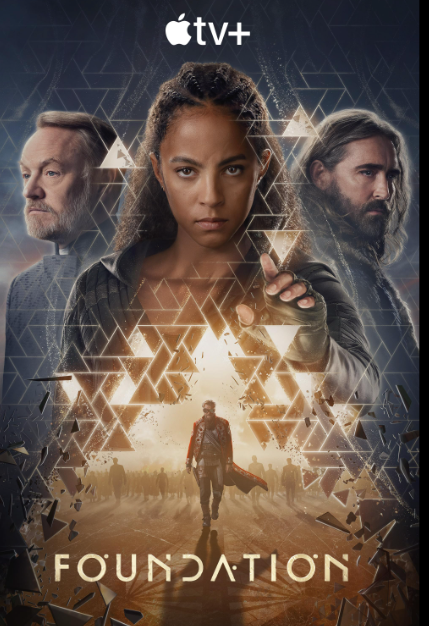
[And there are spoilers ahead ... ]
1. There's a Yiddish saying my grandmother used to tell me: "Mann tracht un Gott lacht". The usual English translation is "Man plans and God laughs," though the literal translation is ""Man tries and God laughs". And we're treated to a rendering of this, when Quent lambasts Dusk for his "math" of destroying planets and billions of people, saying "that's your math, it's not the math I believe in," and Dusk responds, "Your math? Or do you mean Hari Seldon's Plan, at which God is currently laughing." Now, Dusk might be a horrible human being, but he deserves credit for apparently knowing and riffing on this old Yiddish proverb (or, ok, actually the Foundation show's writers do), as well as having a pretty keen understanding of the peril that The laughing Mule (God) is currently posing to Seldon and humanity.
2. Speaking of which -- Hari and The Mule -- that was quite a conversation Hari and Gaal had about The Mule near the end, in which Hari wound up sounding like Data in Star Trek: The Next Generation, wanting a fully human body. This Hari -- whom lots of viewers are sure is a hologram, but I think is indeed more like Data, an android (or for that matter, Demerzel/Daneel) -- says to Gaal two very important things: (a) "don't call me that" (i.e., don't call me Hari), and (b) "I want what he has". So, the first likely means, don't call me Hari, because I'm not Hari (I'm some kind of android), and the second means, I want what The Mule has. (I thought, maybe the "he" in the "I want what he has" was the original Hari, who did have a flesh-and-blood human body -- but the Hari talking to Gaal says "he mysteriously got a body", and as far as we know, there's nothing mysterious in the way the flesh-and-blood Hari Seldon got a body, right?)
We have some inching progress in comprehending what's going on. And next week is this season's finale.
Enjoy Yiddish culture? Check out this short story, just published.
See also Foundation 3.1: Now We're Talkin'! ... 3.2: "The Fault, Dear Brutus, Is Not in Our Stars" ... 3.3: Dawn and The Mule ... 3.4: Cleon Knows His PKD ... 3.5: Cleaving Closer to Asimov's Trilogy ... 3.6: Finally! But ... 3.7: The Origin of The Mule ... 3.8: Deconstructing Concepts
And see also Foundation 2.1: Once Again, A Tale of Two Stories ... 2.2: Major Players ... 2.3: Bel Riose and Hari ... 2.5: The Original Cleon and the Robot ... 2.6: Hari and Evita ... 2.7: Is Demerzel Telling the Truth? ... 2.8: Major Revelations ... 2.9: Exceptional Alterations ... Season 2 Finale: Pros and Cons
And see also Foundation 1.1-2: Mathematician, Man of the People, and Cleon's Clones ... Foundation 1.3: Clonal Science Fiction, Hari Seldon as V. I. Lenin ... Foundation 1.4: Slow Hand, Long Half-Life, Flipped Coin ... Foundation 1.5: What We Learned in that Final Scene ... Foundation 1.6: Folded Variations ... Foundation 1.7: Alternate History/Future ... Foundation 1.8: Divergences and Convergences ... Foundation 1.9: Vindication and Questions ... Foundation Season 1 Finale: Right Up There


3 comments:
I don't see the vault Hari as just a hologram. I think he is a holographic projection of a larger living entity, i.e., the vault. It can project his holographic image as needed as a communication interface with others. It is essentially a robot capable of operating outside of ordinary three dimensional space. I loved the spoon and shadow demonstration of how Hari saved the population of Terminus in season 2. Why he wouldn't do the same when the planet was invaded by the Mule is a good question, but I think it has to do with sussing out the Mule's capabilities and possibly his true identity. I wouldn't expect it to have a human sense of morality which is what makes it jarring when the holographic image of Hari acts so unlike a typical human in making decisions of life and death around him.
They touched briefly on the question of who really built the vault. It always seemed impossibly complex and advanced even for Seldon. I suspect that Kalle, whatever she is, was instrumental in creating it. Personally, I like the idea that she is an Eternal, but I don't think the show wants to get into the necessary exposition to explain that to watchers who haven't read EOE.
I think I agree completely with your analysis (a rarity :) -- especially the possible tie-in to the End of Eternity (which Asimov, near the end of his life -- I think in the Intro to one of his books -- said was part of his thinking).
He explicitly tied EOE to the Foundation universe in Foundation's Edge. The speaker for Gaia, Dom, talked about the Eternals.
'Page 152: “Nor I, on the whole,” said Dom, “which is why I say that it would all seem to be a fable. Nevertheless, the fable states that there were those who could step out of time and examine the endless strands of potential reality. These people were called the Eternals and when they were out of time they were said to be in Eternity.'
That's only the first of at least six references to the Eternals in the text.
Post a Comment