
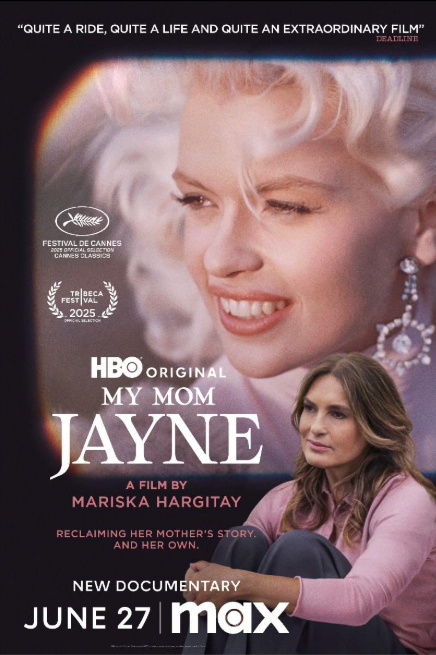
Mariska Hargitay was already an excellent rarity in television -- indeed, unique, in that her character Olivia Benson on Law & Order: Special Victims Unit has been on TV some 26 years and counting, longer than any other character in a TV drama. That's no surprise, given that Hargitay plays Benson with sensitivity and power in episode after episode. It's therefore also no surprise that My Mom Jayne, Hargitay's documentary about her mother Jayne Mansfield, is also unique, sensitive and powerful and unlike any documentary I've ever seen. My wife and I saw it last night on HBO Max, and were glued to the screen, often with tears in our eyes.
I grew up in the 1950s and early 60s, and my friends and I in the Bronx would often debate whom we'd like to spend the night with -- Marilyn Monroe, Jayne Mansfield, or Mamie Van Doren. Of course, they all were highly attractive. But, believe it or not, we also discussed whom we'd like to talk to. We knew that Marilyn was married, then had been married, to playwright Arthur Miller, so we figured she had to be pretty smart. We knew almost nothing more about Jayne and Mamie than what they looked like.
My Mom Jayne makes the convincing case that Jayne Mansfield was no dummy either. She not only was contemplative and intelligent, she played the violin and piano. And after she'd established herself as a hot dumb blonde bombshell, she worked very hard and not very successfully to demonstrate that she had a brain, endeavoring to explain that the dumb blonde was an act. The popular culture is very resistant to that kind of change. It's hard to negate what made you famous, and get your devoted admirers to accept that all of that was just a stepping stone to something else. (One of the things that made The Beatles so transcendent is that they were able to move so smoothly from "I Wanna Hold Your Hand" to "A Day in the Life" and the Abbey Road medley.)
Jayne Mansfield's struggle to get the world to know who she really was, cut short only by her untimely tragic death in an auto accident in 1967, is one of the two central themes of My Mom Jayne, and epitomized in an interview we see of Jayne by Jack Paar. That host of The Tonight Show for just five years (1957-1962) -- who, by the way. introduced The Beatles to America -- was the intellectual's intellectual, more so than Carson, Letterman, and even Dick Cavett. So Jayne must have figured she had a chance of convincing Jack about her fine mind and talent. But the interview ends with a smirking Jack saying he'd like Jayne to kiss him. (Speaking of Jack, he also sounds in that interview a lot like Johnny, which shows that Johnny adopted more than created his inimitable way of talking to his guests.)
The other central theme of My Mom Jayne is Mariska Hargitay's lifelong struggle to find out who she really is. Mariska was just three when her mother died, so she has no memories of her mother. Mariska's quest to find out who her mother was and therefore who Mariska is and how she got here turns out to be such a riveting, complex story, with so many twists and turns, it could almost have been a two-part episode of Law & Order: SVU. Indeed, there are so many surprises packed into the end, I won't say anything more, except that if you've been a fan of Mariska or Jayne, or a devotee of our popular culture, or just like a compelling true story, you'll want to see My Mom Jayne.

science fiction/fantasy novelette


No comments:
Post a Comment