
Chuck Todd interviews me about alternate histories
Showing posts with label Steve Jobs. Show all posts

Saturday, June 18, 2022

For All Mankind 3.2: Dmail


My favorite alternate history detail in For All Mankind 3.2 on Apple TV+ yesterday is "dmail" -- that's the name in 1992 for what we call email in our world.  I guess "d" comes from digital -- digital mail, just as the "e" in ours comes from electronic mail.  I like details like that.

[Now for some bigger spoilers... ]

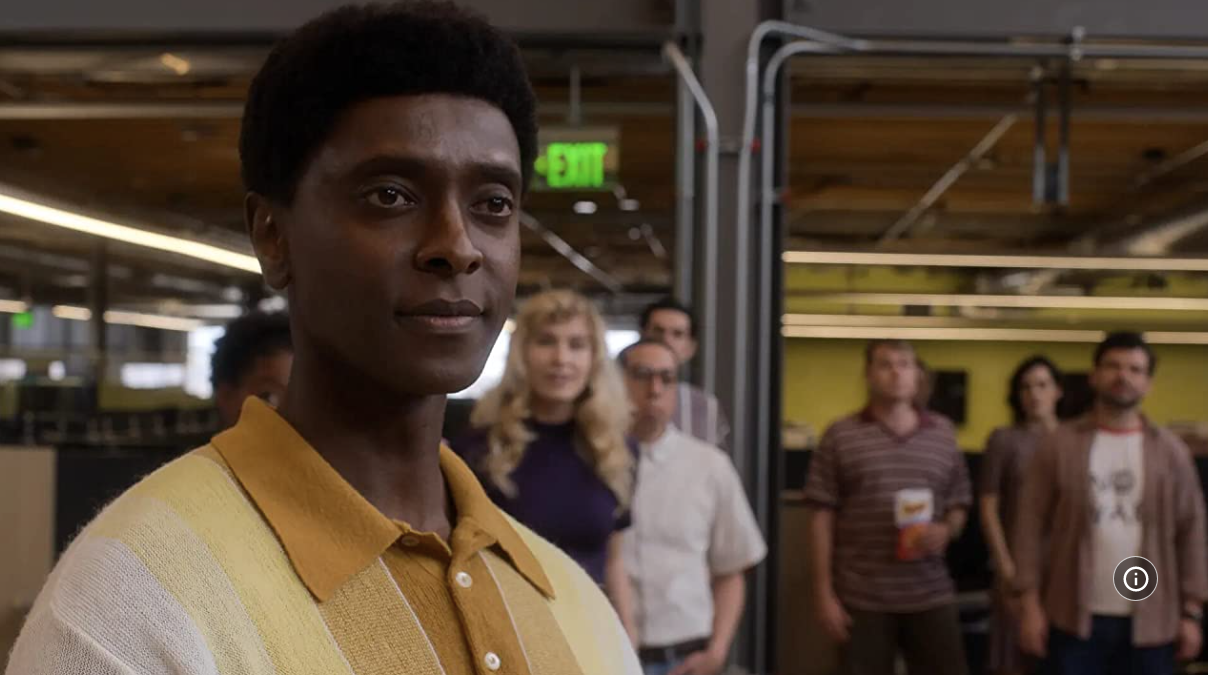
I had a feeling as soon Marge fired Molly and removed Ed from the Mars mission that he would wind up on what Dev was doing.  He's a great character.  An Elon Musk, Jeff Bezos, or Richard Branson mega-rich titan with the cosmic visionary quality of Steve Jobs.  And he's played by Edi Gathegi, who was just iconic in StartUp.

And I like the way Ed got there.  I said in my review of last week's 3.1 that I thought Sam's death was good for the narrative, freeing up Karen to maybe get back with Ed and who knows else.  In 3.2, we learn that Ed has split with his wife (good), and Karen and Ed are indeed much closer.  But, most importantly, she pitches Ed as the leader of Dev's mission (pitch is his apt word), he takes a vote of his people in the room (his company is at least this far a democracy), and Ed is commanding the mission.

This sets up a heated rivalry between Ed (Helios) and Danielle (whom Marge has chosen to lead the first Mars mission for NASA) and who knows who the Soviets might send up there.  And to up the ante, and increase the pressure, Dev is moving up the date of the mission.

It's an easy prediction that Ed and Danielle will be on Mars at the same time, and one will likely save the other.  But that's getting ahead of the story, and I'll see you back here next week with my review of 3.3.


See also For All Mankind 3.1: The Alternate Reality Progresses

And see also For All Mankind, Season 1 and Episode 2.1: Alternate Space Race Reality ... For All Mankind 2.2: The Peanut Butter Sandwich ... For All Mankind 2.3: "Guns to the Moon" ... For All Mankind 2.4: Close to Reality ... For All Mankind 2.5: Johnny and the Wrath of Kahn ... For All Mankind 2.6: Couplings ... For All Mankind 2.7: Alternate History Surges ... For All Mankind 2.8: Really Lost in Translation ... For All Mankind 2.9: Relationships ... For All Mankind 2.10: Definitely Not the End

It's Real Life

get the paperback or Kindle here

or read the story FREE here


*** Note added 27 October 2023:  Check out my review of Jack Dann's new book, The Fiction Writer's Guide to Alternate History

Sunday, October 8, 2017

Review of Doug Hill's Not So Fast: Worth Reading, Not Too Quicky

 photo Not So Fast_zpsdbrxn5pv.jpgI've had an advance reading copy on hand for quite some time of Doug Hill's Not So Fast: Thinking Twice about Technology, and I guess, given the title, who could object to my taking so long to read and review it?  But I've slowly been reading and reviewing two other books - Grant Wythoff's The Perversity of Things and Rob Sheffield's Dreaming the Beatles - and, anyway, now that I've finished Not So Fast, I can tell you two things about it:  I strongly disagree with its premise and just about every argument Hill makes in the book, and I recommend it.

Now, it's rare that I would recommend a book with which I disagree, but it happens.  Before I tell you why, let me tell you why I disagree with this book.   I'm a technological optimist.  Not because I'm ignorant of the many critics of technology Hill cites in his book, but because I've read them all and found them wanting.   The critic often thinks the optimist is ignorant, but the optimist can just as often be a critic of the critic.  In my case, though I don't preach the singularity or any kind of technological utopia, I think technologies help us fulfill our human goals on multiple levels.  I've been saying this since my doctoral dissertation, Human Replay: A Theory of the Evolution of Media (New York University, 1979), which was recently put up on Amazon.

Unfortunately, Hill overlooks the most reasonable pro-technological arguments, and relies instead on quasi-mystical futurists as his opponents.  And sometimes he misrepresents a seminal thinker such as Marshall McLuhan, for example, who didn't turn from pro-technology with the global village to critic of technology with discarnate man as Hill says.  McLuhan instead insisted that he never made value judgements, and indeed his global village had beds of roses with plenty of thorns.

So, why, then, am I recommending Hill's book?  Because I think it's important that we continue to discuss and strive to understand the nature and impact of technology, which is what Hill does in Not So Fast.  I also think it's important to draw into the discussion ancient philosophers such as Plato and Aristotle, and modern practitioners ranging from Edison and Ford to Steve Jobs.  (Indeed, I think touching base with such minds is so important that I frequently include them in my science fiction.)  It's also good to see outright critics of technology ranging from Jacques Ellul to Langdon Winner given such play, if only to offer avenues to students of all ages who are new to the game of fathoming technology.

But in the end, as the Nobel laureate biologist Sir Peter Medawar liked to say, what's most human about us is our technology, which means that to oppose it with a tone or implication of apocalypse amounts to despairing of the human condition itself.


Wednesday, January 4, 2017

The Perversity of Things: review #5 of X: Amateurs vs. Corporations

Continuing with my review (#5 of X) of The Perversity of Things: Hugo Gernsback on Media, Tinkering, and Scientifiction, edited by Grant Wythoff (University of Minnesota Press, 2016). I'm now focusing on pages 28-36 of Wythoff's 59-page Introduction to the 359-page volume, with the proviso that these reviews reflect my not Wythoff's organization of his motherlode of research and analysis.

Wythoff begins this group of pages with a discussion of the important role that women played in creating Gernsback's magazines (recognized by Gernsback) and in the ideal public pressing forward with the technological revolution - a presence which runs contrary to the historical gloss of middle-class young men being the carriers of these ideas, which as Wythoff shows also ignored the role of the working class.  But this sociology of science fiction and technocracy soon gives way to a consideration of an issue which is in many ways more fundamental: the tension between talented amateurs and corporate scientists as the spearheads of technological evolution.

Gernsback was clearly a champion of the latter, though Wythoff points out that Gernsback was not allergic to corporate culture, and willing to accept it if it further technological progress.   But the most significant part of this section is Wythoff's study of the sheer speed with radio was transformed from an amateur to a corporate endeavor - literally in a handful of years.   Not to get too melodramatic about this, but it is almost as if radio's very success, so fervently desired by its first amateur practitioners (who both constructed and listened to radio), spelled the very end of those amateurs, who could not possibly service the millions of Americans who quickly came to love and rely on radio, once its genie of entertainment and news was let out of the bottle.

I'd add here, however, that it's important to note that the amateur impulse, and the great things it engenders, was not extinguished with the corporate co-option of radio in the 1920s.  After all, Steve Jobs, Mark Zuckerberg, and the founders of Twitter were none other than amateurs in our own time, and although their revolutionizing inventions have now, too, become corporatized, there is no reason to think the amateur will not spring forth yet again in the future - or right now, though we don't yet quite know about it.

It's too bad that Gernsback didn't live long enough to see the digital revolution which his tinkering in the early days of electronic media presaged.  Like McLuhan, Gernsback died a little before the digital age which both foresaw, in different, complementary ways.   But their ideas and visions live on, and fortunately in the case of Gernsback, we have Wythoff's The Perversity of Things to carry it forward.

And I'll be back here soon with my next review of this book.

See alsoThe Perversity of Things: review #1 of X: Gernsback as Philosopher of Technology ... #2 of X: Learning by Doing ... #3 of X: The Evolution of Media ... #4 of X: Gernsback and the The First Amendment ... #6 of X: Thought Experiments and Toys ... #7 of X: The Invention of Invention, and the Advent of Science Fiction ... #8 of X: Definitions and Fake News


Friday, October 2, 2015

Heroes Reborn 1.3: Carly Fiorina meets Steve Jobs

Heroes Reborn continues to roll out nicely in episode 1.2, and its focus on Molly Walker as the secret weapon the  Renautas baddies are using to locate and likely kill if they can all of our surviving heroes.

Molly was an appealing character as a child in the original series.   She promises to be even more so as a woman in Reborn, now being used vehemently against her will.   My favorites in Heroes have always been characters with meta-powers - that is, characters whose powers are applied to other heroes.

Molly's being able to pinpoint the whereabouts of anyone with heroic powers is a great two-edged sword.  Yes, it can and is being used to hunt them down, but it can also be used to warn them, if someone like HRG aka Mr. Bennett is able to wrest Molly away from Renautas.   This makes Molly and her literally heroic GPS capacity an ideal pivot point for this reborn series.

Meanwhile, apropos pivotal, one of the most enjoyable components of Heroes Reborn is the ambiguity of some of its characters.  Is Harris Prime just a bad guy?  Well, he takes down Miko  - who's one of the best characters of Reborn - but is that only in service to Renautus?   And will his Clone be exactly the same on the ethical dimension (see Orphan Black for how that can manifestly and powerfully not be the case). Meanwhile, Miko herself is ambiguous - not about her morality but her parentage.   Although her father has a name - not Hiro - Miko has Hiro's sword, and it's tempting to think that she somehow is indeed Hiro's daughter, isn't it.

But there's also some viewing pleasure in unambiguously evil villains, and Erica, CEO of Renautas and its E.P.I.C locator based on Molly's powers, fits that bill just fine.  She looked like a blend of Carly Fiorina and Steve Jobs up there on stage, and promises to be a worthy opponent of HRG.

And I'll be back here with more next week.

See also Heroes Reborn: Good to Be Back

And see also Heroes Season 4 Premiere: Metaphysics, University, Carnival ...Heroes Meets The L Word in 4.5 ... Heroes 4 Mid-Season Finale  ... Heroes Season 4 Resumes ... Heroes 4.15: The Chess Game Continues ... 4.16: The Trial of Hiro ... 4.18: Penultimate  ... Heroes Forever

And see also reviews of Season 3 Heroes Gets Lost ... Heroes 3 Begins: Best Yet, Riddled with Time Travel and Paradox ... Sylar's Redemption and other Heroes and Villains Mergers ... Costa Nuclear ... Hearts of Gold and the Debased ... Seeing the Future Trumps Time Travel ... Superpowered Chess with Shifting Pieces ... Villains and Backstories ... The Redemption of Sylar ... Thoughts on the Eclipse, Part I ... The Lore of the Comic Book Store ... Hiro's Time Traveling Closure ... Augmented ... Shades of Recalibration ... Baby, Rebel, and Last Fantasy ... All that Shape Changes Remains the Same? ... Season 3 Finale: Hopeful Deceptions

Reviews of Season 2 Heroes: Episode 1 ... 2 ... 3 ... 4 ... 7. Heroes Meets 12 Monkeys ... 9. How Immutable Are Fate and Isaac's Futures? ... 10. Penultimate for the Fall ... Heroes 2 Finale: Heroes Who Didn't Survive

And from Season 1: Heroes in Focus ... Heroes Five Years Gone: Triumph of Time Travel and Comics ... Heroes the Hard Part: Only the Pictures Not the Words ... Heroes Landslide: Winnowing and Convergence ... Heroes Volume One Finale

 
no heroes, but pretty strange

Friday, February 24, 2012

Santorum's Deficient Education

Probably Rick Santorum's blanket denunciation of colleges and universities as "indoctrination mills" is the least offensive of his 18th-century regressive, repressive views publicized in the past few weeks.  But that's because his views about contraception, for example - which he opposes, even though he always says he wants to reduce teenage pregnancies - are so far gone and off the wall.

But since I know a  little something about college education, I thought I'd mention how at variance with reality Rick Santorum also is about that.

First, I should say I'm no blind advocate of higher education.  I've always found some merit in Cole Porter's "a college education I would never propose, a bachelor's degree won't even keep you in clothes".   A university degree isn't necessary for everyone.  Bill Gates, Mark Zuckerberg, and Steve Jobs all did just fine without one.

But the claim that a college education is a course in indoctrination is just nonsense.  Where I teach at Fordham University, no one ever told me or even encouraged me to present a specific political or cultural point of view.    That's what academic freedom is all about.

More important, I've never told a student what to think.  The goal, as every college professor knows, is to teach students how to think.  Or, in the Writing Workshop course I'm currently teaching, how to write, clearly and effectively, whatever your point of view.

Perhaps there are professors somewhere who teach differently.  But I've never met one.  And for those many that I have known, their emphasis has always been on teaching students how to think clearly.

Wherever Rick Santorum got his education, he obviously failed to learn that lesson.


InfiniteRegress.tv