Chuck Todd interviews me about alternate histories
Showing posts with label Touching the Face of the Cosmos. Show all posts

Sunday, August 2, 2020

Podcast: SpaceX Splashdown


Welcome to Light On Light Through, Episode 133, in which I give context to why the SpaceX splashdown today is such a momentous event in lifting our species off this planet.

Further reading: Touching the Face of the Cosmos: On the Interaction of Space and Religion


Check out this episode!

Wednesday, February 13, 2019

Project Blue Book 1.6: The Team


My favorite part of Project Blue Book 1.6 last night - and also likely to have some beneficial consequences for Hynek's investigation - is his decision to bring his wife Mimi into his investigations of extra-terrestrial visitations, so the two of them are a "team".

This is a crucial decision for all kinds of reasons.  Mimi is smart and loves him.  Hynek is learning that he can't really trust anyone else - including, sadly, Quinn, who folds when the Generals apply pressure.  I'm still hopeful that he might break away sooner rather than later, and work 100% with Hynek, but this has yet to happen.

My second favorite part is Michael Imperioli in a small role (as of now) as a Soviet agent (or, at least, identified as such by those Generals).   The Soviet part of this is a good counterpart to the extra-terrestrials.  They need to be reckoned with.  The blonde's husband is brutal, and doesn't hesitate to kill anyone who he thinks knows too much, and that apparently includes just seeing him.  Mimi on the team is thus a two-edged sword: she'll no doubt be a big help to Hynek, but her friendship with Susie (the blonde) means that the Soviets could have even better entree to Hynek's work.

And the role of the priest - who seems to know a lot, or more than Hynek, about the extra-terrestrials - is also an important development.  I've been saying for more than a couple of years that religion and space explorations are natural partners - see Touching the Face of the Cosmos: On the Intersection of Space Travel and Religion - and it will be fun and significant to see where this goes.

Project Blue Book could easily be mistaken as an obvious, superficial narrative with 1950s B-movie values.  It's indeed that, but it's beginning to mine deeper elements.  Stay tuned.  I definitely will.

 See also:  Project Blue Book 1.1: Science Fiction, Or? ... Project Blue 1.2: Calling Roy Thinnes ... Project Blue Book 1.3: Peggy Sue Gets Space Ship ... Project Blue Book 1.4: von Braun ... Project Blue Book 1.5: A Theory


here I am talking Ancient Aliens a few years ago on the History Channel

Thursday, April 12, 2018

Shout-Out to Jack Dann and Joseph F. Patrouch


This came up at Monday's conference on Touching the Face of the Cosmos: On the Intersection of Space Travel and Religion, which I organized at Fordham University.  It arose in my answer to a question I posed to the panel on "Science Fiction Looks at Space Travel and Religion" about what was each panelist's most memorable, profound, or otherwise significant example of a science fiction story, book, movie, or TV series they read or saw, in which the subject was space travel and religion.  On the panel with me were David Walton, Alex Shvartzman, and Lance Strate.  Among others in the audience were conference participants Guy Consolmagno, Molly Vozick-Levinson, Brittany Miller, Michael Waltemathe, James Heiser, Mark Shelhamer, and Tom Klinkowstein.

It was a tough question to answer - there are so many good candidate stories on page and screen - but I figured I owed my panelists and the audience my own answer.  That was actually easy for me - it was Jack Dann's Wandering Stars: An Anthology of Jewish Fantasy and Science Fiction, which is just what it sounds like.  I found it in the Science Fiction Shop - a bookstore I discovered on Hudson Street in Greenwich Village one afternoon in 1974.   I had grown up on science fiction in the 1950s and early 1960s.  (I have many times told the story of how I was banned from my Junior High School Library in 1958 by Mrs. Dayson, the librarian, because I refused to read anything other than science fiction.)  But by the early 1970s, I was more into music and protesting against the Vietnam War than I was into science fiction.  Jack Dann's anthology changed all that forever - rekindled a passion for science fiction (soon as a writer as well as reader) that would never leave me.  And it also deepened my interest in Judaism - my religion - at least a little.

Isaac Asimov wrote the Introduction to Wandering Stars - come to think of it, that's likely what gave me the idea to get Asimov to write the Preface to my own anthology, not science fiction, In Pursuit of Truth: On the Philosophy of Karl Popper, nearly ten years later.  The other book that I bought in the Science Fiction Shop that day was Joseph F. Patrouch's The Science Fiction of Isaac Asimov.  It was the first lengthy assessment of Asimov's work I'd ever read. I devoured it.  I still think it's the best.

Jack Dann and I have become friends (and he has a wonderful novella in the first Touching the Face of the Cosmos volume).  I exchanged paper mail with Joseph Patrouch some decades ago.   The Science Fiction Shop has long since closed.  But those books by Dann and Patrouch will live forever.


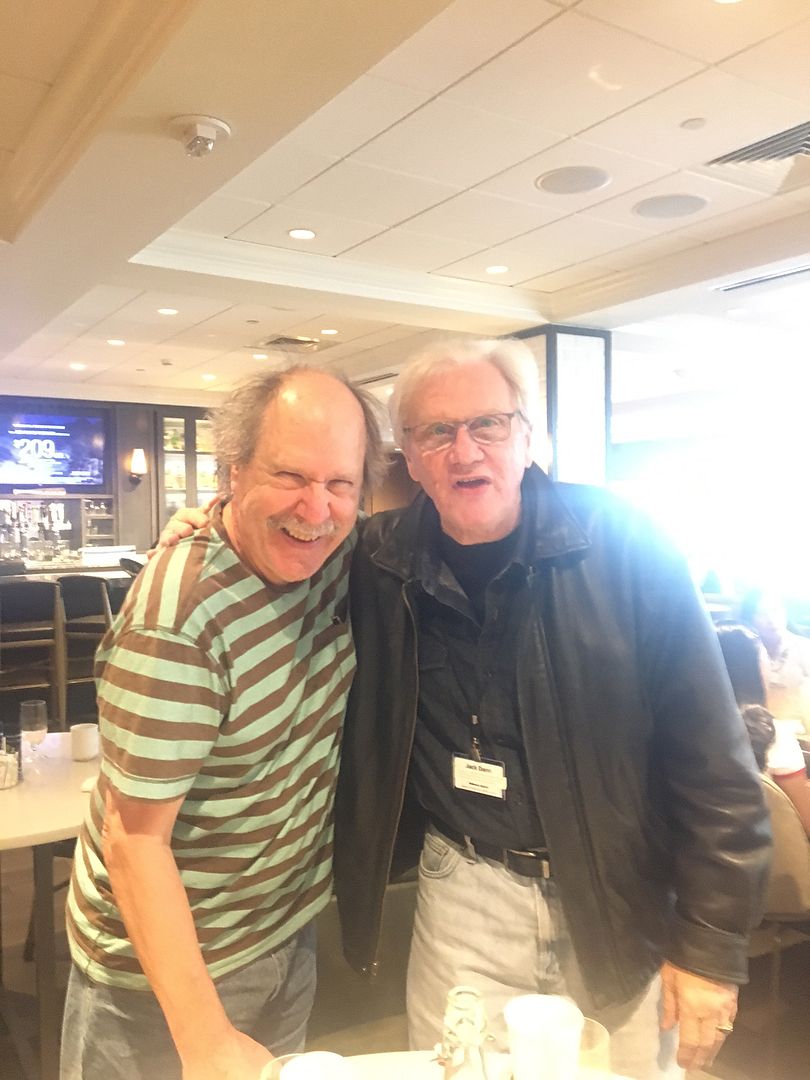
Paul Levinson & Jack Dann at Readercon 2019; photo by Tina Vozick

Wednesday, April 4, 2018

The Titan: Turning the Tables on Humans in the Cosmos

A common scenario in both science fiction and projections of what future science will do to help humans move out into the cosmos is terraforming: we use our technology to make an alien world more habitable, more comfortable, to humankind.  This could include the moderating the temperature, increasing the oxygen, adjusting the gravity, that sort of thing.

Much less frequent is modifying the human being to make us more comfortable on an alien world.  "The Enchanted Village" by A. E. Von Vogt from the early 1950s, which I read as a kid, is a great example, and has always stayed with me. An astronaut lands and come close to dying on Mars.  The environment just doesn't work for him.  As he reaches the end of his rope, he suddenly feels better.  Mars has somehow changed him into an intelligent organism that can flourish on its surface.

The Titan, which just started streaming on Netflix at the end of March, is a similar kind of a story, with the big difference that humans here on Earth are deliberately trying to genetically modify a select group so that they can live in the icy confines of Titan - Saturn's largest room - in comfort.  The result is a strong narrative, incorporating elements of horror as well as military science fiction.

One weakness is a change of character in Prof. Collingwood - well played by Tom Wilkinson, who plays everything well - which doesn't seem completely motivated. (This is a part of larger problem in movie-making, in which professors are often poorly conceived.)  The science is also a little fuzzy - or, at least, specifically what is being done to Lt. Rick Janssen (played by Sam Worthington, last seen by me in Manhunt: Unabomber, where he also did a good job), and how it all fits or doesn't fit together to make Titan habitable for him.

But the story (by Arash Amel, screenplay by Max Hurwitz - writer for Unabomber and Hell on Wheels - and directed by Lennart Ruff) still works, and Taylor Schilling does a fine job as a doctor who is also Rick's wife.  So, all in all, I'd recommend this.  At its best, the movie explores the question of how much of our humanity we're literally willing to sacrifice to go out and live in the stars.  And the timing is great, since this Monday I'll be convening a one-day conference (free admission) at Fordham University on the intersection of space travel and religion, Touching the Face of the Cosmos, with a Keynote by Brother Guy Consolmagno, Director of the Vatican Observatory.  We'll no doubt be exploring some similar issues.


Friday, December 2, 2016

Mars 1 and 2 on National Geographic: New Kind of Helping Hand Into Space

Just caught the first two episodes of Mars on National Geographic, and wanted to post this review before I see and review more.

First, this series is a great amalgam of documentary - up to and including events in 2016 - and a drama about the first expedition to Mars with humans in 2033.   That's a great idea for a story, and it works very well on screen.

The main of the part of the documentary, so far, is Scott Kelly's year in space mission, which ended successfully in March 2016.  This is counterpoint to the 2033 mission to Mars, in which team leader Ben Sawyer is badly injured right before landing and ... well, I won't tell you how that works out, because that's the main personal drama in the first two episodes.

But the point of this new kind of docudrama is that the personal stories are part of the bigger story, the yearning and necessity of human beings getting off this planet, and successfully settling on another planet - in this case, Mars.  Not a complete migration by any means, but establishing enough of  a continuing existence to insure our survival if and when something catastrophic happens to Earth. As Elon Musk of Space X and other worthy fame says in the first episode, this is the only way to insure our survival - since catastrophes happening to both Earth and Mars at the same time are extraordinarily unlikely.

The cinematography in both 2016 and 2033 is stunning.   We've seen all kinds of fictional accounts of space travel - ranging from The Martian to Star Trek - and all kinds of docudramas, such as Apollo 13. I've loved all of them, both as riveting stories in their own right, and as vehicles to getting our imaginations in better gear to actually get further off this planet and out into space.

We'll need all the help we can get, and its good to see Mars now lending a big, bold, imaginative helping hand.


Wednesday, December 16, 2015

Childhood's End 1.2: Losing My Religion

A really good episode of Childhood's End last night - 1.2 in the three day mini-series - which dealt with the impact of aliens on Earth on our terrestrial religions.

The first episode, and part of this second episode, focused on the impact of the Overloads on Earthling science.   The vastly superior tech of the aliens makes our science unnecessary and obsolete.   The impact on religion is even more destructive.

Religion is more than unnecessary in light of the Overloads.  Their presence here on Earth is incompatible with the very bases of most of our religions.  Karellen says this quite clearly near the end, when he points out that we already knew that all of our religions, with their competing views of existence and the universe, could not be right.  But now we see that none could be right.

This, by the way, could well happen as humans go out into the cosmos as encounter alien intelligences - we don't have to be invaded to come upon this challenge to religion.  Some of the essays and stories in Touching the Face of the Cosmos: On the Intersection of Space Travel and Religion delve into this issue.

It was portrayed cogently and beautifully in Childhood' End last night.  The ending was also powerful, when Karellen reveals why he prevented our leading human couple from having children. It was to save them the pain that would ensue.

Tonight we'll see exactly what he was alluding to.  In the meantime, hats off to Charles Dance for his customarily superb performance, and to Childhood's End for now breaking some powerful new ground on television.

See also Childhood's End 1.1: Familiar Territory and Childhood's End 1.3: Literally

#SFWApro 


Tuesday, September 29, 2015

Fordham University Press to Distribute Print Edition of Touching the Face of Cosmos; 1st Glimpse of Cover

Two very good pieces of news regarding Touching the Face of the Cosmos, the forthcoming anthology edited by Paul Levinson (me) and Michael Waltemathe:

1. Fordham University Press will be distributing the print editions of the book, which will appear in its Spring 2016 catalog, with a likely publication date in March.  Connected Editions will still be publishing all digital editions, with a likely publication date in November.   (A list of essays and stories can be found here.)   Paperback and hardcover editions now available for pre-order.

2.  Here's the cover - created by world-renown illustrator Joel Iskowitz.


And here's the catalog copy for the anthology -

Military advantage, scientific knowledge, and commerce have thus far been the main motives to human exploration of outer space. Touching the Face of the Cosmos explores what may be the best motive of all, largely untapped: the desire of every human being, essentially spiritual, to understand more about our place in the universe, how our lives on Earth are inextricably part of that bigger picture. Drawing on leading scientists, religious thinkers, and science fiction writers – including a new interview with John Glenn, and an essay by Director of the Vatican Observatory Guy Consolmagno, SJ – Paul Levinson and Michael Waltemathe have assembled a volume that puts space travel and religion on the map for anyone interested in outer space, theology, and philosophy. 
Paul Levinson, PhD, is Professor of Communication and Media Studies at Fordham University, and author of 16 scholarly books and novels, including Realspace: The Fate of Physical Presence in the Digital Age, On and Off Planet. 
Michael Waltemathe, PhD, is Senior Lecturer in Religious Education, Department of Protestant Theology, Ruhr-University Bochum, Germany, and author of Computer Worlds and Religion, and articles about science, religion, and outer space.

Tuesday, July 21, 2015

Touching the Face of the Cosmos


The following are the contents of our anthology, Touching the Face of the Cosmos: On the Intersection of Space Travel and Religion as of August 1, 2015, one month after our official deadline for receipt of essays and stories. There are several important points to keep in mind about what follows:

1. This is not the Table of Contents*.  My co-editor Michael Waltemathe and I have yet to decide on the specific order of nonfiction essays and science fiction stories.


2. This is not a final list of essays and stories.  We are still expecting a few additional essays.

3. But the following should give you an ample idea of what to expect in the anthology.  Look for further announcements as we get closer to our expected November 1, 2015 publication date.

*Note added 17 December 2015: the Kindle edition has just been published.  Click here and then on Look Inside, to see the Table of Contents and more.

Introduction

John Glenn interviewed by Paul Levinson, 30 July 2015

Essays
  • Joshua Ambrosius (Univ of Dayton) "Our Cosmic Future? How Religion Might Shape It"
  • David Brin (Arthur C. Clarke Center, Univ of California, San Diego) "So You Want to Make Gods"
  • Guy Consolmagno, SJ (Director, Vatican Observatory) "A Catholic in Space: Coming Home"
  • Peter M. J. Hess "Anticipating the Contours of Extraterrestrial Religion"
  • Wu Jianzhong (Sichuan International Studies Univ, China) "Sky One: The Universe and Human Beings are Unified"
  • Paul Levinson (Fordham Univ) "Religion as a Necessary Engine of Space Travel"
  • Juan Pablo Marrufo del Toro, SJ "Space Exploration as a Religious Pilgrimage"
  • Michael O'Neal (formerly NASA, Kennedy Space Center) "Faith in Space: A Christian Perspective"
  • Jeremy Saget (Mars One) "Faith to Face"
  • Barry Schwartz (Rabbi,  Congregation Adas Emuno) "One Earth"
  • Lance Strate (Fordham Univ) "The Touching Interface of the Cosmos"
  • Kathleen D. Toerpe (Astrosociological Research Institute and 100 Year Starship) "Shall the Sacred Heavens Be Cast Down"
  • Molly Vozick-Levinson (Director, Children's Learning Center) "Castles in the Air: Young Children Imagining Outer Space"
  • Michael Waltemathe (Ruhr-Universität Bochum) "The Heavens Declare the Glory of God: Religion in a Spacefaring Society"
  • Deana L. Weibel (Grand Valley State Univ) "Pennies from Heaven: Objects in the Use of Outer Space as Sacred Space"
  • Christian Weidemann (Ruhr-Universität Bochum) "Did Jesus Die for Klingons, Too? Christian Faith and Extraterrestrial Salvation"
Stories
  • Kyle Aisteach (author, science fiction) "Birth of a Pantheon"
  • Arlan Andrews, Sr. (founder, SIGMA, science fiction think-tank) "Epiphany"
  • Gregory Benford (Univ of California) "Winds of Mars"
  • Dave Creek (author, science fiction) "Kayonga's Decision"
  • Jack Dann (Nebula and World Fantasy Award winner) "Jumping the Road"
  • Marianne Dyson (former NASA Flight Controller) "The Right of Interference"
  • Philip Gibson (author, Hashtag Histories book series) "Christmas Message from the Moon"
  • James Heiser (Bishop, Evangelical Lutheran Diocese of North America) "Ecce Aqua"
  • Tom Klinkostein (Hofstra Univ) "The Universe Emerges from Information"
  • Paul Levinson (Fordham Univ) "The Seder in Space"
  • James F. McGrath (Butler Univ) "Biblical Literalism in the New Jerusalem"
  • Robert J. Sawyer (Hugo and Nebula Award winner) "Come All Ye Faithful"
  • Alex Shvartsman (WSFA Small Press for Short Fiction Award winner)"The Miracle on Tau Prime"
Cover art by Joel Iskowitz
Interior art by Brittany Miller

printed editions now available for order

reviews of the anthology: National Space Society  ...  The Jewish Standard  ...  Analog Magazine p. 1, p. 2 (August 2016)

video lectures and interviews with authors in the anthology


podcast of John Glenn interview

Wednesday, January 28, 2015

Touching the Face of the Cosmos: Call for Papers and Stories


Touching the Face of the Cosmos: On the Intersection of Space Travel and Religion

Call for papers, articles, short stories, for anthology edited by Paul Levinson and Michael Waltemathe

Short explanation:  Military advantage and scientific advances have been the main motivations for humans leaping out into space so far.  Commercial reasons have also become more important recently.   But there is a deeper reason that most human beings would want to see us get off and beyond our planet: we will never know who we truly are in the larger scheme of things, never understand our place in the cosmos, from just our vantage point here on Planet Earth.  Touching the Face of Cosmos will explore the intersection of space travel with religion and philosophy, with the goal of tapping into the public's latent but keen interest in this.  The anthology will consist of essays, short fiction, scenarios, and any form of writing which works best to delve into these issues.

Details:

Human spaceflight has always been closely connected to religion. There have been Bible readings and communion on the Moon, Christmas celebrations and Islamic prayer on the International Space Station, and Chanukah dreidels spun on the Space Shuttle.  Religious scholars have written treatises on how to uphold religious tradition in the new environment of space and rituals have been transformed to be valid in space.  Astronauts have spoken about their religious experiences during their time "out of this world".

But humans in space and religion have an even deeper connection. Themes and topics that have for centuries been recurring in religions all over the world are now represented in human spaceflight. There are saints and martyrs of spaceflight. Outer space itself can be described as sacred insofar as the destiny of humanity; it can be seen as a physical haven of salvation for the human race beyond the eventual possible extinction of our planet and solar system.   Although military advantage spurred the initial drive into space, and scientific dividends and knowledge  as well as potential profits from commercial ventures continue as powerful benefits of people in space,  humans beyond this planet may provide answers to some of the most fundamental questions in our existence – what are we doing here in this Universe – and such philosophic and spiritual insights may provide the ultimate motive, still as yet largely untapped,  for space exploration.

This anthology will address the connection between spaceflight and religion from different perspectives.  Examples of religion in contemporary space-activities are welcome, as is theoretical thought on the structural analogies between a space mission and a religious undertaking such as a pilgrimage or construction of a cathedral. We think it is high time to address ways in which religion and human presence in space can benefit each other.  Our goal is to motivate space exploration by drawing on the tradition of religious thought throughout history and explicating ways in which humans in space and religion profoundly coincide.

Papers from 500 to 5000 words. Style can be scholarly or more suited to the popular press. Science fiction scenarios and stories could also work. Atheistic and agnostic perspectives on these issues are also welcome. Due 1 July 2015.   Query with proposals first, or just send the paper. Terms: non-exclusive rights, for ebook and print publication. Authors receive a pro-rata share of 50% of the sales (e.g., if the anthology contains 10 papers, each author will receive a 5% royalty).   This anthology will be published as an ebook by Connected Editions shortly after all papers and stories have been received and accepted.

Contact: Levinson@Fordham.edu

====

Contents of anthology as of 1 August 2015

InfiniteRegress.tv