
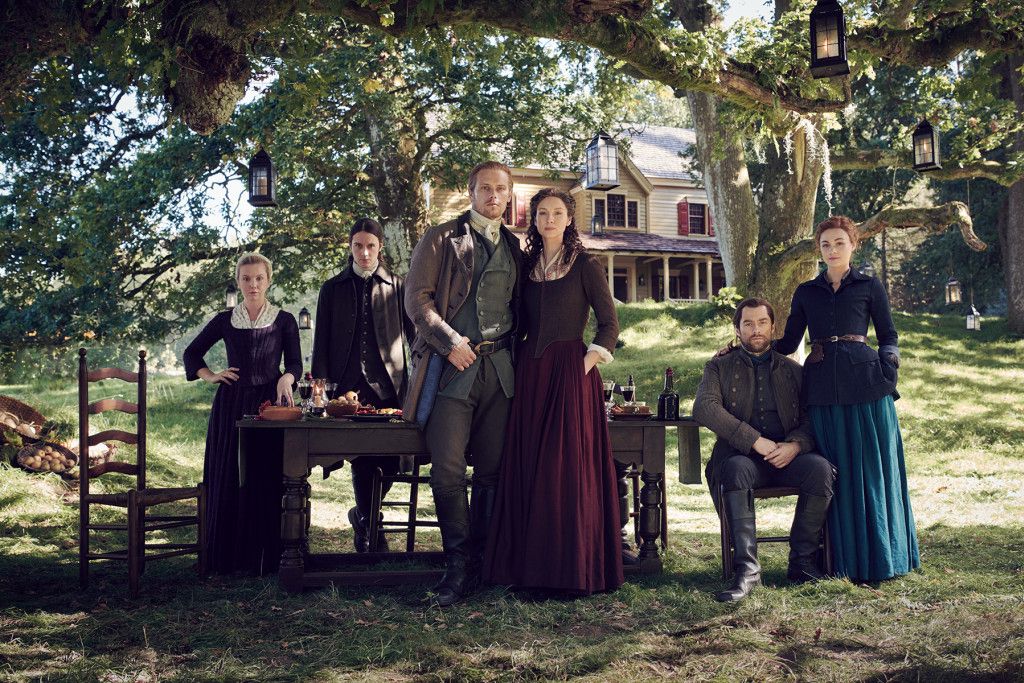
Outlander 5.11 was about as good an episode of Outlander as ever there was, which is to say, superb indeed (not really surprising, since Diana Gabaldon, wrote the books, also penned this brilliant episode). For me, that includes all the trimmings of a heart-rending time-travel tale.
Brianna and Roger taking Jemmy back to the future - back to the future for Brianna and Roger, to the future for the first time for little Jemmy - would have been a great story in any case. Roger always wanted to go back. Brianna was torn, but she's convinced, as is Roger, that Jemmy stands a much better chance of survival 200 years in the future, or the 1970s, if you're keeping track. Before COVID-19, I would've said a better handle on combating illness by the 1970s and after. As it is, it's certainly true that the American Revolutionary War and all the killing it brought to the Carolinas made living then more dangerous than in the 1970s and after. We get stark evidence of that at the very end of this episode.
But how do Brianna and Roger know that the North Carolina stones (or wherever exactly they are) will work like the ones in Scotland? The writing that Ian has, which Claire recognizes was done by a ballpoint pen, is a very good way of showing the time-travel capabilities of the American stones. No way Ian would've gotten that writing by way of Scotland. It was from someone in future America, who for whatever reasons took the stones back to the 1770s or earlier. How far in the future? Well, although the ballpoint pen was invented in the 1880s, it didn't really become popular until after World War II, so there you have it. If the words were written by a ballpoint pen, that makes it highly likely that they were written in the America where Claire arrived, or sometime after.
But ... in the final scene of Brianna, Roger, and Jemmy, Roger says "what the hell" - meaning, he's seeing something he doesn't expect to see. Meaning, not early 1970s America. Well, when, then? A future later than that? Our own, in 2020? Later than that? Or maybe the traveled to early 1970s America, but something they or Claire and Jamie did in the past changed history, so what Roger saw in 1970s America was a brigade of Red Coats? Or maybe they traveled further back in the past? Or maybe the stones brought them not far enough into the future, just a day or two? (Ian saw them vanish, so we know they time-traveled somewhere.)
I haven't read the books, and I'm hoping we get more of a clue next week, in the season finale. See you back here then!
See also Outlander 5.1: Father of the Bride ... Outlander 5.2: Antibiotics and Time Travel ... Outlander 5.3: Misery ... Outlander 5.4: Accidental Information and the Future ... Outlander 5.5: Lessons in Penicillin and Locusts ... Outlander 5.6: Locusts, Jocasta, and Bonnet ... Outlander 5.7: The Paradoxical Spark ... Outlander 5.8: Breaking Out of the Silence ... Outlander 5.9: Buffalo, Snake, Tooth ... Outlander 5.10: Finally!
And see also Outlander 4.1: The American Dream ... Outlander 4.2: Slavery ...Outlander 4.3: The Silver Filling ... Outlander 4.4: Bears and Worse and the Remedy ... Outlander 4.5: Chickens Coming Home to Roost ... Outlander 4.6: Jamie's Son ... Outlander 4.7: Brianna's Journey and Daddy ... Outlander 4.8: Ecstasy and Agony ... Outlander 4.9: Reunions ... Outlander 4.10: American Stone ... Outlander 4.11: Meets Pride and Prejudice ... Outlander 4.12: "Through Time and Space" ... Outlander Season 4 Finale: Fair Trade
And see also Outlander Season 3 Debut: A Tale of Two Times and Places ...Outlander 3.2: Whole Lot of Loving, But ... Outlander 3.3: Free and Sad ... Outlander 3.4: Love Me Tender and Dylan ... Outlander 3.5: The 1960s and the Past ... Outlander 3.6: Reunion ... Outlander 3.7: The Other Wife ... Outlander 3.8: Pirates! ... Outlander 3.9: The Seas ...Outlander 3.10: Typhoid Story ... Outlander 3.11: Claire Crusoe ...Outlander 3.12: Geillis and Benjamin Button ... Outlander 3.13: Triple Ending
And see also Outlander 2.1: Split Hour ... Outlander 2.2: The King and the Forest ... Outlander 2.3: Mother and Dr. Dog ... Outlander 2.5: The Unappreciated Paradox ... Outlander 2.6: The Duel and the Offspring ...Outlander 2.7: Further into the Future ... Outlander 2.8: The Conversation ... Outlander 2.9: Flashbacks of the Future ... Outlander 2.10: One True Prediction and Counting ... Outlander 2.11: London Not Falling ... Outlander 2.12: Stubborn Fate and Scotland On and Off Screen ... Outlander Season 2 Finale: Decades
And see also Outlander 1.1-3: The Hope of Time Travel ... Outlander 1.6: Outstanding ... Outlander 1.7: Tender Intertemporal Polygamy ...Outlander 1.8: The Other Side ... Outlander 1.9: Spanking Good ... Outlander 1.10: A Glimmer of Paradox ... Outlander 1.11: Vaccination and Time Travel ... Outlander 1.12: Black Jack's Progeny ...Outlander 1.13: Mother's Day ... Outlander 1.14: All That Jazz ... Outlander Season 1 Finale: Let's Change History


 An Angel for May just showed up on Amazon Prime. I just saw it, and think of it as a YA (young adult) Outlander.
 I was drawn to the Outlander series on Starz, because, as all of you devoted and casual readers of this blog well know, time travel is one of my passions, as a viewer, reader, and author. In addition, the retooled Battlestar Galactica on the SyFy Channel a few years, by Ronald D. Moore, is one of my favorite series ever on television, period, and Outlander, based on the novels by Diana Gabaldon, is Moore's baby on television.

