Chuck Todd interviews me about alternate histories
Showing posts with label cyberpunk. Show all posts

Monday, August 3, 2026

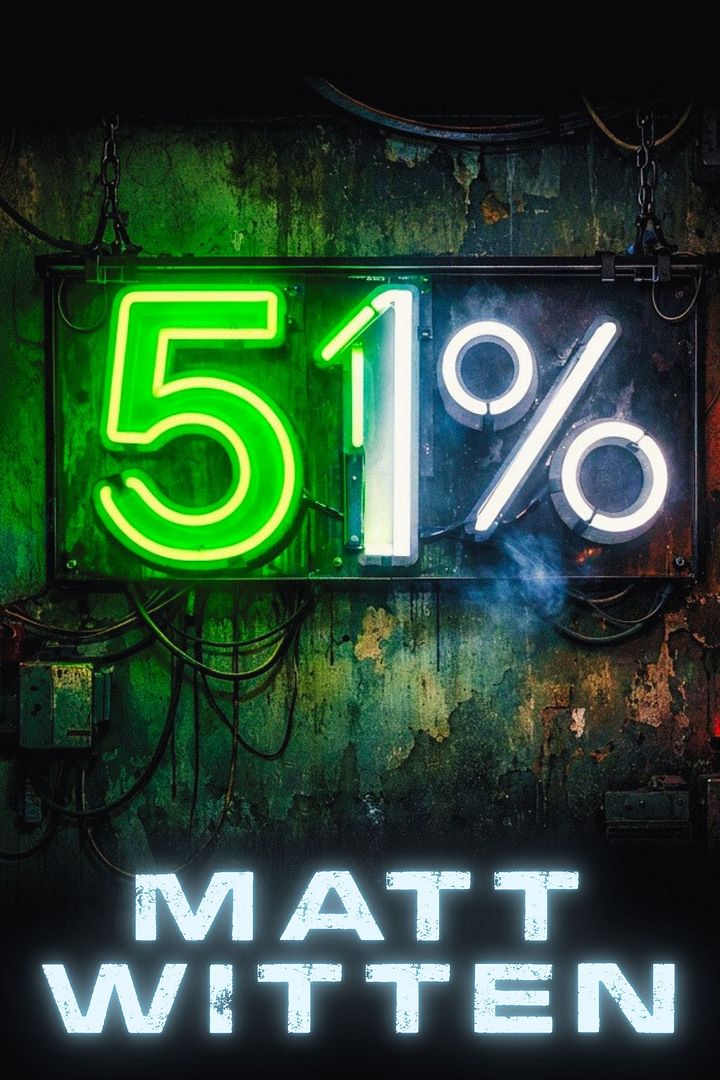
Review of Matt Witten's 51%: 100% Excellent, Relevant, Enjoyable, and Important


There couldn't be a better time to read Matt Witten's cyberpunk novel, 51%, in which Ayn Randian corporate power and philosophy controls and permeates all parts of American life, including the NYPD (New York's police), which are named NYPDInc, and in which police need payment from the people to do their work.  Apple's adaptation of William Gibson's Neuromancer will be streaming this coming January.  Even more important, Trump's hijacking of American democracy is claiming more innocent lives via ICE and other Federal police just about every week -- the most recent, Edwin Lopez-Cornejo, a 41-year-old migrant from El Salvador, died the day before yesterday at the Delaney Hall Detention Facility in Newark, NJ -- and that kind of "legal" killing requires vigorous response in all aspects of communication, including science fiction.

Witten's novel, published this past April, takes place 20 years from now.  People who are not rich pay for their medical treatment, education, and other essential needs by selling percentages of themselves to corporations.  If they sell more than 50%, they become corporate property, with where they live and work completely controlled by their owners.  To make sure that the 51%ers don't try to evade this corporate slavery, biochips are implanted in them, and their owners are alerted if anyone tries to remove them.

This is the environment in which NYPDInc Detective Luke (aka Juke) O'Keefe and his partner Halee Navarro (who carries a gun but is actually a “Crime Marketing Consultant”) must work in as they attempt to find the killer of Talia, a young immigrant 51% woman in New York City, and get drawn into a desperate, ingenious plan to break free of the corporate enslavement.  Witten has a keen sense of what the city would look like in such a corporate-glorified country, with streets renamed "Ayn Rand", "Randy Weaver", "Fountainhead", and "John Galt" -- right alongside current names like "Waverly" -- and gun models called "Hestons" and "Ruby Ridges".  Witten also knows his kittens, writing  "She started down the hall -- and tripped on a kitten, which had slipped out of the speck between her legs".  ("Speck", by way, is slang for apartment in this Big Corporate Apple, in which NYPDInc cops are called "Dincs" and the FBI cleverly called "Fincs".)

Given the ascent of AI in our world today, there of course is an AI character in 51% who, in another move that will make you smile, speaks with Margaret Thatcher's voice.  There's also use of fireflies in the story, which I'm also glad to see because they harken at least as far back in science fiction as my 1999 novel The Silk Code and Peter Watt's 2006 Blindsight, and they warrant more widespread use in our world.  And in the last third of the novel, there's almost nonstop action that will keep you glued for at least a few hours or longer, capping the memorable love story throughout.

But those are the science fiction and police fiction wheels of 51%, and the most important raison d'etre for this successor to Aldous Huxley’s Brave New World and George Orwell’s 1984, along with the enjoyment it provides, is the lesson it gives us about the likes of Trump and his allies and the damage they continue to do to our country and our world, and why we must show up at the ballot box this November and begin to get them out of office.

more about The Silk Code here



Monday, January 5, 2026

The Copenhagen Test: Don't Try to Pass It, Watch It


Binged The Copenhagen Test -- eight episodes -- on Peacock the past the two nights.  It's billed as a spy thriller, which it certainly is.  But in as much as Alexander Hale (powerfully played by Simu Liu, pretty much first time I've seen him, ok I saw him in Barbie) is a spy who discovers he's been hacked -- everything he sees and hears is streamed by his brain to whomever has the receiver -- I'd say The Copenhagen Test easily qualifies as cyberpunk, a well-known branch of science fiction.  I mean, I guess this kind of neural hack is related to Elon Musk's Neuralink, but that's a very first step, and the hack in The Copenhagen Test is already serious big business for the Orphanage, the US spy agency that monitors the CIA, the FBI, etc.

Now, I'm not going to tell you anything about the plot, because one of the many strengths of The Copenhagen Test are the twists and turns which multiply faster than Frank the Bunny in Donnie Darko.  Indeed, just when you think you've been told the whole story, you're dealt another curve ball, and the only way to really know the story is over is when the eighth episode is completed, and even then, well ,,,

Along the same lines, the morphing of heroes into villains and vice versa is the most I've seen or read in any story.   But it all makes pretty much sense in the end, and my only regret is that The Copenhagen Test didn't have the Beach Boys' "Heroes and Villains" as its theme song.

About the acting:  As I said, Simu Liu was superb.  So was Brian d'Arcy James as Peter Moira, someone pretty high up in the Orphanage, whom my wife immediately recognized from The Family McMullen, which we saw last week.  Sinclair Daniel and Melissa Barrera were both indelible in their parts, and you can't go wrong with Saul Rubinek, especially when there's so much action in his character's restaurant.

And trust me, if you're a fan of spy narratives and cyberpunk, even if you're not, you can't go wrong with The Copenhagen Test.


Monday, March 30, 2020

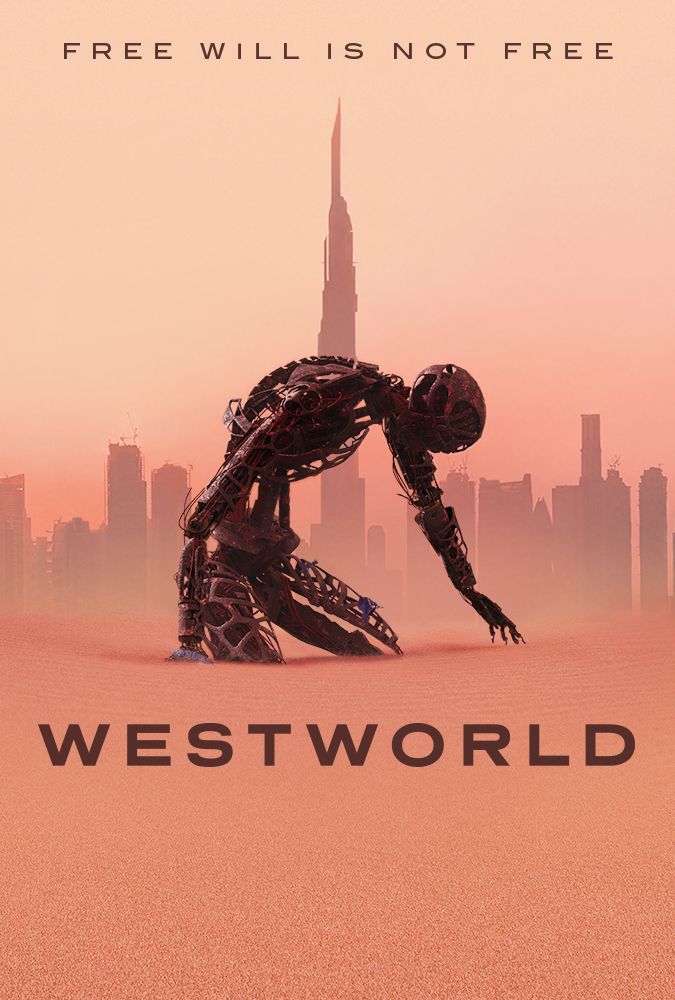
Westworld 3.3: Cyberpunk World


As I said in a previous review of this third season of Westworld, the series' move out of the park(s) into the world at large has made it as much a cyberpunk as an android story, though two genres are related.  The cyberpunk ambience - the colors, the ambience, the cinematography - was even more in evidence in episode 3.3 last night, and I'm really liking it.

Dolores figures in two, thus far almost separate, stories.  One is about Charlotte Hale, who was killed at the end of the last season, and replaced by a host that looks like her with Dolores' mentality inside, but now has another host's AI mind.  She's a crucially important get for Dolores - Charlotte was/is Exec Director of Delos - and Dolores is therefore on hand in episode 3.3 to see that whoever it is inside Charlotte the host is having as smooth a transition as possible.  It's not easy.  Her son, named Nathan Hale (will he go on to have only one life to give for his country?) doesn't completely buy her as his mom.  And neither, quite, does her husband (played by Michael Ealy, who's done a good job in every series in which I've seen him, since Sleeper Cell).

To make Charlotte even more intriguing, we have no idea what host's AI is now driving her.  I've seen suggestions that it could be the Man in Black, since he had a habit of cutting himself, which the new Charlotte has, too.  I suppose there's no reason that a male AI can't be put inside a female host's body, but I don't recall this happening before.  And I'm also wondering: is there any reason a host's AI can't be in two bodies at the same time?  And, if so, why didn't Dolores just stay in Charlotte's body, after getting back into her own?

Meanwhile, a tad earlier than Dolores mentoring/nurturing Charlotte, we pick up the story of Caleb rescuing Dolores.  If Charlotte was an AI story, Caleb and Dolores are pure cyberpunk.  Their relationship is pivotal in all kinds of ways.  It shows that Dolores can have a constructive partnership with a human being, and maybe more than that.  I'll tell you one thing: if Caleb gets killed at the end of this season, and is replaced by a host, I'll be disappointed.  I'd like to see their host-human partnership develop full-throttle in this and subsequent seasons.


Sunday, May 6, 2018

Anon: A Good

Just saw Anon on Netflix, where it debuted just two days ago.  The movie's by Andrew Niccol, and I'd say it's better than The Truman Show but not as good as Gattica, for whatever that's worth to you.

The story's pure cyberpunk, or a mix of cyberpunk and police detective, though police are usually right in the middle of and never too far away from any cyberpunk story.  You could also say that Anon is part of the cyberpunk renaissance, along with the Blade Runner sequel and Altered Carbon, but that wouldn't be quite true, either, since cyberpunk never really went away.

What is true about Anon is that it's a well told and well played story, in near future New York (with scenes in places where I've actually spent time), about a homicide detective (Sal, well played by Clive Owen, who plays everything well) who is hunting an apparent serial killer (a nameless "girl," with one of Amanda Seyfried's best performances) who is hard to find, because she's created an algorithm that erases all of the digital records that police have of everyone, everything they do, and everything they see.   In that sense - police employing some kind advanced almost mental-telepathic system to eradicate crime, or at least keep it bay, Anon has a kinship with Minority Report, and indeed is as Dickian as it gets without actually being based on a Philip K. Dick story.

The plot is pretty tight, with some real surprises and twists.   There is one place in which the "girl" should have recognized Sal after he goes undercover to find her - given that he was just chasing her, in an excellent scene in which she eludes him by making him fall down a flight of stairs by distorting what they actually look like to him.  But, hey, that little glitch is ok with me, given that the stairs scene was so cool, as is the master hacker's power not only to erase records and thereby traces of herself, but also project false visions into any head she chooses to use as a screen.  It's a good thing Google pulled back from Google Glass a few years back, because seeing Anon would have done that product no good at all.

Though, I'd probably still go for Google Glass right now, and take my chances with Amanda Seyfried's character, since ... well, to tell you more would give away too much of the story.  Or maybe I can't relate that part of the story because the hacker removed it from my records ... though, in the narrative, biologically (naturally developed) memories are not affected by the hacking, so ...

Well, see the movie and see what you think.


Tuesday, January 3, 2017

The Perversity of Things: review #4 of X: Gernsback and the First Amendment

Continuing with my review (#4 of X) of The Perversity of Things: Hugo Gernsback on Media, Tinkering, and Scientifiction, edited by Grant Wythoff (University of Minnesota Press, 2016),  this time focusing on pages 26-28 of Wythoff's 59-page Introduction to the 359-page volume, because it tells us that Gernsback was a staunch opponent of government regulation of the nascent radio medium.

So I now have a third area of strong agreement with Gernsback and his work, joining science fiction and media theory: Gernsback not only understood the evolution of media, but got that we should not let the ham-handed government and its penchant for regulations get in the way of that.

Had I known that, I certainly would have mentioned Gernsback in my Flouting of the First Amendment 2005 keynote address - a central part of which is that the Federal Communications Act of 1934 and the FCC it created was a hindrance not a help to the evolution of broadcasting, and violated the First Amendment.  Wythoff again deserves credit for bringing Gernsback into this continuing controversy about how much if any government regulation of media is helpful and constitutional as we move further in the 21st century.

But Wythoff and I don't agree on everything regarding this issue.  He notes on page 27 that Gernback's "arguments against hasty legislation ... are very much reminiscent of advocates for net neutrality".   But net neutrality, though laudable as an ideal, is usually advocated as a government regulation - in other words, an example of the very kind of government meddling in the evolution of media that Gernsback was so eloquently and knowledgeably against. Wythoff is no doubt right that Gernsback the tinkerer would have been no fan at all of today's huge media corporations, but Gernback's often repeated contempt for and fear of government intervention in media development would have made him even less a fan of an FCC induced net neutrality as a way of limiting corporate power.  (My Why I Oppose Net Neutrality summarizes my opposition, pre-Gernsback and Wythoff.)

I would add here that underlying my and Gernsback's opposition to government regulation is not only an understanding of media evolution, but an optimism that this evolution by and large leads to good and better things.   This optimistic outlook, as Wythoff makes clear and I mentioned in previous reviews of The Perversity of Things, is also the basis of Gernsback's hopeful science fiction - in the tradition of Jules Verne, contradicted by the dystopian science fiction of Aldous Huxley and George Orwell, furthered in cyberpunk which was and is specifically scathing about media evolution, in the latter part of the 20th century and the present (and, being a not 100% Gersnbackian, I've occasionally written a little of, I'll admit).

Wythoff goes on to describe the McLuhanesque "global village" that Gernsbach's "new minted citizens of the ether" (Wythoff's apt term) comprised - a development which didn't quite turn out the way Gernsback intended and predicted (and not just because of government interference), which I'll look at it my next review.

See also: The Perversity of Things: review #1 of X: Gernsback as Philosopher of Technology ... #2 of X: Learning by Doing ... #3 of X: The Evolution of Media ... #5 of X: Amateurs vs. Corporations ... #6 of X: Thought Experiments and Toys ... #7 of X: The Invention of Invention, and the Advent of Science Fiction ... #8 of X: Definitions and Fake News


Thursday, July 14, 2016

Mr. Robot Bhack with 2.0

Mr. Robot, the cyberpunk, age-of-Snowden masterpiece that debuted last summer, was back tonight with the start of its second season.  It was altogether surreal, cinematic, and superb - even more cinematic, in fact, than the first time.

Among my favorite "sky above the port was the color of television, tuned to a dead channel" (William Gibson) scenes -

*Phil Collins' "Take Me Home" playing so faintly, almost indiscernibly in the background, and gradually getting louder, all as prelude, building up to the burning of a truckload of cash - 5.9 dollars to be exact - as our hackers get a moment in the sun, or at least the big flame of all that cash.  Hey, I love Phil Collins - he's second only to Paul McCartney and maybe some of Abba in soaring pop music - in fact, I'm listening to that song right now.

*The guy on the basketball park bench talking to Elliot, and saying that he (the guy) knows about as much about digital as his dog does about e. e. cummings.  Or maybe his dog was e. e. cummings compared to what he understood about computers - either way, his name is spelled with no caps, but you don't find a capital throwaway line like that on any other television show.

*Angela's in bed with the guy (different guy) who picked her up in the bar - reminding us that she belongs with Elliot - he's asleep, she's waking up, and throughout all this we see a skyscraper gleaming in the night through an open window.   It's a soft-spoken, almost poetic image of Big Brother out there in the heart of the cold, cold city.

*Elliot with the white bandage around his head for the bullet wound he didn't really have and the hoody looking like a nun or a sheik.

*Real speeches from Obama and Leon Panetta expertly cut to sound as if they're talking our fsociety hackers.  (I'd have found these clips even more eerily disconcerting, though, if Obama had said something about Trump.)

And there were lots more.  But as to the story, Elliott's bound-to-fail struggle against his father in his Fight Club head is nobly rendered, including the slight tinge at the end that maybe, just maybe, Mr. Robot isn't really dead?   No, he's dead, but  having him speak to Elliott remotely, via old-fashioned phone, instead of in-person as he usually does, is a very nice touch, because it shows that Elliott has both succeeded in getting his father out of face but never out of his life.

There's also an unexpected death - but on the slight chance that you haven't seen it, I won't tell you who.

And I''ll be back here with a review next week - though possibly not in quite so good a mood, since earlier this evening I was at the Mr. Robot season 2 launch party at Story, and the hors d'oeuvres were just scrumptious, though I wouldn't have minded a little Phil Collins music...

See also Mr. Robot: Cyberpunk Triumph


#SFWApro


a different kind of cyber-esponiage


Story board at Mr. Robot launch party

Thursday, September 3, 2015

Mr. Robot: Cyberpunk Triumph

Well, my number-one television guilty pleasure this summer was "Mr. Robot" on the USA Network - though it was so good, easily the best new show on TV this summer, indeed of the year, maybe even the past year or two, that there's nothing whatsoever to feel guilty about watching it.  It was just a pleasure, rare, keenly intelligent, and provocative.  I saw most of it in the past few weeks, and the finale tonight.

Hackers have appeared in all kinds of TV series, most of them obvious, a few like CBS's CSI-Cyber not half-bad, but Mr. Robot is something else, in a class all its own.  Impossibly suave and gritty at the same time, as lyrical as Rectify - the other out-of-left-field masterpiece to come along in the past few years - but hipper, with words like louche in  it, and with a heart and soul and slap-in-your face realism and cynicism that's not to be believed, but is plausible all the same, you disbelieve Mr. Robot at your peril.

Cyberpunk has attained impressive heights in writing - Sterling, Gibson, Varley - but not so much on the screen.   Mr. Robot takes its place right up there with its story - its only competition screenwise being Bladerunner, an utterly different kind of tale.

There are elements not only of Occupy Wall Street and V for Vendetta but Fight Club in Mr. Robot, but I won't say which ones or what, because I don't want to spoil your surprise and fun if you haven't yet seen it.  But unlike Fight Club and its progeny, in which the narrative is completely situated in the minds of the characters, in Mr. Robot we have a ratification or support of this in the very digital age we in fact inhabit, in which the difference between the fantasies on screens and realities in first-hand tangible experiences in hand have never been less.

Like many series, the next-to-last episode, and the one before that, packed more of a punch than the finale.  But that doesn't matter, because the story is continuing, the series will be back next year, which makes tonight's finale not a finale at all, but a bridge, and a short one at that.

I'll be here next year with more.

#SFWApro


Tuesday, November 26, 2013

Almost Human 1.3: Change of Face

You can tell a really good series from just an ok series by the way a non-game-changing episode plays:  if it provides a wallop and a jolt and a laugh even in a business-as-usual episode then it's a really good series, even a great series.   So I was pleased to see how good Almost Human 1.3 was tonight.

The decisive way the good guys get the drop on the bad guys is by Kennex using a change-of-face device, but there's lots more.   Dorian getting shot in the head and Kennex doing emergency work on Dorian's purple circuits - in all kinds of shades - and making it stick with a piece of what passes for chewing gum in this future ... Dorian asking Kennex if he's trying to put a woman almost a hostage to sleep as Kennex tries to calm her with a story how he got through a situation as a boy when his life was at stake ... talk of "New Tokyo" and all kinds of satisfying futuristic touches.

It's been suggested that Kennex may be an android himself, but I'm still thinking not, because (a) that would be too close a clone of Bladerunner indeed and (b) why make such a big deal of Kennex's cyberleg if the rest of Kennex was cyber or totally inorganic too?

But there are lots of other Bladerunner touches in Almost Human - and of Gibsonian cyberpunk in general - as well as Asimov's robots, who inevitably and enjoyably reside in any good robot story worth it's salt or circuitry.  Tonight we get a taste of Asimov when Dorian divulges that he doesn't eat, much as R. Daneel didn't eat in Asimov's robot stories, either.  Or, actually, Daneel did eat, for the sake of fitting in with humans, but he did not digest the food.

Which raises an interesting question: what is the mix of organic and inorganic in Dorian?  The issue of skin has already been addressed, but what about other functions and characteristics of human and, for that matter, living organisms?

Dorian confides to Kennex near the end of the episode, before singing "Benny and the Jets," that he doesn't want to die.   Is self-preservation a function of life rather than machines?   If my car said to me, stopping breaking so quickly, you're choking me, and you might make me crash, would my car be alive?

It's a measure of how good Almost Human is that it leads to such questions.

InfiniteRegress.tv