Chuck Todd interviews me about alternate histories
Showing posts with label Playboy. Show all posts

Saturday, August 3, 2019

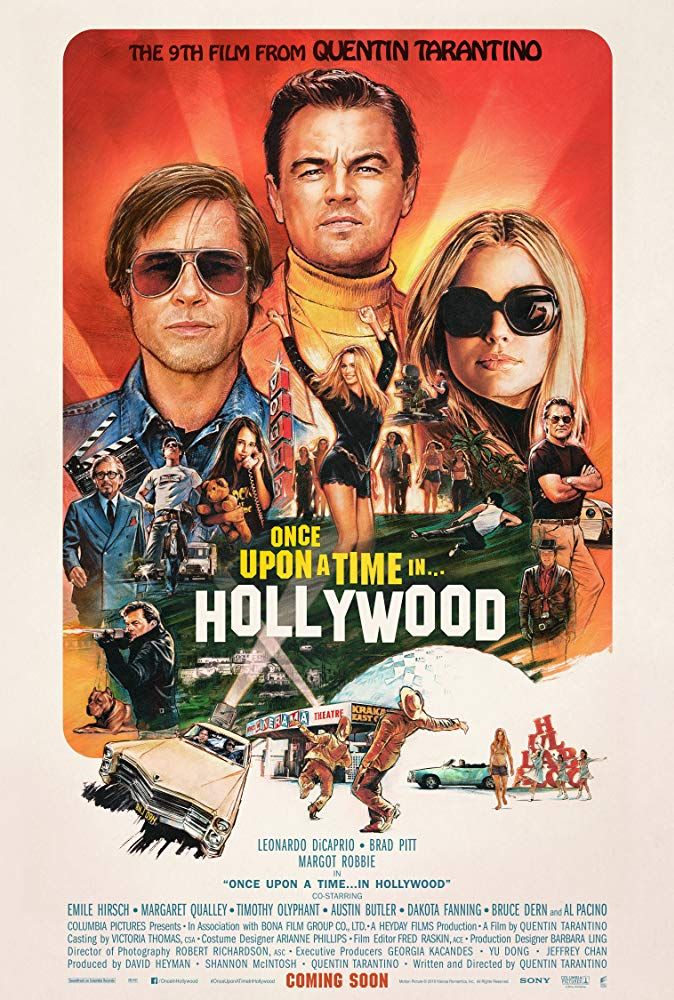
Once Upon a Time ... In Hollywood: Masterful Alternate Reality


My wife and son and I just saw Quentin Tarantino's Once Upon a Time ... In Hollywood at our son's invitation. He's an even bigger Tarantino fan than I am, and my wife liked a couple of his earlier movies too.

The latest is among the best three Tarantino ever made - right up with Reservoir Dogs (in a class by itself) and Jackie Brown, which was just an all-out brilliant movie.  I use the phrase "alternate reality" in the title of this review.  As many of you know, I'm a science fiction author, and a copious reviewer of science fiction television series and movies.  I don't mean to suggest that Once Upon a Time is science fiction alternate reality, in the way that, say, the recently departed Counterpart on television was.   But as the title surely suggests, Once Upon a Time is a fable, neither docu-drama (though it does touch upon many aspects of real history) nor sheer fiction.

And the aspects of reality woven into this marvelous movie that takes place in 1969 Hollywood range from Bruce Lee to Mannix on television to the Playboy mansion to Charles Manson and Sharon Tate.  The fictitious characters are headlined by Rick Dalton (a somewhat washed up 1950s TV Western actor) and his stunt man double, Cliff Booth.  Rick is played by Leonardo DiCaprio and Cliff by Brad Pitt.  I've been saying ever since the two began burning up the screen decades ago that their looks almost made them interchangeable.  It was good to see Tarantino finally build a movie around this.

The movie is chocked full of memorable scenes, including Sharon Tate enjoying her own movie, Cliff getting the better of Bruce Lee in either a fantasy or a flashback, and Al Pacino playing a agent whose name is Schwarz and insists that people don't call him Schwartz (I've known a few people named Schwarz over the years, and have always been aggravated that I couldn't call them Schwartz).  And a plethora of great lines, including Dalton exulting in fried "sour kraut" when he takes a flame thrower to Nazis in an audition for a movie.  (I wouldn't be surprised if Tarantino came up with that line when he was 15, and was just waiting for a chance to write a scene in which he put it into a movie.)  And a full-house of great stars, most of them no youngsters, playing all kinds of bit and bigger parts, as per just about all Tarantino movies.

But the best part - and I won't say more, lest I give too much away - is the ending of the movie, which is why I say this movie is alternate reality (or alternate history, depending on how you look at it).  With so much of our reality animating this fable, Tarantino lulls us into thinking that just about everything will be the same.  It isn't, and that what's wraps up this wonderful package of what will go down as a quintessential Tarantino masterpiece.


real alternate reality, if that makes any sense
"flat-out fantastic" - Scifi and Scary


Tuesday, April 25, 2017

American Playboy: The Hugh Hefner Story: Highly Recommended and Not Just for the Pictures

Binge-watched American Playboy: The Hugh Hefner Story on Amazon Prime the past few days. The 10-episode documentary-docudrama was excellent, and not just because of the pictures.

Hefner himself plays a major role, not just in real footage over half a century, but from an extensive interview he did in 1991.   Matt Whelan is convincing as a young through middle-aged Hefner, and provides narration throughout.  The same formula is effectively employed for Hefner's inner circle and brain trust at Playboy - recent interviews with the real people mixed with actual footage of them in their younger days, and lots of docudrama reenactments for the earlier days - as well as for important women in the story, including Barbie Benton (described by Hefner as the "love of my life"), Dorothy Stratten (a gorgeous blonde Playmate murdered by her jealous husband), and Marilyn Cole (British Playmate who helped Playboy in its competition with Penthouse by showing some frontal nudity).

The battle between Playboy and Penthouse, which came on the scene in America (I'm not going to try and avoid double entendres) in 1969, some 16 years after Playboy launched its first issue in 1953 with Marilyn Monroe on the cover and never looked back, is indeed one of the major themes of the documentary (or its second half). This true story of escalating nudity in the competition for readership and its conclusion in the 21st century and the age of the Internet is especially relevant to media theory. Playboy's circulation today of 600,000+ is less than 10-percent of what it had at its height in the 1970s (over 7 million for its November 1972 issue), and Penthouse, which with its raunchier pictures briefly exceeded Playboy's circulation in the 1970s, now has just a little over 100,000.  The reason is the instant access to porn on the Internet, which caters to every taste, and, by the way, is free.

The U. S. government, by the way, did its utmost to stamp out freedom of expression on the Internet (see my analysis in The Soft Edge of the Communications Decency Act of 1996 and the Supreme Court's wise ruling that it was in violation of the First Amendment),  and though it by and large did not succeed regarding the Internet, it hounded Hefner throughout his career, and did some damage. Hefner himself was never convicted of a crime, but his casinos in New Jersey and England (the British government was no better than the American) were denied liquor licenses on pretexts, and Hefner's long-time assistant Bobbie Arnstein took her own life in the  Nixonian 1970s when faced with the choice of going to jail or making up garbage about Hefner.   This tragic example of a U. S. Attorney behaving like Gestapo has special and chilling relevance in our own age of Trump.

But as this documentary makes clear, Hefner and Playboy were often targets not only of the government but the media, which should have been Playboy's staunchest defenders on freedom of expression, but were either too dumb, blind, jealous, or all three to see that.  In this regard, I was surprised to see what what a, well, a-hole the young Mike Wallace was in his smug sneering interview of Hefner in the early days (though a much older Wallace seems to admit the error of his younger ways).

Gloria Steinem and the feminist critique of Playboy is yet another related issue, and I'd say that both sides have merit to their positions here, so to each her/his own.  Hefner to this day insists he's always been a champion of women and their rights - including medical care and control over their bodies but also taking off their clothes for Playboy.  The feminist argument that this last part "objectifies" women is also true.  My own view, for what it's worth, is that everything's ok among consenting adults.

There's almost no such thing as a perfect documentary on a subject you know well, because it's almost sure to leave out some things that you deem significant, inevitable given you didn't make the documentary.  I regretted no mention of the Marshall McLuhan interview in the March 1969 Playboy in the otherwise good segment on the importance of the Playboy interviews,  because McLuhan was not only the most important media theorist in history but that interview was by far his most informative (see my McLuhan in an Age of Social Media for why his ideas are more relevant than ever today).  And, similarly, no mention of Alice Turner and the great science fiction she brought to the magazine in the 1990s (I met Alice when I was President of the Science Fiction Writers of America in 1999, so I guess I'm a little biased).

But these are small quibbles indeed about an outstanding documentary, free on Amazon Prime, which everyone interested in media and the popular culture of the past 60 years should see.

Monday, April 14, 2014

Mad Men 7.1: Vignettes and Playboy

Mad Men was back with its seventh season last night - it will be its last, though presented in  two seven-episode parts, over two years.   As was the case with much of season 6, this first episode of the final season offered a compelling series of interlocking vignettes, rather than a single overarching narrative. Indeed, the plot barely moved forward, making the episode more like a sequence of still life paintings, brilliantly rendered, hanging on diverse walls, than a story across time.

Among the highlights of this new form of television story telling -

  • Don's slowly deteriorating relationship with Megan:  It was already on the beginnings of the rocks last season, and is moving along to break-up ever so exquisitely slowly.   Megan, out in Los Angles and receiving Don's visit, barely wants to sleep with him.  She might have been more open to Don, had he not been rushing back to New York the very next day on a red eye.  But, understandably, she can't quite see where their relationship can go with this series of in effect one-night stands.  For his part, Don flirts with a blonde real estate agent in LA who looks like a young version of Betty, and a woman on the red-eye, who looks like an older version of Megan, and whom he might even have wanted to have some sex with, if it had been confined to something on the plane.
  • Don's business is more blurry than a watercolor: he's still on leave, but pitching some kind of business, while he's still a collecting a check from what's left of the grand old firm.   The merger has made the firm even less recognizable than it was last year, giving it a faintly alien quality accentuated by Don, Roger, Bert, and Harry not on hand in the office - for different reasons - and Ken with a patch over his eye, courtesy of the hunting accident he had last season.   (Actually, I'm assuming Bert and Harry were absent for different reasons, because no reason was presented.)
  • Peggy and Joan are still have difficulty getting their good ideas accepted, again for different reasons.   And I've got to say that I found Joan's character more interesting than Peggy's in episode 7.1, because Peggy's problems seem a rehash of what we've seen in just about every season.
  • The visual details were outstanding, as they always are.   My favorite was seeing a copy of Playboy in Don's possession.  Let's see: its January 1969 - Nixon is being inaugurated - would have been cool had that copy of Playboy been the March 1969 issue with the McLuhan interview, and a tip of the hat to "the medium is the message" line that we heard lo those many seasons ago on this series.  It wasn't, but its these resonances, real and imagined, that make Mad Men such a fine piece of television.
And it's great to see this series right back where it belongs: on television, not in our recollections - at least, not until after 2015.

See also Mad Men 6.1-2: The Lighter and the Twist ... Mad Men 6.3: Good Company ... Mad Men 6.4: McLuhan, Heinz, and Don's Imagination ... Mad Men 6.5: MLK ... Mad Men 6.6: Good News Comes in a Chevy ...  Mad Men 6.7: Merger and Margarine ... Mad Men 6.8: Dr. Feelgood and Grandma Ida ... Mad Men 6.9: Don and Betty ... Mad Men 6.10: Medium Cool ... Mad Men 6.11: Hand in the Cookie Jar and Guy de Maupassant ... Mad Men 6.12: Rosemary's Baby, Dick Cheney, and Sunkist ... Mad Men Season 6 Finale: Beyond California

See also Why "You Only Live Twice" for Mad Men Season 5 Finale ... Mad Men Season Five Finale

See also Mad Men Season 5 Debut: It's Don's Party  ... Mad Men 5.3: Heinz Is On My Side ... Mad Men 5.4: Volunteer, Dream, Trust ... Mad Men 5.5: Ben Hargrove ... Mad Men 5.6: LSD Orange ... Mad Men 5.7: People of High Degree ... Mad Men 5.8: Mad Man and Gilmore Girl ...Mad Men 5.9: Don's Creativity  ... Mad Men 5.10: "The Negron Complex" ... Mad Men 5.11: Prostitution and Power ... Mad Men 5.12: Exit Lane

And from Season 4: Mad Men 4.1: Chicken Kiev, Lethal Interview, Ham Fight ... 4.2: "Good Time, Bad Time?" "Yes." ... 4.3: Both Coasts ... 4.4: "The following program contains brief nudity ..." 4.5: Fake Out and Neurosis ... 4.6: Emmys, Clio, Blackout, Flashback  ... 4.7: 'No Credits on Commercials' ... 4.8: A Tale of Two Women ... 4.9: "Business of Sadists and Masochists" ...4.10: Grim Tidings ... 4.11: "Look at that Punim" ... 4.12: No Smoking!  ... Mad Men Season 4 Finale: Don and -

And from Season 3: Mad Men Back for 3 and 3.2: Carvel, Penn Station, and Diet Soda and 3.3: Gibbon, Blackface, and Eliot and 3.4: Caned Seats and a Multiple Choice about Sal's Patio Furniture and 3.5: Admiral TV, MLK, and a Baby Boy and 3.6: A Saving John Deere and 3.7: Brutal Edges ... August Flights in 3.8 ... Unlucky Strikes and To the Moon Don in 3.9 ... 3.10: The Faintest Ink, The Strongest Television ... Don's Day of Reckoning in Mad Men 3.11 ... Mad Men 3.12: The End of the World in Mad Men ... Mad Men Season 3 Finale: The End of the World

And from Season Two: Mad Men Returns with a Xerox and a Call Girl ... 2.2: The Advertising Devil and the Deep Blue Sea ... 2.3 Double-Barreled Power ... 2.4: Betty and Don's Son ... 2.5: Best Montage Since Hitchcock ... 2.6: Jackie, Marilyn, and Liberty Valance ... 2.7: Double Dons... 2.8: Did Don Get What He Deserved? ... 2.9: Don and Roger ... 2.10: Between Ray Bradbury and Telstar ... 2.11: Welcome to the Hotel California ... 2.12 The Day the Earth Stood Still on Mad Men ... 2.13 Saving the Best for Last on Mad Men

And from Season One: Mad Men Debuts on AMC: Cigarette Companies and Nixon ... Mad Men 2: Smoke and Television ... Mad Men 3: Hot 1960 Kiss ... Mad Men 4 and 5: Double Mad Men ...Mad Men 6: The Medium is the Message! ... Mad Men 7: Revenge of the Mollusk ... Mad Men 8: Weed, Twist, Hobo ... Mad Man 9: Betty Grace Kelly ... Mad men 10: Life, Death, and Politics ...Mad Men 11: Heat! ... Mad Men 12: Admirable Don ... Mad 13: Double-Endings, Lascaux, and Holes


#SFWApro

InfiniteRegress.tv