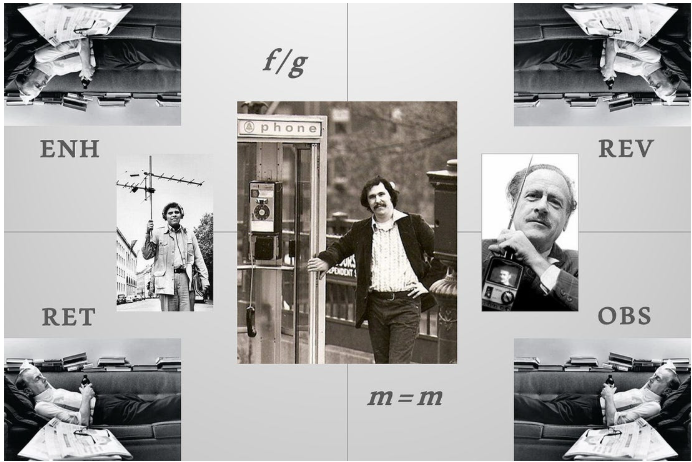
Here's the two-part interview Andrey Mir recently did with me about Neil Postman and Marshall McLuhan. I was Postman's student, and I wrote two books about McLuhan, as well as organized the one and only conference about the Tetrad.

Showing posts with label tetrad. Show all posts
Showing posts with label tetrad. Show all posts
Wednesday, September 9, 2026
In-Depth Two-Part Interview about Neil Postman and Marshall McLuhan


Monday, September 1, 2025
Star Trek: Strange New Worlds 3.8: Pike's Hair and Spock's Smile
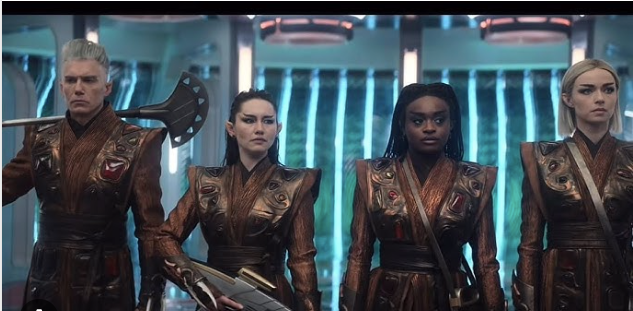
Well, Star Trek: Strange New Worlds 3.8 served up the obligatory comedy of the season. It wasn't as funny as TOS's "Trouble for Tribbles" (which got David Gerrold's career going), but it did have its moments.
[Spoilers ahead ... though it seems a bit off to warn about spoilers where laughs are involved ... ]
First, the set-up: Pike, La-an, Chapel, and Uhura are temporarily turned into Vulcans. But the temporary takes much longer than expected, and hence this close-to-entire episode.
Here are some of my favorite results:
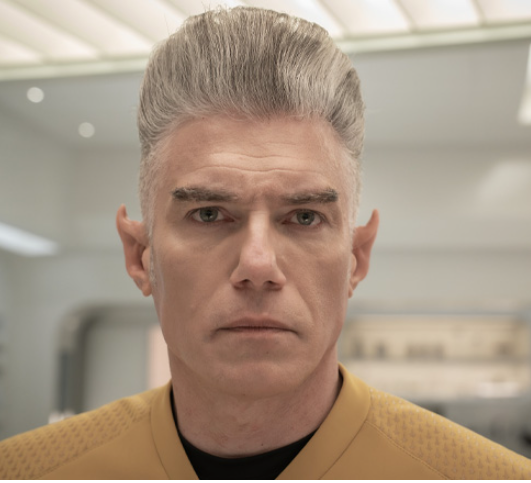
- Pike's hair looks funnier than ever as a Vulcan. They must've applied Brylcreem to Anson Mount's hair, but he deserve credit for some fine deadpan acting as Vulcan Pike.
- La'an (Christina Chong), on the other hand, looked great as a Vulcan, and her dancing with Spock, likely about the closest we'll see of them making love, was fun to see.
- Speaking of Spock, the title of this episode -- "Four-and-a-Half Vulcans" -- though not a result of the change into Vulcans (because it's a title), is so good it deserves a shout-out. The half, of course, is Spock, who's half-human, so Pike, La-an, Chapel, and Uhura = 4 + Spock (1/2) = Four and a Half, and the title itself reflects Vulcan precision with language.
*See Andrey Mir's Digital Reversal for more.
See also Star Trek: Strange New Worlds 3.1-3.3: Gorn, Spock & Chapel, and The Walking Dead ... 3.4: Lots of Laughs and Serious Business ... 3.5: Endearing Pseudo-Science ... 3.6: Chris and Jim ... 3.7: The Medium and The Message
And see also Star Trek: Strange New Worlds 2.1: Nurse Chapel ... 2.2: Racism and Sexism in the Courtroom ... 2.3: Time Travel and Alternate Universes ... 2.5: Chapel and Spock ... 2.6: Jimmy Kirk ... 2.7: Pike, Spock, and Boimler ... 2.8: Ethically Wrenching ... 2.9: The Operetta ... 2.10: Young Scotty and Five Other Great Things about This Season 2 Finale
And see also Star Trek: Strange New Worlds 1.1-1.2: Great Characters, Actors, Stories ... 1.3: "Instead of terraforming planets, we modify ourselves ..." ... 1.4: The Gorn and the Wub ... 1.5 Going to the Chapel ... 1.6: Two Stories ... 1.7: The Kiss ... 1.8: Ends of the Continuum ... 1.9: Momentous! ... 1.10: Everything!
Thursday, August 14, 2025
Review of Andrey Mir's The Digital Reversal: Media, Social Media, AI, and the Fate of Humanity
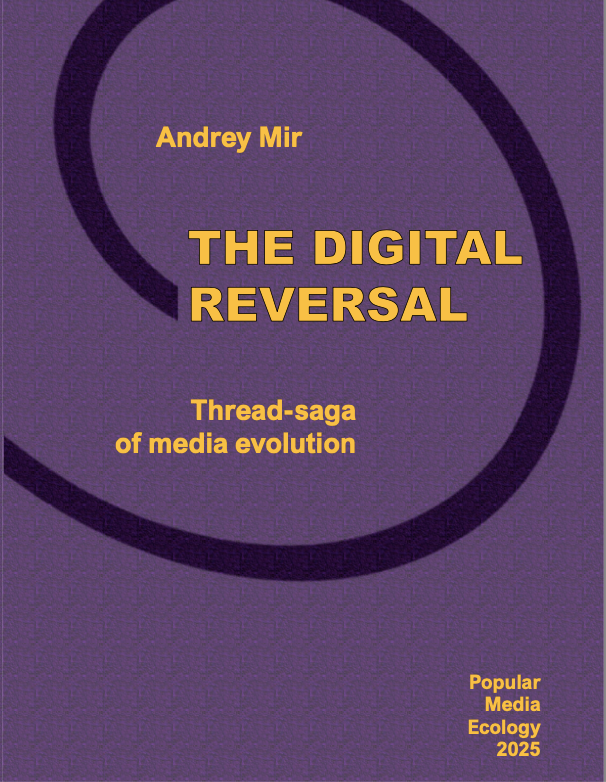
Andrey Mir's The Digital Reversal, building on his recent series of books with pathbreaking analyses, is so far ahead of any other scholarly work in understanding what's going on in the media world, and hence the world per se, today, that it hurts, even as it brilliantly elucidates. I'm in strong disagreement with Mir's insistence in his final chapter that humanity as we know it is inevitably doomed by the media evolution he so astutely traces and explains, but I nonetheless am sure that if you want to know where we are and perhaps what to do about this immensely difficult world we inhabit in 2025, you can do nothing better than read The Digital Reversal.
The foundation of Mir's book, the basis of its title, comes from Marshall McLuhan's "Laws of the Media," which postulate that all technologies have four modes of existence: they amplify or enhance some aspect of communication and life, they obsolesce an aspect of life that was previously amplified, they retrieve an aspect that had previously been obsolesced, and ultimately they reverse or flip into some new kind of technology that has some relation to the original but is markedly different. Since I first began thinking about the Laws of Media or Tetrad and published a Preface to one of McLuhan's first articles about the Laws in 1977, I've found radio and television to be a clear example of how the Laws work: Radio amplifies speech, music, news, verbal communication by sending it instantly across great distances with no wires; obsolesces printed newspapers and wired telephones; retrieves verbal communication with those close to us; and reverses into television. Now, lest you think that there's not much difference in the impact of radio and television, consider that radio made possible not only FDR and Churchill, but Hitler and Stalin, whereas the political impact of television brought us JFK, Reagan, and Obama, and, on the other side of the world, Gorbachev. That's because radio boosted unseen power, in contrast to television, which showed us what the would-be people of power looked liked. Nixon lost the television debates with JFK and thereby the election because Nixon looked sweaty and shifty in his reaction shots on TV while Kennedy looked cool and comfortable and in control.
Mir's Digital Reversal, then, delves into something that happened to us -- is still happening to us, right now -- after the revolution in personal computers and the Internet in the 1980s and 1990s. The reversal happened quickly, virtually overnight, if we look at the time it took the printing press to make its mark, and then electronic media, and every media shift that came before those two momentous developments. "The blogosphere, cellphones, and tablets already belong to media archaeology," Mir correctly notes. And he proceeds to tell us the results of this reversal. Building upon his Postjournalism and the Death of Newspapers (2020), Mir notes that the search for truth and the goal of accuracy in traditional journalism has been supplanted by the quest for Likes and Shares online and the self-affirmation they provide. Joining this reversal is what Mir calls the "emancipation of authorship" and I call "consumers becoming producers" (in New New Media, 2009), with conservatives and reactionaries joining progressives online in the 2010s, coalescing with a few of them into MAGA aggrieved Americans pushing glittering outright lies, electing Donald Trump in 2016, falling short in 2020 (probably due to COVID), and putting Trump back in office in last year's election.
But Mir expects this digital reversal to do far worse than Trump to humanity. After detailing the impact of the digital reversal on everything from how we know -- epistemology -- to how we sense and perceive, in a philosophic tour-de-force that Immanuel Kant would have welcomed, Mir turns to an issue that everyone in and out of academe seems to be talking and writing about these days: AI. And his view on that, I'm happy and unhappy to say, explicitly builds upon my "anthropotropic" theory of media evolution, that I came up with and developed in my 1978 doctoral dissertation, Human Replay: A Theory of the Evolution of Media: as media evolve, they attempt under our invention to replicate as much of our natural modes of communication as possible, as the media extend our communication beyond our original, unmediated ways of conveying information. Writing extended our voice beyond its immediate surroundings, but sacrificed the pitch and all the acoustic characteristics of speech. Telephone and radio eventually corrected that, but left out what we see when someone talks to us face to face, in person. Television and then Facetime, Skype, and Zoom corrected or "replayed" that crucial missing nonverbal visual aspect of speech.
And Mir argues, regarding AI, that it will be responsible for the greatest flip of all: human replay will flip into human replacement. That is, the AI that we invented will replace us, merge with us into something in the AI's favor, in the very near future. Among the many casualties, we won't go physically out beyond the planet into space anymore. "Deep space exploration—anything beyond Mars (and even that’s unlikely)—will never happen. There’s no real practical need for it" because "why bother escaping polluted, annoying Earth for Mars if you can escape into an induced, endlessly modifiable reality? Chasing interstellar travel is like staring into the rearview mirror." (My response: We'll keep going physically out into space, because we'll never find out what we're doing here in this universe from down here on this planet -- see Touching the Face of the Cosmos: On the Intersection of Space Travel and Religion for more.)
But not going out beyond this planet is the least of Mir's apocalyptic vision for the immediate future, which "will occur sometime in the middle of this century". Mir writes, "humans themselves are becoming digital—so far just metaphorically, but soon literally, and not in the literate sense of the word." Not just metaphorically? Meaning, what? That sometime around 2050, if I live that long, my blood cells, my brain, my DNA, or whatever will literally turn into some kind of digital code, which will replace my self-awareness? Mir says about Douglas Rushkoff and his book Team Human: "he takes a moral stance and insists on people’s ability—and even duty—to seize back control of media evolution". Who says it's out of control, let alone totally out of control? Trump's ascension is drastically not enough to support this claim. True, he was elected U. S. President twice, but he also was defeated once, and the first time he won, he nonetheless lost the popular vote. A far more likely explanation for his success in 2024 was Biden's disastrous performance in their June 2024 debate (see my continually updated McLuhan in an Age of Social Media for more -- it makes the point that maybe debates have outlived their usefulness).
Mir's final paragraph -- all his paragraphs are deliberately the length of Tweets -- advises “'Endure and abstain' is literacy’s last resort, futile but noble." But as Jim Bishop wrote in the New York Journal-American on March 14, 1959: "The future is an opaque mirror." Mir is flawless, perceptive, ingenious, splendid when he writes about the past up to the present. But like any other mortal, he cannot possibly predict the future with any acumen, certainly not 25 years from now. By then, this very book, The Digital Reversal, may well have woken enough of us up, so we don't sleepwalk into this AI nightmare.
Saturday, January 6, 2024
Tetrads for History and Alternate History
listen to this podcast here, or anywhere you listen to podcasts
Marshall McLuhan's tetrad is a useful tool for discovering and understanding how human activities, especially media, are connected to one another. It maps a four-part relationship that happens in any human endeavor. That activity AMPLIFIES or ENHANCES an aspect or certain aspects of human life; as it does this, it OBSOLESCES an activity that had previously been amplified; and the human endeavor also RETRIEVES an activity that had previously been obsolesced or pushed off center stage; and the amplified activity REVERSES or FLIPS INTO a new activity, at once very different from but closely related to what was amplified.
So, for example:
RADIO AMPLIFIES sound and speech heard instantly across great distances, for the purposes of news, entertainment, etc; OBSOLESCES slower visual media such as newspapers and books; RETRIEVES word of mouth, in-person singing, oral history; and REVERSES into TELEVISION.
And TELEVISION, in turn, AMPLIFIES audio-visual sent instantly across great distances; OBSOLESCES radio (as a source of drama and comedy); RETRIEVES cave painting and all painting, motion pictures, and all forms of writing; and REVERSES into the Internet, smartphones, holography.
In other words, tetrads move through history in cycles -- or, as I have put it, in wheels or spirals.
Now, I've been thinking a lot about alternate history these days -- writing, reading, watching narratives in which some crucial element in the past has been changed. Last week, I had a great conversation with Chuck Todd on his podcast, in which I said in order for an alternate history scenario to be plausible, its elements must be as close to real history as possible -- that is, everything other than the element of history that you're changing in your scenario.
And I realized last night that history and alternate history reside in a tetradic relationship. Here's how I see that:
Tetrad for HISTORY
AMPLIFIES: the past, as accurately as we can know it
OBSOLESCES the daily news, focus on the here and now
RETRIEVES: myth, legend, religion, non-scholarly accounts of the past
REVERSES INTO: alternate history -- changing a key element of the past; for both entertainment (fiction) and a better understanding of "real" history (in quotes, because even real history is not the entire story)
Tetrad for ALTERNATE HISTORY
AMPLIFIES: a fictitious better or worse world, obtained by changing a crucial element of history (for example The Man in the High Castle imagines a world in which Germany and Japan won the Second World War).
OBSOLESCES: our immersion in the present, and our view that it was inevitable
RETRIEVES: the notion most of us had when we were children that we could change something just by wanting it
REVERSES INTO: real alternate realities, which recent data from the Webb Telescope suggests could be possible (see this article in the New York Times which says our universe may be just one universe is a "multiverse").
***
Further reading on Tetrads: Laws of the Media (by Marshall McLuhan, with Preface by Paul Levinson); Tetrad Wheels of Cultural Evolution (Paul Levinson); Tetrad on the Selfie (Paul Levinson); Tetrads and Chiasmus: A Reclamation of the Tetrad Wheel (Matthew S. Lindia & Paul Levinson),
Further reading, listening to, viewing Alternate History: A Fiction Writer's Guide to Alternate History by Jack Dann; Paul Levinson's review of A Fiction Writer's Guide to the Alternate History; Paul Levinson's interview with Jack Dann; Paul Levinson's interview with Rufus Sewell, who starred in The Man in the High Castle series on Amazon Prime Video; Chuck Todd's interview with Paul Levinson about alternate histories; It's Real Life (alternate history about The Beatles by Paul Levinson, made into a radio play)
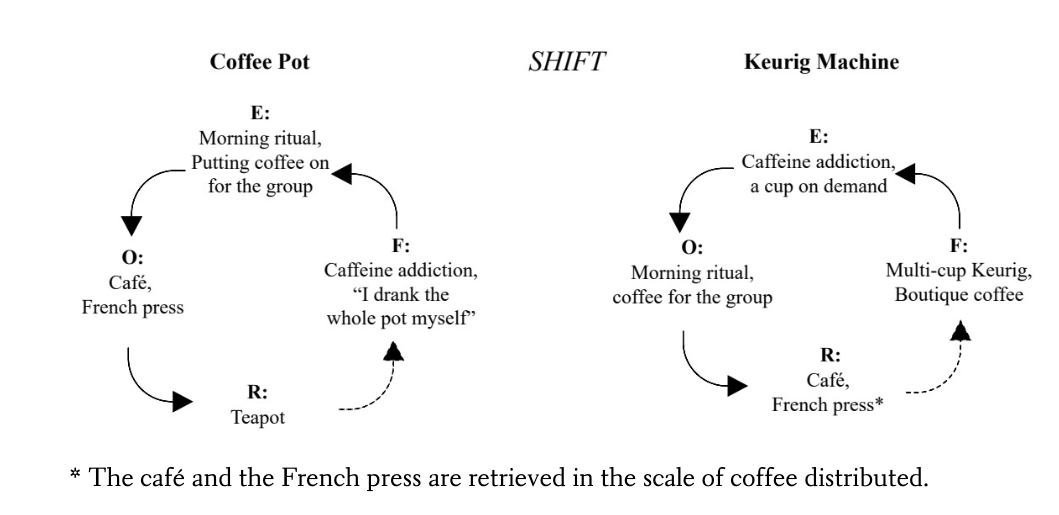
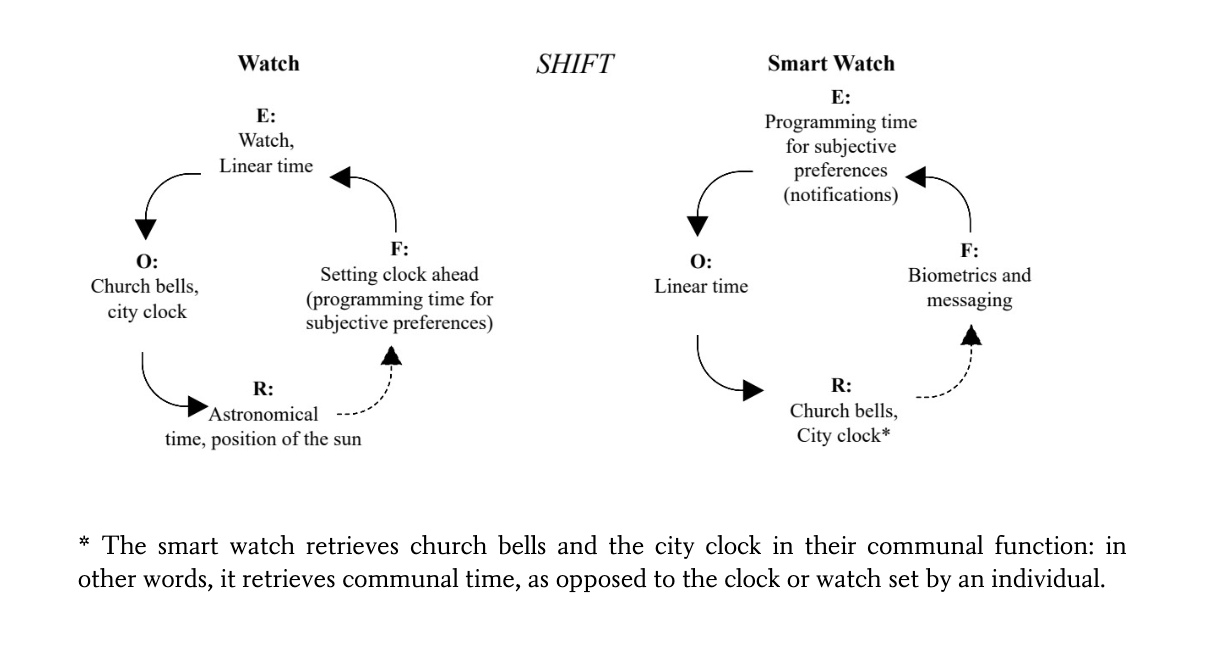
More Tetrad Wheels (from Lindia & Levinson)
Wednesday, December 30, 2020
Four Publications
I've had four publications in the past week, and since all are available FREE online, I thought I'd list them for you right here:
- Foreseeable -- brand new science fiction story in debut issue of Academfic
- The Missing Orientation -- essay about space exploration, sense of wonder, and religion in Religions
- Popper and Evolution Over the Decades -- how I met the great philosopher
- Tetrads and Chiasmus: A Reclamation of the Tetrad Wheel -- a pathbreaking, scholarly new article by Matt Lindia and me in New Explorations
Monday, October 27, 2014
Photography Flips into Snapchat
One of the joys of understanding McLuhan is how his insights can leap forth at unexpected times to supply us with a connection or a new insight about a matter - or medium - at hand. About six months ago, I came to realize that the photograph has flipped into the selfie in our own day and age. Just yesterday, I did a little podcast on this subject - in which I also pointed out that radio has flipped into the podcast. And today, just a few hours ago, I realized that photograph has also flipped into Snapchat.
One of the best things about McLuhan's tetrad or four laws of media is that a given medium can enhance, obsolesce, retrieve, and flip into multiple media. In case you'd like a quick refresher on the tetrad, it is an exploratory tool that McLuhan developed to help us make sense out of the emergence of media. Take radio, for example: It (1) enhances or amplifies sound (speech, music, etc) sent instantly across great distances simultaneously to lots of people; (2) obsolesces the written word as in newspapers as a mode of news delivery; (3) retrieves the spoken word that of course never really went away but was eclipsed to some extent by the products of the printing press; and radio, when it is pushed to its limits, (4) flips into television, which broadcasts like radio but re-inserts the visual into the mix. And, radio, the professional mass medium, also flips into podcasting that anyone with a microphone and a connection to the Internet can do. More on the tetrad in my book, Digital McLuhan, pictured below.
But back to photography: its flip into Snapchat is profound indeed, because permanency has always been one of photography's hallmarks. As Andre Bazin so aptly noted, a photograph rescues an image from "its proper corruption in time". In contrast, the Snapchat photo is deliberately intended to corrupt over time - and very quickly. Because the essence of Snapchat is that you send someone a photograph that you want him or her to see only when they receive it, and not any time after. If only former Congressman Anthony Weiner had known about Snapchat!
So we can now add Snapchat to the selfie as one of the media that photography has flipped into. Like a reflection in a pool of water, which can also be a selfie and also can disappear as soon as the person staring into the pool walks away, Snapchat epitomizes the ever percolating evolution of media to forms that are at once both new and well established in our past.
See also Marshall McLuhan and the Kindle and Tetrad on Eyeglasses Flipping into Google Glass

the spoken word
McLuhan and the Kindle | McLuhan and the Selfie
One of the best things about McLuhan's tetrad or four laws of media is that a given medium can enhance, obsolesce, retrieve, and flip into multiple media. In case you'd like a quick refresher on the tetrad, it is an exploratory tool that McLuhan developed to help us make sense out of the emergence of media. Take radio, for example: It (1) enhances or amplifies sound (speech, music, etc) sent instantly across great distances simultaneously to lots of people; (2) obsolesces the written word as in newspapers as a mode of news delivery; (3) retrieves the spoken word that of course never really went away but was eclipsed to some extent by the products of the printing press; and radio, when it is pushed to its limits, (4) flips into television, which broadcasts like radio but re-inserts the visual into the mix. And, radio, the professional mass medium, also flips into podcasting that anyone with a microphone and a connection to the Internet can do. More on the tetrad in my book, Digital McLuhan, pictured below.
But back to photography: its flip into Snapchat is profound indeed, because permanency has always been one of photography's hallmarks. As Andre Bazin so aptly noted, a photograph rescues an image from "its proper corruption in time". In contrast, the Snapchat photo is deliberately intended to corrupt over time - and very quickly. Because the essence of Snapchat is that you send someone a photograph that you want him or her to see only when they receive it, and not any time after. If only former Congressman Anthony Weiner had known about Snapchat!
So we can now add Snapchat to the selfie as one of the media that photography has flipped into. Like a reflection in a pool of water, which can also be a selfie and also can disappear as soon as the person staring into the pool walks away, Snapchat epitomizes the ever percolating evolution of media to forms that are at once both new and well established in our past.
See also Marshall McLuhan and the Kindle and Tetrad on Eyeglasses Flipping into Google Glass
the spoken word
McLuhan and the Kindle | McLuhan and the Selfie
Wednesday, April 30, 2014
Tetrad on Eyeglasses Flipping into Google Glass
I was just Skype interviewed by Nick Kyrouac at the University of Arkansas for a documentary he's doing as a Senior Project. We talked about my work with Marshall McLuhan, among other things, and I came up with a tetrad for eyeglasses flipping into Google Glass:
Eyeglasses enhance seeing the world around you.
Eyeglasses obsolesce poor vision.
Eyeglasses retrieve 20/20 vision.
Eyeglasses flip into Google Glass, or literally seeing not just the world around you but anywhere and everywhere in the world.
For more on the tetrad ...
the spoken word
McLuhan and the Kindle | McLuhan and the Selfie
Sunday, April 6, 2014
Tetrad on the Selfie

I just had an exchange with Ian Bogost over on Twitter, after I posted the above photograph of me, Marshall McLuhan, and Eric McLuhan, taken at the "Tetrad Conference" I organized at Fairleigh Dickinson University in March 1978.
Ian aptly said that I needed a "4th" (the "tetrad" has four components).
I replied that the 4th person pertaining to the photograph was the photographer*, which has flipped into the selfie.
Here, then, is a full tetrad on the photograph, and it's flipping into the selfie:
The photograph enhances capture of literal images.
The photograph obsolesces portrait painting.
The photograph retrieves memory, looking at images in pools of water, etc.
And the photograph flips into the selfie.
And it's a physical flip of the camera in the phone, as well as a philosophic flip.
*photographer was my student, Mary Lou Bale
For more on the tetrad ...
Subscribe to:
Posts (Atom)
