reviewing Black Doves; Dark Matter; Dept. Q; Detective Hole; Dexter: Resurrection; Fauda; For All Mankind; Foundation; Hijack; Memory of a Killer; MobLand; Outlander; Paradise; Presumed Innocent; Reacher; Severance; Silo; Slow Horses; Smoke; Star City; Star Trek: Strange New Worlds; Tehran;The: Day of the Jackal, Diplomat, Night Agent; Your Friends & Neighbors +books, films, music, podcasts, politics
George Santayana had irrational faith in reason - I have irrational faith in TV.
Chuck Todd interviews me about alternate histories
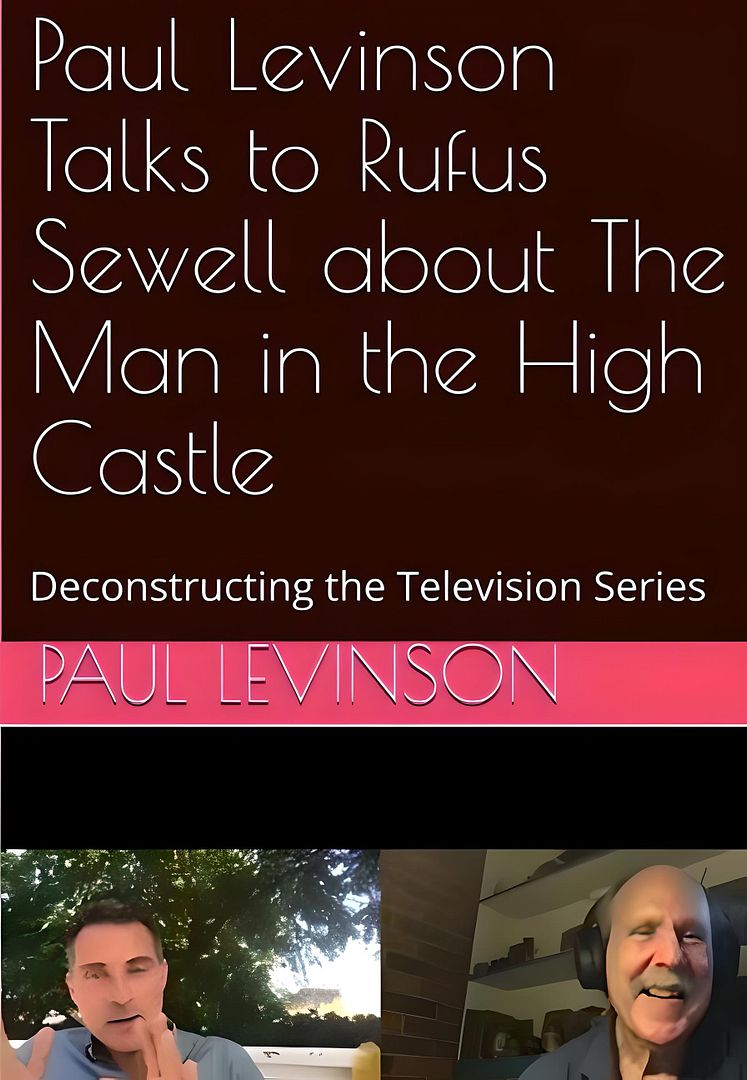
Couldn’t be a better time for The Man in the High Castle to show up on Netflix — here’s the 90-minute conversation I had with Rufus Sewell about his deeply thought-out performance in the lead role, in July 2021, shortly after the conclusion of the pathbreaking series on Amazon.
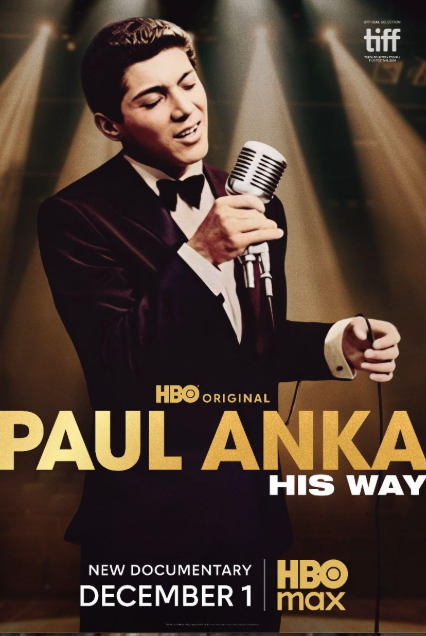
My wife and I saw Paul Anka: His Way, a 2024 documentary, last night on HBO. Why did we wait so long to see it? I don't know. Probably because we weren't paying enough attention.
I've been a fan of Anka since 1957, when I was in 5th grade in PS 96 in The Bronx, and Anka had a great hit, "Diana". Joel Iskowitz, Jordan Axelrod, Steven Auerbach, and Paul Gorman were in my class. I started an acapella group, Little Levi and the Emeralds. I don't think we sang much of "Diana" -- we were more into The Five Satins, The Harptones, and The Del Vikings -- but we sure loved it.
Anka explains and demonstrates at the beginning of the documentary that the ease of playing those 4-chord songs -- C, Am, F, G -- when he sat down at the piano was what drew him into singing and then writing. And he progressed in extraordinary ways, writing "My Way" for Sinatra, the Johnny Carson theme song, and even some songs with Michael Jackson. He also wrote "It Doesn't Matter Anymore" for Buddy Holly and "She's a Lady" for Tom Jones, and those are just a fraction of the more than 900 songs Anka has written!
Of course, no documentary can play even small parts of most of that number of songs, but the question always arises (for me, at least) of what songs would I have liked to hear and see Paul Anka perform in His Way? And, yes, there is one, in particular. It's a song that played a crucial role in Amazon's adaptation (by Frank Spotnitz) of Philip K. Dick's The Man in the High Castle, which ran for four seasons (2015-2019) and helped establish streaming as the titan it is today, The first episode of the second season in 2016 opens with an extended mise-en-scène of protagonist John Smith's (Rufus Sewell brilliantly portrays Smith) young teenage son Thomas getting off the school bus and walking into class. Everything seems so normally, happily, suburban American, as Thomas Smith (good job Quinn Lord) looks at the girls and walks into school. We begin to get a disquieting taste of this alternate history in which the Nazis beat America in the Second World War when we see the Nazi insignia on Thomas's arm and then a kid in the class asks Thomas how many slaves George Washington and Thomas Jefferson had. Thomas Smith then looks at a girl in the class in that certain way, she looks back at him when he isn't looking, but the joy of that budding teenage romance is shattered to pieces for the TV viewer when Thomas is called up to the front of the class to give a Nazi pledge of allegiance that he does with pride.
Now, this is one of Spotnitz's best conceived and realized scenes, and he hammers it home playing Paul Anka's 1960 hit song, "My Home Town," loudly and softly in the background until Thomas begins the pledge. This is an upbeat, zestful song, brimming with the enthusiasm and pleasures of living that is a hallmark of Anka's music, especially his early recordings -- the perfect background for the unnerving perversion of American life that the Nazi conquest has wrought.
So, yeah, I missed "My Home Town" in Paul Anka: His Way -- especially given the steps to fascism our country is currently taking -- but the documentary is titled "His Way", that is, Paul's way, and/or the movie's director and writer John Maggio's way, not my way, and as I've been known to say to someone who tells me that they would have had a character in one of my novels do or say something different than what I had them do or say: hey, go write your own novel. :) And all in all, there's not much I would change in this rendition of Anka's incredible inspiring life and journey. At 84 years old, he's still going strong, hasn't reached the top of the mountain yet (as he says), and I'm looking forward to hearing and hearing about the rest of the climb.
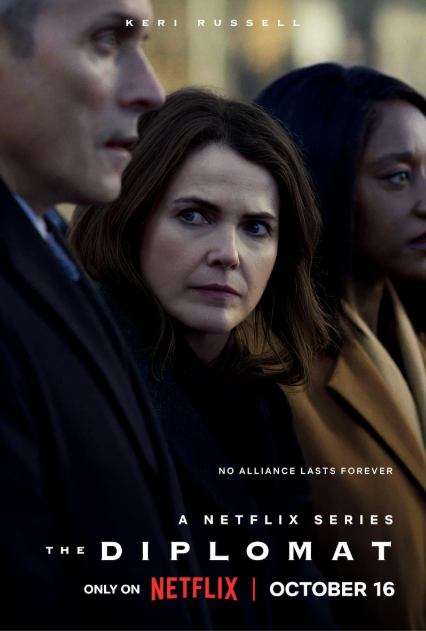
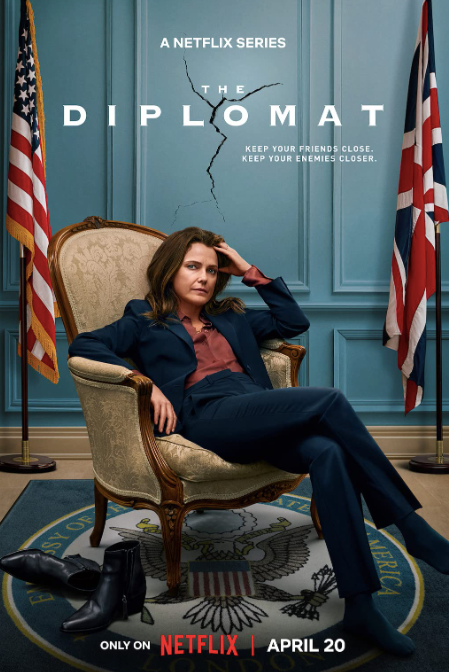
My wife and I just finishing bingeing the 8th episode of The Diplomat season 3 on Netflix. I thought this third season was the best season so far. Every episode was brimming with excitement and surprise. Indeed, the only predictable thing in this phase of The Diplomat is the content and conclusion of every episode was unpredictable, and radically so. This season couldn't have been presented more effectively than all episodes at once. Each episode was a chapter in a book that you couldn't put down (in both meanings of the word).
It was also was the most romantically explicit -- not that it would be "R" rated, the only nudity was the British PM's backside -- but the romance was hot, inhabiting and invigorating just about every relationship and every episode.
[And there will be spoilers ahead ... ]
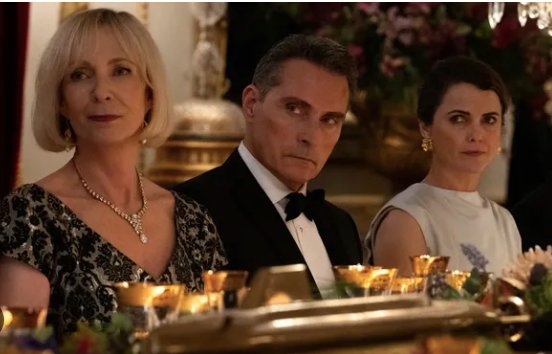
Indeed, there was a very big hint at the very end that Hal Wyler (perfectly played as always by Rufus Sewell) as VP of the United States was sleeping with Grace Penn, who became President after the death of Rayburn that was the stunner at the end of season 2, after Kate Wyler (perfectly played as always by Keri Russell) makes passionate love with Callum Ellis in a previous episode, and then in the final episode apologizes to Hal staying away from him physically and enthusiastically adhering to their "secret divorce" in Ellis's arms. And the First Man -- Todd Penn -- suspects something may be going on in bed between his wife (The President) and Hal (the Vice President), with the ending certainly suggesting that Hal is living up to his title as "Vice" President in more ways the one.
The thrill of The Diplomat is also political, and a political thriller, almost James Bondian (as I said about the previous seasons), this third season of The Diplomat certainly is. Not only are the Russians and Chinese involved, but the US and the UK are on the edge of being at serious odds, after the truth comes out that the US was responsible for the sinking of the British ship with which the series began. And the political thrills are lubricated by the lies that we see the US side cooking up to protect President Penn, blaming the deceased former President for something that Penn was actually responsible for when she was VP.
Also like the Bond movies, we're told at the end of The Diplomat season 3 that there will be a fourth season. My only regret is that it won't be up on Netflix tomorrow.
I just finished watching the six episode second season of The Diplomat, which went up on Netflix on the last day of October. Here's a review with no specific spoilers, and therefore no warning.
Let's begin at the end. It's got the best surprise ending I've seen in at least the hundred seasons of any television show, on traditional network, cable, and streaming. I don't know ... maybe make that five hundred.
Now, it's important to state the obvious, and keep in mind that this second was finished before the results of our election for President a few days. So think of this second season as capturing the ambience and reality of the American President, VP, and staff maybe a year or six months ago, replete with a pretty old old American President, and a somewhat younger female VP.
I say American, even though the story takes place in Britain. But American leaders appear in person and on video calls, And of course the central characters are Kate Wyler, recently appointed US ambassador to the UK, and her husband Hal Wyler, former ambassador to Lebanon. Unsurprisingly, both parts are played to perfection by Keri Russell and Rufus Sewell (who sounds, as always when he wants to, as American as I am).
Indeed, every bit of the acting was top-notch, especially Rory Kinnear as the British PM, and Allison Janney as the US VP. But don't get me wrong. I didn't love every last scene in this second season, such as when one character explaining something to another character says it's a case a correlation not causation, and the other smugly says no one really gets what that means. In off-screen fact, that's actually a very easily comprehensible concept, with an obvious example: there may be sunspots when the stock market crashes (correlation) but that doesn't mean the sunspots caused the crash (causation). (Here's a video from CNBC in which I explain the concept to an anti video-game crusader.)
Now banter like that, whether clumsy or astute, serves in this series to give it a cutesy, savvy flavor. But the story is so bold and powerful, it doesn't need any help from the cutesy side. Further, honestly, it couldn't have come along -- this second season -- at a better time for we Americans, and a lot of the world, as we try to make sense out of what just happened in our election.
See? No spoilers. And do see this second season of The Diplomat. After you've seen the first (and maybe read my review, see the link below). You'll be in for a treat.
My wife and I just binged the first season of The Diplomat and loved it.
[Spoilers ahead ... ]
To begin with, it seemed like for most of the first episode -- in fact, until to the very end of that episode -- we were watching an updated, 2023-rendition of West Wing, on a more global scale. Which would have been very welcome. But the news at the end of this first episode made The Diplomat much more than that. Almost a James Bond, without the central character being an MI6 agent with a license to kill. So think The West Wing in politics, and Bond in terms of intrigue bringing the world to the edge of nuclear war, and that's even more welcome than just an updated West Wing. More welcome, that is, as fiction on the screen, not of course as reality.
Speaking of which, I'd say The Diplomat is the best treatment of world politics in the aftermath of the Russian invasion of Ukraine I've so far seen on the fiction screen. The attribution of the attack on the British ship to the Russians instantly moves the whole rest of the story into the dilemma of what can be done to punish the Russians, given that Putin has already threatened, many times, to unleash his nukes on Russia's enemies in our off-screen world.
And then there are the twists, the biggest being the one near very end of final episode of this season, that the attack on the British ship was ordered by the British PM, apparently as way of enabling him to be a Churchill of our time, and show Britain and the world how his country deals with deadly aggressors. I didn't see that coming -- not at all -- and yet it all makes sense in retrospect.
Before I get, though, to the big question, let me say that the acting was superb, on every level. Keri Russell as the diplomat, Kate Wyler, US Ambassador to the UK, was outstanding, delivering her lines, her facial expressions, and body language with sheet perfection, exceeding her previous peak performance in The Americans. And Rufus Sewell as her husband Hal was equally outstanding, though I wouldn't say he exceeded his performance in The Man in the High Castle, because that was in a class of its own. So what I will say is his Hal in The Diplomat is his best performance, other than as a character added to the TV adaption of a science fiction novel that almost single handedly defined a genre. And in The Diplomat, Russell and Sewell, individually but especially together, were a pleasure to see. And the same for everyone else.
Meanwhile, plotwise, I'm still not 100% convinced that their marriage wasn't working out, even though Kate explained that to Hal and us at least a dozen times. But maybe that's the point -- that Kate feels the need to say -- most of the time -- that they can't make it as a couple, because she knows how deeply she loves him, and still hasn't really convinced herself that the two need to split.
And let's get to the very ending: a car bomb in London that may have killed Hal, Stuart (Kate's second in command in the US Embassy), and Ronnie. There are tears in Kate's eyes when she gets the news in Paris. This means that at very least all three did not escape unscathed. If I had to bet, I'd say Ronnie was killed and Hal and Stuart survived, both headed to the hospital. All three dying would dramatically change the basis of the story -- and that would be more true of Hal dying than Stuart dying, so, of the three, I'd say Hal is the most likely survive. But I'd put my money on seeing Stuart next season, too.
I also have no idea if a decision has even been made as to who will be returning in Season 2. All I can tell you for sure is that my wife and I will be watching Season 2 of The Diplomat that day that it comes up on Netflix.
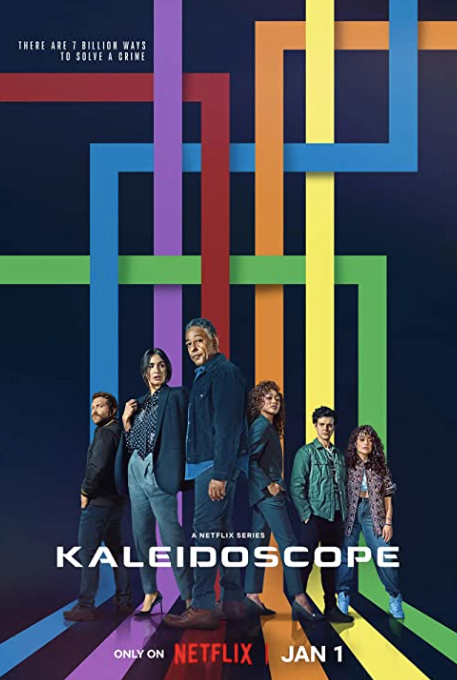
Hey, I just saw a great movie on Netflix -- actually, not a movie, but nine episodes of a television series, each of which feels like a movie in itself, and they all fit together like, well, a kaleidoscope.
And, this is the best heist story I've ever seen. It has everything, a suitably complex plot, a story in which every character is memorable, all kinds of things that go wrong and sometimes right, a superb soundtrack, and scenes that will move you to tears.
[There's bound to be some spoilers ahead ... ]
Apropos a kaleidoscope, we're told at the beginning that the episodes can be seen in any order. I saw them in the order presented on Netflix and listed on IMDb. I have no idea if this was the best order, or indeed if there is a best order. I will say, for whatever it's worth, that I thought the first and last (ninth) episodes were the weakest. That's because the eighth episode, which takes place at the end of the story, was the best. And even though I thought the first and ninth episodes were the weakest, I still think this was the best heist story I've ever seen on a screen.
I'm not going to reveal how many characters die and in what circumstances. But I will mention two unexplained deaths and my best guesses as to who did the killings.
Let's look at FBI Agent Abassi's death first. An old guy brushes past her on a New York City street, and she soon keels over and dies. The characters with the most motives are the Triplets (whose bonds in Salas's vault were the object of the heist), Leo/Ray's daughter Hannah, and Roger Salas's son Brad. Here's why: the Triplets want to stop the FBI's investigation into their business, Hannah is the one who got away with the money and she also doesn't want the FBI to continue looking into this heist, and although Roger is in prison his son Brad must know there is a lot more crime his father could be kept up the river for. My best guess is: Hannah. And if I had to rank the three, I'd say Hannah, the Triplets, and Brad, in descending order. Hannah has more than one motive. In addition to wanting to keep her money, she also wants to protect her father.
But speaking of her father, and even more important, who killed Leo/Ray? First, we don't see him actually killed. We see him, struggling to walk with Parkinson's, being stalked. And we hear a shot fired. So ... he easily could have fallen right before the shot was fired, with some good samaritan then tackling the gunman. But who then was the shooter? Not Hannah, who clearly continued to deeply love her father, in some of the best scenes in the series, by the way. The Triplets really had no motive, especially given Ray's deteriorating condition. That leaves, by process of elimination, Roger's son Brad. His motive was he blames Ray for ruining his father's life, and doesn't know Ray's true motivation.
By the way, not only was every character memorable, so was the acting. Three that especially stand out: Giancarlo Esposito as Leo/Ray gave the best performance of his career, even exceeding his outstanding work in Homicide and Breaking Bad. Rufus Sewell, as superb and versatile an actor as you'll find, was perfect as the complicated, driven, highly intelligent villain and victim of the heist. And Paz Vega as Ava was just perfect as Leo's indefatigable supporter.
This will be a series for the ages, right up there with the best work of Kurosawa and Scorsese. Hats off to creator Eric Garcia, and the four directors.
my interview of Rufus Sewell about The Man in the High Castle
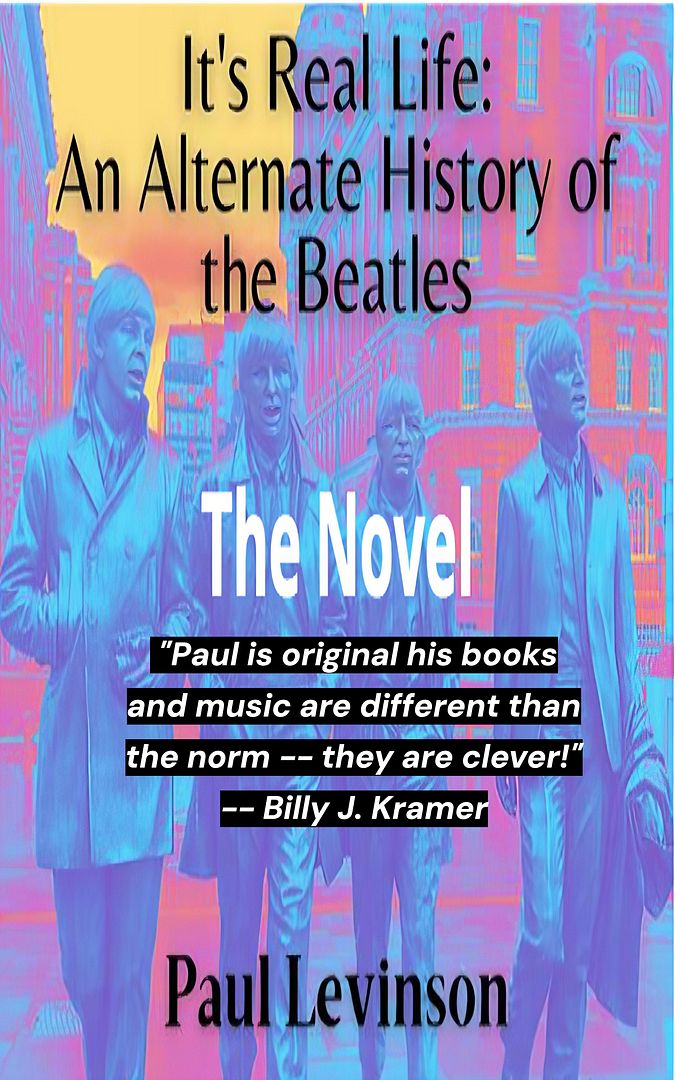
This seems to be my year -- by which I mean all of 2021 and 2022 -- for alternate history. The second season of For All Mankind in February 2021, Ronald D. Moore's masterful alternate history about the race to the Moon in the 1960s, and ensuing decades, was even better than the first. My 90-minute interview with Rufus Sewell in July 2021 about The Man in the High Castle series on Apple TV+ got me even deeper into that one-of-a-kind stunning story. And just this month, a favorite story that I've written was published -- "It's Real Life," my alternate history about The Beatles.
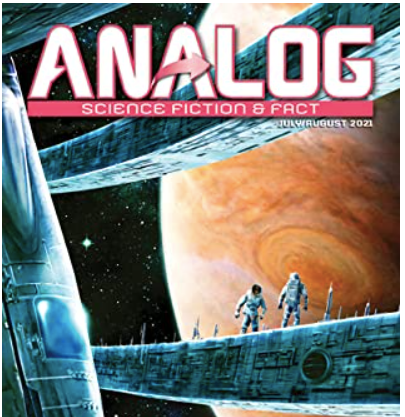
So I was well prepared to catch up in my reading with Rosemary Claire Smith's "The Next Frontier" in the July/August issue of Analog Magazine. And the novelette exceeded my high expectations, delivering a memorable mix of alternate history about our species reaching the Moon, heart-throbbing detailed astronaut action in space, keen social valence, and even a scene that brought tears to my eyes.
Here's the set-up, with just some introductory spoilers: Natalya Orlova has defected from the Soviet space program, and has joined Armstrong, Aldrin, Bean, et al as possible to likely candidates for our American missions to the Moon. Jackie Kennedy has become co-director of NASA (I just love that!), and she's far tougher than the media allowed us to see in our reality. Bobby Kennedy survived the attempted assassination in June 1968 (with just a scar on his head) -- another facet of this alternate history that I love -- and is locked in a tight race with Nixon for the U. S. Presidency.
If that doesn't tempt you to read this story, I guess alternate history is not your thing. Smith's novelette makes important statements about the role of women in getting our species off this planet (similar in that regard to For All Mankind), as well as the realpolitik of space travel. Highly recommended, to say the least, not just to read but as the best novelette for the AnLab, Nebula, and Hugo Awards this year.
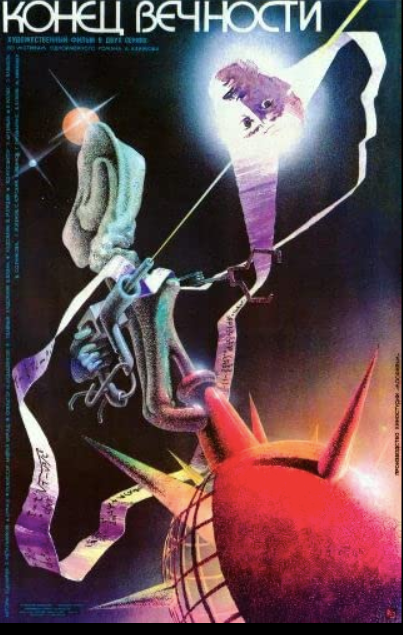
I saw a thread on Reddit about a 1987 Soviet adaptation of Isaac Asimov's The End of Eternity -- my favorite time travel novel, published in 1955 (which I first read as a kid in 1959) -- and of course I had to see it. Fortunately, it's available free, in two parts, on YouTube.
I don't speak or read Russian, but the movie has English subtitles. It's surprisingly good. When I review movie or TV series adaptations of novels and stories, I usually don't go into point by point comparisons with the source material. I try to assess the adaptations on their own terms, and stick to generalities and sprinkle in a few specifics as far as comparisons go. I'll do that here, as well as avoid specific spoilers, for those who haven't read the novel.
I say Andrei Yermash's movie is surprisingly good, because adaptations are difficult to do. The Man in the High Castle on Amazon Prime was superb, but in part because of the introduction of a new character not present in Philip K. Dick's novel, John Smith (see my conversation with Rufus Sewell, who brilliantly played the part ). There's widespread feeling that the best part of the recently concluded first season of Foundation was the clonal Cleon triumvirate, also not present in Asimov's novels and stories (see my conversation with reviewers Cora Buhlert and Joel McKinnon about this). Yermash's The End of Eternity was powerful and enjoyable and stayed pretty close to Asimov's account of a group of people, The Eternals, who use time travel to control and improve history -- according to their standards, which include stopping our movement off this planet into space -- but are challenged by one of their own who puts falling in love above all else.
Asimov's "allwhen" council of The Eternals works well in Yermash's Russian, and its evocation of the Soviet politburo. The movie also depicted my favorite gambit in the novel, communicating to the future via an ad in a news magazine. The acting was pretty good, with Oleg Vavilov as protagonist Andrew Harlan and Vera Sotnikova as his lover Noyes Lambent. And there was some nudity (I guess the Soviet Union wasn't that puritanical -- on the other hand, Konets vechnosti was made in almost the closing days of the Soviet regime.)
So my recommendation: if you like Asimov (1920-1992) -- who, after all, was born in Russia (I wonder if he knew about this movie?) -- and even more so, if you like time travel, do see this movie (again, it has English subtitles, unlike this 1976 Hungarian adaptation). It's not as good on screen as The End of Eternity is on the page, a creme de la creme of a time travel novel, the last novel that Asimov wrote, before he stopped writing science fiction novels for nearly two decades until The Gods Themselves in 1972. The End of Eternity is Asimov at his very peak as a science fiction writer, and it would be extraordinarily difficult for any movie version to equal it. But this Soviet adaptation conveys enough of the novel with style and flair to be in the upper echelon of time travel movies and well worth watching.
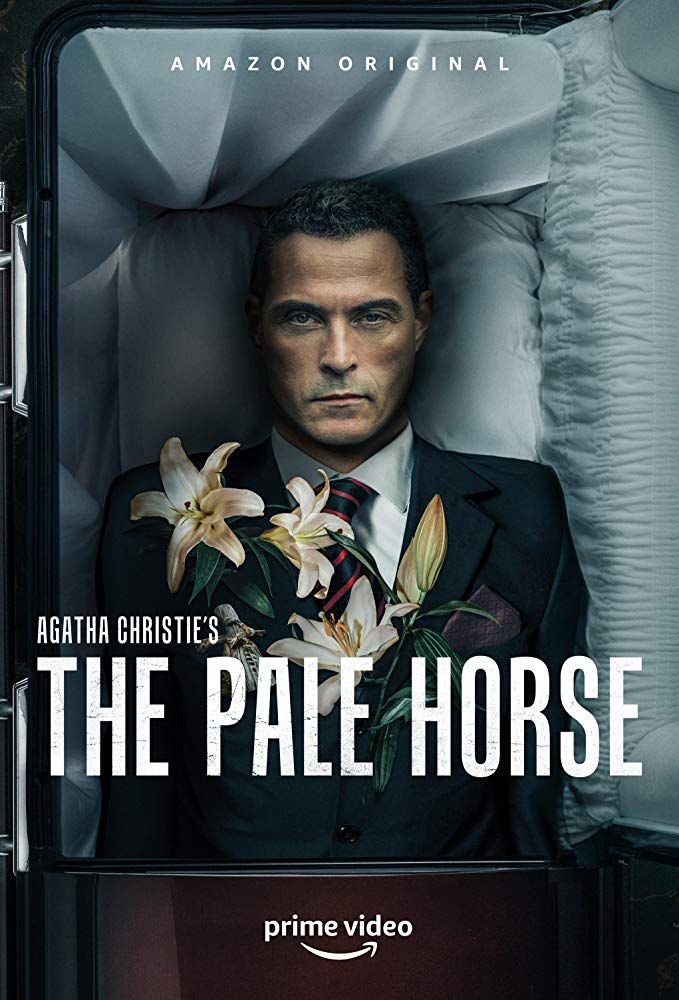
Good to see the versatile Rufus Sewell in The Pale Horse, a two-episode mini-series adaption of Agatha Christie's 1961 novel of the same name.
Agatha Christie is of course known for her cosy British detective stories, and The Pale Horse at first and even continuing glance seems something else. Mark Easterbrook (played by Sewell) finds himself on a list of people who died, and who, apparently are due to die, after he wakes up next to a dead redhead he slept with. It seems, at first, that a witches coven is responsible for this lethal mischief.
But, have no fear, Christie is a rational being, just as Easterbrook professes to be, and provides a perfectly logical, non-supernatural explanation for what happened and what is going on, at the end. Sewell provides a great performance of Easterbrook's tormented evolution along the way, and the end, like conclusions of all excellent mysteries, provides culprits and villains who were hiding in plain sight but seem perfectly plausible in retrospect.
I do wonder, though, why this Pale Horse was presented as a two-part mini-series? Why not just a one-part movie, or stretch out the story to make it a three- or four-part little series? But, hey, those kinds of divisional choices have no impact on the plot and performances (also good to see Kaya Scodelario, from the unfortunately not renewed Spinning Out, as Easterbrook's second wife Hermia) and The Pale Horse, especially with its twist that it's all-too-natural murder not supernatural witchcraft that moves the pieces, is wholeheartedly welcome viewing.
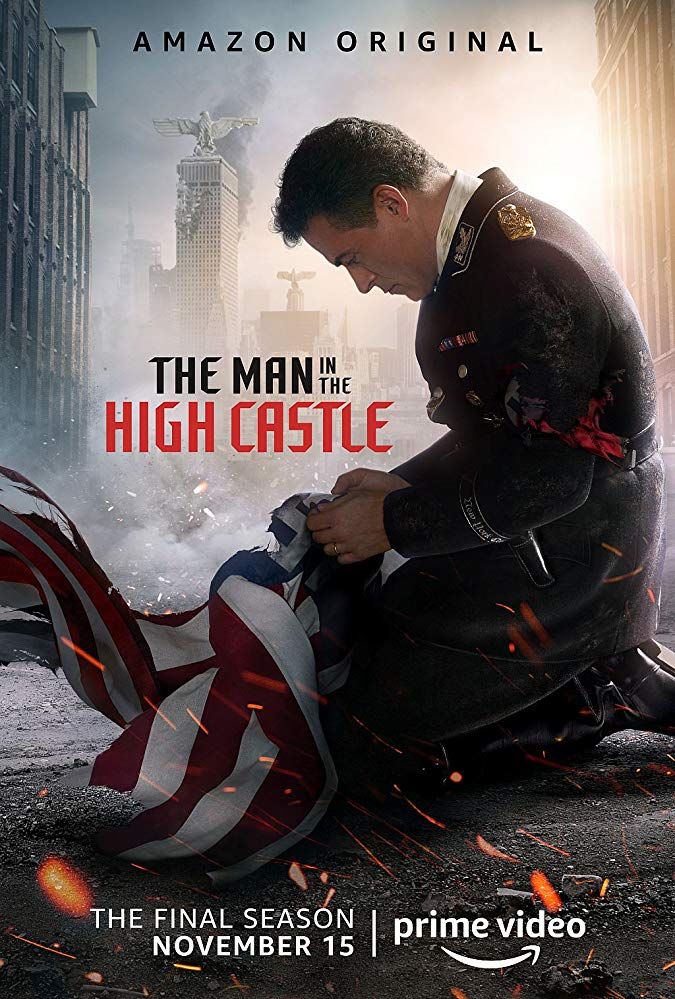
I've been saying ever since Trump began running for President with his anti-immigration policies that The Man in the High Castle and its alternate reality of literally Nazi America had special relevance to the reality in which we now all reside, in which the Allies not the Axis won the Second World War. In the final season of this extraordinary adaptation of Philip K. Dick's extraordinary 1962 novel, immigration plays a major role in the story, especially in the very last scene of the series.
[some spoilers below]
But although that story and that image are crucial to we the people on the both sides of the screen - the characters and their stories, which we are watching - there were parts of this final season that I liked even more. The details, as always in this series, were provocative pleasures to behold. Abendsen presents an alternate-history Twilight Zone on American Reich TV, intoning in Rod Serling style "The High Castle" at the beginning of every episode. Japanese and Nazis in America exchange bows and Sieg Heils, just as we saw in prior seasons, but Kido and Smith shake hands, as the Japanese and the German Nazis later recede from America - a striking evolution of symbolic gestures. Years earlier, as the American military struggles with whether to continue fighting the Nazis after they nuke Washington, DC, one officer notes that "Paton shook hands with Goering"; another counters that "Ike is gathering men" for the resistance; in this reality, the reality that is the home reality of The Man in the High Castle, the Paton quote wins.
In this season, much more attention is given to exactly how this alternate America came to be. And the vehicle is full-fledged access to our reality in which we won the war, an access much more satisfying in the narrative than the I-Ching glimpses and snippets of movies we were provided in earlier seasons. John Smith from the American Reich visits our reality. His wife Helen in our reality finds Nazi John more sexually robust than her husband who, unbeknownst to her, has been killed by another American Reich operative who crossed realities into our reality (superb performances throughout by Rufus Sewell and Chelah Horsdal). John is overjoyed that Thomas is alive and healthy in our reality, but heart-broken and furious when Thomas walks off with Marines to fight in Vietnam, echoing when Thomas walked off in the American Reich to be put to death because of his illness. These parallels, palpable echoes of one reality into the other, provide a haunting foundation for everything that happens in this final season.
In the Japanese American West, Kido (fine acting by Joel de la Fuente) has his own life-rending difficulties with his son. There's no interplay of alternate realities in the Japanese part of this season - mainly, I guess, because Tagomi and his I-Ching play almost no active role, given that Tagomi is killed in the opening Western scene in the first episode (which I regretted). Julianna picks up the I-Ching torch on the East coast, in contrast to the Nazis who travel to alternate realities via technology. The protagonist in the West is now 100% Kido, who struggles against all odds to become a better person, and succeeds. The Black Communist Rebellion along with Childan's capacity to survive also play a major role out West.
But the locus of the story and action remains in New York City and its environs. Smith always manages to outwit the German Nazis, now led by Himmler and Eichmann. In the end ... well, I won't reveal exactly what happens to you, in case you've only seen part of the final season when you're reading this. But I will say that I didn't think what Smith tried to do, the order that he gave, was entirely or even well motivated. (He was free of German Nazi control, so whose demon was he following, his own? Why?) The overall series, and this last season in particular, could be seen as Smith struggling to find his better self, the American that he was before the Germans dropped the bomb. There was ample reason to think that maybe he had.
But this disappointment, though it pertains to the central, pivotal character, did not mar the impact of this powerful, brilliant, and so very timely series for me. Too bad Philip K. Dick wasn't alive to see it. But I did, and I will always be profoundly glad for that.
The Man in the High Castle episodes 3.4-6 contain the biggest stunner of the series. It's so unexpected, and handled so well, that I won't say what it is, on the slim chance that you're reading this and haven't yet seen these three episodes.
I will offer this proviso: when you're dealing with intersecting alternate realities, as The Man in the High Castle is most surely doing this season, anything that happens in our point-of-view reality can be reversed or undone, or at very least deprived of its impact, by the same character or characters from another reality popping into ours (or arriving by whatever means). Or as the poet Shelley wrote about Keats in our reality, "tis death that's dead not he".
And the potential for undoing or reversing animates everything and everyone in the multi-verse that this season of The Man in the High Castle has become. All that remains in question in which things or people.
Meanwhile, the action in our reality -- that is, the point-of-view alternate reality in which the Nazis and the Japanese won the Second World War -- remains taut and excellent. I said in an earlier review that ARBI (American Reich Bureau of Investigation) Director J. Edgar Hoover would always act in his own best interest, and that's just what he does in these episodes, as Smith, always one step ahead of the game, uses Edgar to turn the tables. The consequent killing of George Lincoln Rockwell (I never said there would be no spoilers at all in these reviews) is a satisfying touch, since Rockwell was in fact murdered in our off-screen reality, in which we won the war. And speaking of deft details, we also learn that in this alternate history John Wayne left the screen to fight with the Americans (of course) and lost his life in the "Battle of Dayton," and Joe DiMaggio plays for the "New York Valkyries" (I hope they whip Boston, whatever their name).
Smith continues to be a riveting character - brilliantly played by Rufus Sewell (all the parts are well acted, but William Forsythe's sieg heiling J. Edgar also warrants special kudos) - and now we're tasked to wondering what he'll do about his wife. I just can't see him killing his wife, as Himmler told Smith he would have to do if she displayed any more weakness, but you can never be 100% sure about these things.
The final scene in episode 3.6 was one of the most effective and iconic of the series: Smith getting a ticker-tape parade, Nazi-style, in New York to mark his promotion, intercut with Frank Frink's bar mitzvah (yes, he's alive) in Denver. That says it all about the resilience of freedom in the face of overwhelming power.
And I'll be back here soon, likely after I've seen the concluding four episodes of this superb season.
Well, I couldn't resist watching the rest - the last four episodes - of The Man in the High Castle, Season 2, and I'm glad I did. Much as I love a good night's sleep, it isn't all it's cracked up to be, especially when there's a series like this to be binge-watched.
Let me start this review by saying my favorite scene in the final four episodes - well, maybe not my favorite, but the one I enjoyed most in a perverse sort of way - was when that Nazi newscaster in New York was shot dead on the air right in the middle of his announcing that Hitler had died. He was actually telling the truth, and didn't want to make that announcement (he was blackmailed into doing it), but, boy, there's a satisfying example - in fiction, of course, where it should stay - of a propagandist newscaster getting a just desert. (A less over-the-top way of silencing him would just been to cut the power - but, hey, this is alternate reality, and a Nazi alternate reality at that.)
Now on to the major plot: the use of a tape from our reality, showing a hydrogen bomb test conducted by the US in the Pacific Ocean, in what would have been Japanese territory had it won the war, was a brilliant twist and an ingenuous, unpredictable use of alternate reality. And it didn't even come from the man in the high castle.
Which gets us to Tagomi. As I said in an earlier review, he's a fabulous character - literally, because he can travel back and forth between our reality and the one in which the Axis powers won the Second World War. One slight hole in the plot is why he wasn't missed more, especially in such crucial times, when he was away from the Axis-victorious reality and at home with his family in ours. But that's a small quibble. On the plus side, we find out that one his colleagues also made the trip, and that possibly the US atom-bombing of Japan was the trigger. I like that a lot better than the I-Ching.
The doings in Nazi Germany were outstanding television, especially the evolution and devolution of Joe's father. One point, though, that I'm not 100% clear about regarding Berlin: Did Hitler die of (a) natural causes, (b) Japanese poison, or (c) part of a plot pulled off by Joe's father? Smith cleverly uses "evidence" of (c) to get Joe's father out of the acting Chancellorship, which therein saved the world (for now), but I certainly wouldn't put it past Smith to have concocted some or all of this evidence.
And speaking Smith - an Emmy-worthy performance by Rufus Sewell, and memorable work by Alexa Davalos, too. Frank Spotnitz left the show-running after episode 5 - did I notice a difference before and after? Maybe a little - after was a little less metaphysical, a little more large in terms of big developments and important characters killed, and the ending with Abendsen and Julianna was a little mawkish. Also, I don't know whose fault this is, but we basically learned everything we would about the man in the high castle - and not very much - in the very first episode, with not much in any later episode. We still don't know the all-important source of Abendsen's news reels - fake news, of sorts, in today's parlance, with the twist that the news is real in our reality. But all together, the 10 episodes continue what I thought after the first season: The Man in the High Castle is the best series on television this year, and in many ways the best science fiction television series ever made (Star Trek the original series and the next generation are the only competition, in very different ways).
There couldn't be a better time to see The Man in the High Castle - actually, any time would be great - but recent events make this weekend an especially chilling and resonant time to see the 10-part television series on Amazon, based on the Philip K. Dick justifiably lionized novel of the same name. The United States and the civilized world are involved in a 21st century version of a world war, this time against DAESH aka ISIS, with the latest atrocity committed in France last week; Donald Trump is calling for registration of Muslims in the United States, a move that recalls how Nazis began their persecution of Jews; and DAESH regularly releases videos which show what they expect to be doing to the world in the near future.
The Man in the High Castle debuted its pilot in January of this year, and I thought it was superb. My review is here. I found the rest of the season in some ways better than the pilot, in a few ways not as good, but altogether also superb and deserving of being called a masterpiece.
Since this isn't a comparative media paper, I won't get into the differences and similarities between the novel and the television series,* other than to say there indeed significant differences and similarities, I liked most but not all of the changes, and you can 100% enjoy the television series without having read the novel, if that's what you'd like to do.
Germany and Japan winning World War II and splitting up the United States remains a brilliant alternate history tableau, as is the peek into the alternate reality of that alternate reality in which we won after all - i.e., the reality which you and I inhabit. The attention to alternate reality detail is riveting, ranging from 1962 American hit records sung in Japanese in San Francisco, to the Nazi celebration of "VA Day" as in a nightmarishly twisted 4th of July, firecrackers and all, at the Long Island home of Obergruppenführer John Smith, well played by Rufus Sewell (Alexa Davalos was also especially good as Juliana, as was Cary-Hiroyuki Tagawa as Tagomi - and Rupert Evans was strong as Frank, so was Luke Kleintank as Joe - there wasn't an off-key note in any performance, even the minor characters were memorable). The palpable impact of these details is more than enough to make you suspend your disbelief and contemplate how profoundly horrendous it would have been had we lost the war, and those words don't even scratch the surface. Any American who isn't shaken to the core by these details has ice water in his veins.
There are lots of unexpected but motivated twists in the plot, which works well on both the macro and micro levels. The tension between Germany and Japan - worried about the Nazis now dropping the a-bomb on them - provides a plausible backdrop to the narrative. Germany is more advanced than Japan - with not only atomic weapons but rocket passenger planes - and this flows logically out of the technological sophistication in our own reality.
But the ultimate backdrop and mystery is the source and content of the newsreels that everyone - including an aged Hitler (played by Wolf Muser, who looks an aged Peter Graves) - is intent on getting in their hands. The source is not revealed, and the content ...
Well, it starts off showing the Allies winning the war (what the book does in the novel - I'm making just this one comparison), with the implication that ours is the more prime reality, a very cool Philip K. Dick ingredient. But the newsreels morph into a selection of alternate realities - also interesting in its own way (and disturbingly reminiscent of what Donald Trump has been saying about seeing videos of Muslims in Jersey City cheering as the Twin Towers fell on 9/11, which didn't happen in our reality).
And, in the end of The Man in the High Castle-- well, that's the part - the very end - which I thought was not too good, and not really explained, and even could be interpreted as everything we've seen in the narrative being a given character's bad dream. But see it yourself. Whatever you think of the ending, you'll be treated to what has set a standard for alternate reality brought to television, in the same way the novel did that for alternate reality in writing.
Hats off not only to Philip K. Dick, but Frank Spotnitz, who created the series - and presented a visual tableau in many ways evocative of Hitchcock - and Ridley Scott, one of the executive producers, who even put in an origami-making character, a nice shout-out to his other masterwork, Bladerunner.
*Ok, here's a very significant difference between the novel and the television series - which is actually the second comparison I'm making, if you've read this far in the review and are keeping track. In the book, the alternate history which is our reality is told in a book - a secret book, like Goldstein's in 1984 (and this device in the Philip K. Dick novel was likely inspired by Orwell's). In the television series, however, the alternate histories which start as ours are in movie reels - news reels - and this gives them a chilling verisimilitude, especially when the characters themselves begin appearing in them near the end. Seeing yourself in a newsreel, doing things you didn't do, or didn't do yet, is the ultimately effective way of telling an alternate history narrative. (Read here for further analysis, with spoilers.)
What if the Soviet Union had survived into the 21st century
I just saw I'll Follow You Down - an excellent small-scale but large-idea time travel movie, panned by myopic critics, such as in this review last month in the Hollywood Reporter.
By small-scale, I mean that the movie concerns one family only - grandfather, daughter and husband, and their son and his girlfriend. There's no gunplay (except one time), no history of the world at stake, none of the things we've come to expect in time travel on the big screen, and which, by the way, I also very much enjoy.
But I'll Follow You Down has something else, more rare in time travel stories. We see the effect of time travel on a few human beings - in this case, the time traveler's family. To do this well, a movie has to make the time travel seem plausible, real enough so that those characters who realize what has happened to their family can take action to correct it.
At the same time, the story has to respect the paradoxes of time travel, especially the chestnut of, if I travel to the past to correct a problem, and I succeed, how will I know about the problem in the first place, in the future? Multiple universes or realities are one good way of dealing with this, as I explain in this 2-minute video on Vidoyen:
How can I get around the grandparent time travel paradox? posted by Paul Levinson, PhD on Vidoyen.
I'll Follow You Down takes great and rare care in treating these paradoxes seriously, in both the set-up and resolution of the story. The acting is excellent - with Haley Joel Osment, Gillian Anderson, Victor Garber, and Rufus Sewell in the major roles - and the plot is satisfyingly tight in both the interpersonal relationships that power the story, and the science in the science fiction that makes it possible. Little details such as a pocket watch being left on the ground in a mugging, and a character commenting I don't know the reason the muggers left the watch, create a straightforward verisimilitude that lends credence to the entire story. That's a better way of handling loose ends than coming up with a convoluted explanation.
The ending in particular is outstanding (don't worry, I won't give it away) - motivated, shocking, and ultimately ... well, see the movie. It's not perfect - there's a crucial scene in which a father should have recognized his son a little sooner - but this movie comes pretty close, and scores on all the issues that count in a narrative about the impact of time travel on a family that could almost be living next door.








 Well, I couldn't resist watching the rest - the last four episodes - of The Man in the High Castle, Season 2, and I'm glad I did. Much as I love a good night's sleep, it isn't all it's cracked up to be, especially when there's a series like this to be binge-watched.
 There couldn't be a better time to see The Man in the High Castle - actually, any time would be great - but recent events make this weekend an especially chilling and resonant time to see the 10-part television series on Amazon, based on the Philip K. Dick justifiably lionized novel of the same name. The United States and the civilized world are involved in a 21st century version of a world war, this time against DAESH aka ISIS, with the latest atrocity committed in France last week; Donald Trump is calling for registration of Muslims in the United States, a move that recalls how Nazis began their persecution of Jews; and DAESH regularly releases videos which show what they expect to be doing to the world in the near future.


 I just saw I'll Follow You Down - an excellent small-scale but large-idea time travel movie, panned by myopic critics, such as in this review last month in the
