Chuck Todd interviews me about alternate histories
Showing posts with label Buckminster Fuller. Show all posts

Friday, April 1, 2022

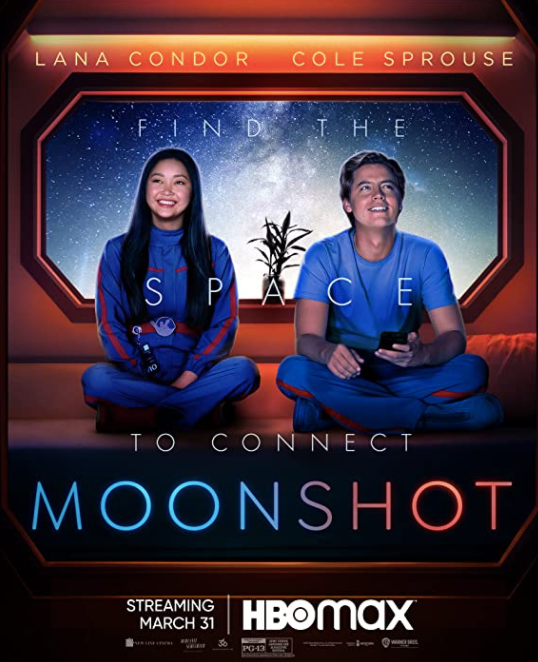
Moonshot: Buckminster Fuller and True Love


Hey, not every movie about humans in space has to be about battles for the galaxy, or, if the story is about planets closer to home, about being stranded on Mars or otherwise vexed by its harrowing problems.  There's a place in movies about Mars for profundity delivered through joy, even the joy of maybe slightly older than teenage romance and humor.

That's right, and Moonshot is such a movie.  A ways ahead in our future (2049), Walt (well acted by Cole Sprouse) wants to go to Mars because he kissed a girl (Ginny) one night, and she's going to Mars, and Walt wanted to go there anyway.  He stows away on a ship to Mars with the help of Sophie (well acted by Lana Condor), a brilliant and deep thinker, who doesn't like space travel but whose boyfriend Calvin is already on Mars with his family.

Lots of frivolity and even Animal House-like slapstick ensue, but there's also lots of philosophic awareness onboard, with thoughts about the ultimate home of humanity and Earth as our best place in the universe and therein (ala Buckminster Fuller) a unique and irreplaceable spaceship for humankind. These come mainly from Sophie, with Walt providing encouragement and some pretty crucial common-sense thinking of his own at crucial times in the narrative.

Predictably but still enjoyably, the two fall in love on the trip to Mars, and the story then becomes how will Sophie break that news to her boyfriend (Ginny has already found someone else on Mars). I won't tell you how all of this ends, other than that there are good twists and turns.  Will true love triumph over the human drive to go further out into space in pursuit of something which many people (including me) view as our destiny?

See Moonshot and see for yourself.

first spaceship to Alpha Centauri from Mars


Saturday, May 30, 2020

Spaceship Earth: The Misunderstood Success


I don't often watch documentaries, and review them even less often, but Spaceship Earth is an exception, because it tells at least two highly significant stories: (1) the attempt to construct a totally self-contained environment or biosphere (Biosphere 2) on Earth, with human inhabitants, as a template for what could be sent out to our solar system and beyond in the future; and (2) the media misreporting of what Biosphere 2 accomplished.

The truth is that Biosphere 2 was unable to maintain total self-sufficiency.  At seventeen months into its two year 1991-1993 mission, oxygen was imported from the outside into the biosphere to combat the sharp reduction in oxygen from 20.9 to 14.2 percent of the biosphere atmosphere.  Obviously, this is not something that could have been done in the middle of a mission to Mars or anyplace off the Earth.  But the media were wrong to report this as evidence that the Biosphere 2 mission failed, or was some kind of publicity stunt rather than a scientific experience.  Apparently no one in the media read British philosopher Karl R. Popper (for example, The Logic of Scientific Discovery), and his widely accepted view that mistakes are the way that science learns and progresses.

The Hulu documentary, named after Buckminster Fuller's apt characterization of our planet as "spaceship Earth," does a fairly good job of reporting and assessing the above, relying on extensive current and historical in-situ interviews with most of the central players in the Biosphere project, including the Biosphereans themselves.   I know at least two people who provided support for Biosphere 2, Carl N. Hodges, an atmospheric physicist at the University of Arizona, who was not in the documentary, and Kathy Dyhr, Director of Public Affairs for Biosphere 2, who had a major role in the documentary.   I had long and riveting conversations with each of them in the mid-1980s, when Biosphere 2 was under planning and construction, and both were students at the Western Behavioral Sciences Institute pioneering online education program, where I was a faculty member and was first introduced to online education, which gave me the idea for Connected Education and which has become so important during our current Coronaviris pandemic.  These conversations, as well as my knowledge of how science works, and plain common sense, are what led me to conclude that the media assessment of Biosphere 2 was so wrong.

But why, then, did the media jump on the bandwagon of Biosphere 2 failure?  The documentary provides one of the two answers.  Steve Bannon - yes, that Steve Bannon - was brought in by financer Ed Bass to run the Biosphere managing company (Space Biosphere Ventures).  Apparently Bannon sought to make a name for himself by publicly and repeated denouncing the project (including destroying some of the crucially valuable data it had collected, according to the documentary).

The second reason is more endemic and intrinsic to the media and to us, its public.  As Phil Ochs pointed out so well in his song "The Crucifixion" (1966), we love to tear down, or see torn down, that which we have built up for adulation.  The idea that we could build here on Earth a habitat which with proper propulsion could take us to the stars was heady, intoxicating stuff.  When it failed to achieve that goal in at least one critically important way, the disappointment that resulted was enough for the media and many viewers to discard the entire project as an ambitious entertainment gambit that flopped.

But facts are stubborn things, and I expect the documentary to continue to bring the truth of Biosphere 2 out to the world and the future, which is that it was an important and major first step that taught us a lot about how we can get beyond this planet to the cosmo beyond.


Sunday, June 3, 2018

Buckminster Fuller: The Real Dome


I spent the early part of this afternoon looking at Buckminster Fuller’s geodesic dome.

Who, you may ask, was Buckminster Fuller? He was my favorite theorist of technology and the human condition, also known as a futurist. He was and is still my favorite because his optimistic views - I and he would say they were not only optimistic but realistic - most closely agree with my own. He thought, for example, that human intelligence channeled through technology was the ultimate anti-entropic force, able to overcome the ubiquitous down escalator of existence and turn it upward.

This view has a plethora of practical significance.  Just a few weeks ago, someone asked me how a media theorist would explain the fact that we have much more computing power in our current smartphones than our laptops of just a few years ago.  "Buckminster Fuller's dymaxion principle," I immediately replied, citing the name Fuller gave for the phenomenon he noticed back in 1938 in his Nine Chains to the Moon, that as technologies are evolved, they do more and more with less and less size.

Unlike the myriad of easy critics in the academic world, Fuller saw technology as intrinsically, inescapably, and beneficially human.  For the point of view of the interior mind, he also observed in Nine Chains to the Moon, there is no difference between eyes and eyeglasses.

Which brings us to the geodesic dome, a term Fuller took from earlier inventions, and applied it housing - "dymaxion housing" - which Fuller saw as the most efficient way, requiring the least amount of energy and human resources, to build efficient homes, offices, and structures for sundry human uses.  The Dome at Woods Hole - pictured above - is oldest existing geodesic dome in the world, constructed in 1953 in Woods Hole in Falmouth, MA, and serving for many years as a restaurant.  It's fallen into disrepair, and, just yesterday, my wife Tina saw a note on Facebook from Jessica Lipnack (an old friend of Tina's and mine, from the very early days of Connected Education), that she would be in Woods Hole today, as part of project to raise money for repair of the geodesic dome to full functionality.

We drove about an hour to see her at Highfield Hall near Woods Hole, and were rewarded not only by the first face-to-face conversation we had in decades, but the chance to meet and talk to Allegra Fuller Snyder, Buckminster Fuller's daughter, and see a small version of the dome, being constructed before our very eyes, to serve as a beacon for restoration of the original dome.

It was gratifying indeed to see the future still so much alive and kicking.


Tuesday, July 10, 2007

Nano iPhone and the Dymaxion Principle

Way back in 1938 - in Nine Chains to the Moon - Buckminster Fuller coined a term, the "dymaxion principle," to describe a progression in technology that he was seeing all around him, and expected to see much more of in the future.

It was this: as technology became more advanced, it did more and more with less and less. Lighter, smaller, more flexible devices were more powerful.

Transistors, which would replace vacuum tubes, were right around the corner. Microchips were a few decades away. Two prime example of the dymaxion principle in operation.

It occurred to me, when I first read Fuller in the 1970s, that our brains are the ultimate embodiment of the dymaxion principle - we think, dream, plan, imagine, reason all from that kilogram of matter in our skulls.

It is therefore not surprising to learn that Apple will likely sometime next year replace its popular iPod Nano with a Nano iPhone. At first, the Nano iPhone will no doubt do less than the bigger, current model. But I predict that pretty soon, the standard iPhone will be both smaller than the current iPhone and more powerful ... all according to the dymaxion principle...

Indeed, this will happen, whether these initial reports are true or not...

See also: Hats off to George Hotz ... iPhone Arrives - I Predicted It in 1979 and iPhone Boosts Literacy and History Lesson: iPhone Sales Will Exceed Expectations and New York Times' David Pogue Sings "I Want An iPhone" to "My Way" and iPhone: Not Better iPod but New Species Media ... Mouth-Watering iPhone Commercial and the Real World ... Harry Potter and iPhone ...


The Plot to Save Socrates


"challenging fun" - Entertainment Weekly

"a Da Vinci-esque thriller" - New York Daily News

"Sierra Waters is sexy as hell" - curled up with a good book
InfiniteRegress.tv