Welcome to Light On Light Through, Episode 152, in which I review Borat 2: Borat Subsequent Moviefilm.

Showing posts with label Sacha Baron Cohen. Show all posts
Showing posts with label Sacha Baron Cohen. Show all posts
Sunday, October 25, 2020


Saturday, October 24, 2020
Borat 2 (Borat Subsequent Moviefilm): Camera Epistemology

My wife and I just saw Borat 2 aka Borat Subsequent Moviefilm on Amazon Prime Video. As with the first Borat movie in 2006, it was at turns and sometimes all together (and altogether) hilarious, horrifying, over the top, sobering, and vulgar. And there's the already infamous Rudy Giuliani scene near the end.
As always, the question -- Giuliani aside -- is how much the people in the movie, other than Borat and his daughter Tutar -- knew about what was going on, i.e., that they were appearing in a movie. The two guys who took Borat into their home and spouted dangerous conspiracy theories, the woman who genuinely tried to help Tutar, the various women and men who tried to understand Tutar and Borat, however outrageous or insane their stories, until these marks either broke or continued to work with varying degrees of discomfort inside this horror-show amusement-park universe -- were they really marks or were they part of the paid, unacknowledged, scripted acting cadre?
The people singing the at once very funny and deeply disturbing Covid-19 song were at a rally, and they most likely were real. They wouldn't have wondered what the cameras that were recording them were doing there. But what about the conspiracy duo -- who were also at this rally -- what did they think when Sacha Baron Cohen entered their home with not just his mustache but some kind of camera crew? Or, again, that wonderful woman who took Tutar under her wing, and tried to give her guidance? I sure hope she was real -- she showed there's still some hope for humanity -- but what did she make of the cameras? Or, did both Cohen and Maria Bakalova who played his daughter have some kind of super-micro cameras tucked somewhere into their shirts? Which brings us to Giuliani.
The good thing about Pence and Giuliani -- good, that is, as far as their roles in the movie -- is that neither would have been surprised by cameras in the contexts in which they were filmed, and of course there's no way they would have agreed to play along with Cohen, anyway. So about Giuliani: He consents to go into Tutar's hotel room, leering during the interview, and for some reason lies back on the bed (I'd rather not say "lay" here, and who knows exactly if that's grammatically right) and then either (a) tucks his shirt down the front of his pants or (b) you be the judge (this is Cohen's advice to viewers of his movie). It probably doesn't really matter - Giuliani is a sleaze either way, just a worse sleaze if he's not tucking in his shirt.
Anyway, a brilliantly funny and all too instructive movie by Cohen, wonderfully acted by him and by Bakalova as his daughter. And as for the rest of people who appear in this movie? Brilliantly acted or real? Follow Cohen's helpful advice: See the movie and decide.
Monday, October 19, 2020
The Trial of the Chicago Seven: A Little Too Much Fiction in this Docudrama

My wife and I saw The Trial of the Chicago Seven on Netflix on Saturday. Having lived through the real trial of the Chicago Seven (originally Eight) in 1969-1970, we thought there was a little too much fiction in this docu-drama to be 100% successful and effective. Nonetheless, it was powerful viewing.
To back up a little, as I alway tell my classes, docu-dramas are by definition never 100% truth or exactly as the events in the movie actually happened. Hey, even straight-up documentaries are never 100% true, because the film-maker inevitably has to leave some events, one hopes inconsequential, out of the film. Real life is too sloppy and inexact to fit in just as it is or was in a documentary.
But docu-dramas go a big step further away from truth. At the very least, they rewrite or make-up dialogue. Worse, they often make up characters and/or endow characters who existed in real life with deeds they never did. This works best the further back in history the docu-drama goes. I couldn't possibly have any personal recollection of what Lincoln said and did. So I was able to enjoy Spielberg's Lincoln with zero quibbles. But 1969-1970 is a lot closer than are the early 1860s to our time.
So, lots of people noticed that Tom Hayden's closing statement in the Aaron Sorkin docu-drama wasn't made by Hayden in reality, and was not a closing statement. Or that the pacifist Dellinger -- who did in fact earlier read the names of some of the American fallen in Vietnam during the trial-- never hauled off and punched a guard who was trying to escort Dellinger out of the courtroom, as so dramatically depicted in the movie. To be honest with you, neither my wife or I jumped up and shouted during the movie that those events never happened. But my wife had a vague sense of irritation throughout the film, and I was annoyed after the movie to have been brought to tears by that closing scene, so effective, that didn't happen in real life.
I suppose Sorkin might say that such a reaction is my problem, not his, and if I was brought to tears by the ending that didn't happen in reality that shows that Sorkin succeeded, doesn't it. I'm not so sure. I think that, even in a docu-drama, or maybe especially in a docu-drama, the film maker has an obligation to present a greater quotient of truth. Again, especially if the docu-drama is so close to home in time. I'm sure Marc Anthony never said "Friends, Romans, countrymen, lend me your ears; I come to bury Caesar, not to praise him," but that didn't in the least get in my way of really enjoying Shakespeare's Julius Caesar, from the moment I first read it, so many decades ago, and for that matter thinking about that play right now.
Maybe the answer is Sorkin's movie is meant for a younger generation than mine. It has lots of assets, including boiling down the differences between the protestors on trial to Hayden vs. Abby Hoffman. I don't know if that's true, either. But since I don't know for sure that it isn't, I'm ok with thinking back on that crucial aspect of The Trial of the Chicago Seven, and enjoying the recollection and contemplation of that fundamental conflict between political revolution (Hayden) and cultural revolution (Abby Hoffman). And I should say the acting in this movie, including Eddie Redmayne as Hayden and Sacha Baron Cohen as Abby Hoffman, was just superb. Regarding those two, special kudos to two Englishmen talking at each at some length in passable American accents.
So, see the docu-drama - with no reservations if you weren't around the first time this trial happened, back in the 1969-1970. And see Medium Cool made in 1969 if you'd like to see a documentary about the protests around the Democratic National Convention which ignited the trial.
Saturday, September 7, 2019
The Spy: Homeland Brought Home
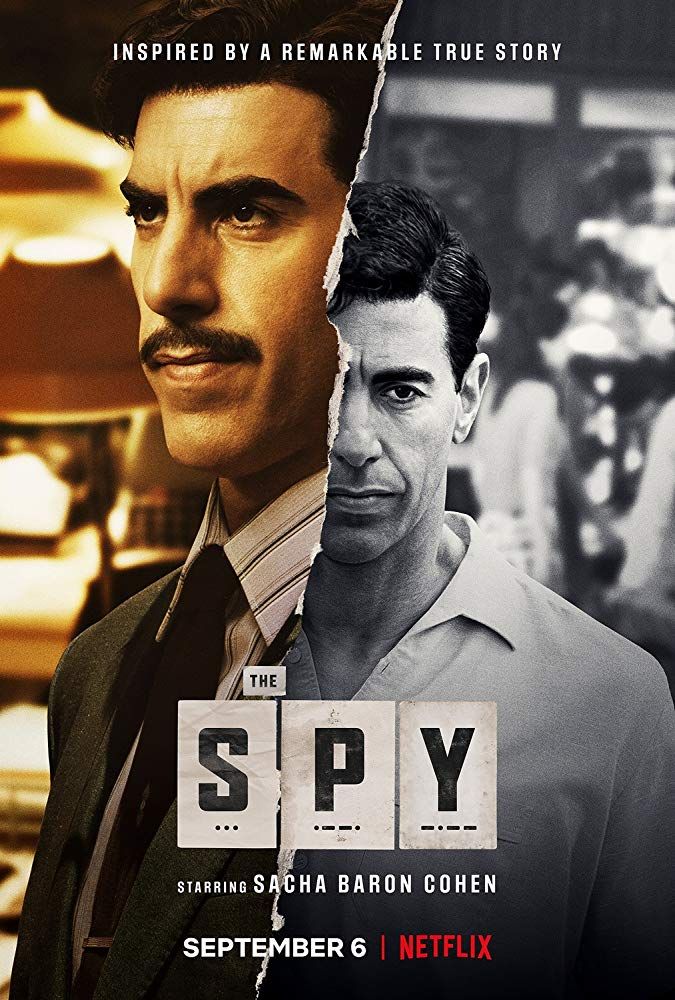
Gideon Raff is best known for Homeland, soon to begin its final season on Showtime. In its first few seasons - its best few seasons, by far - Homeland told the story of an American who was brainwashed in Iraq, to hate Americans and identify with terrorists, who returns to the U. S. as a war hero and moves to within a heartbeat of the Presidency. It was all fiction, of course, but ....
In The Spy (on Netflix), more completely the creation of Raff than was Homeland, we get the true story of Eli Cohen, a brilliant Mossad agent who infiltrated Syria in the early 1960s and provided crucial information to Israel. In the docu-drama, Cohen is appointed Defense Minister by the Syrian President. I don't know if this happened in real life, but that touch provides a powerful resonance to Homeland.
Even without that parallel, The Spy, in six episodes, is every bit as good as the best of Homeland, and that's good indeed. Deftly portrayed by Sacha Baron Cohen - no relation, as far as I know - Eli Cohen struggles with the erosion of his real identity as he becomes the suave Syrian businessman Kamel Amin Thaabet. Kamel befriends the powerful in Syria, including the military, and gains access to their bases and plans.
The thanks he gets for that back home includes an all but broken marriage. Cohen is forbidden from telling his wife the truth of what he's doing. Hadar Ratzon Rotem does a good job as Nadia Cohen, as does The Americans' Noah Emmerich, who plays Eli's knowledgeable boss - knowledgeable in that he knows how this will end for Eli. Emmerich has the spy master with a conscience down pat.
In case you haven't seen this yet, or don't know Eli's story, I won't tell exactly what that ending is. What I will say is that The Spy is a masterful piece of work, and just homage to a great Israeli covert warrior.

Subscribe to:
Posts (Atom)
