Chuck Todd interviews me about alternate histories
Showing posts with label John Stuart Mill. Show all posts

Monday, March 13, 2023

The Last of Us Season One Finale: The Limits of Utilitarianism


Well, the season one finale of The Last of Us, just up on HBO Max tonight, was everything it could be and even more.

[And there will be spoilers ahead ... ]

So, first, here's what happened.  Turns out, at least as far as the docs in the hospital that Joel and Ellie finally get to, think: only by destroying Ellie's brain can her immunity to the fungi be disseminated to the rest of humanity.  We never find out if they're scientifically right or wrong, because Joel, once he finds out what the docs plan to do with Ellie, kills the doc about to perform the surgery and everyone else in his way so he can make good his escape with Ellie.

But here, then, is the question: was Joel right to do this?  Was he right to go against the fundamental principle of utilitarianism of the greatest good for the the greatest number, and deprive humanity of its rescue from death, all so one person, Ellie, can survive?  I tend to be utilitarian in many things, but ...

I would have done exactly what Joel did, had I the lethal prowess, to save Ellie.  Does that mean I'm weak?  Did Joel ignore logic and give into his emotions? Well, he did follow his emotions, but that doesn't mean he was weak or even illogical. Maybe there's a higher logic at work here.  The logic of going with your deepest emotion, if that emotion is love.

Joel acted on that principle, but he's not a philosopher.   He unconsciously refuted the utilitarian principle, and then he compounded that ethically dangerous action by lying.   Parents often lie to their kids -- the younger the kids are, the more often they're not told the truth, presumably for their own good.  I said Joel was right to save Ellie.  The docs could have been wrong.  Even if not, he was right to save her.  But was he right to lie to Ellie at the end of the episode when she asked him if he had told her the entire story of what had happened back at the hospital? Here I'd say, probably not.  I'm pretty sure I think he owed Ellie the truth.

On the other side of both of these issues, we have Marlene. She kills Ellie's mother Anna, her friend, after she'd given birth to Ellie, after Anna had been bitten, on Anna's instruction. She saved baby Ellie's life. Marlene is able to think clearly, rise above her emotions, and make tough decisions. The decision to kill Ellie, the baby she saved, years later, was an even tougher decision. She went with her head, not her heart. John Stuart Mill would have approved. It's tough to hate or even dislike her, because she was really trying to do the right thing. Unlike Joel, she told the truth. But Joel had to kill her -- fittingly, the last person he killed -- to escape with Ellie. I think he made the right decision here, too. 

Being right two out of three times in these hellish circumstances ain't bad.  And The Last of Us was 100% right to give us such an ethically wrenching season finale.  I'll certainly be back here with more reviews when the series resumes.

See also The Last of Us 1.1-1.2: The Fungus Among Us ... 1.3: Bill and Frank ... 1.4: Gun and Pun ... 1.5: Tunnels ... 1.6: Joel ... 1.7: Riley's Wise Advice ... 1.8: Ellie vs. the Resort


I talk about The Last of Us, beginning at 40mins 40secs


Sunday, November 7, 2021

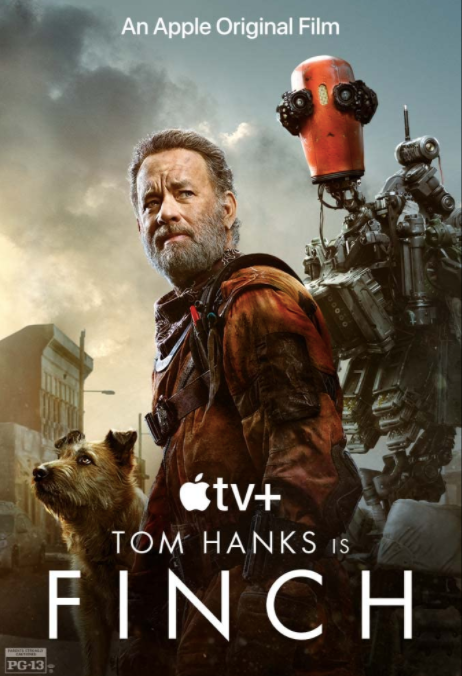
Finch: Heartwarming, Even Reassuring, About a Robot


Just saw Finch on Apple TV+, at once a small scale infinitude of a movie, a quiet triumph of a story that may be the best robot AI film I've ever seen.

The bare bones are Finch is a genius inventor in a post-apocalyptic America who builds Jeff, a gangly robot, to take care of Finch's dog Goodyear, after Finch is gone, which won't be long.  He's dying from over-exposure to UV radiation, due to the solar flare that wiped who knows how much of the world.  But the apocalypse is the least important part of the story, a means to an end, which depicts how Jeff learns to be human.

As such, Finch (the movie and the character) builds on Asimov's three laws of robotics -- (1) a robot cannot harm a human, or by inaction allow such harm to occur, (2) a robot must follow every command it receives from a human, except commands in conflict with the First Law, and (3) a robot must act to protect itself, except when such a protection conflicts with the first two laws.  So, for example, in Asimov's schema, a robot would have no choice but to destroy itself if so ordered by a human, unless it was needed to protect a human.  Asimov's later promulgated a "zeroth" law, that a robot must act to save the many rather than the few, but not every Asimovian purist has accepted that John Stuart Millian utilitarian principle.

Finch (brilliantly played by Tom Hanks) expands the three laws by adding a fourth -- Jeff must protect Goodyear the dog, but that's just shorthand for the rich tableau, sometimes funny, sometimes heartrending, in which Jeff (deftly played by Caleb Landry Jones), growing into his intelligence, seeks to protect both Finch and Goodyear.  Jeff makes mistakes, has its/his feelings hurt, but learns the importance of mastering such mundane but essential tasks -- essential to Goodyear's wellbeing -- as playing throw and fetch the ball with the lovable pooch.

There have been many a depiction of robots, with or without Asimov's laws as a guide, on television and movie screens.  Demerzel, more properly an android than a robot, began existence as R. Daneel Olivaw in Asimov's robot novels, and became Demerzel is Asimov's Foundation prequel decades later.  He became she in the Foundation series also on Apple TV+ these days, and I've found myself irritated at her character, in contrast to the Foundation series as a whole, which I think is top notch.  Having just seen Finch, I now understand why.

Jeff in Finch is somehow more than just a character, a cog in the machine of the motion picture.  The movie manages to make us believe that he is human in the end, and not because he looks good in a hoodie jacket.    That evolution makes the movie heart-warming, even reassuring, despite the apocalypse and its effects, and one I'll always treasure seeing.


Saturday, November 7, 2020

Truth Wins in the Marketplace of Ideas


Welcome to Light On Light Through, Episode 155, in which I put Joe Biden's victory in some philosophic context: it offers proof of John Milton's argument, way back in the Areopagitica, that truth can win in the marketplace of ideas, even this age of social media.


Check out this episode!

Monday, October 2, 2017

Ray Donovan 5.8: Paging John Stuart Mill

Tonight's episode 5.8 of Ray Donovan was so terribly heartbreaking that I almost don't want to write about.  Maybe it's better that it just rest in peace, like Abby.

But I think there's a vitally important morale to this story, somewhere not that far beneath the surface, that needs to be said.  It's the cliche that where there's life, there's hope.  Words strung together become cliches because they contain some truth.

Ray, despite the horrible thing he did to that patient in New York, injecting him with meningitis so he would be disqualified from the trial, did indeed have the key to Abby's survival.  We saw on an earlier episode this season that the trial surgery worked on another patient.  I guess that's no guarantee that it would have worked on Abby, but we were shown the success with the other patient for a reason.

Ray's doing what he did to save Abby does not justify what he did to get Abby into the trial - the ends do not justify the means if the means cause someone else's death - but that doesn't negate the strong possibility that Ray may have saved her.

And that in turn means, I would say, that it's not only tragic that she took her life because it's tragic that she died, but it's also even more tragic because she took her life when perhaps she didn't have to.  Not that she would have wanted Ray to do what he did, or approved of it after he did it, but it must be said that, in light of what Ray accomplished back East, Abby may taken her life unnecessarily.

This is why I've always had mixed feelings about suicide being legal.  I'm a strong believer in adults doing whatever they please to themselves and their bodies, as long as that doesn't harm anyone else.  But like John Stuart Mill, who argued the same in the middle of the 19th century, I can't quite extend this to suicide.  Or, to put it otherwise, I think someone who prevents or tries to prevent someone from committing suicide is more likely than not to be doing the right thing.

But these are wrenching issues, personal as well as philosophical, and Ray Donovan deserves lots of credit for putting them out on there on our screens.


 FREE on Amazon Prime  


See Ray Donovan 5.1: Big Change  ... Ray Donovan 5.4: How To Sell A Script ... Ray Donovan 5.7: Reckonings

See also Ray Donovan 4.1: Good to Be Back ... Ray Donovan 4.2: Settling In ... Ray Donovan 4.4: Bob Seger ... Ray Donovan 4.7: Easybeats ... Ray Donovan 4.9: The Ultimate Fix ... Ray Donovan Season 4 Finale: Roses

And see also Ray Donovan 3.1: New, Cloudy Ray ... Ray Donovan 3.2: Beat-downs ... Ray Donovan 3.7: Excommunication!

And see also Ray Donovan 2.1: Back in Business ... Ray Donovan 2.4: The Bad Guy ... Ray Donovan 2.5: Wool Over Eyes ... Ray Donovan 2.7: The Party from Hell ... Ray Donovan 2.10: Scorching ... Ray Donovan 2.11: Out of Control ... Ray Donovan Season 2 Finale: Most Happy Ending

And see also Ray Donovan Debuts with Originality and Flair ... Ray Donovan 1.2: His Assistants and his Family ... Ray Donovan 1.3: Mickey ... Ray Donovan 1.7 and Whitey Bulger ... Ray Donovan 1.8: Poetry and Death ... Ray Donovan Season 1 Finale: The Beginning of Redemption

Monday, June 9, 2014

24 Season 9.7: Silent Clock in President Heller's Future?

Another powerhouse episode of 24 tonight - 9.7 - featuring a wild car chase, with Jack behind the fleeing wheel, that would have made James Bond proud.  What made this car chase different - what gave it a special edge - was that Jack (with Kate and Simone in the car) - was fleeing a drone missile launched on order of Margot.   And he in fact successfully evades several missiles, by not only daring driving but setting forth a car with no driver or passenger, propelled by a big rock on the gas pedal.

Jack was also in peak form in the hospital scene, in which his quick action gets Kate, Simone, and Kate's niece out alive.   As I've noted several times in this new season, Jack has grown, at least a bit, as a human being.  He can't resist applying pain to Simone to get some crucial information (which he fails to get), but he apologizes for that to Kate, explaining that he "hates those people" (i.e., terrorists bent on killing innocent people).

Of course, Jack is not above punching an innocent person out, or applying a gun to an innocent person's head, when thousands or more other innocent lives hang in the balance.  This makes Jack's philosophy solidly utilitarian - the good of the many outweigh the good of the few - which is especially appropriate this season, with the action taking place in England, 19th-century home of the utilitarians James and son John Stuart Mill.

Elsewhere, the voice on the phone to Steve indeed turns out to be the ersatz Julian Assange (Adrian), as I predicted in my review last week.   With his sending out an assassin to kill Jordan, I can only hope now that Steve as well as Adrian get their just deserts, with Steve maybe getting a chance to perform more nobly as he departs.

Which brings us to President Heller, who's positioning himself to give himself up to Margot, since he knows he'll soon have to resign because of his mental condition anyway.  I'm predicting Jack won't allow it - out of love for Audrey.  There may be a silent clock on 24 before this season is over - as there was for Buchanan, Renee, Teri, and eight others in the history of 24 - but it won't be for Heller, at least, not by Margot's hand.

See also 24 Season 9 Hours 1 and 2: The Sheer Intelligent Adrenalin Is Bac... 24 Season 9.3: Shades of Disloyalties ... 24 Season 9.4: Brass Tacks and Strong Women ... 24 Season 9.5: Jack and Audrey .. 24 Season 9.6: Expendable In-Laws

And see also Season 8 reviews: Hours 1 and 2 ... Hours 3 and 4 ... Hour 5 ...Hour 6 ... Hour 7 ... Hour 8 ... Hour 9 ... Hour 10 ... Hour 11 ... Hour 12... Hour 13 ... Hour 14 ... Hours 15-16 ... Hour 17 ... Hour 18 ... Hour 19... Hour 20 ... Hour 21 ... Hour 22 ... 24 Forever!

And see also Season 7 reviewsHours 1 and 2 ... Hours 3 and 4 ... Hour 5... Hour 6 ... Hour 7 ... Hour 8 ... Hour 9 ... Hour 10 ... Hours 11-12 ...Hour 13 ... Hour 14 ... Hour 15 ... Hour 16 ... Hour 17 ... Hour 18 ... Hour 19 ... Hour 20 ... Hour 21 ... Hour 22  ... Hours 23-24  

And see also Season 6 reviews: Hours 1 and 2 ... Hours 3 and 4 ... Hour 5 ... Hour 6 ... Hour 7 ... Hours 8 and 9 ... Hour 10 ... Hour 11 ... Hour 12 ... Hour 13 ... Hour 14 ... Hour 15 ... Hour 16 ... Hour 17 ... Hour 18... Hour 19 ... Hour 20 ... Hour 21 ... Hour 22 ... Hours 23-24


#SFWApro


  Enjoy a little high-tech espionage?  Try The Pixel Eye


Monday, February 27, 2012

After the Oscars, The Walking Dead 2.10 Meets John Stuart Mill

After an excellent Oscars with Billy Crystal - except for the cowardly ABC bleeping - it was pleasing jolt to see The Walking Dead 2.10, which was all about rules.

Rick vs. Shane: whose rules?  We've seen that before, lots of it, but this time their argument over what to do with the kid who lost his leg in town is interrupted by one of the best walker scenes all season. Shane in the bus with walkers breaking into the door, and the way he handles two of them, and the way Rick rescues him (I know he wouldn't leave him there), was itself worth the price of admish.

Meanwhile, back at the ranch (farm), there's also a clash of rules also going on, between Lori and Andrea, over what to do about Beth, who wants to commit suicide.  Andrea says let her make her own choice.  Lori (and Maggie) want to do everything in their power to stop her.

Philosophy question: what would a utilitarian philosopher like John Stuart Mill, who held that you could swing your arm, anytime any way you want to, as long as you don't hit someone else's nose, have said about suicide?  No easy answer.  One way of dealing with this is to say that anyone who wants to commit suicide is not in his or her right mind, so the usual utilitarian principle doesn't apply.  But that could be a slippery slope ...

Anyway, back on the farm, Andrea gets to give Beth a choice - who slashes her wrist, but regrets it.  And since the cut is not deep enough to kill, she'll get to live.   And now she's empowered, becauses she made the choice to live, not someone else.  So she's likely to stand by that decision.

Was Andrea therefore right?  Well ....  I still say not ...  What if Beth had killed herself?  Had that happened, she'd have lost the opportunity to change her mind.

And this is what makes The Walking Dead so good - it's not just horror, it's intelligent horror, the kind John Stuart Mill might well have enjoyed.


                 Special Discount Coupons for Angie's List, Avis, Budget Car, Garden.com, eMusic


The Plot to Save Socrates

"challenging fun" - Entertainment Weekly

"a Da Vinci-esque thriller" - New York Daily News

"Sierra Waters is sexy as hell" - curled up with a good book


Enjoy listening to audio books? Get a free audio book copy of The Plot to Save Socrates - or any one of 85,000 other titles - with a 14-day trial membership at Audible.com ...
InfiniteRegress.tv