Chuck Todd interviews me about alternate histories
Showing posts with label Orson Welles. Show all posts

Monday, December 7, 2020

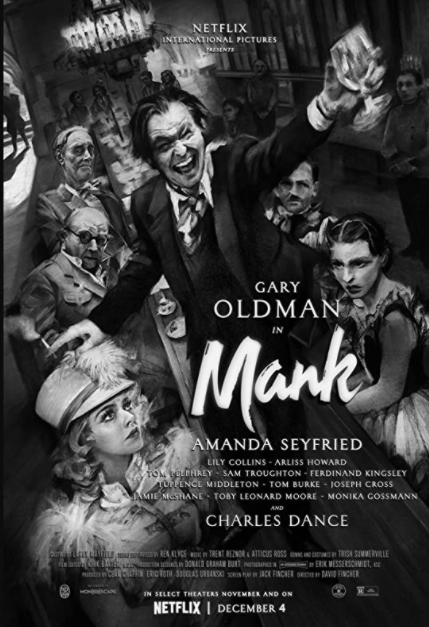
Mank: Elusive Truth


I've had an abiding interest in Herman Mankiewicz and Orson Welles since I first saw Citizen Kane and devoured Pauline Kael's Raising Kane in an MA in Media Studies class I was taking at The New School in 1975.  Welles became such a passion that I devoted one of my Ian's Ions and Eons stories ("Ian, George, and George") to Welles (George actually was his first name, and Orson his middle name) and I even talked about his work in this History Channel interview in 2010:


I've had less opportunity to talk about Mankiewicz, but pleased to discover that his son Frank was Robert F. Kennedy's 1968 Presidential campaign press secretary, and his grandson Josh (son of Frank), a local New York City television and now a national NBC reporter.  I was therefore glad to see Mank on Netflix last night.

I thought it was good but not great.  The black-and-white, flashback format was a nice, if somewhat obvious, homage to Citizen Kane.  Herman's writing of the script, with no credit but ample payment from Orson, at first, and then Herman insisting on getting credit, because he realized the impact the movie would have, was also well presented.  But the probing, enduring questions around the creation of this masterpiece were barely touched upon and not extensively explored.  What was Herman's ultimate motivation in writing such a devastating take-down of his friend and patron William Randolph Hearst aka Charles Foster Kane?  Did Herman love Hearst's young wife Marion Davies, platonically but nonetheless deeply enough to motivate the script?

And speaking of Davies, when Herman's brother Joe asks Herman about the "rumor" that "Rosebud" was Hearst's name for Davies' "genitalia," Herman scoffingly denies it.  Was that denial truthful (which it appeared to be in the movie) or just Herman not wanting to admit the truth to his brother?

The problem is that, since presumably almost no one in the audience for Mank knows what really happened, and why, we have no way of judging the accuracy of this docu-drama.   That's ok.  I often tell my students that you can't expect complete truth even in documentaries, let alone docu-dramas.  But because that elusive truth of such keen interest, I found Mank enjoyable -- and certainly lifted by Gary Oldman's brilliant performance in the title role -- but somewhat unsatisfying.

Sunday, December 23, 2018

Counterpart 2.3: Echo


Another sharp episode of Counterpart tonight - 2.3 - actually, they've all been sharp this season, more clear and precise than last season, which works for me.

Among the most instructive developments: our Howard is taken to the "Echo" facility on the other side.   First of all, Echo is a good name for this, and could've even been a name for the series, given that counterparts are in effect echoes of their originals.   And the facility is a logical place for the other side - a place where the memories of people are "mined" (Peter Prime's apt word), with a view to getting insights into the people on the other (our) side, so the "bad" side can more effectively undermine them, play them, whatever in the cold war they're waging on us.  In addition to it being good to meet Peter Prime, he's a well of important information for our Howard.

The other big deal in tonight's episode is our Emily telling Naya that the "Shadow" was not Aldrich (who Emily doesn't know is dead, since she had just emerged from her coma the night he was killed).  Emily thinks the "Shadow" is a woman - assuming she's right, could she be thinking of herself, and not realize it?  (I can't recall if we have any other reliable knowledge about the Shadow - if only Orson Welles were alive, he'd make a perfect person to play this character in Counterpart.)

Meanwhile, Peter on our side, no longer the dupe he was last year, continues to get tough with his wife Clare and everyone.  But he'll likely be no match for Howard Prime, who comes to pay them a visit at a propitious moment.

Last thought in this review:  when Emily Prime was talking about the fact that there is no evidence that our side was responsible for the flu that wiped out so much of the other side, I couldn't help thinking, so who is?  Maybe the other side?

Looking forward to more alternate realities.  In the meantime, there's Samantha ...


See also:  Counterpart 2.1: "Strange" and "Lucky" ... Counterpart 2.2: The Emilys

And see also  Counterpart 1.1: Fringe on Espionage ... Counterpart 1.2: Two Different Worlds ... Counterpart 1.3: Identification and Pandemic ... Counterpart 1.4: The Switch ... Counterpart 1.5: Ménage à Alternates ... Counterpart 1.6: Alternate Prince, Funeral, and Clear Clare ... Counterpart 1.7: Spying Across Dimensions ... Counterpart 1.8: Conversations ... Counterpart 2.9: The Spy Who Came Into the Fold ... Counterpart Season 1 Finale: Stuck in the Middle


alternate Orson Welles in here

Monday, March 26, 2018

Timeless 2.3: Orson, Hedy, and Lucy

A thoroughly satisfying Timeless 2.3 tonight, which featured, among other good things: Orson Welles (or, at least Citizen Kane), Hedy Lamarr, Lucy singing "You Made Me Love You," Lucy and Wyatt finally together, Flynn out of prison via an inter-temporal gambit, and a surprise ending I won't mention until the end in case you don't like spoilers (which, by the way, were mentioned, literally, in this fine episode - as was, come to think it, "fake news," too).

Now Lucy and Wyatt finally in bed together is something that's almost happened a bunch of times already, so that was no big surprise.  But it was nice to see, anyway.  And the same for Flynn out of prison, but it happening via time travel - or, at least, the means of his escape - was a nice touch, too.

But Lucy singing and therein declaring her love to Wyatt was unexpected and great.  Kudos to Abigail Spencer for singing the part, and don't tell me it wasn't really her singing, I won't believe you.  And Orson Welles, even though we didn't actually see him, is a worthy subject of any tine travel story (I thought this so much that I made him the central character of the third novelette in my Ian's Ions and Eons series.)

And now to the ending:  after Wyatt and Lucy make tender love which left both happy and even more in love, what does Timeless do?  It somehow allows Wyatt to find his lost - as in deceased - love.  Very much alive.  Poor Lucy!

But, hey, this makes for a good story.  And we also have some significant developments with Jiya, which I didn't mention in the first paragraph because I wasn't sure what they meant.  A doctor tells her off-camera that she's in fine condition - in better condition, even, then before she started having the visions of the future and passing out, because she had a heart murmur before then which is now gone.  But is Jiya telling the truth?  I think so.  Was her doctor telling her the truth (and who was he or her)?  Impossible to say, because we didn't see this doctor.

So ... though Timeless made some great progress with Lucy and Wyatt, the future is by no means bright for them, and Jiya is more unknown in her future than ever.  I'll be back after the next episode to tell you what I think about where this series - now undeniably much better than in its first season - goes with all of this.

See also Timeless 2.1: "Mein Kampf, by Philip K. Dick" ... Timeless 2.2: The Nod

And see also Timeless 1.1: Threading the Needle ... Timeless 1.2: Small Change, Big Payoffs ... Timeless 1.3: Judith Campbell ... Timeless 1.4: Skyfall and Weapon of Choice ... Timeless 1.5: and Quantum Leap ... Timeless 1.6: Watergate and Rittenhouse ... Timeless 1.7: Stranded! ... Timeless 1.8: Time and Space ... Timeless 1.9: The Kiss and The Key ... Timeless 1.10: The End in the Middle ... Timeless 1.11: Edison, Ford, Morgan, Houdini, and Holmes (No, Not Sherlock)! ... Timeless 1.12: Incandescent West ... Timeless 1.13: Meeting, Mating, and Predictability ... Timeless 1.14: Paris in the 20s ... Timeless 1.15: Touched! .... Timeless 1.16: A Real Grandfather Paradox Story


Sunday, January 22, 2017

The Perversity of Things: review #8 of X: Definitions and Fake News

Continuing with my reviews (#8 of X) of The Perversity of Things: Hugo Gernsback on Media, Tinkering, and Scientifiction, edited by Grant Wythoff (University of Minnesota Press, 2016) - at a more leisurely place now, reporting here on two gems in pages 52-55 of Wythoff's 59-page Introduction to the 359-page volume.

Wythoff describes Gernsback's keen concern with the definition of science fiction - or scientifiction, as Gernsback usually had it - which in turn led to a thoughtful, even profound, analysis of how much science and truth needs to be in the science fiction.   There are several bells that this discussion rung for me.

First, I'm reminded about both Karl Popper's and Marshall McLuhan's dislike for definitions.  Popper held that they were a distraction, and McLuhan was fond of quoting French poet Stéphane Mallarmé that “To define is to kill. To suggest is to create.”  I generally agree with that, but Gernsback's quest to define science fiction was valuable.

As Wythoff points out, it led Gernsback to probe the evolution of technology, with the realization that the science in science fiction was a progressing target.   A century later, anyone familiar with science fiction knows that it predicted and even provided a template for everything from space travel to gene-splicing (H. G. Wells' The Island of Dr. Moreau).   In Gernsback's day, this was not as obvious, and he deserves credit for holding science fiction to the test of not only plausibility but physical possibility - which remains an important point of demarcation between science fiction and fantasy.(See this for my very brief definition of the two.)

Gernsback's focus on scientific possibility and truth led to what today is an astonishing example. Wythoff, writing before our current crisis regarding fake news, tells us about Gernsback's 1926 "The Moon Hoax," in an early issue of his Amazing Stories, which reprinted a series of articles in The New York Sun from 1835 which reported an intelligent civilization of the Moon.   Gernsback was confident, in 1926, that such a "hoax" would quickly be exposed by radio.   He of course missed not only Orson Welles "War of the Worlds" (thanks to my wife Tina for this example), but the way that our social media today not only unmask fake news but disseminate it.

I thought this example was so telling, that I just added it to my Fake News in Real Context.  That's what I mean about The Perversity of Things being a treasure trove to anyone who's interested in the evolution and impact of media.  And I'll be back here, sooner or later, with more.

See also: The Perversity of Things: review #1 of X: Gernsback as Philosopher of Technology ... #2 of X: Learning by Doing ... #3 of X: The Evolution of Media ... #4 of X: Gernsback and the The First Amendment ... #5 of X: Amateurs vs. Corporations ... #6 of X: Thought Experiments and Toys ... #7 of X: The Invention of Invention and the Advent of Science Fiction


InfiniteRegress.tv