Chuck Todd interviews me about alternate histories
Showing posts with label Joe Biden. Show all posts

Saturday, April 11, 2026

Which President Was Most Responsible for the Artemis Project?


The Orion spacecraft during trans-lunar injection, to bring an Artemis mission to the moon. (Image credit: NASA)

The short answer, much as it pains me to say this, is that our current President, Donald Trump, is the President most responsible for the Artemis Project.  My readers will know how strongly I have opposed and criticized Trump's policies in his two administrations, on immigration, ICE, just talking about destroying Iranian civilization, and just about everything else.  But a key factor in Trump's policies is his disregard for the truth.  And the truth is that the Artemis Project was initiated in Trump's first administration, enacted with the uncrewed Artemis I in Joe Biden's administration, and furthered with the human trip around the Moon just completed by Artemis II, in the current second Trump administration.  The truth therefore is that Trump is the President who was most responsible for Artemis.

There's of course a history to all this.   As I outlined in several books -- Realspace: The Fate of Physical Presence On and Off Planet and Touching the Face of the Cosmos: On the Intersection of Space Travel and Religion -- Richard Nixon, a Republican, stopped trips to the Moon in the space program, dropped them like a hot potato, after the extraordinary success of the Apollo Program in 1961-1972, because it heralded the vision of John F. Kennedy, a Democrat, who beat Nixon in the 1960 election and ignited NASA and the US space program after its slow start in the 1950s under Republican Dwight Eisenhower.  By the time we got to the 1980s, Democrats like Walter Mondale were active opponents of spending money on space, and Ronald Reagan and the Republicans had become the champions of extending our species off this planet.  That reversal continued into the first Trump administration.  Democrat Bill Clinton did little for space.  Republican George W. Bush started the Vision for Space Program in 2004, which included the Constellation initiative, a vehicle aimed at returning astronauts to the Moon by 2020 as a stepping stone to Mars.  Democrat Barack Obama ended the Constellation in 2010, which almost made me sorry I voted for him.

This history is important, because it spotlights the significance of Joe Biden's strong support for Artemis in his one term in office.  That crucial support makes Biden the first Democratic President to fully support the space program -- specifically, getting human beings to actual moons and worlds beyond this planet -- since LBJ in the 1960s.   When the history of how the human species went out into the universe is someday written, it will show that we Americans, supported by both parties, led the way.  And if Donald Trump was a crucial factor and force in that success, so be it.   

That doesn't mean that we have to support Trump and his dangerous policies that threaten our very democracy.   But it does mean that we have to stand up for the truth, which in just about every other aspect of his presidency, Trump disdains.


Wednesday, December 18, 2024

US Supreme Court Completely Right to Take Up the Tik Tok Banning Case


The New York Times just reported that the US Supreme Court has decided to hear TikTok's challenge to the law that would ban TikTok from the USA on January 19, 2025 unless its Chinese owners sold it to a non-Chinese company.   I've been very critical of our current Supreme Court for all kinds of important reasons, but I think it is doing the right thing to take up this case.  I applaud its decision to take up this case, and I further hope that it strikes down the law that would ban TikTok as blatantly unconstitutional -- because it is -- a clear violation of the First Amendment.

As everyone knows, including the bipartisan Congress that passed the law, and President Biden who signed it into law, earlier this year, the First Amendment to our Constitution says "Congress shall make no law abridging the freedom of speech or of the press." The only exception is speech or any communication that contributes to a criminal act.  So, to use an obvious example, you can't put an ad in a newspaper or on a social media site saying you're looking to hire a hitman as competent as the Jackal.  Now, I get that China is our adversary in the habit of spying on us in all kinds of ways, but I haven't seen any evidence or proof that such spying, which would be a crime, is actually happening via TikTok. Have you?

I've also heard, by people who should know better, that the First Amendment applies to the United States and its citizens, not its Chinese owners who are bringing the case to the Supreme Court.  That argument either accidentally or deliberately misses the crucial fact that it is Americans, people who are living in the United States, more than 160 million of us, whose First Amendment rights will be violated the moment we're no longer able to post videos on TikTok, talk to people on the site, etc.  How anyone could miss that point is beyond me.

Congress and the President have been muddled about the First Amendment and it how it applies to the Internet since Congress passed and Bill Clinton signed into law the Communications Decency Act in the 1990s.  It was left to the US Supreme Court to strike down that unconstitutional law, which made it a crime punishable not only by hefty fines but a few years in prison for anyone to post anything on the Internet that was "objectionable" and potentially viewable by minors.  I hope the current Supreme Court once again rises to the occasion, and lets the well-meaning but muddled members of both political parties that they need to take the First Amendment, and the rights it guarantees, which are fundamental to our democracy, a little more seriously.


Here is what I had to say about this impending ban, shortly after the law was enacted this past Spring


Wednesday, November 6, 2024

Some Thoughts on the Results of the US 2024 Election

 Some thoughts after the most consequential US election in my lifetime:

1. The pollsters got it wrong -- for the third time in as many US Presidential elections.  The vote tallies were not razor thin, or even just plain thin by any margin.  Donald Trump won the popular vote by more than 5 million votes, and the Electoral College by 292 to 224 at this moment.  He won the swing states of Georgia, North Carolina, Pennsylvania, Michigan, and Wisconsin, with Arizona and Nevada still too close to call.  He lost New York State, but Kamala Harris did much more poorly than Joe Biden in New York four years ago.  The polls predicted none of this.  Maybe it's time to stop paying so much attention to them -- or any attention at all.

2. Maybe all the Democrats who hounded Joe Biden out of the race after his unsettling performance in his debate in June with Trump should have thought twice about coming after Biden.  I said at the time that debate performance has nothing to do with Presidential decision-making and governing.  But everyone from George Clooney to Adam Schiff* were so sure that just about anyone other than Biden would do better than the man who was born in Scranton -- one of the reasons that Biden did so well in Pennsylvania in the 2020 election -- that they went on and on in the media as if it were their sacred duty to make sure Biden stepped down.  Kamala Harris would have made a great President.  But she would have been far more likely to beat Trump or any opponent four years from now, after she had served another term as VP in a second Biden administration.  Of course, no one can know now if Biden would have bested Trump in yesterday's election, but I and everyone who expressed concern about Biden being driven out of the election can't help but think that he might well have done better, much better, in the election just concluded, given his success against the same opponent in 2020.

*No doubt influenced by the same polls that later said the Harris/Trump run for the White House was way too close to call.

3. The US House of Representatives is still up for grabs.  If the Democrats don't retake control of the House, we can expect unobstructed Republican rule, with the courts as the only check on their power. And we've already seen more than once where the Supreme Court stands on that.

I may have some further thoughts as the day goes by.


Tuesday, October 1, 2024

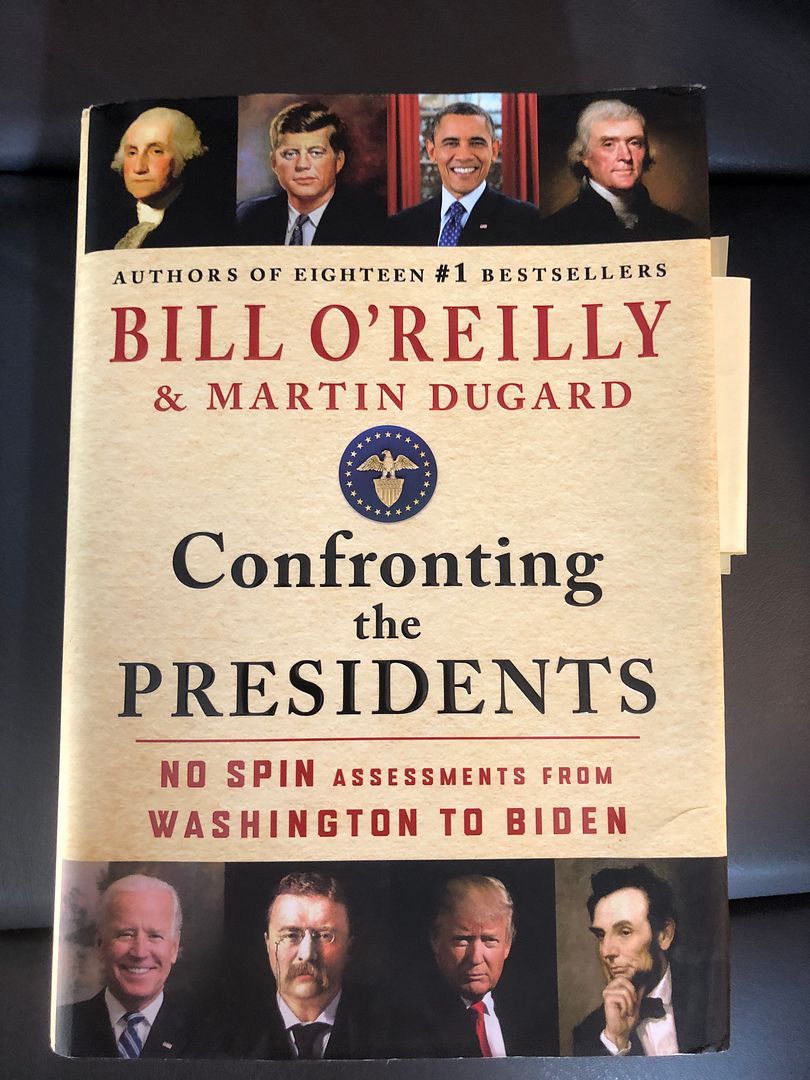
Confronting the Presidents: A Review of Bill O'Reilly and Martin Dugard's New Book


I started reading Bill O'Reilly and Martin Dugard's new 400+ page book on Friday.  I finished it last night -- Monday night.  That should give you an idea of how important and captivating Confronting the Presidents is. 

It is subtitled "No Spin Assessments from Washington to Biden".  But that obscures what the book actually is: assessments of US Presidents from Washington to Obama, co-written by O'Reilly and Dugard, followed by assessments of Trump and Biden written by O'Reilly, and assessments of Trump and Biden written by Dugard.  I'll explain near the end of this review why I think that distinction is crucial.

First, let me begin by saying I was on the O'Reilly's Fox show, The Factor, several times over 20 years ago (here's the video of my first appearance in January 2004), and four times on O'Reilly's No Spin News podcast several years ago.  We have strongly different political opinions, but I very much enjoyed our conversations.  O'Reilly has written numerous best-selling books, and O'Reilly and Dugard have a best-selling series (the "Killing" series about assassinations, attempted assassinations, killings of terrorists, etc), which I haven't read, but based on the writing in Confronting the Presidents, I expect that I eventually will, or at least read some of the books.

That writing is crisp, informative, and even exciting.   In part because most of it is in the present tense -- "At the start of Jefferson's second term, he is sixty-one years old.  He is no longer the young idealist...."  And in part because it has so many facts, big and little, that I didn't know and, after reading them in Confronting the Presidents, I think I should have known.  Like Theodore Roosevelt planning to run for a third term as president in 1919, before he died, and LBJ having a decades-long affair with Alice Glass, which Lady Bird knew about, and only ended when Alice left him because she was so furious about the Vietnam War.

We learn what each president ate for breakfast (right, I find that interesting), what kind of exercise they preferred, and how they died.  There's lots of humor in the book, but cradled in an underlying gravity and mortality.   And this is not because of what happened to Lincoln, Garfield, McKinley, and JFK, and almost happened to several others, but because as the authors make clear, the job of president, given the power to make one's dreams come true, is almost guaranteed not to be fulfilled, meaning your dreams will end up broken, their only chance being some future president may pick one up and carry it to victory in some more hospitable time.

Another salient point of history which I already knew as a media historian, and Confronting the Presidents makes abundantly clear, is that the intense polarization in our current world, (wrongly often blamed on social media, I would say), actually has been in the United States of America from the very beginning.  Editors of newspapers were prosecuted under the Alien and Sedition Act that John Adams signed into law, and O'Reilly and Dugard tell us that Alexander Hamilton wrote that Adams was "a mere old woman and unfit for president".

As a professor and lifelong student of communication and media studies, I was also glad to see that Confronting the Presidents notes that First Lady "Carrie" Harrison brought electricity to the White House but she and her husband Benjamin (1889-1893) were afraid of being electrocuted, radio began to have a big influence on politics in the 1920s, and of course TV took center stage in the 1960s.  (See my continually updated McLuhan in an Age of Social Media for how and when television gave way to the social media president.)

***

But this powerhouse book, brimming with fascinating, useful, and important information, concludes its confrontation of presidents with Barack Obama.   An "Afterword" briefly gives O'Reilly's and Dugard's assessments of Trump and Biden independently.  The reason for this change in format isn't given, but it must be because Trump's presidency may not be finished (he's currently running for a second term), and at the time the book was written, neither was Biden's (he had not yet withdrawn from the current election).

I'm making such a big deal about this because O'Reilly's assessments of Trump and Biden are the first in the book I strongly disagree with.  No mention is made of Trump's treatment of COVID, and the attack on the Capitol he instigated on January 6, 2021 is barely mentioned, as a political mistake, not the fundamental attack on our democracy that it was.  Even more incredibly, O'Reilly ranks Biden as the second worst president in American history (after James Buchanan).  

As I said at the beginning of this review, O'Reilly and I are on opposite sides of the political spectrum.  But I was nonetheless taken aback by what he said about Biden and didn't say about Trump because I found his joint assessments with Dugard about other progressive presidents like Obama and Clinton, and conservatives like Nixon, to be right on key.  

Obviously, Dugard was a moderating factor, and he had plenty to say in his own assessment of Trump about January 6, 2021 (because of this, he ranks Trump the worst president, one below Herbert Hoover).  Dugard also had some praise for Biden, and went so far as to say he hopes Biden wins in 2024 (the book was completed, again, before Biden withdrew from the race).

So what you'll get from Confronting the Presidents is a fair and balanced -- to use that Fox cliche -- assessment of every American President prior to Trump.  Then, for Trump and Biden, separate assessments from each author, which taken together accurately reflect the current polarization of this country.

I'm not sure what I would have suggested to the two authors prior to publication about how to conclude this book.  Maybe conclude with Obama with no Afterword.  Or maybe struggle to find some common ground as the authors did for every other president.  But I can say I recommend this book to anyone who'd like to have a handy, accessible guide to the people who have been at the top of our noble, imperfect experiment with democracy.




Friday, June 28, 2024

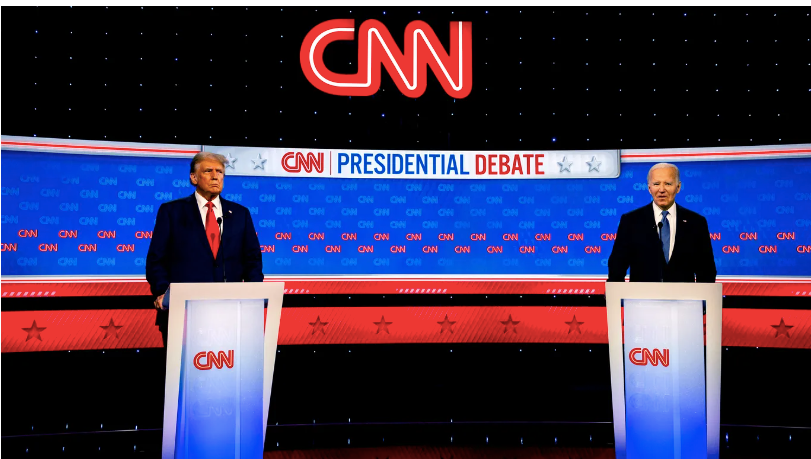
It's the Debate that Failed Last Night, Not Biden


Biden tried to say decent, ethical things but delivered most of his words poorly in last night's Presidential debate; Trump spoke much more clearly but said vile things and lied just about every time he opened his mouth (lies which the CNN moderators failed to call out).

What are we to think about this?

I would say it's that debates shouldn't matter as much as they seem to.  JFK looked better on TV than did Nixon, and a majority of people who saw the two on TV thought Kennedy won.  A much smaller number of people heard the same debate on radio, and thought Nixon won.  That event certainly demonstrated the importance of debates.  But though JFK proved to be an excellent President, the fact that he won the debate was really no indication that JFK would do so well in office.   The debates, in other words, were very valuable windows into the effects of media in politics, not indicators of the political character and acumen of the candidates.

It's plain logic that what a President does in office has nothing to do with the President's voice quality or appearance.  FDR was in a wheelchair throughout his presidency.  He connected to the American people in an age before television via his fireside chats on radios.  Few people knew he was in a wheelchair.  Most historians agree he was our very best President, getting the United States out of the Great Depression, and guiding us and our allies to victory in the Second World War.

I've spent my professional life as a professor of media and an author talking about the importance of televised debates, how candidates look and sound on television. JFK won the debate with Nixon because because by 1960 more than 90-percent of Americans had television in their homes. Reagan prevailed over Mondale by making a savvy joke about not making the younger age of his opponent an issue. Obama faltered in his first debate with Romney but came back strong in their second nationally televized conversation. But maybe it's time to focus on what debates really are: a 90-minute performance that has little to do with what the candidate did, is doing, or will do in office.   The truth is that the skills needed to be an effective debater have nothing to do with the skills needed to be an effective President.  Never did, never will.  Maybe it's long since time that we recognized that.

Marshall McLuhan was the first to point out that JFK won the 1960 debates and then the election because he performed so well on television, in contrast to Nixon who was judged as winning the debates on their radio broadcasts that so few people listened to. McLuhan made this observation in Understanding Media (1964), whose breakthrough message was "the medium is the message". The view that Biden's poor performance in Thursday's debate means he's no longer fit to be President strikes me as an egregious case of mistaking the medium (the debate) for the message (Biden's been doing a superb job as President).

Or, to paraphrase Shelley, maybe it's the debate that failed last night, not Biden.

***

Note added Friday, June 28th, afternoon:  And Biden amply demonstrated his power to effectively communicate in a rip-roaring speech in North Carolina.  Again, a debate is a unique mode of communication, which not only has nothing to do with Presidential decision-making and other Presidential activity, but not much in common with speech-making, interviews, and other kinds of communication, either. 

Note added Saturday, June 29The New York Times' editorial board called on Joe Biden to leave the race. They didn't say a word about Biden's speech in North Carolina. What are we to make about such an unprecedented call from the editors of what used to be known as the newspaper of record? I would say this is just more evidence of the decline of a once-great newspaper.  See my What's Wrong with The New York Times for an example this past Fall of what I'm talking about.


Sunday, October 17, 2021

Looking Back at “The Missing Orientation”: One Year Later


Abstract: Space tourism has received four literal liftoffs in the past year, and science fiction about space travel is flourishing, with new Star Trek seasons and Isaac Asimov’s Foundation series streaming this Fall. All of these both kindle and express our sense of wonder, but the pathways to space are still expensive and dangerous, and they need to be connected to the taproots of our sense of wonder In religion and science fiction, so those pathways stay open and strong.

Key words: space tourism, science fiction, religion, sense of wonder, Star Trek, Foundation, Richard Branson, Jeff Bezos, Elon Musk, Joe Biden, William Shatner

======

It’s been nearly a year since I wrote “The Missing Orientation” (Levinson, 2021), and its call for enlisting our religious or spiritual sense of wonder about our place in the universe in our continuing efforts to expand our existence off this planet and out into space.

Billionaires Richard Branson (Chang, 2021) and Jeff Bezos (Rincon, 2021) touched space in July, albeit briefly, kissing the cosmos in their spaceships and laying the equivalent of groundwork for tourism off this planet. William Shatner aka Star Trek’s Captain Kirk him went up to space in Jeff Bezos’s Blue Origin in October (Pereira, 2021; Roulette, 2021). And Elon Musk’s Space X literally brought four civilian tourists into space for three days in September (Duffy, 2021). But Branson’s Virgin Galactic apparently had a problematic re-entry (Wattles, 2021), showing how dangerous space flight still is, and seats on the Space X’s Inspiration 4 are estimated as costing some $50 million per seat, putting that flight beyond the reach of most tourists (Kelvey, 2021).

Meanwhile, the sense of wonder intrinsic in science fiction has been firing on all cylinders. Paramount+ will be streaming new seasons of Star Trek: Discovery and Picard in the months ahead, and Isaac Asimov’s Foundation series at long last found expression on the screen when Apple TV+ began streaming Foundation in September. As I mentioned in “The Missing Orientation,” it was the original Star Trek series in the 1960s that ignited my interest in space travel, and the Foundation trilogy got me thinking about humanity in galactic terms when I was a boy in the 1950s.

Star Trek always emphasized the inherently international nature of space travel and exploration. In 2021 and the years ahead, China is promising a robust space program (SCMP Editorial, 2021). And U. S. President Joe Biden’s 2022 budget request for NASA is the “2nd-best budget proposal for the space agency in 25 years,” supporting projects on the Moon, Mars, and Jupiter’s moon Europa (Dreier, 2021).

But, as the vacuum in the American space program for decades after humans walked on the Moon in 1969 and a few years after so vividly shows, budgeting for space exploration, especially in democracies, is unreliable. And space tourism needs to drastically lower its price before it becomes a part of our lives. Tourism is rooted in our sense of wonder, and as long as that sense remains strong, and connected to space via the ancient and more modern channels of religion and science fiction, our path to space will remain open and expand.

References

Chang, Kenneth (2021) “A Ride to Space on Virgin Galactic? That’ll Be $450,000, Please,” The New York Times, 5 August https://www.nytimes.com/2021/08/05/science/virgin-galactic-ticket-price.html

Dreier, Casey (2021) “Biden's 2022 NASA Budget Says Yes to Pretty Much Everything,” The Planetary Society, 4 June https://www.planetary.org/articles/nasas-fy2022-pbr-analysis

Duffy, Kate (2021) “SpaceX's all-civilian crew chatted with Elon Musk and shared photos of Earth from the spaceship's glass-dome bathroom on their first full day in space,” Insider, 17 September. https://www.businessinsider.com/spacex-civilian-inspiration4-elon-musk-spaceship-shared-photos-earth-2021-9

Kelvey, Jon (2021) “Inspiration4: How Much Does a Ticket to Space Cost?” 16 September. Inverse. https://www.inverse.com/science/inspiration-4-how-much-is-a-ticket-to-space

Levinson, Paul (2021) “The Missing Orientation,” Religions. 2021;12(1):16. https://www.mdpi.com/2077-1444/12/1/16/htm

Pereira, Ivan (2021) “How William Shatner's Blue Origin space trip can reignite passion for science,” ABC News, 12 October. https://abcnews.go.com/Entertainment/william-shatners-blue-origin-space-trip-reignite-passion/story?id=80404356

Rincon, Paul (2021) “Jeff Bezos launches to space aboard New Shepard rocket ship,” BBC News, 20 July https://www.bbc.com/news/science-environment-57849364

Roulette, Joey (2021) “In a Blue Origin Rocket, William Shatner Finally Goes to Space,” The New York Times, 13 October. https://www.nytimes.com/2021/10/13/science/william-shatner-space-blue-origin.html

SCMP Editorial (2021) “The sky is the limit for the emerging Chinese space industry,” South China Morning Post, 24 July https://www.scmp.com/comment/opinion/article/3142412/sky-limit-emerging-chinese-space-industry

Wattles, Jackie (2021) “FAA grounds Virgin Galactic, says it's investigating problems with Richard Branson's flight to edge of space,” CNN Business, 2 September. https://www.cnn.com/2021/09/02/tech/richard-branson-virgin-galactic-space-danger-scn


Tuesday, April 20, 2021

Chauvin Guilty on All Three Counts: Thoughts on How this Happened

Today will be recorded in history as a great day for Black Live Matter and American jurisprudence:  former police officer Derek Chauvin was found guilty on all three counts.  Chauvin is now a justly convicted murderer.

This is the beginning of a profound correction in the American judicial system, which for decades and centuries has exonerated police who took the lives of innocent black men with impunity.  What was different in this case?

It's because the killing of George Floyd by Derek Chauvin was not only captured on video -- that has happened many times before, with police acquitted, as happened with Rodney King in the 1990s -- but because the murder of George Floyd was conducted in slow, agonizing motion.  Sometimes a killing by an officer with a gun happens so quickly that it's difficult to see on a shaky video.  Not so so the video recorded by the 17-year-old Darnella Frazier that all of us, including the jury, have seen of Chauvin taking the life out of Floyd with his knee on Floyd's neck.  They and we saw the horror of murder in slow motion.

This verdict is the end of this trial, but not the end of the process of holding murderous cops to account, and, even more important, getting them not to kill innocent human beings in the first place.  This will require much better hiring and much better training of those who want to wear the badge.

It's good that we now have a President in office who wholeheartedly supports this verdict.  I have confidence that Biden and the Democrats in both Houses of Congress will keep applying maximum pressure to move this profound remaking of the police forward in this country.


Wednesday, February 17, 2021

Trump Impeachment Aftermaths

Here are some of my thoughts about the Trump impeachment acquittal and where we go from here, a week after the conclusion of the Senate trial:

1. Mitch McConnell's vote and statement:  I of course was very disappointed but not surprised by McConnell's vote to acquit Trump.  I was surprised by McConnell's accompanying statement, both the content and the intensity.  In particular, that McConnell said 

There’s no question, none, that President Trump is practically and morally responsible for provoking the events of the day. No question about it.... Trump is still liable for everything he did while he was in office, as an ordinary citizen. Unless the statute of limitations is run, still liable for everything he did while he was in office. Didn’t get away with anything, yet. Yet. We have a criminal justice system in this country. We have civil litigation and former presidents are not immune from being accountable by either one.  [See here for the transcript of McConnell's statement.]

There's no doubt that the country -- and therefore the world -- would have been better off had Trump been found guilty and thereby prohibited from ever holding public office again.  But McConnell's statement is nonetheless part of the record of the impeachment process, and is and will be of great value.  It shows that, whatever McConnell's reasons for voting for acquittal, he nonetheless thought Trump was responsible for the insurrectionist riot, and, just as important, ought to be held accountable for his actions and non-actions.  Coming from the Republican Senate Minority leader, that's significant, and will be prominently noted by historians.

2. Republican attacks on Republican Senators who voted to convict Trump:  McConnell also said that "I respect my colleagues who’ve reached either conclusion" about whether a conviction of Trump in the impeachment trial would be constitutional.  Not so some other Republicans around the country, including  local Pennsylvania  GOP Chair Dave Ball,  who said

We did not send him [Senator Pat Toomey, who voted to convict Trump] there to vote his conscience or ‘do the right thing' or whatever he said he was doing there.  We sent him there to represent us.  [Interview on KDKA-TV]

Now there's been a debate as old as our republic about whether our elected representatives should vote their conscience or ascertain what the people who elected them want.  I've always been a strong supporter of conscience, on general principle, and also given the unreliability of polling in discovering what the voters want.  But the position of finding out what the public wants and basing your vote on that at least has a logic to it, and is consistent with the democratic process.  Is that what Ball was urging?  I don't think so.  The "we" in that last sentence more likely refers to the Republican Party, who put Toomey up for general election and supported his campaign.   And if that was what Ball was saying, that Toomey should keep in line with his party's policies, that's disturbingly reminiscent of insistence on adherence to the party line in totalitarian societies like the former Soviet Union.

3. Biden Administration response to Trump acquittal:  The Biden Administration clearly wants to focus on the pandemic and other challenges it views as more urgent than what to do now about Trump.  Vice President Kamala Harris said today on the Today Show:

Right now I'm focused on what we need to do to get relief to American families and that is my highest priority, it's our administration's highest priority, it's our job, it's the job we were elected to do, and that's my focus. [See more on that here.]

I agree completely with Biden and Harris.  Not only is the pandemic an obviously immediate life and death matter -- on a massive scale -- but there are other ways to hold Trump to account.  New York and Georgia are already investigating criminal charges against Trump, and the U.S. Attorney General's office, which Biden wants to be non-political, i.e., not serving Biden's political interests as Attorney General William Barr did Trump's, can investigate Trump and seek to indict him, without instruction from Biden.

In sum, although conviction of Trump in the impeachment trial was amply merited and would have benefited the country, we who value justice and freedom and democracy are in a good position to do something about the fascist former President who did so much damage to our country.


Thursday, January 7, 2021

The View Looks Better from Here

I wrote here the morning after the election in November that there were grounds for optimism -- Biden was gaining in Wisconsin, Michigan, and Arizona, which provided enough votes to win in the Electoral College. The last stage of that anachronistic, indirectly democratic process, but the only process we have right now, was completed last night.

I don't like Vice President Pence in the least.  He's enabled and promoted four years of Trump's fascist regime.  But, in the end, he did his job in Congress certifying the electoral vote yesterday.  It's a measure of how far we've gone away from decency and integrity in the Trump regime that a Vice President deserves praise for doing his job, but there you have it.

Yesterday also brought the news that the Democrats will control the Senate, and therefore both houses of Congress.  Warnock's and Ossoff's victories in George are profound game changers, which will open the way for Biden with Harris's help to enact all the major components of his rebuilding a better America. (In addition what needs to be done in making health care universal, countering racism, gun control, protecting the environment -- I've also long yearned, on a relatively minor, personal level, for a rail system in the United States as high-speed and effective as the ones in Europe and Japan, and I think that will now finally happen.)

There's still an enormous amount of danger to be dealt with, ranging from every minute Trump is still in the White House to the tap root of fascism Trump called forth* to the still-raging pandemic.  But we've finally reached the light at the end of one of the long, deep tunnels we've been struggling the navigate, and the view looks better from here.

*The storming of the U.S. Capitol, which happened a few hours after this blog post, is a tragic and infuriating example of what this fascism can do.  See my comments in the NY1 video below:


Saturday, December 12, 2020

Why Republicans Continue to Support Trump

Here's my best explanation/theory about why those 126 Republican members of the House of Representatives, and 17 Republican state attorneys general, signed amicus curiae briefs in support of the attempt by Texas to get the U. S. Supreme Court to disallow the votes in swing states Pennsylvania, Michigan, Wisconsin and Georgia that went for Biden in the Presidential election.

Republicans were traumatically horrified when Obama won not once, but twice, and against two mainstream, highly regarded, mainstream candidates. When Trump beat Hillary, even more loathed by Republicans than Obama, Trump won the inchoate love of many otherwise sane Republicans. They support Trump now because they want, against all odds, to somehow hold on to that evil magic.  To keep that sick hope alive.

The Supreme Court wisely threw out the Texas attempt to overthrow the election.   Biden will take the oath of office on January 20, 2020.  But it will take a lot more than one Supreme Court decision to put the fascist, racist rage back in the hole from which it emerged.


Monday, November 9, 2020

Why Did So Many People Vote for Trump?


Welcome to Light On Light Through, Episode 156, in which I consider why more than 70 million Americans voted for Donald Trump in the just concluded Presidential election.

Further reading: Escape from Freedom by Erich Fromm


Check out this episode!

Saturday, November 7, 2020

Truth Wins in the Marketplace of Ideas


Welcome to Light On Light Through, Episode 155, in which I put Joe Biden's victory in some philosophic context: it offers proof of John Milton's argument, way back in the Areopagitica, that truth can win in the marketplace of ideas, even this age of social media.


Check out this episode!

Wednesday, November 4, 2020

Podcast: Grounds for Optimism the Day after the Election


Welcome to Light On Light Through, Episode 154, in which I explain how Joe Biden is winning the 2020 U.S. Presidential election.


Check out this episode!

Grounds for Optimism at 9:30 in the Morning, the Day after the Election

The counting in the 2020 Presidential election in the United States continues, despite that fascist in the White House.   And the results are providing grounds for real optimism.

Joe Biden is close to being called winner in Wisconsin.  He's beginning to move up in Michigan (AP is already calling Biden leading in Michigan).   AP and Fox News have Biden winning Arizona.  He also won a district with one electoral vote in Nebraska.   That's enough to make him President.  

And ... Philadelphia's mail-in ballots, to be counted tonight, could well give him a victory in Pennsylvania, too.  Even Georgia's still in play.  I'm moving from guardedly optimistic to solidly optimistic. 

The course of true democracy never did run smooth.  It's beset by ignorance and fascistic impulse in the populace at every turn.   An impulse that bids people to act on their worst instincts, to ignore facts and throw away logic in favor of gratifying grievances and delusion.   Trump has fanned these flames at every turn.

But the counting continues nonetheless.  Hope and truth and respect for truth persist.   And I expect, before this day is over, that it will triumph over the despoiler in White House, and consign him to the ignominy of history.

Saturday, October 24, 2020

"Abraham Lincoln Over There"

I've been thinking about the second and final Presidential debate between Biden and Trump last week.  Obviously, and as I said on Twitter and Facebook right after the debate, Trump was less abusive than he was in the first debate (faint praise), but Biden held his own, and delivered a vastly more effective closing statement.   But as Election Day -- or the end of Election time -- looms, and that last debate fades into history, I'm realizing the highpoint of the debate, certainly its most memorable line, came when Joe Biden looked at Trump and said, "Abraham Lincoln over there..."

This came a little after Trump had claimed with a straight face that he done more for African-Americans than any other President, with the possible exception of Abraham Lincoln.  It had much the same power as Lloyd Benson's rejoinder to Dan Quayle's statement in the 1988 VP debate that he and Jack Kennedy had been of a similar age, allowing Bentsen to say to Quayle, I knew Jack Kennedy and you're no Jack Kennedy.  Quayle had been warned by his prep team not to say that in the debate -- he had been saying that on the campaign trail -- and Bentsen had been well prepared for such a statement.  In the case of Trump, there's no warning such arrogance,  and it didn't matter if Biden had been prepared for that statement and was ready with the Lincoln jibe, it was delivered with just the right tone at just the right time.

Trump unsurprisingly went on to dig a bigger hole for himself, responding that he had never said he was Abraham Lincoln.  This was literally true but a lie in effect.  Everyone had heard him compare himself to Lincoln just a few minutes earlier.  The denial also showed that Trump is metaphor-blind.

In all fairness to the Trump-Quayle comparison, Quayle did go on to win the Vice Presidency in that 1988 election.  But that was only because George H. W. Bush ran a much better campaign for President than his Democratic opponent Michael Dukakis.  Though anything is possible when the votes begin to get counted next week, and underestimating Trump's support is an ever-present danger, I expect Joe Biden to do much better than the ersatz Abraham Lincoln who masquerades as President.


Thursday, October 8, 2020

Podcast: Running Scared


Welcome to Light On Light Through, Episode 150, in which I discuss Trump's decision to withdraw from the 2nd 2020 Presidential debate because it was virtual (online not in person) which allow him to be easily "cut off".

Further reading (blog post):

Running Scared: Trump Withdraws from Second Presidential Debate


Check out this episode!

Running Scared: Trump Withdraws from Second Presidential Debate

 I was not in the slightest surprised to just hear this news

“I’m not going to do a virtual debate,” Trump told Fox Business anchor Maria Bartiromo... “I’m not going to waste my time on a virtual debate. That’s not what debating’s all about. You sit behind a computer and do a debate — it’s ridiculous. And then they cut you off whenever they want.”

I and many others have been calling for moderators to have the technological capacity to cut off microphones during the Presidential and Vice Presidential debates.  Trump interrupted Biden just about every time the Democratic candidate started talking in their first debate, and Pence repeatedly talked far over his allotted time in the VP debate last night.  Moderator Chris Wallace in the first debate and Susan Page in the second debate complained and chastised Trump and Pence, but to no avail.  A capacity to cut off the microphone would have been  useful indeed, and would have well served the goal of the debates to give the American people a chance to see and hear the candidates discuss the issues.

Of course, there's no guarantee that a moderator, in-person or virtual, would use the option to cut off the microphone of a bullying (Trump) or over-talkative (Pence) debater.  But without such an option, the moderator's ability to reign in abusive and errant debaters is limited.  I would have liked to have seen Wallace and Page stand up and refuse to allow the out-of-line candidate to continue talking, but I recognize that that's easier said than done.  

A cut-off switch would have surely helped, and muting someone in an online conversation is easier and far less confrontational than in person.   Not to mention that online debates cannot be vectors of COVID-19.  But Trump cares as much about personally spreading the virus as he does about adhering to the rules of civil debating, which is to say, not much at all.  So, with his poll numbers plummeting, and his desire to keep faith with those who like his truculence, he ran scared and pulled out of the upcoming virtual debate.  Good riddance, and looking forward to November 3.


Tuesday, September 29, 2020

Biden vs. Trump Presidential Debate #1: Chris Wallace Should Have Cut Off Trump's Microphone

Donald Trump, who has destroyed or impaired so much of what we cherish and deem important in America, took his pickaxe to the First 2020 Presidential debate tonight, interrupting Joe Biden almost every time he spoke.  And though Chris Wallace weakly protested this disruption many times, he failed to stop Trump's rampage.  Wallace should have cut off Trump's microphone, or requested the audio engineer to do that.

Nonetheless,  Biden did break through a good number of times, beginning with when he said to Trump, early in the debate, "will you shut up, man".  Biden went on to be very effective when he looked at the camera and spoke directly to the American people about his positions about health care, Black Lives Matter, the importance of voting, and other crucial issues.

I just heard Nicole Wallace say on MSNBC that Trump abused Chris Wallace as moderator.  That may be true, but the more important point is that Wallace had a responsibility to keep this abusive President in check.   And although he tried from time to time, he let Trump interrupt Biden over and over again.

I've enjoyed Presidential debates since Kennedy-Nixon in 1960.  Tonight's debate, although I thought Biden the better candidate won, was a disgrace.  Civilized discourse lost, another victim of Trump and his contempt for reason.  I hope subsequent moderators do better.


Thursday, August 20, 2020

Written Report on Fourth Day of 2020 Democratic National Convention

And the 2020 Democratic National Convention concluded tonight, very likely the most important political convention in our American history, because it nominated candidates for President and Vice President for what in many ways is the most important election in our history, upcoming in November.  Why so important?  Because it's the last and only chance to vote out of office a President who is the biggest threat to our democracy in history, Donald Trump.

This convention, as you know, was conducted virtually.   The reason, as you also know, was safety, with the COVID-19 pandemic still raging across America.  This would have been a very necessary compromise.  But I thought it came off so well, the virtual convention was in many ways so much better than the in-person convention,  that it thus was not only no compromise, but something, or parts of which, that should be done again, and become part of the basic structure of how conventions to nominate Presidents of our country are conducted and presented to our nation.

The virtual convention was better, I thought, in at least two ways.  First, the sequences of people across America, in the nomination roll call, in the endorsements and nominations, in the people talking about their struggles with racism, the pandemic, and their businesses, were the best way I've seen of putting substance to the "We, the people," the first words of our Constitution that were  adopted as the motto of this 2020 Democratic National Convention.

Second, I think talking into a camera in a quiet hall or room made for better speeches by the major speakers.  Part of the reason why I thought everyone from Bernie  to Obama and Joe Biden gave the best speeches of their careers was the clarity and intensity that the camera rather than a huge crowd affords the speaker.  I'm not sure this kind of speech making will continue when COVID subsides.  I hope it does.

The Democrats, at least in my lifetime, have always been the Party of the future, so it's only fitting that they trail-blazed a new way of conducting conventions in this age of COVID-19.

Now as to the content of this final night of the 2020 Democratic National Convention, it had many splendid, memorable moments, many of them bringing tears to the eyes and hope to the soul.  I thought the rivals segment was especially effective.  Julia Louis-Dreyfus as host of the entire evening was not only emotionally satisfying but laugh-out-out funny.  And the teenage boy in New Hampshire who stutters, and who explained how Joe Biden, who also stutters but has largely gotten on top of it, gave him some helpful advice was ... well, courageous and inspiring only do it partial justice.

And Joe Biden ... well, yes, he too indeed delivered the speech of his life.  Summoning all of America to join him in the battle ahead to reclaim America, and then set it on a better path. The great speeches earlier in the convention were delivered by people like Barack Obama who had delivered many an inspirational and eloquent speech before.   But I've never heard Joe Biden deliver anything like what he said tonight, masterfully written and masterfully delivered, in equal measure.

I can barely imagine, and don't particularly want to imagine, what the Republicans will do next week at their convention.  I can imagine the America that Joe Biden so powerfully described, and I'll do all in my power in the months ahead to help make that happen.

See also Written Report on 1st Night the 2020 Democratic National Convention ... Written Report on 2nd Night of the 2020 Democratic National Convention ... Written Report on 3rd Night of the 2020 Democratic National Convention


Wednesday, August 19, 2020

Written Report on 3rd Day of 2020 Democratic National Convention

What a speech by Barack Obama on the third night of the 2020 Democratic National Convention, the first virtual National Democratic or Republican Convention in history.  I thought the speech was so pertinent and powerful it was even better than his speeches as President, and in his campaigns for that office.  Unafraid to call out the monster, the would-be destroyer of our democracy, now in the White House.  Sobering, inspiring, chilling, and so very necessary.

Kamala Harris gave an outstanding speech, too, accepting her nomination as Vice President on the Democratic ticket.  Her empathy for the victims of racism and COVID, combined with her astute attack on Trump, and her winning charm, show what a wise choice Joe Biden made in selecting her as his running mate.  And wasn't it excellent to see him come out on stage and join her after her speech, especially impressive in this age of COVID.

Elizabeth Warren's speech was powerful, as well, preceded by real people across the country whose businesses have been jeopardized to the edge of extinction by the COVID pandemic and the poor leadership -- non-leadership -- of Donald Trump.   I hope she gets a prominent position in Biden's cabinet.

And the segment on victims of gun violence, followed by Gabby Giffords, was also ever timely and necessary.  Good for the Democratic National Committee for not letting this life-and-death issue get lost in the toxic sea of COVID and racism and attempts to suppress the vote that beset all Americans. 

So this third night was a real joy and inspiration.  Biggest surprise for me: Mariska Hargitay of Law & Order SVU endorsing Biden for President!  You just can't beat a Benson endorsement!

I'll see you back here tomorrow after the fourth and final night of the 2020 Democratic National Convention.


See also Written Report on 1st Night the 2020 Democratic National Convention ... Written Report on 2nd Night of the 2020 Democratic National Convention


InfiniteRegress.tv