Chuck Todd interviews me about alternate histories
Showing posts with label Arnold Schwarzenegger. Show all posts

Tuesday, November 5, 2019

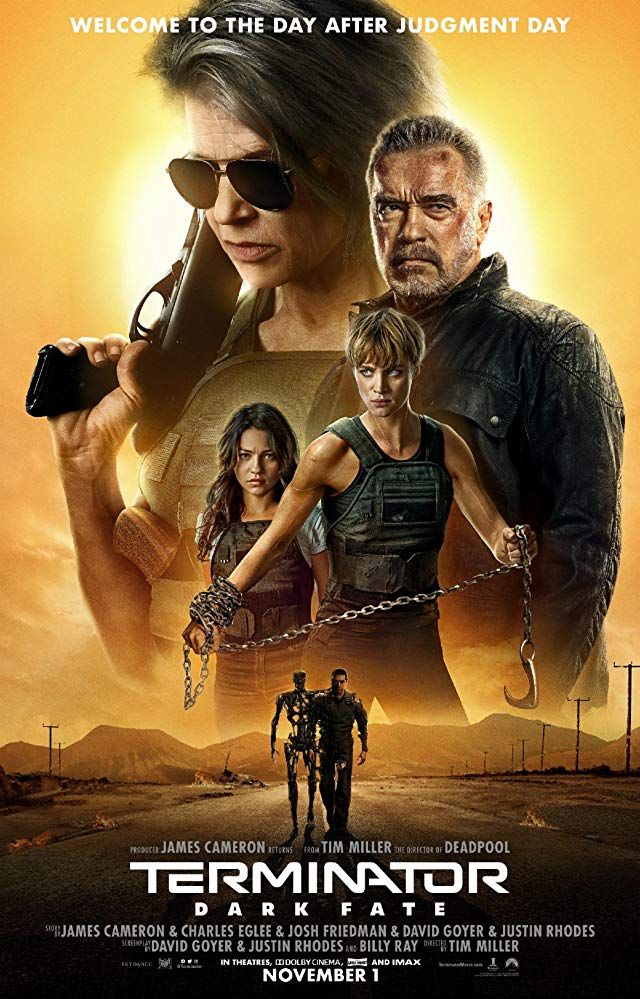
Terminator: Dark Fate: Bright Future


So here we go again.  The critics panned it.  The box-office in the first few days is not impressive.  All manner of self-appointed prognosticators pronounce the franchise deader than an outmoded Terminator model, because that's what it is.

But my son Simon and I saw it tonight.  In the Magic Johnson theater in Harlem, in Dolby, in seats more comfortable than a Lazy Boy, which rumbled when the action on the screen called for it, which it often did.  And ... we enjoyed it immensely.

[some spoilers follow]

This Terminator movie was made by James Cameron, his first since the iconic and brilliant Terminators 1 and 2, lo those many years ago.  It tells a story that take a different path, and obviates, the non-Cameron sequels that followed Terminator 2.  I enjoyed those, too.  But not as much as this new movie.

Skynet is indeed destroyed.  But young John Connor is killed by an Arnold Terminator anyway, sent back before Skynet was destroyed.  This killer Terminator took some time finding John Connor, but he did.  All of that, in effect, is prelude to the story in Dark Fate, where we see another newer Terminator model - that dwarfs T-800/Arnold's powers - hunting a young woman which another monstrous digitized war-system, Legion, has unleashed on its past and her/our present.  This new model, a REV-9 that goes by the name of Gabriel, is so potent a machine that no one human or lesser model like a T-800 can destroy it.

I'd say that's the makings of an excellent movie, and Dark Fate was.  Linda Hamilton is back as a much older Sarah Connor, with a hatred of the T-800 who killed her son,  She gave an effective performance.   Arnold is no great actor, but he put in an outstanding performance as the T-800, showing a combination of humor, sensitivity, and ferocity as called for.  Mackenzie Davis was good as an augmented human Grace from the future, Gabriel Luna was effective as Gabriel, and Natalia Reyes was appealing as Dani, the woman Gabriel is after, first thought by Sarah to be another mother-of-the-savior version of her , but who turned out to be someone different (that was pretty easy to figure out, but that didn't put too much of a dent in the fast action and suspenseful pleasures of the movie).

Like many time travel movies, Dark Fate suffered from the problem of, once we find out that Dani in the future sent Grace back to save her, we know that Grace had to succeed, otherwise there would have been no Dani in the future to send Grace back.   There are ways of handling this - like the multiple worlds scenario - but the Terminator movies, especially the first two, were never about working out all those metaphysical paradoxes of time travel.  There were about the human/machine interface, and, even though I love those paradoxes dearly, the two movies succeeded grandly.

As did Dark Fate.  So, I predict that some year before too long, we'll indeed see another Terminator movie, contrary to all the current doomsayers.   I'll look forward when that happens to reviewing that movie, and putting in a link to this one.


The androids are coming out into the open, for the first time in centuries ....

Friday, December 30, 2016

Terminator Genisys: You Know What? I Liked It

With 2016 coming to a close, I thought it was long past time that I saw - and reviewed - Terminator Genisys, released in 2015, the 5th movie in the Terminator saga, in which a lot of the action takes place in early 2017.

The movie did ok at the box office, better worldwide, but not enough to be fast-tracked by Paramount for sequels, which nonetheless may be still be made.   It was panned by many critics.  I had lots of problems with it, but also thought it had some redeeming elements.   I loved the first two Terminator movies, the third almost as much, and enjoyed the fourth (though a lot of people didn't - enjoy the fourth, that is).  I also enjoyed and reviewed the television series. See the links below.  All told, given this history and the bright parts of Genisys, I'd definitely like to see more sequels.

Here's what wasn't so hot in the movie:  A lot of the dialog is ridiculous, such as Sarah Connor saying "bite me".   A lot of the acting - including Emilia Clarke from Game of Thrones playing Sarah - was nothing special, either.  She was no Linda Hamilton or Lena Headey (TV series) in the role.

Here's what I liked: Arnold Schwarzenegger reprising his Terminator role, in fact as a young, middle-aged, and old version of him/itself.  He did this with just the right mix of seriousness, wooden style, and humor - including a smile he is trying to convey, to make himself seem more human, but which only makes him more frightening, right in the uncanny valley.   The plot around this Terminator is good, too.

And the same for the overall storyline.   There's respect for paradoxes of travel to the past, attempts to explain how someone could remember a history which his or her action had eliminated, and some good twists regarding heroes and villains.   And the Genisys being Skynet, drawing a connection between our social media giants and the emergence of Skynet, was a nice touch, too.

J. K. Simmons also was excellent as an older detective who had an encounter with our heroes when he was a young cop, and  Jason Clarke as John Connor was pretty good, too.

So, yeah, I'm down for another movie or two or more.  Emilia Clarke says she won't be back - sorry, but she's much better in Game of Thrones.   Our growing 24/7 immersion in social media - which I actually think is mostly a good thing - makes the Skynet story, especially now as Genisys, more relevant than ever.  Hey, maybe my enjoyment of social media is part of the very problem that made our species so vulnerable to Skynet.   But I'm not worried - as long as there's a good Arnold-Terminator model on hand to help us out.

See also Terminator Salvation: A Compelling Time Travel Story Nonetheless

and also my reviews of The Sarah Connor Chronicles 2.1 Cameron's Back ... 2.2 Firing on All Cylinders ... 2.3 Who, Truly, Is Agent Ellison? ... 2.4: Meet Allison ... 2.5: Unpacking the Future ... 2.6: Terminator Mom, Human Daughter ... 2.7: The Saving Robbery and Cromartie ... 2.8 Perspectives and Death ... 2.9: An Idiot's Guide to Time Travel in The Sarah Connor Chronicles ... 2.10: Riley Lashes Out at Facebook ... 2.11: Cameron Meets A. E. Housman and Andre Bazin ... 2.12 Sarah Connor Chronicles in Triple Time ... 2.13: Space, Time, and Blogging in The Sarah Connor Chronicles ... 2.18: The Sarah Connor Chronicles and the Life of Riley ... 2.20: Sarah Connor vs. Death in Two Forms ... 2.21: Profound Lessons from a Kidnapping in The Sarah Connor Chronicles ... The Sarah Connor Chronicles Season 2 Finale

And from Season 1: The Sarah Connor Chronicles 1 and 2 ... 3 ... 4. A Robot Primer ... 5 ... 6 ... 7 ... 8-9
 
time traveling a little further back in history ...

Friday, August 8, 2014

The Killing Season 4: Masterpiece Finale

I just saw the final season of The Killing on Netflix - all six episodes of Season 4 - and it is a masterpiece.

Not because of the new murder story, which was excellent in its own right, with all kinds of brutal twists and turns.   With a much shorter arc than the earlier murders in this series, this one - about a family execution with only the son surviving - had to be tighter, and it was.

But the part of season 4 of The Killing which will make it, and the whole series, something which will be watched and remembered through the ages was the Linden and Holder story.  Part of that is the continuation of the Skinner story from Season 3.  But the even more important part is the toll that takes on Linden and Holder, and the aftermath.  Don't worry, I won't give anything specific away.  But if you'd rather not get any inkling that even a generality can give, don't read any further.

First and foremost, the ending was something I often want to see in a television series, but never do, because most television is afraid to deal with the realities of human nature, ugly, beautiful, destructive, redeeming, and all together. The final season shows Linden and Holder at their best and worst.  They support each other magnificently when one or the other is down, and they turn on each other like nearly rabid dogs when the going gets impossibly tough.   They're both deeply flawed but brilliant.   And the kicker is they're brilliant not only as detectives, but in their understanding of human relationships, often occluded but always on the verge of breaking through.

The last 10 minutes of the very last episode are like nothing I've ever seen on television - hell, that's true of the last 50 or more minutes, but the last ten are something else.  If you think you'll know how this is going to end, I promise that you don't, unless you have even more sensitivity than Linden and Holder in their best moments.

And, by the way, all six episodes are superbly acted. Joel Kinnaman is better than ever, and Mireille Enos is never anything short of fabulous (hey, she was even the best part of that big bad Schwarzenegger movie earlier this year).  Joan Allen puts in a strong performance, and Gregg Henry is excellent.  And there are nods to events from the first three seasons - just what you'd want in a final season - including a crucial appearance from Richmond.

But most of all, as I already said, it's just great and uniquely satisfying to finally see a finale to a television series that in its very last seconds its right where you always wanted it to be.

See also The Killing 3.1-2: Poe Poetic Po-po ... The Killing 3.3: Hitchcockian Scene and More ... The Killing 3.7: "Opiate of the Masses" ... Killing 3.8: The Kidnapping, and a Prediction ... The Killing 3.9: Suspect Elimination and Incompatible Components ... The Killing 3.10: Capital Punishment ... The Killing Season 3 Finale: We Need Another Season

See also The Killing Season Two Premiere ... The Killing 2.2: Holder ... The Killing 2.11: Circling Back ... The Killing Season 2 Finale

And see also The Killing on AMC and The Killing 1.3: Early Suspects ... The Killing 1.5: Memorable Moments ... The Killing 1.6: The Teacher ... The Killing 1.8: The Teacher, Again ...The Killing 1.9: The Teacher as Victim, Again ... The Killing 1.10: Running Out of Suspects ... The Killing 1.11: Rosie's Missing - from the Story ... The Killing 1.12: Is Orpheus the Killer? ... The Killing 1.13: Stretching Television

 
another kind of crime story

#SFWApro

Friday, January 1, 2010

Terminator Salvation: A Compelling Time Travel Story Nonetheless

I saw Terminator Salvation on DVD last night, and, contrary to the ton of criticism and weak box office it received last summer, I thought the movie was pretty good - powerful, intellectually provocative, with fine action scenes. It was not as good as the first two Terminator movies, to be sure, but it was better in some ways that the third Terminator, and makes an important contributor to the overall Terminator story and lore.

The action takes place at a time in the future when John Connor is high in the resistance command, but has not yet taken command, and has not yet sent Kyle Reese back to save Sarah Connor from the bad Arnold T-800 Terminator. But the most compelling character is someone/something new - Marcus Wright, first seen as a prisoner being executed in 2003 (before the rise of the machines), but who turns up in the future in the same time as John Connor. Turns out Marcus hasn't time traveled, though. He's been rebuilt into a half-human, half-machine - a cyborg - but by whom? And for what purpose? With the characteristics of both human and machine, Marcus makes for the perfect infiltrator - he can pass as human (until a machine-killing mine unveils him), and as a machine (able to pass Skynet scans). If the humans had created him, Marcus would be an ideal destroyer of Skynet, and vice versa. The denouement hinges of what Marcus really is, and is played out just right.

There's no time travel in this Terminator movie, which for me is unfortunate, but the John Connor we see has lived through the earlier Terminator movies - he knows he will later have to send Kyle back to save his mother, and become his father - and this makes Kyle, a teenager at this time, the person to most need protection and saving in this story. Early on, we and John Connor learn that John is the second most wanted human on Skynet's hit list, and Kyle is the first. Which makes sense, because if Skynet kills John Connor but leaves Kyle alive, he could conceivably still go back in time and father another John Connor with Sarah. Thus, even though there is no time travel per se in this story, it informs the story in a way that makes it a fine, harrowing, paradoxically pummeling time travel narrative anyway. (One of my commentators in this blog, "radabad," wonders why Skynet didn't just kill Kyle when it had him in custody, instead of using Kyle as lure to get John. See my response, in the 5th comment below.)

No mention is made of any of The Sarah Connor Chronicles in Terminator Salvation, but nothing in the movie contradicts what we saw on television for two years, and we do get to see a good minute of bad Arnold in the movie. All in all, if you're a Terminator and/or time travel buff, I highly recommend Terminator Salvation. Don't listen to the critics. They don't know it, but they were probably programmed to dislike it.

See also reviews of The Sarah Connor Chronicles 2.1 Cameron's Back ... 2.2 Firing on All Cylinders ... 2.3 Who, Truly, Is Agent Ellison? ... 2.4: Meet Allison ... 2.5: Unpacking the Future ... 2.6: Terminator Mom, Human Daughter ... 2.7: The Saving Robbery and Cromartie ... 2.8 Perspectives and Death ... 2.9: An Idiot's Guide to Time Travel in The Sarah Connor Chronicles ... 2.10: Riley Lashes Out at Facebook ... 2.11: Cameron Meets A. E. Housman and Andre Bazin ... 2.12 Sarah Connor Chronicles in Triple Time ... 2.13: Space, Time, and Blogging in The Sarah Connor Chronicles ... 2.18: The Sarah Connor Chronicles and the Life of Riley ... 2.20: Sarah Connor vs. Death in Two Forms ... 2.21: Profound Lessons from a Kidnapping in The Sarah Connor Chronicles ... The Sarah Connor Chronicles Season 2 Finale

And from Season 1: The Sarah Connor Chronicles 1 and 2 ... 3 ... 4. A Robot Primer ... 5 ... 6 ... 7 ... 8-9


The Plot to Save Socrates


"challenging fun" - Entertainment Weekly

"a Da Vinci-esque thriller" - New York Daily News

"Sierra Waters is sexy as hell" - curled up with a good book


Read the first chapter of The Plot to Save Socrates
.... FREE!

Sunday, November 30, 2008

Excellent That Chris Matthews May Run for Senate

I just heard, again, on Wolf Blitzer's Late Edition on CNN, that MSNBC's Chris Matthews may run as a Democrat against Republican Arlen Specter for his Senate seat in Pennsylvania in 2010. Reports about this are flying all over the place.

I hope it's true. I live in New York, but I'd vote for Chris Matthews not only over Specter but just about anyone. I agree with most of Matthews' positions - his consistent opposition, from the beginning, to the war in Iraq, and his enthusiastic support of Obama are what most come to mind - but I also like the fact that, although he was once a Tip O'Neill staffer, and ran unsuccessfully for Congress in 1974, Chris Matthews is currently very much an outsider in politics.

We have long recognized that a life in politics is by no means a prerequisite for high office. Whatever we may think of Reagan and Schwarzenegger's governance - I certainly opposed a lot of Reagan's - there is no denying their effectiveness in office. Indeed, Renaissance men were among our leading Founding Fathers - in an age before xerox, Thomas Jefferson invented a way of automatically making a copy of a letter, as it was being written.

Matthews on television has been articulate and passionate. The main problem with his brand of Hardball is that he frequently interrupts and talks over his guests. That could be a big asset in the Senate.

Tuesday, October 7, 2008

The Sarah Connor Chronicles 2.5: Unpacking the Future

Another prime Episode - 2.5 - of The Sarah Connor Chronicles last night, in which we get to see Kyle Reese in the future.

Kyle, of course, is John Connor's father and Derek Reese's brother. He was the heart and soul, in many ways, of the very first Terminator movie. Last night, we get to see Kyle and Derek in the future, along, with Martin Bedell (memorably played by Will Rothhaar).

Bedell is leading a mission to save John Connor and other prisoners. Kyle and Derek are his right-hand men. Skynet would love to wipe Bedell out of existence, so the mission never existed.

Skynet sents an Arnold-type terminator back to 2008 - a very nice touch, since it was of course the original Arnold who was hunting Sarah in the first Terminator movie. Excellent action as young Bedell and older Derek beat the terminator in 2008, with young John Connor's help. Also a fine little time-travel loop here, as the experience of killing this terminator convinces Bedell not to leave military school.

Sarah gets in some good time with another Martin Bedell in 2008 - a younger boy with the same name. I wonder if he'll have some role in the future. And Catherine Weaver reveals herself, once again, as the deadly liquid terminator model she is, while drawing Agent Ellison into the process. (He says "nucular" rather than "nuclear" at some point ... first non-obviously-Republican I've heard say this, but that's another story.)

And in the future ... well I won't tell you what happens to Bedell, if you haven't yet seen this episode.

Suffice to say it's one of the best episodes this season, in what is continuing to be a top-notch season indeed.

See also 2.1 Cameron's Back ... 2.2 Firing on All Cylinders ... 2.3 Who, Truly, Is Agent Ellison? ... 2.4: Meet Allison ... 2.6: Terminator Mom, Human Daughter, Questions


The Plot to Save Socrates


"challenging fun" - Entertainment Weekly

"a Da Vinci-esque thriller" - New York Daily News

"Sierra Waters is sexy as hell" - curled up with a good book


more about The Plot to Save Socrates...

Get your own at Profile Pitstop.com


Read the first chapter of The Plot to Save Socrates
.... FREE!

Monday, March 3, 2008

The Sarah Connor Chronicles 8-9: Terminate with Puzzles, Surprises, and Soul

The two-hour season (and I hope not series) finale of The Sarah Connor Chronicles on Fox tonight was about as offbeat yet compelling an ending as ever I recall seeing on television. I could speculate about why the producers did it that way - but I think what happened on the television screen, which was pretty extraordinary in a low key way, is much more important than why it was made that way.

Agent James Ellison finally gets the FBI to take out Cromartie. Unsurprisingly, the terminator totally devastates the team - but lets Ellison live. Why? Because Ellison will play some future part in the emergence and success of Skynet...

Cameron turns out to be good, through and through. She kept the terminator part because it contained information that could help save John. She risks her own cyber brain so it can be plugged into the city's traffic control system. As Derek rightly remarks, she could certainly have used that access to do something bad - but she does not.

But she is apparently blown to bits in a car rigged to explode in the very last scene - with Derek nowhere to be seen.

Was that his doing, somehow?

Now, I don't believe that Cameron's really gone. The Arnold and other terminators have gotten up and walked away and put themselves back together from much worse. Not to mention that Fox, if it does continue this fine series, would be crazy to do it without the hottest character on the show - who even has virtues of adding a little humor.

Ok, I did talk there about the producers' motives. Which brings to the question: will Fox executives renew the series?

I hope they do. These Chronicles add a thoughtful, even leisurely piece to the Terminator stories - which is just what television should do in comparison to movies. Philosophic issues were raised and explored. Strong relationships were developed. The Sarah Connor Chronicles have soul.

And there's a lot more to be told of John and Sarah's story - and now Cameron's, and Derek's, and Ellison's. I hope to see it next year.

But, whatever happens, here's a round of applause for what we saw this year.

See also: The Sarah Connor Chronicles 1 and 2 ... 3 ... 4. A Robot Primer ... 5 ... 6 ... 7 ...


The Plot to Save Socrates


"challenging fun" - Entertainment Weekly

"a Da Vinci-esque thriller" - New York Daily News

"Sierra Waters is sexy as hell" - curled up with a good book


more about The Plot to Save Socrates...

Get your own at Profile Pitstop.com


Read the first chapter of The Plot to Save Socrates
.... FREE!

Tuesday, January 22, 2008

The Sarah Connor Chronicles: 3

Episode 3 of The Sarah Connor Chronicles was excellent, and brought back most of the exciting complexity of the pilot.

First, to bring these reviews up to speed - because my intro review was non-spoiler - our trio of heroes used a time machine in the bank to travel to our present. Which opens up all sort of possibilities.

And the trio is Sarah, John, and beautiful Cameron Phillips (yes, homage to James), a new terminator model played fetchingly and cold-bloodedly, sweetly as in innocent and angel of death, as needed, by Summer Glau. Cameron is a fine addition to the Terminator crew, and even brings some continuing lines of humor to the story, as Sarah reminds Cameron in just about every episode to keep her clothes on when at home. (Sarah doesn't John want to get too attracted and who knows what else to Cameron. I say - go for it, John.)

But don't let the humor fool you. Episode 3 and The Sarah Connor Chronicles in general are deadly serious, and grapple with profound moral dilemmas much like Battlestar Galactica - which, come to think of it, bears a kinship to the Terminator universe, if only because of the flesh-and-blood and "toaster" model interplay that characterizes both series, in different ways. (And Bear McCreary also does the superb music for both series.)

The moral issue in tonight's Episode 3 of The Sarah Connor Chronicles is as wrenching as it gets: should Sarah kill a guy who is working on a life-like chess program, which could well be the basis of the killing machines. Of course, one of the conceits of all the Terminator movies is that, however much we humans and good Terminators try to prevent Skynet from arising, something always slips through someone's fingers in the past or present, and Skynet happens anyway. Still, it's fun to play this game, and when you add into the mix that stopping Skynet will likely erase Cameron (Phillips not James) from existence, and we wouldn't really want that - she's much more lovable than Arnold - we get a nice, complex story. (By the way, is it only me, or do you feel like you might be using something connected to Skynet every time you make a call or IM on Skype?)

And there are other dangerous things brewing in this series - including a really bad Terminator (maybe the bad Terminator from T2) who is trying to get some meat on him, and sort of reminds me a little of Darth Vader, another good movie resonance.

The Sarah Connor Chronicles is touching a lot of good bases, juggling a lot of flaming pins, and I'm very much looking forward to more.

See also: The Sarah Connor Chronicles 1 and 2 ... 4: A Robot Primer ... 5 ... 6 ... 7 ... 8-9: Terminate with Puzzles, Surprises, and Soul


The Plot to Save Socrates


"challenging fun" - Entertainment Weekly

"a Da Vinci-esque thriller" - New York Daily News

"Sierra Waters is sexy as hell" - curled up with a good book


more about The Plot to Save Socrates...

Get your own at Profile Pitstop.com


Read the first chapter of The Plot to Save Socrates
.... FREE!

Tuesday, June 12, 2007

Fred Thompson and the Fame-Game in Politics

Fred Thompson - former Senator and current actor - has soared into second place in the Republican presidential polls. I thought this might be a good time to post my 2003 op-ed from The Atlanta Journal-Constitution, about Arnold Schwarzenegger.

When you consider that Thompson is not only an actor, but a bona-fide public servant - unlike Schwarzenegger and Reagan before they were first elected to public office - Thompson may be hard to beat, at least for the Republican Presidential nomination...


Schwarzenegger and the Fame Game

Paul Levinson

Op-ed, The Atlanta Journal-Constitution, 12 October 2003


Fame is a highly transferrable commodity. The part of our
brain that feels it knows someone isn't too choosy about how we
came by this comfortable acquaintance. If we admire someone as a
movie star, that person has a far better chance in politics than
a little-known politician. Although the recall election in
California was extraordinary, Arnold Schwarzenegger's victory
was predictable. As soon as he announced, most people figured
he would win. Only a robot devoid of popular culture would not
find at least a little temptation to vote for the Terminator.

Television has intensified this process, serving as a
cauldron for the fusion of fames. Martin Sheen plays President
Bartlett on The West Wing, then tapes a political commercial
against the Iraqi War. Who is talking to us in that commercial
-- an actor or a President? Years ago, Robert Young, who played
Marcus Welby, MD on television, appeared in a series of
commercials for Sanka decaffeinated coffee. Who was telling us
this coffee was good for us, an actor or a doctor?

There presumably are some limitations on this
transferability of celebrity. One hopes the Menendez brothers,
if they were able to get out of prison and run for office, would
not be elected. On the other hand, we get briskly selling books
from people behind bars all the time.

Even before television, the cross-pollination of politics
and other kinds of fame was a staple of American elections.
After all, generals from George Washington to Dwight David
Eisenhower became President on the strength of the gratitude
Americans felt for the military, not necessarily political,
prowess of these men. Of course, a general's work and experience
usually has more relevance than an actor's to the actual world.
But the experience of a governor or senator still seems the
better political credential, and would be, were the
transferrability of fame not so powerful.

The real question may be why we are still so surprised when
an actor is elected to public office. We may be getting to the
point that acting, military leadership, anything that puts
someone in the limelight is the surest path to political victory.

Not that there is anything necessarily nefarious about
this, or any use of fame in one area to make an impact in
another area. Eriq La Salle, who played Dr. Benton on ER, did a
very effective public service commercial against drugs. If the
kids who saw it were influenced by La Salle/Benton's medical
imprimatur, what's wrong with that?

Furthermore, although actors are unlikely to make good
doctors -- unless they happen to have medical degrees -- the
same is not necessarily true for actors elected to public
office. Some historians give Ronald Reagan pretty high marks for
his presidency. And generals Washington and Eisenhower have
fared pretty well in presidential history, too. The fact that
Arnold Schwarzenegger was elected governor for perhaps not the
best reasons does not mean that he cannot do a commendable job.

In the current age of specialization, we often forget that
multi-tasking human beings can come equipped with more than one
talent. Thomas Jefferson invented a device that automatically
copied a document as it was being written -- no shabby invention
in an age before carbon copies and xeroxes. C. G. Dawes, Vice
President in Coolidge's second administration (1924-1928), wrote
the music to "It's All in the Game" in 1912 -- which some of us
with recollections that go back to the 1950s may remember as a
beautiful recording by the mellow-voiced Tommy Edwards. Dawes,
for good measure, had also been a banker in Chicago.

Yet, there is still something at least faintly disquieting
in someone being elected to high public office on the basis of
credentials in areas other than political accomplishment and
wisdom. The concern is as old as democracy. Socrates, in his
student Xenophon's Memorabilia, points out that on a ship,
everyone follows the captain's orders (including the owner of
the ship), because the captain presumably is an expert in
navigational matters. But in a democracy such as Athens,
everyone has a say in policy, and leaders arise not necessarily
on the basis of their political wisdom or expert knowledge, but
on the basis of their popularity with the crowd. Sound familiar?

Of course, Socrates was not trying to improve or safeguard
democracy, but do away with it. In his and his student Plato's
views, the ideal leader was not someone who was elected for any
reason, but someone whose wisdom was such that he (not likely
she, in those days) would rise to the top. In Plato's
Republic, this "philosopher-king" would have absolute
authority.

In practice, in the twentieth century, such self-appointed
philosopher kings have come closer to Hitler, Stalin, and Saddam
Hussein than any democratically elected leader. (Hitler actually
was democratically elected, at first, but then seized
totalitarian power.) Even in Roman times, the generally
effective emperor and philosopher Marcus Aurelius disastrously
chose his son, Commodus, as successor (contrary to the Roman
proscription at the time on anointing one's child as the next
emperor). The philosopher-king failed in his most important
responsibility.

The process of free elections in a democracy, for all of
its imperfections, succeeds much better in choosing new leaders.
This is because the process is self-correcting. If the people do
not choose wisely -- if they elect someone for the wrong
reasons, such as a feeling of confidence born of seeing the
candidate in appealing roles on the screen -- they can always
vote the official out of office the next time. Or, as the
California recall has shown, even before the next election.

Winston Churchill probably said it best when he observed
that "democracy is the worst form of Government except all those
others that have been tried from time to time." So, yes, one of
the characteristics of this least worst form of government is
that people vote with their emotions. Good looks and engaging
voices were always at least as important as what candidates for
office said and did, and in the age of media a powerful persona
in fiction on the screen may be more important still. But
emotions make us human, and sometimes they can be better guides
than stringent logic. And if not? Well, the nice thing about
democracy is that there is always another election. It's not
the end of the world. It's all in the game.

InfiniteRegress.tv