Chuck Todd interviews me about alternate histories
Showing posts with label Anson Mount. Show all posts

Monday, September 1, 2025

Star Trek: Strange New Worlds 3.8: Pike's Hair and Spock's Smile


Well, Star Trek: Strange New Worlds 3.8 served up the obligatory comedy of the season.  It wasn't as funny as TOS's "Trouble for Tribbles" (which got David Gerrold's career going), but it did have its moments.

[Spoilers ahead ... though it seems a bit off to warn about spoilers where laughs are involved ... ]

First, the set-up:  Pike, La-an, Chapel, and Uhura are temporarily turned into Vulcans.  But the temporary takes much longer than expected, and hence this close-to-entire episode.

Here are some of my favorite results:

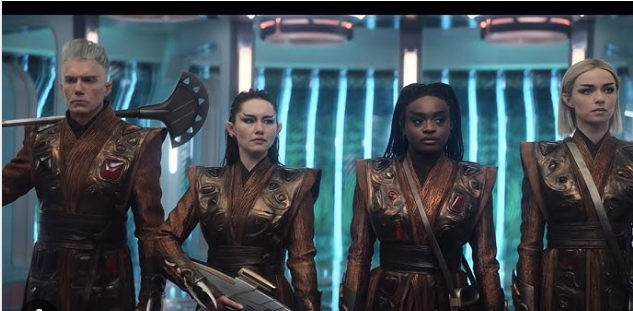
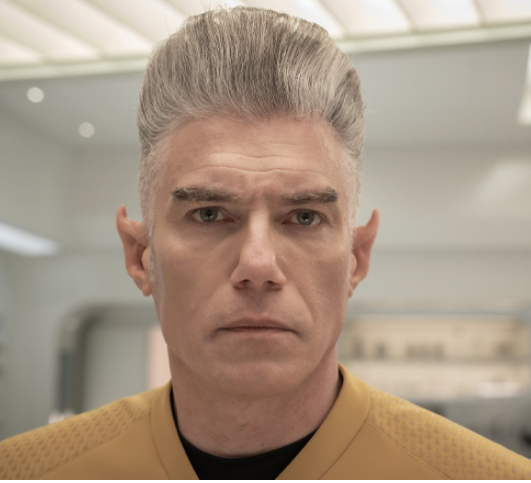
  1. Pike's hair looks funnier than ever as a Vulcan.  They must've applied Brylcreem to Anson Mount's hair, but he deserve credit for some fine deadpan acting as Vulcan Pike.
  2. La'an (Christina Chong), on the other hand, looked great as a Vulcan, and her dancing with Spock, likely about the closest we'll see of them making love, was fun to see.
  3. Speaking of Spock, the title of this episode -- "Four-and-a-Half Vulcans" -- though not a result of the change into Vulcans (because it's a title), is so good it deserves a shout-out.  The half, of course, is Spock, who's half-human, so Pike, La-an, Chapel, and Uhura = 4 + Spock (1/2) = Four and a Half, and the title itself reflects Vulcan precision with language.
Also outside the theme of this episode -- but deserving mention -- though it could be seen as a reversal of the theme (and related to the theme as per Marshall McLuhan's tetrad)* -- is Doug (played by Patton Oswalt!), a Vulcan who is fascinated by humans, and may want to become one of us.  He and Spock have a coda scene, in which Spock tries to teach Doug how to use word contractions, etc, and all of that ends with Spock's smile, a rarity and always good to see.

*See Andrey Mir's Digital Reversal for more.

See also Star Trek: Strange New Worlds 3.1-3.3: Gorn, Spock & Chapel, and The Walking Dead ... 3.4: Lots of Laughs and Serious Business ... 3.5: Endearing Pseudo-Science ... 3.6: Chris and Jim ... 3.7: The Medium and The Message


Saturday, October 1, 2022

Podcast: Roundtable Discussion of Star Trek: Strange New Worlds


Welcome to Light On Light Through, Episode 340, in which I join Captain Phil on WUSB-FM Radio (Stony Brook, New York) and Marybeth Ritkouski, Michael Rizzo, Roy Bjellquist, and Colleen Bement in a 2-hour in-depth, fun discussion of Star Trek: Strange New Worlds.

More about the discussants: Marybeth Ritkouski, Michael Rizzo,  Roy Bjellquist, Colleen Bement

Check out this episode!

Boarding the Enterprise (edited by David Gerrold and Robert J. Sawyer), anthology with essay "How Star Trek Liberated Television" by Paul Levinson, which discusses the Star Trek syndication impact

Fringe Science: Parallel Universes, White Tulips, and Mad Scientists (edited by Kevin R. Grazier) anthology with essay by Paul Levinson, "The Return of 1950s Television in Fringe," which discusses Levinson's "First Love Syndrome" in popular culture appreciation.

Welcome Up: Songs of Space and Time (2020 LP by Paul Levinson on Old Bear Records and Light in the Attic Records)

Sunday, May 15, 2022

Star Trek: Strange New Worlds 1.1-2: Great Characters, Actors, and Stories


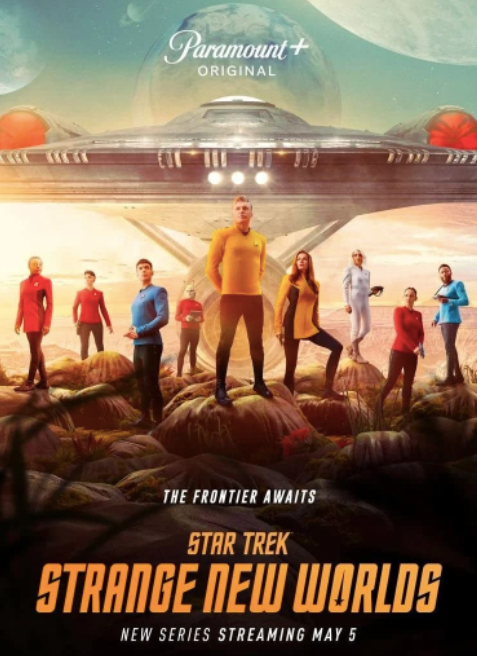
I saw the first two episodes of  Star Trek: Strange New Worlds on Paramount+ late last night and really enjoyed them.  More than Picard and a lot more than Discovery, to rank the new Star Treks that Paramount+ has been rolling out.   Strange New Worlds brought back a lot of the verve and joy of watching TOS aka the original Star Trek series.  And here are some of the more specific reasons why:

[No big spoilers ahead ... ]

1. It was wonderful to see so many of the TOS characters brought back, in their younger days, as befits a narrative about Captain Pike ten years before he suffered the disfiguring injuries that we saw so vividly in one of the all-time best TOS episodes, the two-hour "The Menagerie".  Anson Mount's Pike, first introduced in Discovery, is superb. I first noticed Mount in Hell on Wheels, where he also gave a top-notch performance.  His Pike is tough, sarcastic, empathetic, and now tormented by the disfiguring future he's seen.  Ethan Peck's Spock is also outstanding, providing his logical commentary in perfect pitch, struggling to throw in some lame humor, even being pretty effective in a romantic scene back home before he's called to join Pike on the Enterprise. Cecilia Rose Gooding was great as Uhura, as was her back story, and her affinity for language including music.  Jess Bush's Nurse Chapel was also fun to see, especially her crush on Spock.  And speaking of Nurse Chapel, she of course was originally portrayed by Majel Barrett,  who played Pike's Number One in "The Menagerie" -- Rebecca Romijn's Number One in Strange New Worlds looks to be a strong, literally supporting character whom Pike can confide in.  And just for good measure, Sam Kirk, James T's brother, was on board as well as an anthropologist.

2. The new characters were excellent, too.  My favorite was Christina Chong's La'an Noonien-Singh. She's tough-minded and  tough to beat, and will make a very effective Security Chief.  From what we briefly saw of the new doc and the new engineer -- as always, a bit behind the eight ball with beaming -- they'll be bringing a lot to Strange New Worlds, too.

3. I've been saying for years now, ever since cable and then streaming television emerged, that I much prefer continuing narratives throughout a season to standalone stories.  But I thought the first two standalone episodes of Strange New Worlds -- the first with the same title as the series, the second aptly named "Children of the Comet"-- worked great.  The first episode did violate the Prime Directive, though in all fairness, the don't-interfere-directive was not yet named Prime, and only became Prime as a result of what Pike did in this episode.  The second, about (I guess) an AI-driven comet, and the belief of its protectors that the comet was a vehicle of a higher power, was one of the best religion in space stories I've ever seen, a really fine and intelligent job.  And this made me realize I prefer religion treated in Star Trek to the way it's treated in, for example, Raised by Wolves. I guess that amounts to a preference for intellectual ingenuity over blood and gore.

So I'm really onboard with this new Enterprise. Its position, a decade before Sam Kirk's brother took the helm, is in many ways ideal. In particular, what Pike does to follow Number One's good advice to resist and contest what he saw in the future and those of us who are old enough first saw in 1966, will be fun and exquisite to see. 

And I'll see you back here next week with my next review.


And see also The Missing Orientation (free essay)


Thursday, April 14, 2022

Review of Stream this Next: The Start of an Indispensable Guide


I've been saying at least since 2015 that streaming -- in particular the capacity it gives viewers to watch as much of a television series as they like, at one time, as if reading book -- constitutes a third golden age of television (the first being what TV broadcast networks began to bring us in the 1950s, the second being the cable revolution which I take as beginning with The Sopranos on HBO in 1999).  Indeed, I watch a huge amount of television -- I find it good for my brain -- and I'd estimate more than 80% of the dramas and comedies are streaming (all the live news I watch is on cable -- mostly MSNBC, with a little CNN, if you'd like to know).

And the streaming world has grown exponentially since 2015, with Apple TV+, Paramount+, HBO Max, Disney+, and (I'm probably leaving some out) joining Netflix, Amazon Prime Video, and Hulu as big-time streamers.  And  the nature of the streaming has evolved.  For example, several of the newer players -- especially Apple TV+ and Paramount+ -- have made binging possible only after a complete season of a series has been streamed, with each episode becoming available on a weekly basis, much as networks and cable still do, when they put up their new series.

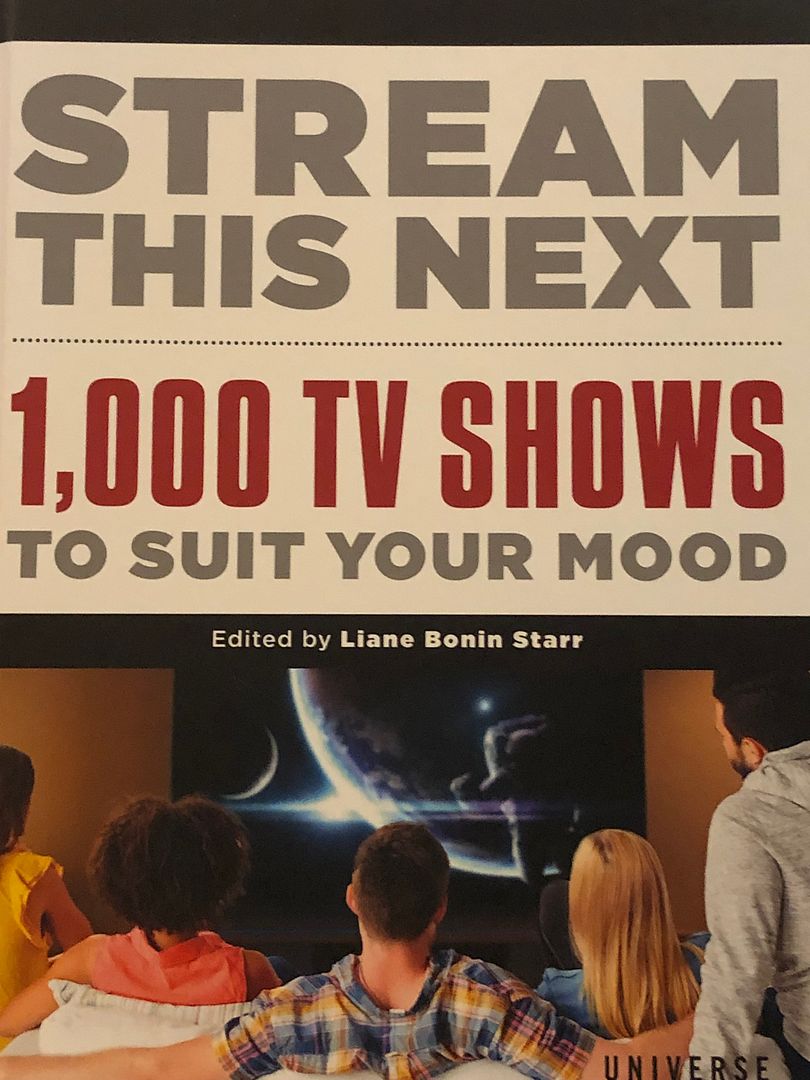
The result is a still expanding avalanche of TV shows to possibly watch, on a growing number of venues with overlapping and different presentation modes.  A handbook or guide to at least some of these shows would be handy to have, and that's just what Liane Bonin Starr's Stream This Next: 1,000 TV Shows to Suit Your Mood is.  There of course are far more than 1000 TV shows now streaming or soon to stream, and this book does miss some of the best, in my view. For example, Star Trek: Discovery on Paramount+ is listed and well described, but there's no mention of Star Trek: Picard (the best of the new Star Treks, in my opinion) or Star Trek: Strange New Worlds, to debut next month, starring Anson Mount as Christopher Pike, in my view one of the best new captains.  It also would be useful to know whether the series streams all at once, i.e., is immediately available for binging, or doled out on a weekly basis for each new season.  Other meta-details, such as Paramount+ lacerating its shows with commercials, even though it requires paid subscriptions, would also be helpful to know.

But such perceived oversights, especially in terms of series that should have been listed, are inevitable -- different strokes for different folks -- and there's plenty of value in the categorization of the shows listed in Stream This Next -- ten categories ranging from comedies, thrillers ... to science fiction -- as well as is the show best watched with a group of family or friends, cuddling with someone as a couple, on your own, etc.  Liane Bonin Starr is listed as the book's editor, and she and her team have done a fine job in assembling this indispensable guide, published last month in hardcover by Universe, especially appealing if you like to put your eyes on the pages of a thick book, once in a while.

In fact, having just thumbed through this book, I realized I really wanted to see a streaming science fiction series I somehow must have missed in the past year. Want to know what it is? Keep reading my reviews ...


Friday, April 17, 2020

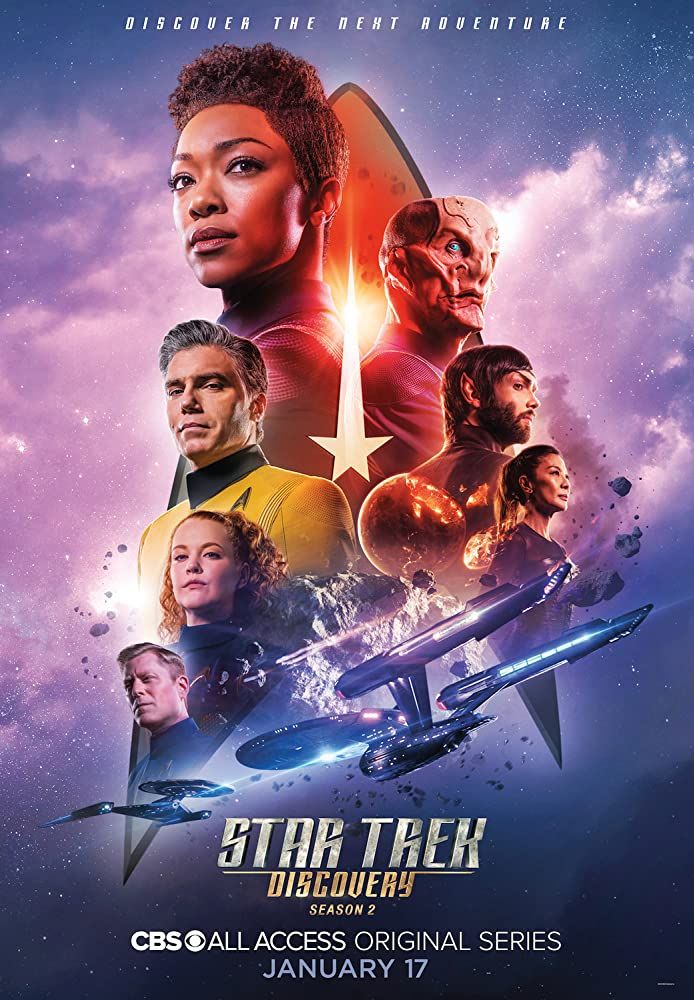
Star Trek: Discovery 2: Tour de Force Story and Characters


I endeavored in my reviews of Star Trek: Picard and the first season of Discovery to keep them free of specific spoilers. But it is not possible to review the tour de force that is the second season of Discovery without them, so expect plenty of spoilers in what follows.

First and foremost, as what was hinted at/promised at the end of Discovery 1, the emergence of Spock and his self-transformation from a troubled young man/Vulcan to the Spock we came to know, blue Star Fleet uniform and all, was one of the main and most gratifying themes of Discovery 2.  There is a great call-back in "If Memory Serves" (2.8)  to the two-part classic TOS episode "The Menagerie" (which incorporates the unseen pilot for the series, "The Cage") in which Spock violates Star Fleet quarantine (an unfortunately apt word in our current, real world) to help his former Captain, Christopher Pike, reunite with the love of his life on Talos.  Spock's defiance of Star Fleet for a greater good was a rare occasion in TOS, but in Discovery 2 we see that this is a fundamental part of his nature, which as a younger person is much closer to the surface.  Meanwhile, "If Memory Serves" shows some actual clips from "The Menagerie" - meaning "The Cage" actually figured, literally, in two Star Trek episodes, more than fifty years apart - and it was great to see Melissa George as Vina (originally played by Susan Oliver) and Anson Mount as Pike (originally played by Jeffrey Hunter and Sean Kenney) who, in a later episode in Discovery 2, palpably sees his future in a wheelchair, courtesy of a time crystal in a Klingon monastery.

About Mount, last time I saw him was in the lead role in Hell on Wheels, where he was outstanding.  If anything, he was even better as Pike in Discovery, with the result that Pike has now become, at least in my opinion, one of the most memorable Captains in all of Star Trek, second only, I would say, to Kirk and Picard.  And that's after just one season.  It's not clear how much more we'll be seeing of Pike, since Discovery 2 ends with Pike on the Enterprise - with Spock, beard shaven, his science officer - on the way (in some near-future date) back to Talos, and what awaits them there in "The Menagerie".  The Star Trek: Discovery series is of course about the ship Discovery, which is last seen hurtling into the future, following Burnham the Red Angel's lead, with Saru in the Captain's seat.

Time travel, indeed, plays as important a role in Discovery 2 as space travel (which, as readers of this blog will know, makes me very happy, since I'm a fan and a writer of both kinds of travel stories).  Spock even mentions the "grandfather paradox" (which could also be "grandmother" or "parent" or any recent or remote ancestor), noting that future Burnham has no choice but to save her younger self (but Spock missed the point that any member of the crew could also have saved the younger Burham). And in a nice sprinkle of humor, Tilly mentions "time bend"; Pike replies "time bend ... I like that"; and Tilly comes back with "everything sounds cooler when you put time in front of it". I completely agree.

There's also some unintentional humor afoot or onboard.  The Ba'ul, the predator species on Saru's world, is pronounced by most of the crew, including Saru, who should know, just the way it's spelled.  But at least one crew member referred to the species as "The Bowel," and I'm pretty sure I heard another call them "The Bowl".  On the plus side, it was good to see Pike have some of the subtle mannerisms of Kirk, including the way Pike stands when he's at the helm and delivers the truth to difficult-to-pronounce species like the Ba’ul.

But Discovery 2 evokes a wide range of emotions, including tears, sense of wonder, edge-of-your-seat excitement, and deep satisfaction in following a story not only very well done, but fitting in beautifully with not only the past Star Trek corpus, but ongoing new series, such as Picard, which addresses the same AIs wanting to destroy all organic sentient life as Discovery 2 confronted in the epic space battles at the end of the season.

Count on me to be back with more after I see Season 3 whenever it airs this year.

See also: Star Trek: Picard: Non-Pareil ... Discovering Star Trek: Discovery


Wednesday, December 7, 2011

Hell on Wheels: Blood, Sweat, and Tears on The Tracks, and the Telegraph

Thought it was time that I rolled in with a review of Hell on the Wheels, which rolled out its 5th episode on AMC this past Sunday.

I gotta first say that AMC has been coming up with nothing but aces with its series.  From Mad Men to Breaking Bad to The Walking Dead to The Killing and now Hell on Wheels, I'd say AMC has more top-notch series on the air than HBO and Showtime put together these days.

And Hell on Wheels is one of the best - which is to stay, every bit as good as those other four so far.  Now readers of this blog will know how partial I am t to historical dramas - Rome (HBO), The Tudors (Showtime), Mad Men (AMC), The Borgias (Showtime),  Boardwalk Empire (HBO) - and Hell on Wheels has carved out a niche all its own, in 1865, with the Civil War just over and Lincoln in his grave, as the opening episode tells us.

What I especially like about historical dramas is when they not only get the events but the technology and media of the time just right.   Hell on Wheels is about the building of the transcontinental railroad in the U.S., so it's just bursting with technology, accurately portrayed, blood, sweat and tears at every turn.

The only long distance medium at hand in those days was the telegraph, whose poles went up alongside the tracks, and kept information and money, the lifebloods of the massive construction project, flowing.  Colm Meaney puts in his best performance since Miles on Star Trek: The Next Generation (hey, another travel show) as the boss of the whole railroad operation - Thomas 'Doc' Durant - and one of my favorite parts of every episode is watching him bark messages ("STOP") to his hardworking telegraph operator.   (For more on the history and early impact of the telegraph, see my 1997 book, The Soft Edge: A Natural History and Future of the Information Revolution.)  The telegraph has been called The Victorian Internet, and I call it an early form of tweeting in New New Media (2009).

Dominique McElligott is beautiful and bright as Lily Bell, whose beloved husband, surveyor for the railroad, dies at Indian hands in the first episode.   Durant certainly wants Lily - though he probably loves his railroad more - but it's likely just a matter of time before she gets together with Cullen Bohannan (Anson Mount), the other fine lead of the series, a former Confederate determined to kill all of the Yankees who killed his wife in their home.

There's just one of those Yankees left, at this point, and it will be interesting to see whether he remains elusive for the entire season or series, or meets his demise sooner.  One of many interesting stories, subtle and powerful, that keep this railroad of a series and its viewers stoked.


                 Special Discount Coupons for Angie's List, Avis, Budget Car, Garden.com, eMusic


InfiniteRegress.tv