Chuck Todd interviews me about alternate histories
Showing posts with label Edgar Allan Poe. Show all posts

Saturday, December 20, 2025

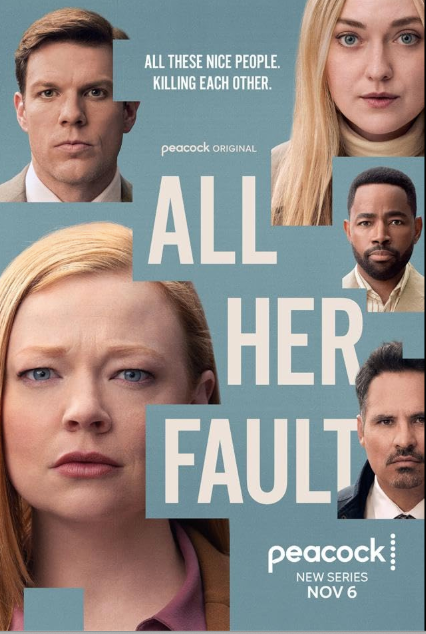
All Her Fault: McLuhan and Poe Would've Loved It


My wife and I binged All Her Fault on Peacock the past two nights.  It's a riveting, powerful, different kind of kidnap drama, with all kinds surprises and twists and turns in family relationships.

Herewith some of the highlights, with no spoilers:

  • The lead detective -- Detective Alcaras (very well played by Michael Peña) -- has real heart.  My wife said he reminded her of Brandis in Task, and she's right.  You know, it's hard to come up with a fresh take on a genre as well worn as the detective, which goes at least as far back as the 1840s with Poe, but All Her Fault (and Task) does that, and does that very well.  I hope we see more of this character (his partner, Det. Greco, played by Johnny Carr, is good, too).
  • Most kidnap stories focus on the angst of getting the child back home, which All Her Fault does, too.  But it also delves deeply into who did the kidnapping, and how and why this came to happen. 
  • The immediate family of the kidnap victim of course is always a central part of a kidnap drama.  In All Her Fault, that family is a little more than immediate, and they each have significant stories as well.
  • Friends and business associates also have important stories, which intersect with the kidnapping story.
  • Back to the kidnapper's story: there's quite a narrative there, too.  Indeed, All Her Fault is as much the kidnapper's story as the family whose child was kidnapped.
  • Marshall McLuhan liked to talk about synesthesia, the rare blending of senses, that a few people have, in which hearing a sound can immediately generate an image, and more.   This plays a crucial role in All Her Fault.
  • I guessed who the real villain was pretty early on in the eight-episode series, but it was exciting seeing that play out.
How's that for a review without spoilers?  I will say that the acting was excellent -- Sarah Snook, who was so good in Succession, is superb as the mother of the kidnapped child, Dakota Fanning was fine as friend Jenny, Jake Lacy was memorable as the father, and hats of to Duke McCloud who played Milo the victim.


Saturday, January 14, 2023

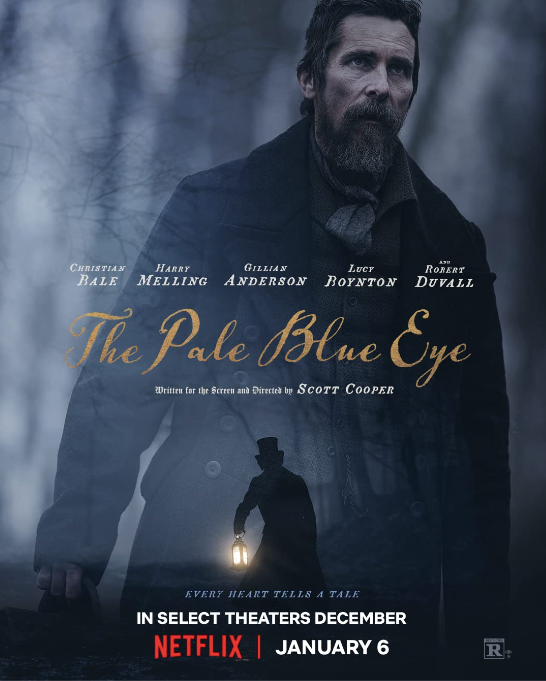
The Pale Blue Eye: Splendid Secret History of Young Poe


A murder mystery with all kinds of twists featuring a young Edgar Allan Poe quoting from Thomas Grey's "Elegy Written in a Country Churchyard," my all-time favorite poem, what more could I ask for?  Well, The Pale Blue Eye has that, as well as a first class story of life at West Point in 1830, so I couldn't ask for much more regarding a movie indeed.

This gem of a movie is in effect a secret history of Poe, that is, a story of what happened to him in 1830 when he was a cadet at West Point and a newly published poet -- a story which could have happened, but no doubt didn't, which is why we don't know anything about it.  We find Poe already a published poet at this time, and his involvement in a case in which hearts and other organs are removed from bodies, and his success in figuring out who the ultimate villain was (who was also and mostly a good guy), provides a brilliant case study of how Poe already had and further developed the chops to become the father of the mystery writing genre in our real history.

[Some very general spoilers ahead ... ]

Meanwhile, the mystery story is first class.  The ultimate solution is that one person was the murderer (for the sake of revenge) and two other people dismembered most of the dead bodies.  This is itself a solution that the real Poe in our history, and for that matter, Agatha Christie, would have approved of.

Like all good secret histories, The Pale Blue Eye offers satisfying anchors to what we know of the real Poe in our history.  The stolen physical heart shows up in our reality as one of Poe's most famous short stories, "The Tell-Tale Heart".  The name of a beloved and major character shows up as title of one of Poe's best-known poems.  And of course there's a raven -- though for all I know, it could have been a crow.

The West Point and surrounding upstate New York ambience in the 1830s feels just right, at least from what I know of it from my late 20th-century early 21st century experience.  There's nothing quite like the Hudson River at this point, with the cliffs and the trees and that upstate shade of green.  John Crowley captured it well in his science fantasy trilogy, as did Scott Cooper who directed and wrote the script of The Pale Blue Eye, based on Louis Bayard's novel of the same name (which I haven't read).  And while we're at it, Harry Melling, whom I recall from the Harry Potter movies and The Queen's Gambit was excellent as Poe, even looking like him, as was Christian Bale, whom I've seen in a ton of movies, as retired NY detective Landor.  Robert Duvall as Professor Jean Pepe and Gillian Anderson as Julia Marquis were pleasures to see.  And Lucy Boynton, whom I don't recall seeing before, was just right as Lea Marquis.  All in all, one stunningly fine cast.

If you're at all a Poe fan, you won't regret seeing this movie.  I'm a huge Poe fan, and count it was one of the best films I've seen in years.


Poe figures in this alternate history novel -- more about it here


Interview with Mark Dawidziak about his book, A Mystery of Mysteries: The Death and Life of Edgar Allan Poe


Tuesday, November 17, 2020

Joel Iskowitz at the Atlantic Gallery

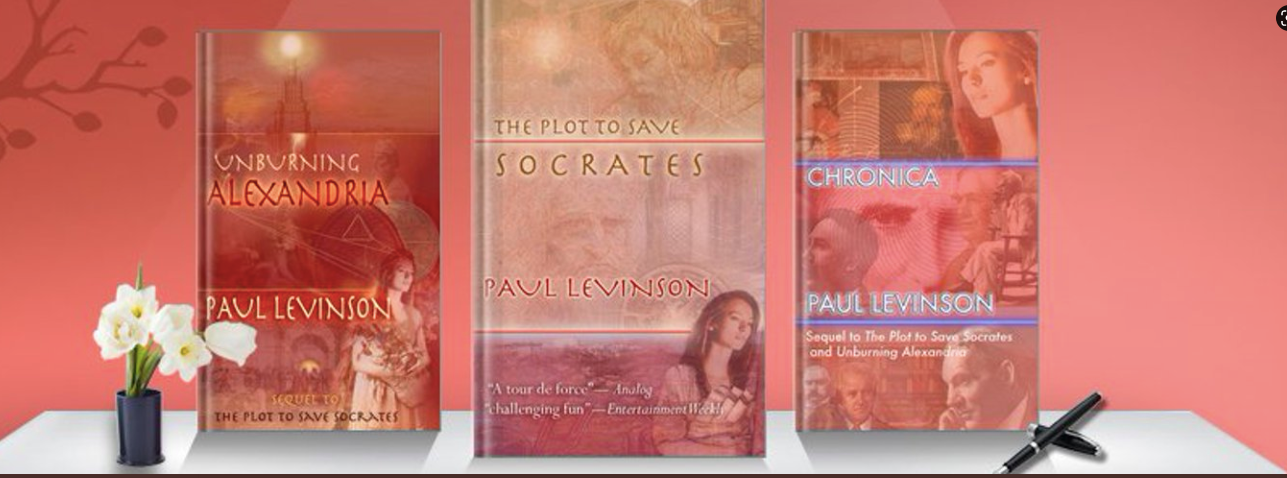
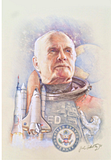
As many of you know, I've had the great fortune of having Joel Iskowitz design the covers for many of my books, ranging from the Sierra Waters time travel trilogy (pictured above -- and note that the third novel, Chronica, written in 2015, makes reference to Joe Biden as President!) to Marilyn and Monet (pictured at the end of this post).  Isky, as I call him, has been my friend since the 5th grade in the Bronx, where we conspired about how to impress girls, and I first became aware of his talent for illustration.   More recently, he has guest lectured in some of my classes at Fordham University, I interviewed him on my Light On Light Through podcast, and he introduced me to John Glenn (subject of several Iskowitz portraits), whom I interviewed just a year before his passing for Touching the Face of the Cosmos: On the Intersection of Space Travel and Religion (for which Isky also did the cover) (here's an audio of the interview).

So, I was truly delighted to learn about Joel Iskowitz's first solo show, Icons of Inspiration, at the Atlantic Gallery in New York City.  Our continuing caution about COVID kept Tina and me from attending in person, but, happily, you can see all of Isky's works online at the virtual show, right over here.  

My favorites are just about all of them, but here are some that really hit the spot for me: Bob Dylan, Edgar Allan Poe, Louis Armstrong (with Bogey and Bacall), George Gershwin, and of course John Glenn.
Prints are available of many of these -- they'd light up any wall, just as they light up the soul.


Sunday, March 22, 2020

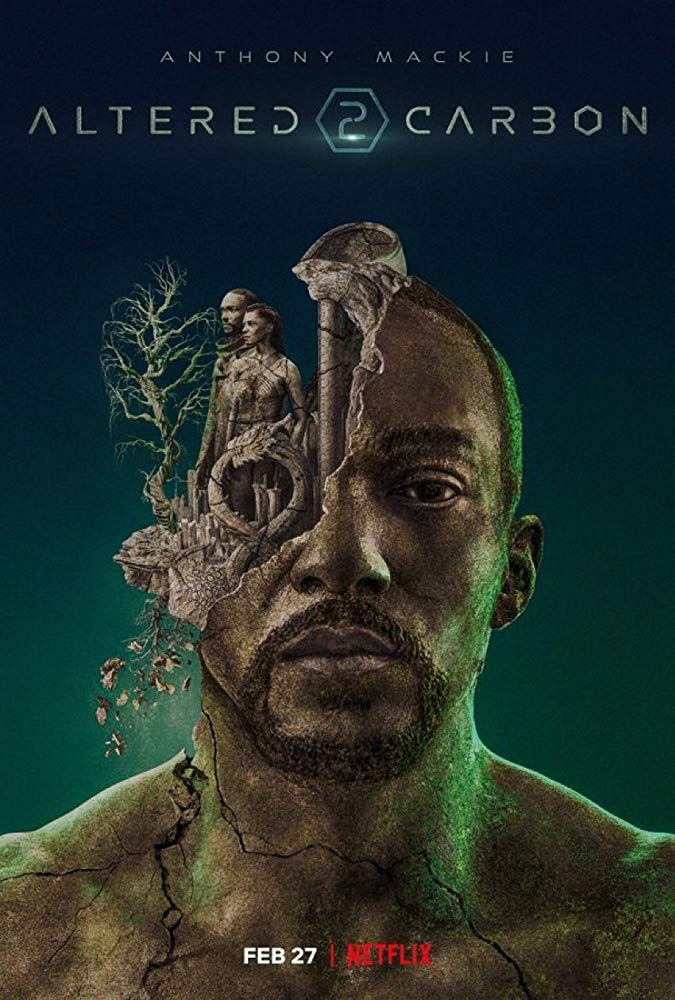
Altered Carbon 2: Timeless


I really enjoyed the first season of Altered Carbon.  I enjoyed the second season even more.  It was sharper, tighter, more effective in narrative in just about every way.

I did miss Joel Kinnaman as Takeshi Kovacs.  In a universe in which brain, soul, whatever you want to call it - in Altered Carbon it's become "stack" - can be relatively easily inserted into any sleeve aka body, it's not surprising to see Tak in a new sleeve in Season 2.  Not to mention that he gave up his Kinnaman sleeve at the end of Season 1.  Anthony Mackie does a fine job as Tak in the new sleeve in the new season.  And we get the benefit of two Taks in the second season - a younger Tak played by Will Yun Lee - who has a much larger role in the second season.  But I miss Kinnaman, whose acting I've admired since The Killing.

But my favorite character is the AI Poe, perfectly played by Chris Conner.  He had an appealing mix of vulnerability and savvy, loyalty and stubborn independence in the first season, and all of this is heightened in the second season, by his digital mind not being all there, literally, having been damaged in the first season.  I can't think of an AI I've liked more in any science fiction on the screen, maybe only Star Trek: The Next Generation's Data, if we consider an android an AI, though the two kinds of artificial beings are very different in many ways.  Season 2 also has the addition of Dig 301, well played by Dina Shihabi.  Dig makes a great apprentice, guardian angel, and eventually loving partner for Poe.

The master plot is fast moving and hard hitting, with Simone Missick doing a good job as Trepp on the gritty ground, and Renée Elise Goldsberry effective as Quellcrest, more tortured than ever by what turns out to be the Elders, an indigenous intelligence with super powers on Harlan's World, where the action takes place and Tak urges her to change her modus operandi of fixing things then dying. Torben Liebrecht rounds out the crucial cast as Carrera, an at once brutal and cunning military man, with his own very complex axe to grind, a condition common to all the major characters in a story in which the only way any human can succumb to death is via destruction of the stack at the base of the head.

I was talking to a reporter from The Washington Post the other day about what it's like to watch television in our Coronavirus age.  Series that take place in our present, such as any hospital show, seem oddly out of synch with what is going on in our world - they have no mention of Coronavirus, since it was not yet known when the episode was made.  I mentioned Altered Carbon as a series which doesn't have that effect, since it takes place so far in the future.  "How far in the future?" the reporter asked.  "Thousands of years," I unthinkingly replied. (Here's the article.)  Actually, Altered Carbon takes place less than 400 years from now.

It's a measure of how well Altered Carbon has created its future world that it feels so timeless.  Back to our own 2020 world, if you're home and looking for a high-concept, engaging, story-book colorful series, I'd recommend Altered Carbon, both seasons.

See also Altered Carbon 1: Roads, Spit, and Immortality


"As otherworldly, mystical and far-out as the subject
matter may be, the songs burst with love and warmth
and humanity."  -- Evan LeVine, Swan Fungus, 3 February 2020

Sunday, February 4, 2018

Altered Carbon 1: Roads, Spit, and Immortality


Critics who've said that Altered Carbon, the 10-part series I just binged on Netflix (based on the 2002 novel by Richard K. Morgan, which I haven't read) is not as good as Bladerunner, which it strives to be, are myopic - or to put it bluntly, completely wrong.  That's because Altered Carbon is at least as good if not better than the two Bladerunner movies (certainly the second), which it not only exceeds in scope and variety, but plain-out doesn't resemble in crucial ways.

Both are hardboiled cyberpunk, to be sure.   Both therefore entail murder and sets that look like Tokyo on speed.  Both have have sardonic investigators who crack wise.  And both are about the extents and limits of human and human-like minds in human and human-like bodies.

And there the similarities, impressive as they are, end.  Bladerunner is about androids, or artificial, flesh-like beings, with artificially created minds.  Altered Carbon is about transferring human minds to "stacks," composed of a crystal-like substance found on an alien world somewhere out there in space.  These stacks can be put into bodies ("sleeves") that look nothing like the body that housed the original mind, including different genders, and even an adult stacked into a child.  They can also be put into an identical body - "double-sleeved" - or cloned, with the clones having completely identical consciousnesses until the moment of the sleeving and stacking.    The possibilities for love and death (sleeve death of just the body, so the stack can be implanted in some other body vs. "real death" when the stack is destroyed, too) are almost endless.  Freud would have loved it.  I did.

Planets far from Earth are not just a backdrop. Important parts of the narrative occur there.  The characters have a media ecological sense of how minds and bodies intersect (see Human Replay for what that means).  They also understand the pivotal role of media in human history.  Quellcrist (a central character) notes that Rome went from a city to one of the most powerful empires in ancient history because of its "roads" - an observation that comes right out of Harold Innis's Empire and Communications.

The stacks in effect make humans immortal, and in one of the main threads of the story, Quellcrist heads a team of rebels who want to return humans to their pre-stack mortality.   (I like the character, but disagree with her on this, btw.)  Takeshi Kovacs is one of the team, and he's the prime protagonist in this story, which includes solving a murder ("the dead can now accuse their murderers," he aptly says), fighting off potent villains of both genders, and wending, usually fighting, his way against all manner of physical and digital constructs - if he doesn't embrace them - including an AI hotel named the Raven with an Edgar Allan Poe as its concierge avatar.

Joel Kinnaman puts in his best performance on the screen so far - and it's fine indeed - in this role, sometimes even looking a little James Dean.  He spits on a sensor which expected to get his DNA in another package, and is compassionate and brutal as need be.  Convincing acting, too, by Martha Higareda as Ortega, Renée Elise Goldsberry as Quellcrist, Dichen Lachman as Rei, Chris Conner as the aforementioned Poe, and how could I not give a shout-out to Tamara Taylor from Bones.

Slight quibbles: the story is set hundred of years in the future, but the ambience on Earth seems more like just decades away.  And there's one scene in which someone tries to elude attackers by pretending to be dead amongst a group of corpses, but wouldn't the attackers in this far-future scenario be able to digitally scan the area for any signs of life?  But these quibbles are small indeed.

There's plenty of violence (which has received some criticism) as well as nudity of all kinds (I haven't seen any criticism of that) and I think both are right and work well for the series.  There's room for a sequel, which I hope is made (Morgan published two additional novels in this saga).  Laeta Kalogridis gets the "Created by" credit on Wikipedia, and there's a full house of directors, producers, and writers in this powerfully rendered series.  All deserve kudos.


Sunday, November 2, 2014

The Walking Dead 5.4: Hospital of Horror

Hospital are scary places, and have played decisive roles in many a horror movie.  Hey, they're scary in real life, especially in our day and age of Ebola and who knows what.   So, it makes sense that The Walking Dead, or one of its main characters, would sooner or later be situated in a post-apocalyptic hospital.

Beth has been out of sight but not of mind since last season, when she was kidnapped not quite under Daryl's nose but close enough.   We still don't know how exactly she got from the kidnapping car to the hospital in Atlanta, but there she is, in a place populated with the requisite mixture of people who prey on the weak, people struggling to maintain some sense of order, and those with a few shreds of humanity still intact.

Actually, on that last point, those shreds are pretty thin.  The doc who befriends Beth has her kill a bed-ridden patient, simply because, as we learn at the end, the patient was himself a doctor, and the doctor in the hospital of horrors didn't want any competition.

This hospital comes replete with a pit - literally - making this an episode of The Walking Dead meets Poe's The Pit and the Pendulum.   But there are a few glimmers of hope, for Beth, maybe.   The orderly who helps her escape does make it to freedom, himself, even if Beth does not.   When I saw this, I was thinking, good, he's the way Daryl and Rick will now be able to find out where Beth is.

But the ending held another nice surprise - Carol wheeled in on a stretcher.   Not that seeing Carol on a stretcher is nice.   But she's still alive, and if anyone can get Beth sprung from this quiet madhouse, it's Carol.

Another good standalone story, which wraps up nicely with a splash of the reality - in the person of Carol - we've come to know and look forward to.

See also: The Walking Dead 5.1: The Redemption of Carole ... The Walking Dead 5.3: Meets Alfred Hitchcock and The Twilight Zone

And see also The Walking Dead 4.1: The New Plague ... The Walking Dead 4.2: The Baby and the Flu ... The Walking Dead 4.3: Death in Every Corner ...The Walking Dead 4.4: Hershel, Carl, and Maggie ... The Walking Dead 4.6: The Good Governor ... The Walking Dead 4.7: The Governor's Other Foot ... The Walking Dead 4.8: Vintage Fall Finale ... The Walking Dead 4.9: A Nightmare on Walking Dead Street ... The Walking Dead 4:14: Too Far ... The Walking Dead Season 4 Finale: From the Gunfire into the Frying Pan


#SFWApro


no cannibalism but at least a plague in The Consciousness Plague

Tuesday, April 1, 2014

The Following 2.11: Lily not Joe

A strong episode 2.11 for The Following last night, with Lily Gray and Joe Carroll both in action.  And of the two psycho families, I have to say that I like Lily's better, in every way.

Indeed, in many ways, Lily is the more logical successor to the Joe of Season 1 than is the Joe of Season 2.  The Season 1 Joe was secular, and went for Edgar Allan Poe when he needed a little mysticism.   The Joe of Season 2 has taken over an annoying cult, has wrapped himself in its nonsense, and is even attracting the ire of another, non-murderous cult leader. I  of course get why Joe thinks he has to do this, but I'm with Emma in wondering about its ultimate value.

In contrast, Lily just goes about her murderous business, with no religious overlay.   Further, she has an abiding loyalty to her family, which Joe never quite had.   Most important, Lily murders for logical reasons - sick, but logical.  She did it first to re-establish Joe's cult and meet Ryan, and now she's doing it to save one of her deranged twin sons.

If Joe dies - really dies - at the end of this season, Lily would be a good person to take the story forward.   But it's hard to say what will happen in terms of who will survive this season.

Mike, Max, Carrie, and the newly revived Claire are all likely candidates, among the good guys.  At this point, the only one of those I wouldn't mind departing would be Claire, although I'd hate to see Ryan going through her death a second time.   As for the bad guys, it's pretty clear that either Emma or Mandy won't survive, but it's tough to call which one.

Just two more roller coaster episodes left this season - I'm looking forward.

See also The Following Is Back for Its Second Season ... The Following 2.2: Rediscovering Oneself ... The Following 2.3: Coalescing ... The Following 2.4: Psycho Families and Trains ... The Following 2.5: Turning Tides ... The Following 2.8: Coalescing? ... The Following 2.9: The Book Signing

And see also The Following Begins ... The Following 1.2: Joe, Poe, and the Plan ... The Following 1.3: Bug in the Sun ... The Following 1.4: Off the Leash ... The Following 1.5:  The Lawyer and the Swap ... The Following 1.7: At Large ... The Following 1.9: All in a Name, Or, Metaphor in the Service of Murder ... The Following 1.13: At Last Something of a Day for the Good Guys ... The Following Season 1 Finale: Doing Dead

#SFWApro


Like a Neanderthal serial killer in the current world? Try The Silk Code

Tuesday, December 17, 2013

Almost Human 1.6: The Blackmarket Heart and Double Dorian

The Blackmarket Heart ... that could have been the title for Almost Human 1.6.   It could also have been the title of a song on Nashville, and is reminiscent of an Edgar Allan Poe story, in any case.  But it would have worked well tonight on Almost Human, which offered another fine standalone episode of cops and robbers in the future, this time an operation selling heart organs designed to run out of time, unless their human receivers pay a continuing fee.

Almost Human as been good at configuring futuristic crime, just as it has been with the partner repartee between Kennex and Dorian.   Both are sharp, wisecracking, and one of the best cop partnerships on television since Starsky and Hutch.

Meanwhile, there's also an android story, or a new twist on the android set-up of this series, behind every corner.  Tonight we get to meet another Dorian model - not decommissioned, but serving as a janitor for his sins.   Up until now, we've see MXs in duplicate profusion.  And although we knew that there was more than one of Dorian, and why not another one walking around somewhere now, we were permitted the illusion that he was more or less unique as an android of his model in any kind of significant action in this world.

For Dorian's double to work, though, he needed to have a personality both distinct from Dorian's but different from it.   Michael Ealy did a good job of delivering just that.   And I give this episode creds for not doing what a more conventional television series might have done in these circumstances: have Dorian's double dying heroically because we can't have two Dorians at work in this series.

But Dorian's fellow model survived, which thereby opens up all kinds of possibilities for the future. Another reason to keep watching Almost Human when it returns another year closer to its time, in January 2014.

See also: Almost Human debuts: A Review ... Almost Human 1.2: Sexbots ... Almost Human 1.3: Change of Face ... Almost Human 1.4: Almost Breaking Bad ... Almost Human 1.5: Clones and Holograms


#SFWApro


Monday, June 3, 2013

The Killing 3.1-2: Poe Poetic Po-po

The Killing was back in fine brooding, mysterious form for its third season on AMC last night.  The series was almost killed itself, by carping critics unhappy that the first season's murder was not resolved at the end of that season.   I actually enjoyed the twist of no resolution at the end of the first season, and thought the first two seasons were understated quiet masterpieces of television.

Season 3, based on the first two episodes, promises to be the same.   The skeleton of the story is familiar - the M.O. of a brutal guy on death row seems to be repeated, at least in part, by a brand new killing.  Sarah Linden was one of the arresting detectives on the death-row case, and the new homicide is being investigated by Holden and his new partner.    This would be provocative enough, but, in typical Killing fashion, the clues are not at all clear, and, even more intriguingly, seem to point in different directions.

The easy conclusion would be that the guy on death row didn't do the killing for which he was sentenced to death.  Linden has been haunted by the this possibility since the first season, but she tried to put it out of her mind so she could focus on Rosie Larson's killing.   With that finally solved at the end of the second season, Linden is attempting to live an easier life out of downtown Seattle, on her island.   But Holder comes a calling, and she's drawn back into the horrific death row case.

Before the two hours are over, we see we're being treated to a serial killer case of some sort.  And, if the death row guy isn't involved, how come his son keeps drawing pictures of a stand of trees behind which is a pond with a bunch of wrapped dead bodies?   Drawings and memories, I'm glad to see, will continue to be play a crucial role in The Killing.

Holder's pseudo-hip banter, and his interaction with witnesses who call him "po-po," continues in enjoyable form - meaning, I like it, even though I know the grunge demeanor is contrived.  The whole show works as piece of Poe poetic narrative - and it occurs to me that The Following, which I also enjoy, owes a lot of its ambience to The Killing.   But The Following explicitly works the stories of Edgar Allan Poe into its storyline, and The Killing picks up only Poe's cadence, which makes me look forward to The Killing even more.

See also The Killing Season Two Premiere ... The Killing 2.2: Holder ... The Killing 2.11: Circling Back ... The Killing Season 2 Finale

And see also The Killing on AMC and The Killing 1.3: Early Suspects ... The Killing 1.5: Memorable Moments ... The Killing 1.6: The Teacher ... The Killing 1.8: The Teacher, Again ...The Killing 1.9: The Teacher as Victim, Again ... The Killing 1.10: Running Out of Suspects ... The Killing 1.11: Rosie's Missing - from the Story ... The Killing 1.12: Is Orpheus the Killer? ... The Killing 1.13: Stretching Television


download The Killing season 3 on

Monday, April 29, 2013

The Following Season 1 Finale: Doing and Dead

The Following concluded its first season with a suitably harrowing and ambiguous ending, and Ryan's denouncement not only of Joe - "those who can do, those who can't teach" (ouch!) - but of Poe, which shows that Ryan was mainly baiting Joe, i.e., not necessarily telling him what he really believed.  Good!

But the biggest tantalizing ambiguity we're left with is how many major characters died in the finale?

Debra, alas, yes.   Ryan and Mike just don't get there quite in time, and although Debra's head hasn't been blown off - the surest sign of death in a TV drama - she looked pretty lifeless as Ryan tried in vain to revive her.

Next, we have Joe himself.  He's blown to smithereens, but we don't see his body.  Remains are recovered in the water, but another guy also died in the explosion, and though the dental records and preliminary DNA say it's Joe, I'm thinking that's not quite a definitive ID.  I give Joe a 50/50 chance of showing up alive next season.

Of course, even if Joe is dead, all of his followers are not.  We see Emma near the end in Alabama, and the woman who has been sleeping with Ryan on and off, but is a follower, shows up as Ryan and Claire are about to have dinner, and badly stabs them both.

Ryan looks to be a little less wounded than Claire, and, let's face it, killing him would end the series, which is returning next season.

What about Claire?  The series could definitely go on without her, with Ryan grimly hunting Joe or his surviving followers if Joe is dead, but I'm thinking Claire has a chance of pulling through.

So, where does that leave us?   We'll definitely see Ryan alive and kicking next season, and I'm thinking Claire will pull through, and, you know what, I bet we'll see Joe afoot at some point next season, too - though whether he'll be the major villain as he was this year, it's hard to say.

Ok, enough speculating.  I'm going back to writing - doing - not teaching.  The spring semester is almost over.


Monday, February 4, 2013

The Following 1.3: Bug in the Sun

In case it's not yet clear, The Following has something in common with Criminal Minds - serial killers and a BAU (FBI Behavioral Analysis Unit).   Except, whereas Criminal Minds has a serial killer in just about every episode, The Following has most of them acting in sociopathic syncopated concert every night.  The Following is the BAU on speed.

Tonight's episode 1.3 had at least four psychos and plots in various tandem, with Ryan and the BAU a crucial step or more behind in every instance.   Even when the killer in the hospital divulges a crucial bit of information under Debra's astute badgering, the information is too late to save Agent Reilly, who is stabbed in the neck and killed - by Maggie the victim he was protecting.  She, too, is part of the following, and escapes Ryan - who does at least manage to get her psycho husband.

This BAU's victories, at present in this series, are so small as to make them the least successful police unit we've ever seen on television.  The reversals encountered by Jack Bauer and his CTU seem, if not small in comparison, certainly a little less frequent.   In just an hour, we had not only the above tonight, but a man set on fire by the psycho in a Poe mask (who turns out be Rick, Maggie's husband, this time), a dean or some academic official stabbed in the neck and killed because he didn't give Joe the mastermind tenure (The Following is no friend to the academic world), and a woman beaten unconscious and kidnapped.

All of this is possible because Joe has his diabolical following in simultaneous and sequential operation.   And there may be some hierarchy that we're just beginning to glimpse.  Joe's at the top, calling the shots, of course, but he's in prison and presumably could not have sent the text message that signaled it was time for Reilly to die.  So, who did?  Likely Rick, but who knows.

As I said last week and will probably keep saying, everyone is suspect.  Tonight it was one of the victims.   I'm still thinking someone in the FBI, maybe even the BAU, may also be under Joe's control. Given the kind of mind games Joe exults in, he might very well have an agent in the BAU who is now helping Ryan, only to turn against him at a crucial time.

The only people who couldn't possibly be under Joe's control are we the viewers, right?  Near the end of the episode, the pyschos holding Joey send Claire and Ryan a video in which Joey's being schooled in the ways of death - being encouraged to enjoy the suffocation of a mouse and the burning of a bug in the sun under a magnifying glass. That bug is our usual television sensibility. The Following is not only Criminal Minds on speed but Dexter turned on his head.   Not for the weak of stomach, but television like you've never seen it before.

See also The Following Begins ... The Following 1.2: Joe, Poe, and the Plan


Tuesday, January 29, 2013

The Following 1.2: Joe, Poe, and the Plan

The Following followed through tonight with an episode as tight and powerful as the premiere, which is to say, about as on-the-edge-of-your-seat powerful, frightening, and unexpected in its twists and turns indeed.  The Following is not like any other show on network television, and more than most shows on cable at that.

We learn tonight a very unsettling thing: the followers have been in training, deep undercover, for years.   This is true of the babysitter, the not-gay guys, and the security guard.  It could therefore be true of anyone, except Ryan and Claire, and I'm not even 100% sure about them.  But it could certainly be true of anyone else in the FBI, especially the new woman chief who came on board this episode.  She gives Joe a nice edition of Poe's works at the end - likely just a gambit to establish some rapport with him, but you never know - never know what happened in the past or what could happen in the future.

Actually, I'm pretty close to 100% sure we can trust both Ryan and Claire, but Claire reminds us just how suspect everyone is when she says Ryan is the only person she can trust.

So far, Joe and his followers are winning just about every encounter.  The one apparent failure is Ryan shoots the security guard before he harms Claire.  Then Joe tells us that was part of the plan - to give Ryan some confidence so that he can be a better opponent - but it turns out that Ryan's wounding rather than killing the guard was not what Joe expected.   Hence Joe's one failure tonight.  He can't control everything.  But it's a minor failure indeed.

The Following is unafraid to dole out death and other nasty surprise at every corner, street as well as metaphoric.  The babysitter's mother succumbed to murder by the babysitter her daughter some years ago, and there's clearly some tension brewing between her now and the guy she's not sleeping with in the kidnap house.   Is this also what Joe intended?

It's rare to see a show so brimming with unpredictable psychos whose only constant is allegiance to Joe and Poe.  But since Poe himself was a master not only of the macabre but the unpredictable, that leaves us in a truly unsettling and excitingly fine kettle of blind fish indeed.

See also The Following Begins


InfiniteRegress.tv