Chuck Todd interviews me about alternate histories
Showing posts with label Altered Carbon. Show all posts

Sunday, April 5, 2020

John G. McDaid: Found in Translation


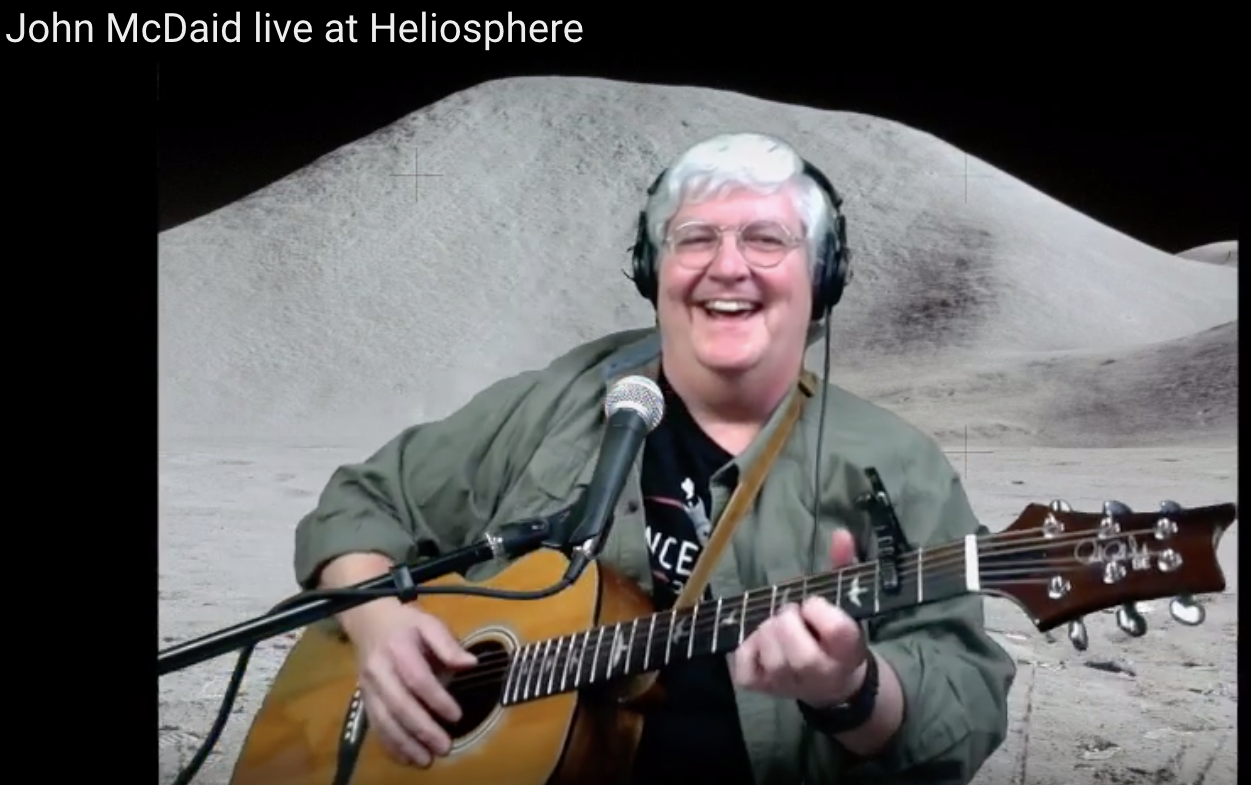
Let me introduce you to John G. McDaid.  He was my student in the MA in Media Studies Program at the New School for Social Research in New York City in the early 1980s.  I was delighted when his first professionally published science fiction story "Jigoku No Mokushiroku" (in Asimov's Science Fiction magazine) won the Sturgeon Award in 1995, right around the time one of my first published stories, "The Chronology Protection Case,"  in Asimov's older sister magazine, Analog, was nominated for the Nebula Award.   I was pleased when I began to see John start showing in Media Ecology Association conferences about a decade later, singing a variety of catchy songs.

But I had no idea, until John's Internet concert at HELIOsphere Beyond the Corona yesterday, about five hours before mine, what a superb songwriter and captivating singer John is.   What do I mean by superb songwriter?  Think Dylan, Phil Ochs, and a little Tom Lehrer humorous topicality thrown in.  His first song, "Lost in Translation" is one of my favorites, filled with Dylanesque rhymes, acerbity, and lines like "Mango Mussolini" (guess who that is).  Same for "Buy the Ticket".

But his next song, "Aaron Swartz," was really something.  Much in the tradition of Phil Ochs' "Joe Hill," McDaid tells the story of the Internet visionary and activist who was persecuted by Federal prosecutors to the point that he took his own life.   McDaid brings to this ballad a memorable mix of savvy, sensitivity, and anger.   His Tom Lehrer came out a song or two later, in "Check Out Time At The Owl Creek Hotel," in some of the lyric juxtapositions, and the song come to think of it also resonates with a combination of the Eagles' "Hotel California" and Netflix's Altered Carbon and its memorable character Poe.

I'm not going to say something about every song, because I want to leave you some surprises for the concert, which you can see and hear in its entirety below.  But I will say that "Love on the Moon" is some kind of masterpiece of angst and imagery, and itself worth the price of admission, which on Bandcamp is as much as you want it be.

Enjoy ...


Sunday, March 22, 2020

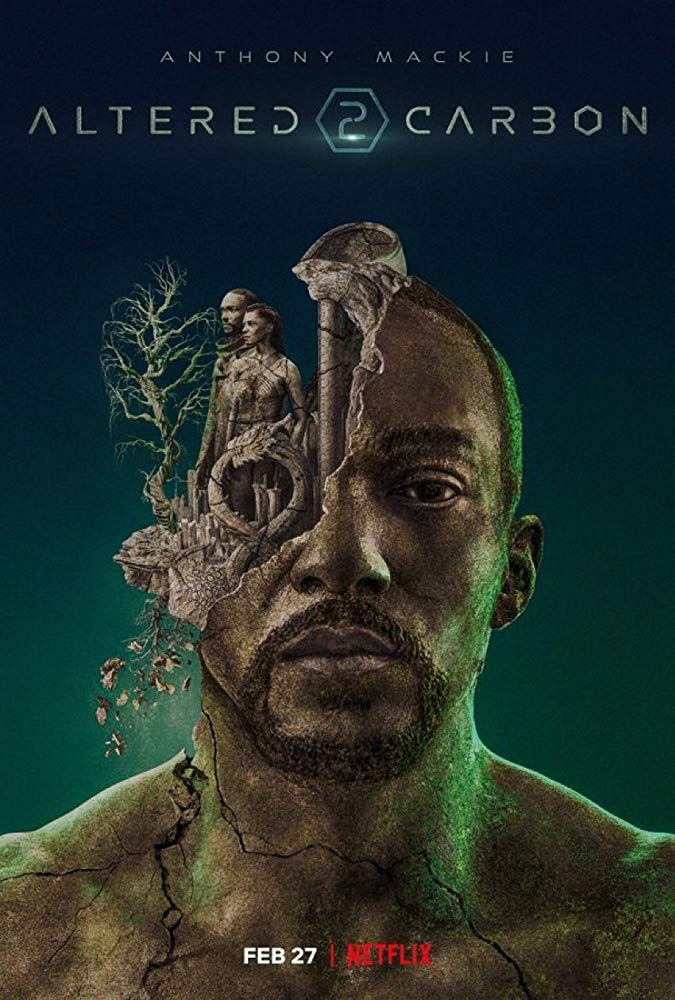
Altered Carbon 2: Timeless


I really enjoyed the first season of Altered Carbon.  I enjoyed the second season even more.  It was sharper, tighter, more effective in narrative in just about every way.

I did miss Joel Kinnaman as Takeshi Kovacs.  In a universe in which brain, soul, whatever you want to call it - in Altered Carbon it's become "stack" - can be relatively easily inserted into any sleeve aka body, it's not surprising to see Tak in a new sleeve in Season 2.  Not to mention that he gave up his Kinnaman sleeve at the end of Season 1.  Anthony Mackie does a fine job as Tak in the new sleeve in the new season.  And we get the benefit of two Taks in the second season - a younger Tak played by Will Yun Lee - who has a much larger role in the second season.  But I miss Kinnaman, whose acting I've admired since The Killing.

But my favorite character is the AI Poe, perfectly played by Chris Conner.  He had an appealing mix of vulnerability and savvy, loyalty and stubborn independence in the first season, and all of this is heightened in the second season, by his digital mind not being all there, literally, having been damaged in the first season.  I can't think of an AI I've liked more in any science fiction on the screen, maybe only Star Trek: The Next Generation's Data, if we consider an android an AI, though the two kinds of artificial beings are very different in many ways.  Season 2 also has the addition of Dig 301, well played by Dina Shihabi.  Dig makes a great apprentice, guardian angel, and eventually loving partner for Poe.

The master plot is fast moving and hard hitting, with Simone Missick doing a good job as Trepp on the gritty ground, and Renée Elise Goldsberry effective as Quellcrest, more tortured than ever by what turns out to be the Elders, an indigenous intelligence with super powers on Harlan's World, where the action takes place and Tak urges her to change her modus operandi of fixing things then dying. Torben Liebrecht rounds out the crucial cast as Carrera, an at once brutal and cunning military man, with his own very complex axe to grind, a condition common to all the major characters in a story in which the only way any human can succumb to death is via destruction of the stack at the base of the head.

I was talking to a reporter from The Washington Post the other day about what it's like to watch television in our Coronavirus age.  Series that take place in our present, such as any hospital show, seem oddly out of synch with what is going on in our world - they have no mention of Coronavirus, since it was not yet known when the episode was made.  I mentioned Altered Carbon as a series which doesn't have that effect, since it takes place so far in the future.  "How far in the future?" the reporter asked.  "Thousands of years," I unthinkingly replied. (Here's the article.)  Actually, Altered Carbon takes place less than 400 years from now.

It's a measure of how well Altered Carbon has created its future world that it feels so timeless.  Back to our own 2020 world, if you're home and looking for a high-concept, engaging, story-book colorful series, I'd recommend Altered Carbon, both seasons.

See also Altered Carbon 1: Roads, Spit, and Immortality


"As otherworldly, mystical and far-out as the subject
matter may be, the songs burst with love and warmth
and humanity."  -- Evan LeVine, Swan Fungus, 3 February 2020

Sunday, February 4, 2018

Altered Carbon 1: Roads, Spit, and Immortality


Critics who've said that Altered Carbon, the 10-part series I just binged on Netflix (based on the 2002 novel by Richard K. Morgan, which I haven't read) is not as good as Bladerunner, which it strives to be, are myopic - or to put it bluntly, completely wrong.  That's because Altered Carbon is at least as good if not better than the two Bladerunner movies (certainly the second), which it not only exceeds in scope and variety, but plain-out doesn't resemble in crucial ways.

Both are hardboiled cyberpunk, to be sure.   Both therefore entail murder and sets that look like Tokyo on speed.  Both have have sardonic investigators who crack wise.  And both are about the extents and limits of human and human-like minds in human and human-like bodies.

And there the similarities, impressive as they are, end.  Bladerunner is about androids, or artificial, flesh-like beings, with artificially created minds.  Altered Carbon is about transferring human minds to "stacks," composed of a crystal-like substance found on an alien world somewhere out there in space.  These stacks can be put into bodies ("sleeves") that look nothing like the body that housed the original mind, including different genders, and even an adult stacked into a child.  They can also be put into an identical body - "double-sleeved" - or cloned, with the clones having completely identical consciousnesses until the moment of the sleeving and stacking.    The possibilities for love and death (sleeve death of just the body, so the stack can be implanted in some other body vs. "real death" when the stack is destroyed, too) are almost endless.  Freud would have loved it.  I did.

Planets far from Earth are not just a backdrop. Important parts of the narrative occur there.  The characters have a media ecological sense of how minds and bodies intersect (see Human Replay for what that means).  They also understand the pivotal role of media in human history.  Quellcrist (a central character) notes that Rome went from a city to one of the most powerful empires in ancient history because of its "roads" - an observation that comes right out of Harold Innis's Empire and Communications.

The stacks in effect make humans immortal, and in one of the main threads of the story, Quellcrist heads a team of rebels who want to return humans to their pre-stack mortality.   (I like the character, but disagree with her on this, btw.)  Takeshi Kovacs is one of the team, and he's the prime protagonist in this story, which includes solving a murder ("the dead can now accuse their murderers," he aptly says), fighting off potent villains of both genders, and wending, usually fighting, his way against all manner of physical and digital constructs - if he doesn't embrace them - including an AI hotel named the Raven with an Edgar Allan Poe as its concierge avatar.

Joel Kinnaman puts in his best performance on the screen so far - and it's fine indeed - in this role, sometimes even looking a little James Dean.  He spits on a sensor which expected to get his DNA in another package, and is compassionate and brutal as need be.  Convincing acting, too, by Martha Higareda as Ortega, Renée Elise Goldsberry as Quellcrist, Dichen Lachman as Rei, Chris Conner as the aforementioned Poe, and how could I not give a shout-out to Tamara Taylor from Bones.

Slight quibbles: the story is set hundred of years in the future, but the ambience on Earth seems more like just decades away.  And there's one scene in which someone tries to elude attackers by pretending to be dead amongst a group of corpses, but wouldn't the attackers in this far-future scenario be able to digitally scan the area for any signs of life?  But these quibbles are small indeed.

There's plenty of violence (which has received some criticism) as well as nudity of all kinds (I haven't seen any criticism of that) and I think both are right and work well for the series.  There's room for a sequel, which I hope is made (Morgan published two additional novels in this saga).  Laeta Kalogridis gets the "Created by" credit on Wikipedia, and there's a full house of directors, producers, and writers in this powerfully rendered series.  All deserve kudos.


InfiniteRegress.tv