22 December 2024: The three latest written interviews of me are here, here and here.
Showing posts with label Red Moon. Show all posts

Sunday, June 9, 2019

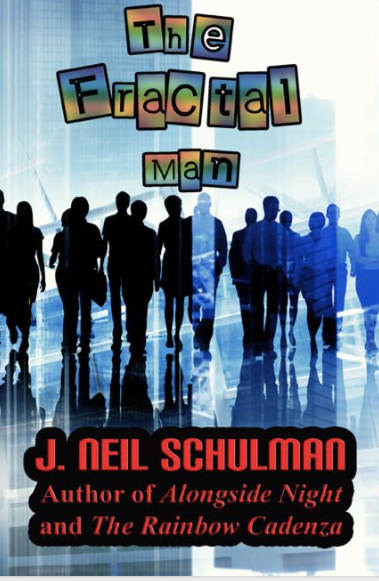
Review of J. Neil Schulman's The Fractal Man: Alternate Reality Autobiographies


Alternate realities have become something of a vogue in science fiction, especially on television with Fringe and Counterpart.  I've even tried my hand at it in a few short stories such as The Other Car.  But J. Neil Schulman has outdone all of this with his novel The Fractal Man, which for most of its 160 some odd pages - meant literally as well as a figure of speech here - is not only a masterpiece of alternate reality, but one of the best science fiction novels I've ever read, literally.

It's also a tour de force of meta-fiction and autobiography.  What do I mean by that?  Well, the main character - the narrator - is David Albaugh, a character in Schulman's 1979 novel Alongside Night, played by Schulman in the 2014 movie that Schulman wrote and directed.  In The Fractal Man, we meet Schulman - one of Albaugh's fractals, i.e., existences in an alternate reality - to the point of the character Schulman warning Albaugh about a danger that lies ahead, because, after all, Schulman wrote Albaugh's account of Albaugh's  alternate reality adventures which is the novel The Fractal Man.   I'd say I'm a sucker for that kind of science fiction, but if a I'm a sucker for delighting in that, then anyone with any appreciation for the finer tropes of science fiction, carried to their logical extents and well beyond, should be a sucker, too.

And the novel is chocked full of tidbits to delight the science fiction devotee and anyone with a taste for new ways of thinking about old things.   Distant galaxies that we see in our reality may be alternate timelines.   Arguments that a couple may have over whether an event unfolded this way or that way may reflect an alternate reality that one of the couple for some reason came from or has access to.   Everything from timeless music to time travel is woven into the undulating fabric.  It's all served up so well that I don't even mind that Schulman and most of his alternates are thorough-going libertarians, in contrast to me (I'm an absolutist only about the government keeping its hands off of all media and communication, i.e., the First Amendment)

Schulman sprinkles in some of his real libertarian friends as greater and lesser characters in this novel.   We know each other and have worked together, but I can't hold it too much against him that I didn't make the grade, because I'm not a close friend of his, and, as I said, I'm not an across-the-board libertarian.   And he makes up for this with some derring-do espionage escapades across realities, and a galactic scope that reminds of both Asimov and Heinlein, which is no mean feat  (Schulman, at least in this reality, did an important interview with Heinlein in 1973).

What I do hold against the novel is a long play within the novel, near the end, that has lots of relevance to the novel's philosophy and was excellent in and of itself, but comes out of left field, so much so that the reader is offered the option of skipping ahead.  This doesn't exonerate the play's inclusion.

But, hey, the rest of the novel is so bright and wonderful - such an intellectually exciting and satisfying ride - that I put it up there with David S. Michaels and Daniel Brenton's Red Moon and David Walton's Three Laws Lethal (to be published in two days, look for my review) as one of the best standalone science fiction novels I've ever had the pleasure of reading.   Is it a contradiction to describe The Fractal Man and its immersion in alternate realities as a standalone novel?  There's a sequel afoot - "The Metronome Misnomer - the title comes from a fractal version of the author in The Fractal Man, who wrote a book of that title in an alternate timeline" (this quote from Schulman's biography at the end of The Fractal Man) - so you may not need to answer that.


more alternate reality - "flat-out fantastic" - Scifi and Scary

Monday, August 18, 2014

Falling Skies 4.9: To the Moon, Anne, To the Moon!

The big story development in Falling Skies 2.9 - the second good episode in a row - is the discovery that the Espheni are controlling their operations from a base on the moon - on our moon, that is.  This leads to a good rendition by Tom of JFK's exhortation that we'll get to the moon by the end of the decade - the 1960s - except, of course, that Tom wants to start working on this right away.

Anne, sometimes the voice of reason, thinks it's a crazy, unworkable idea.  But Tom talk her into it, even before they're formally married, in a nice ceremony performed old reliable Weaver.   But it's good to see the moon brought into Falling Skies.

The moon, unsurprisingly, has been the focus of some of the best science fiction ever written, ranging from Robert Heinlein's Moon is Harsh Mistress to David S. Michaels and Daniel Brenton's Red Moon, the best science fiction novel that you probably never heard of.   And what's not to like about the moon as part of the story of Falling Skies?  It's a great locale because, after all, we indeed actually set foot on it in 1969, and a few times after, though nowhere nearly enough.

Indeed, the Espheni use of the moon can be seen as a good argument for us to get cracking as a species and get ourself on the moon in a more permanent way.   If we had actually done that by now in our reality, we might have seen the Espheni approaching before they wreaked havoc on us, and might have even be able to take out their base.

But, then, there would gave been no Falling Skies, and though I wouldn't have missed the show all that much earlier this season, it's finally come alive in the month of August.   Looks like some good episodes ahead this season and next.

See Red Moon: The Best Novel You Likely Never Heard Of

See also Falling Skies 4.1: Weak Start ... Falling Skies 4.2: Enemy of my Enemy ... Falling Skies 4.3: Still Falling ... Falling Skies 4.5: Cloudy ...Falling Skies 4.7: Massacre Indeed ... Falling Skies 4.8: Spike ... Falling Skies Espheni: How to Pronounce?

And see also Falling Skies 3.1-2: It's the Acting ... Falling Skies 3.3: The Smile ... Falling Skies 3.4: Hal vs. Ben ... Falling Skies 3.6: The Masons ...Falling Skies 3.7: The Mole and a Likely Answer ... Falling Skies 3.8: Back Cracked Home ... Falling Skies Season 3 Finale: Dust in Hand

And see also Falling Skies Returns  ... Falling Skies 2.6: Ben's Motives ... Falling Skies Second Season Finale

And see also Falling Skies 1.1-2 ... Falling Skies 1.3 meets Puppet Masters ... Falling Skies 1.4: Drizzle ... Falling Skies 1.5: Ben ... Falling Skies 1.6: Fifth Column ... Falling Skies 1.7: The Fate of Traitors ... Falling Skies 1.8: Weaver's Story ... Falling Skies Concludes First Season

#SFWApro


no moon, no aliens, but other strange stuff

get Season 4 of Falling Skies on

Tuesday, December 3, 2013

The Best Novel You Likely Never Heard Of

No, it's not one of my mine.   And I do this every few years - blog about a novel that's not only one of the best you likely never heard of, but, for what it's worth, is one of the best I've ever read.  I guess I should also mention that the novel is science fiction - which means, it's not competing with Austen or Dickens or Tolstoy or Hemingway.   But I should also say that I think science fiction always has a leg up - a page up? a screen up? - on all other kinds of literature, because science fiction deals with makes us quintessentially human, which I take to not just accept what the universe deals out, not just cope with it, but strive to change the universe itself.

The novel is by David S. Michaels and Daniel Brenton.

You never heard of them, right?

They published a novel, in the year 2000, entitled Red Moon (not to be confused with Michael Cassutt's novel of same name published around the same time, and the half a dozen other novels by the same name published since then). Cassutt's novel is good. Dave Michael and Daniel Brenton's is among the best three or four novels I've ever read, period - as I already said.

The background of the novel: I've always been fascinated by the collapse of the Soviet space program in the 1960s. The Soviets jump-started the space age with Sputnik in 1957. They got the first animals and then the first people up into space. They sent spacecraft – with no people – to the moon. They were on the verge of getting people there.

They inspired John F. Kennedy – in the senses of both wonder and security – to put the U.S. on a course to send a human to the moon and safely back by the end of the decade. Which we did.

But the Soviets never made it. Their move into space hit a strange stone wall. And the lack of continuing competition between the Soviets and us was likely the most significant factor in the fizzling of our own efforts in space.  Forty-five years later, and we have yet to set foot on the moon again, or anywhere beyond the space station.

What happened to the Soviet space program? The death of its mastermind, Sergei Korolev in 1966, no doubt was a grievous blow.  But… I don't know… there were a lot of other talented people working in the Soviet space program. The death of one man, however important, should not have led to the crash of the entire program.

Red Moon provides some breathtaking science fictional answers.

How I found out about the novel: It was at a reading I was giving at a science fiction convention – Balticon (in Baltimore) in the Spring of 2001. David S. Michaels came up to me after the reading, with a copy of my novel, The Silk Code, for me to autograph. Then he pulled a 600-page book out of his backpack, and asked me to please accept it, as a gift.

I wasn't sure what to say. First, traveling back from Baltimore to New York by train (I love driving, but trains even more) is no fun with a heavy bag of books, which I already had. Second, as a writer, I find I don't read as much fiction as I would like – if I'm writing a novel, which I usually am, reading someone else's can throw me off course. But ...

There was something about Dave, and I was already keenly interested in the subject, so I thanked him for the present and added it to my bag (it was filled with non-fiction books, by the way, which I do read when I can).

It was well into June before I had a chance to open Red Moon. And when I did – well, I couldn't put it down. It might as well have been a new Foundation novel. The subject, the plot, the characters, the writing was brilliant. I contacted Dave right away, told him how much I enjoyed the novel. It had been published by a very small press. I told him I would try to get it to the attention of a bigger publisher.

Which I did… But all of this was right before September 11, 2001, when lots of things changed in the publishing world (most of which is headquartered in New York City). And in the aftermath, at least the publishers that I had been in contact with were doing other things, and cutting back their acquisition lists.

And so, nothing more happened with Dave Michaels and Daniel Brenton's Red Moon. I listed it as my #1 favorite first science fiction novel on a list I started on Amazon. (It's a pretty exclusive list. I'd highly recommend Bob Katz's Edward Maret, which is #2 on the list. Wen Spencer's Alien Taste and Larry Ketchersid's Dusk Before Dawn are there, too.  I've put up and expanded the list on Goodreads, where you and everyone can add books and vote on their ranking.)

Amazon's Kindle revolution now has given Red Moon a new life. (I also have a reader review of the novel there.)  Kindle has been doing this for lots of novels, including many of mine.   (The Red Moon paperback is still available.)

If you're at all interested in the space race, what could have been, why what happened — and didn't happen – happened, the extraordinary human struggle to reach the cosmos, give yourself a treat, and get a copy of this novel. Trust me – you'll be caught up in an adventure, in an intrigue of alternate and real history, that you'll never forget.


#SFWApro

InfiniteRegress.tv