reviewing Black Doves; Dark Matter; Dept. Q; Detective Hole; Dexter: Resurrection; Fauda; For All Mankind; Foundation; Hijack; Memory of a Killer; MobLand; Outlander; Paradise; Presumed Innocent; Reacher; Severance; Silo; Slow Horses; Smoke; Star City; Star Trek: Strange New Worlds; Tehran;The: Day of the Jackal, Diplomat, Night Agent; Your Friends & Neighbors +books, films, music, podcasts, politics
George Santayana had irrational faith in reason - I have irrational faith in TV.
Chuck Todd interviews me about alternate histories
An excellent episode 3.4 of The Girlfriend Experience, with an excellent quote from a researcher that tells us at least what part of the series is really about: “There is clarity in realizing what isn’t working.”
That quote is in response to Iris's question, not as a call girl, but as a researcher into human behavior herself, her alternate persona, to another researcher touting what she's been pursuing. Iris asks her, let's say you find you've been on the wrong track? And she gets her answer, “There is clarity in realizing what isn’t working.”
That answer comes right out of Karl Popper, the philosopher of science, and one of his bedrock principles of how we attain knowledge: we not only learn from our mistakes, but our mistakes may be our own way of really learning. If we see a hundred white swans, and see another hundred white swans, that doesn't and cannot prove that all swans are white. But the instant we encounter a swan that is not white, we have learned something very profound: all swans are not white.
Of course, they could be complications in our observation of the non-white swan. Maybe we are having a problem with our eyesight. Maybe the bird we saw is not really a swan. But the principle still remains: we learn by discovering our errors, and subtracting them from our possible knowledge.
Now, the fact a philosophy this astute can be part of The Girlfriend Experience tells us a lot about this show. It's not all about or just about sex. Iris, as prominent as that it is in her life, is more than that. She has a brain that quests for knowledge. That's why she has her day job, that's why she can have a conversation that gets at the root of Karl Popper's falsificationist philosophy.
And no, that's not the only reason I watch this show, but it's one of things that make The Girlfriend Experience intriguing.
It all started in the hot summer of 1960, when Marilyn Monroe walked off the set of The Misfits and began to hear a haunting song in her head, "Goodbye Norma Jean" ...
I don't often watch documentaries, and review them even less often, but Spaceship Earth is an exception, because it tells at least two highly significant stories: (1) the attempt to construct a totally self-contained environment or biosphere (Biosphere 2) on Earth, with human inhabitants, as a template for what could be sent out to our solar system and beyond in the future; and (2) the media misreporting of what Biosphere 2 accomplished.
The truth is that Biosphere 2 was unable to maintain total self-sufficiency. At seventeen months into its two year 1991-1993 mission, oxygen was imported from the outside into the biosphere to combat the sharp reduction in oxygen from 20.9 to 14.2 percent of the biosphere atmosphere. Obviously, this is not something that could have been done in the middle of a mission to Mars or anyplace off the Earth. But the media were wrong to report this as evidence that the Biosphere 2 mission failed, or was some kind of publicity stunt rather than a scientific experience. Apparently no one in the media read British philosopher Karl R. Popper (for example, The Logic of Scientific Discovery), and his widely accepted view that mistakes are the way that science learns and progresses.
The Hulu documentary, named after Buckminster Fuller's apt characterization of our planet as "spaceship Earth," does a fairly good job of reporting and assessing the above, relying on extensive current and historical in-situ interviews with most of the central players in the Biosphere project, including the Biosphereans themselves. I know at least two people who provided support for Biosphere 2, Carl N. Hodges, an atmospheric physicist at the University of Arizona, who was not in the documentary, and Kathy Dyhr, Director of Public Affairs for Biosphere 2, who had a major role in the documentary. I had long and riveting conversations with each of them in the mid-1980s, when Biosphere 2 was under planning and construction, and both were students at the Western Behavioral Sciences Institute pioneering online education program, where I was a faculty member and was first introduced to online education, which gave me the idea for Connected Education and which has become so important during our current Coronaviris pandemic. These conversations, as well as my knowledge of how science works, and plain common sense, are what led me to conclude that the media assessment of Biosphere 2 was so wrong.
But why, then, did the media jump on the bandwagon of Biosphere 2 failure? The documentary provides one of the two answers. Steve Bannon - yes, that Steve Bannon - was brought in by financer Ed Bass to run the Biosphere managing company (Space Biosphere Ventures). Apparently Bannon sought to make a name for himself by publicly and repeated denouncing the project (including destroying some of the crucially valuable data it had collected, according to the documentary).
The second reason is more endemic and intrinsic to the media and to us, its public. As Phil Ochs pointed out so well in his song "The Crucifixion" (1966), we love to tear down, or see torn down, that which we have built up for adulation. The idea that we could build here on Earth a habitat which with proper propulsion could take us to the stars was heady, intoxicating stuff. When it failed to achieve that goal in at least one critically important way, the disappointment that resulted was enough for the media and many viewers to discard the entire project as an ambitious entertainment gambit that flopped.
But facts are stubborn things, and I expect the documentary to continue to bring the truth of Biosphere 2 out to the world and the future, which is that it was an important and major first step that taught us a lot about how we can get beyond this planet to the cosmo beyond.
The full title of this 45-minute documentary - Liberty Loves Reason: The Evolved Wisdom of Trees versus Identity Politics and Political Correctness - shows exactly what you're getting into if you watch it, which I very much recommend: a brief on the importance of reason in this, our hyper-partisan age, and its connection to the biological, evolutionary basis of our and all living knowledge and intellectual faculties, as well exemplified in trees.
Well, maybe this documentary is a little more than that. It argues, as did John Milton, that truth and falsity must be free to fight it out in the marketplace of ideas. This means that excluding any patently untrue idea is a dangerous thing to do, on even the slim chance that it may be not be untrue, for that would result in truth not falsity being excluded.
In the realm of trees and all non-human organisms, nothing is ipso facto excluded. Instead, strategies are tested (unconsciously, for trees). If they survive, their lack of falsity has been demonstrated, at least to a point. In trees and other living, non-human things, these "ideas" will continue to be employed in this way, unless and until something in the environment changes and the strategy no longer works.
Karl Popper and his evolutionary epistemology is most and correctly associated with this (though Ray Scott Percival should have mentioned that Donald T. Campbell most developed that term, in a brilliant essay with that very title in The Philosophy of Karl Popper two-volume anthology published in 1974). Percival might have also mentioned Popper's "paradox of tolerance" (from Popper's 1945 The Open Society and its Enemies), lately used as a justification for censoring hate speech. I always thought that Popper's argument that allowing speech that preaches the destruction of a free society should be not be allowed, since such speech is designed to destroy the free society, misses the point that the free society is compromised the instant it censors anything, including noxious hate speech. (See my Government Regulation of Social Media Would Be a Cure Far Worse than the Disease for more.)
But despite these inevitable imperfections, Liberty Loves Reason is a lushly imagined and photographed masterpiece, beautifully scored, of an intellectual argument absolutely crucial to these our dangerous times. Eminently worth your time.
I just saw Katy Tur grill Michael Wolff on the errors in his book, Fire and Fury.
Wolff correctly replied that there's no such thing as perfection in journalism. I agree, and I would add there's no such thing as perfection in publishing, either. No matter how carefully and studiously you try to avoid them, little errors crop up in all books.
Going over those page proofs - the last step before publication - I was determined that this book would have no errors, including no typos or misspellings. In the last round of this work - I had gone through three sets of page proofs already, and had corrected errors in all of three - I found a single misspelling: the German word für - meaning "for" - was spelled fur, or without the umlaut over the u.
This might seem like a minor error, but in German, the lack of the umlaut back then was a flat-out misspelling. (These days, the word is often spelled fuer, with the e taking the place the umlaut.)
So I sent this final correction back to the publisher. I received the final corrected page proofs a few days later. When I looked at the correction, I saw that rather than changing the fur to für, the fur had been changed to "for" (the English translation). I of course immediately returned the page proofs so this new error could be corrected. Well ... I went another three rounds, and each time I sent the page proofs back, they were returned with new errors, including one time with the umlaut above the o in for.
At this point, I realized I had found a fundamental source of error or noise in the universe: in publications of any length, especially books, it's impossible to get perfection. An irreducible amount of error is intrinsically part of the publication process.
And, indeed, that's held true for all of my books, including, for example, first edition of New New Media in 2009, where I corrected an error on the final set of page proofs, on the first page, only to see that the publisher in correcting that error inserted another error (left out a closing quote) on the same page. If you have that first edition, you can see it. The error was finally corrected in the second edition.
What all of this means for Michael Wolff and the press: don't expect perfection in his book. Expect truthfulness and accuracy to the best of his ability, and the ability of the publisher, which as far as I can see and tell is just fine.
An excellent season 1 finale of The Orville tonight - 1.12 - which picks up on what I long ago adopted as the mantra of this blog (see above), what George Santayana called an "irrational faith in reason".
That philosophic recognition - that the value of reason cannot be demonstrated without an appeal to reason, which in assuming the value of the very proposition under investigation is circular reasoning, or illogical, and is a form of infinite regress - was a cornerstone not only Santayana's philosophy, but Bertrand Russell's and Karl Popper's.
In The Orville, it's the solution to a violation of what in Star Trek is known as the prime directive, or the need for an advanced civilization to keep clear of any less-advanced civilization, lest it pollute it and derail its evolution. Of course, in Star Trek that happened all the time - Kirk violated the Prime Directive with near abandon - and it happens tonight when Kelly visits a planet, in a primitive stage of pre-civilization, that phases into our universe every 700 or so years in its timeline, which plays out as 11 or so days in ours. In the tritest part of the story, a religious cult grows up around Kelly. But the resolution is pretty nifty.
And it entails a faith in reason. Isaac is left on the planet - because, as in Star Trek, the only way to undo a contamination caused by a violation of the Prime Directive is to violate it again (a sort of paradox in itself) - and he manages to transform the faith in Kelly into a faith in reason. And this, as Santayana, Russell, and Popper argued, is the basis or best defense of rationality over irrationality on our Planet Earth, as well.
Did Seth MacFarlane read those philosophers? Maybe, very likely, who knows? But what I do know is that he's created a space opera it is as profound as it is funny - or maybe as funny as it is profound - and it's funny and profound indeed.
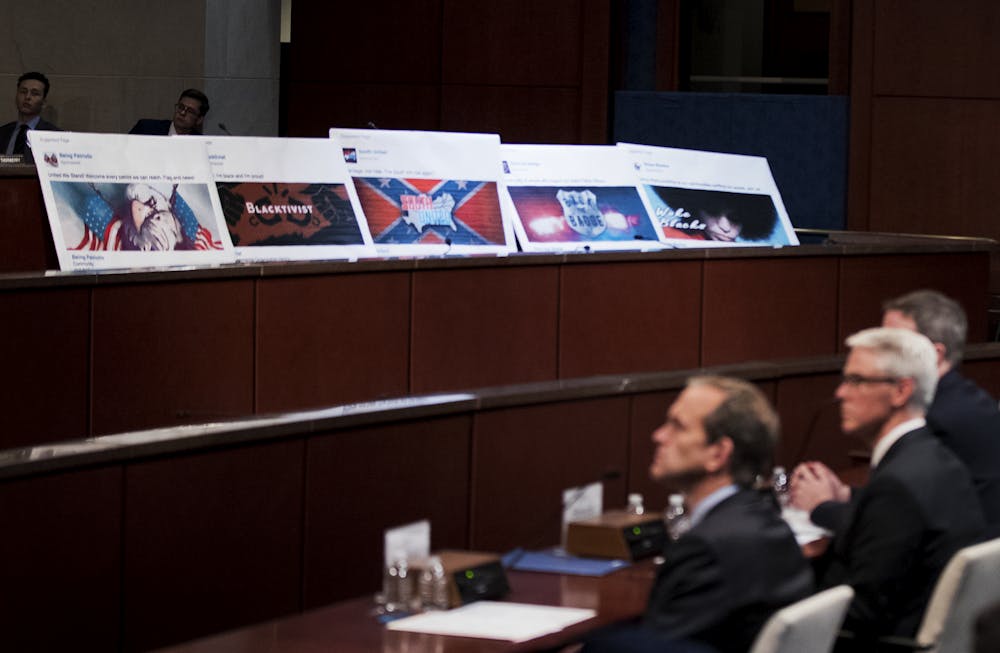
In recent weeks, Congress has grilled Twitter, Facebook and Google about their role in allowing foreign interests to place ads and articles intended to divide the electorate and spread false information during the 2016 election.
Now a number of people in and out of government are calling for federal regulation of social media. Lay down some rules, the thinking goes, and we would be able to prevent the infestation of bots and fake news from our news feeds and ads. Democracy would be saved – or, at least, foreign interference in our elections kept in check.
However, as someone who has studied and taught the First Amendment for decades, I would argue that if such regulations were enacted, the main victims would be not the purveyors of fake news, but our freedom of expression. In my view, the result would do far more damage to our democracy than any foreign misinformation campaign ever could.
Free speech being attacked from all sides
The First Amendment is under a lot of duress.
Arguably, it’s been that way since the Supreme Court’s “clear and present danger” decision in 1919, which spelled out when limits on free speech could be lawful. It not only held that the government had an obligation to stop someone from “falsely shouting fire in a theater,” but also opened the gates to all manner of government violations of the First Amendment injunction that “Congress shall make no law…abridging the freedom of speech, or of the press.”
Indeed, with the exception of Supreme Court decisions in the Pentagon Papers case in 1971 and the Communications Decency Act in 1997, the American government has systematically increased its control of media.
The situation has gotten much worse over the past year. President Trump has tweeted about withholding the licenses of NBC affiliates and lashed out at other media not to his liking.
Although Trump’s bluster about limiting and punishing media may be easy enough to deride, the fact that he is in the White House – and has the ability to appoint FCC commissioners – means his threats must be taken seriously.
Meanwhile, a theory of philosopher Karl Popper – the “paradox of tolerance” – is being widely cited as a justification for outlawing hate speech, notwithstanding the First Amendment. From his 1945 book “The Open Society and its Enemies,” it says that tolerance defeats itself when it permits intolerant speech.
I studied Popper extensively while researching my first book, an anthology of essays about Popper’s work. There are many aspects of Popper’s philosophy to admire, but I don’t believe the “paradox of tolerance” is among them.
To ban hate speech could turn our tolerant, democratic society into precisely the kind of state that hate speech is calling for: It could open up an opportunity for all sorts of speech to be dubbed “hate speech.”
A slippery slope
When regulating fake news on social media sites, there’s the danger of the same sort of phenomenon taking place. And it’s exactly why the well-meaning hue-and-cry that the government needs to intervene and forbid social media sites from disseminating fake news or allowing accounts that are actually bots is so dangerous.
Fake news is nothing new. Centuries ago, anti-Semitic publications spread rumors that Jews murdered Christian children and drank their blood on holidays.
Over the past two years, social media have increased the amplitude and reach of fake news. But there’s also been the ascension of a political figure – Trump – who has turned the tables by labeling any unwelcome news as “fake.”
Facebook ads linked to a Russian effort to disrupt the American political process are displayed as representatives from Google, Facebook and Twittertestify before the House Intelligence Committee on Nov. 1.Manuel Balce Ceneta/AP Photo
The latter should be more than enough reason to reject calls for government censorship of fake news. After all, who’s to say a government that determines what’s “fake” won’t simply follow Trump’s lead, and suppress critical and truthful content under the guise that it’s fake?
Instead, social media networks could develop and implement algorithms for identifying and removing fake news by marshaling the same engines that spread fake news in the first place. These algorithms would not be administered by the government; rather, Facebook and other social media would be responsible.
Twitter has already made considerable progress flagging and removing accounts that spread Islamic State propaganda. There’s no reason to think that the same process can’t be applied to Russian bots seeking to inflame political discord and therein damage America’s political system.
Such self-regulation is in the best interest of these media companies. It would increase the confidence of their users in what they encounter online. It would also have the added benefit of keeping government regulators at bay.
In the end, the ultimate antidote to fake news and bots is the rationality of the human mind.
As John Milton famously urged in his “Areopagitica,” if you let truth and falsity fight it out in the marketplace of ideas, human rationality will most likely choose the truth. Regulating what can enter that marketplace could impair or destroy this process, by inadvertently keeping truth from public awareness.
Rational thinking’s ability to identify fake news is more than a Miltonian ideal: It’s been demonstrated in a carefully conducted 2015 experiment. When given a small financial incentive, the subjects were able to identify fake news as fake, even if the fake news supported the political views of the subjects.
Indeed, rationality is deeply implicit in democracy itself. You can’t have the latter without the former.
The key in combating fake news and kindred attacks on our body politic is to give our rationality maximum access to all information, including the truth. And in my view, this means resisting any attempts by government to limit the information that reaches us.
This may come as a surprise to you, my readers, but I think the moving of the Doomsday Clock by the Science and Security Board
of the Bulletin of the Atomic Scientists 30 seconds forward, so it's now 2 and 1/2 not 3 minutes to midnight, does more harm than good. I agree completely with the reasons given for the unprecedented move (first time in the Clock's 70-year history), ranging from Donald Trump in the White House to the rise of fake news, but I think the clock exacerbates the problems, especially the crisis of fake news and its effects, and the deterioration of the public's understanding of science.
Science is supposed to be about the search for truth, and the test of results, all via methods that make it likely that facts and truth have been discovered (see Karl Popper for more). Scientists are of course entitled and encouraged (as are all human being) to have opinions on political and social issues which go beyond science. There's nothing whatsoever wrong with a scientist saying I, as a scientist, have such and such a political view, for the following reasons. Nor is there anything wrong with scientists or anyone agreeing or disagreeing with a political view because they think that view runs contrary to science. Indeed, expression of such disagreement is a public service.
But there is something harmful in presenting political views, and social forecasts, in a literally numerical package which, frankly, feigns the imprimatur of science. Hari Seldon's psychohistory sought to do that in Isaac Asimov's Foundation trilogy, but that is superb science fiction not fact.
The fact is that the metaphor of the clock is just that - a metaphor. Two and 1/2 minutes to midnight has no more correspondence to the reality of present or future than does 3 minutes or 30 minutes. It is just a clever way of calling attention to concerns that scientists have - scientists who are not Hari Seldon, and therefore have no better mathematical way of predicting the future than anyone else outside of characters in science fiction.
And it hurts science, and the public's confidence in it, precisely at a time when we most need it. Scientific research and models which show climate change come from real evidence and events, and we need that respected as such. The Doomsday Clock is a dramatization of understandable opinions - opinions which I share - but which ought not be presented or even implied to be in any way the result of scientific research.
Indeed, to present such as concerns as science is in itself a form of fake news, which thrives in making the boundaries between science and opinion even less clear than they now are. I think the best thing that can be done with the Doomsday Clock is retire it.
Wythoff describes Gernsback's keen concern with the definition of science fiction - or scientifiction, as Gernsback usually had it - which in turn led to a thoughtful, even profound, analysis of how much science and truth needs to be in the science fiction. There are several bells that this discussion rung for me.
First, I'm reminded about both Karl Popper's and Marshall McLuhan's dislike for definitions. Popper held that they were a distraction, and McLuhan was fond of quoting French poet Stéphane Mallarmé that “To define is to kill. To suggest is to create.” I generally agree with that, but Gernsback's quest to define science fiction was valuable.
As Wythoff points out, it led Gernsback to probe the evolution of technology, with the realization that the science in science fiction was a progressing target. A century later, anyone familiar with science fiction knows that it predicted and even provided a template for everything from space travel to gene-splicing (H. G. Wells' The Island of Dr. Moreau). In Gernsback's day, this was not as obvious, and he deserves credit for holding science fiction to the test of not only plausibility but physical possibility - which remains an important point of demarcation between science fiction and fantasy.(See this for my very brief definition of the two.)
Gernsback's focus on scientific possibility and truth led to what today is an astonishing example. Wythoff, writing before our current crisis regarding fake news, tells us about Gernsback's 1926 "The Moon Hoax," in an early issue of his Amazing Stories, which reprinted a series of articles in The New York Sun from 1835 which reported an intelligent civilization of the Moon. Gernsback was confident, in 1926, that such a "hoax" would quickly be exposed by radio. He of course missed not only Orson Welles "War of the Worlds" (thanks to my wife Tina for this example), but the way that our social media today not only unmask fake news but disseminate it.
I thought this example was so telling, that I just added it to my Fake News in Real Context. That's what I mean about The Perversity of Things being a treasure trove to anyone who's interested in the evolution and impact of media. And I'll be back here, sooner or later, with more.
It's been a week of deep loss - of people I didn't know personally whose work made a difference in my life, of people I did know personally whose work made a difference, of perhaps - though I hope not - of something in America itself which many of us hold very dear.
Back in the day - actually, just a decade ago, but time flies when you're having a good time - Dom Balestra and I did some good things together at Fordham University, when he was Dean of Faculty and I was Chair of the Communication and Media Studies Department. A few years earlier, in the summer of 1998, Dom was the first person who interviewed me when I first came to Fordham seeking a job as a professor.
We already knew each other. The first time we met was when Dom came up to me after the conference about Karl Popper and his philosophy that I had organized at the Prince George Hotel in Manhattan. (It's also been week for remembering seedy hotels - just yesterday I was recalling how I had met someone who claimed to be Leonard Cohen's Suzanne, in the Milburn Hotel on West 76th Street.)
Dom had love of philosophy of technology, as did I, which is why our paths first crossed at that conference. It provided a great basis of conversation years later at Fordham, where I briefed Dom on McLuhan, he briefed me on Spinoza, and we discussed everyone and everything in between.
Most academics have a love of knowledge in one way or another. Dominic Balestra embodied it, and epitomized what it literally meant to be a philosopher. After the funeral, a colleague said to me, as I mentioned what I said above about this being an especially tough week, that Dom died at the right time, so he didn't have to see what had happened in America.
True enough. But, even though we hadn't spoken in years, it would be wonderful indeed if I could talk to Dom right now and get his sage, thoughtful views of our world and its dangers.
An outstanding episode 1.3 tonight of Westworld, turning out to be one brilliantly philosophical ride of a series, as we would want a drama about artificial intelligence in android bodies to be.
We learn from Dr. Ford that Arnold, who co-created the androids with Ford, thought that the creations could achieve true sentience via a bicameral mental process, in which the two halves of the mind worked together - one talking to the other - to attain human consciousness. This, as far as I know, is the first time this theory of Julian Jaynes - that our own human consciousness arose from bicameral minds - has ever been employed as a mechanism in a science fiction television series.
It's appeared in science fiction - including in one of my own novels, The Consciousness Plague - but not as an explanation for the design and emergence of artificial sentience. Jaynes was a real person, by the way, whose book The Origin of Consciousness in the Breakdown of Bicameral Mind caused something of a stir when it was first published in 1976. Jaynes argued that prior to the invention and adoption of the phonetic alphabet in the Middle East, human beings were not conscious in the way that we have been ever since and are today, but instead heard voices in their heads that told them what to do. Those voices are now known in our history as the voices of the Biblical prophets, and they survive today in schizophrenics.
We studied Jaynes in the Media Ecology PhD Program at New York University under Neil Postman. I once asked Marshall McLuhan what he thought of Jaynes and he said it was "science fiction" - another prophetic observation of McLuhan, who talked about the global village decades before the Internet and social media. I met Jaynes a few times - he was charming and erudite. But I thought his theory foundered in Far Eastern cultures, which are conscious the way we Westerners are, but never had a phonetic alphabet.
But that's no reason Jaynes' theory couldn't be brought into Westworld, which was really on a philosophic roll tonight, also invoking Karl Popper's notion that learning proceeds via mistakes, as Bernard muses about life and intelligence. Neither Jaynes nor Popper were mentioned by name, but the presence of their core concepts in Westworld makes it not just science fiction but philosophic fiction, an amalgam you don't get on the television screen every day.
Meanwhile, Dolores's story (very well played by Evan Rachel Wood) is progressing beautifully - in beautiful sorrow, apropos her name - and we see some monsters in the park, with unclear origins. Also, a host kills himself with a rock to the head - presumably to stop himself from hurting one of the programmers.
Westworld is a trip for the mind as well as the senses, and I'm all eyes and ears for more.
I saw Beau Willimon at Fordham University earlier this evening - thanks to my colleague Beth Knobel (erstwhile CBS Moscow bureau chief) for arranging this. The hour was the best of this kind I've ever attended. By which I mean, a creator of a landmark work talking incisively, truthfully, vividly about the creative and business processes employed in bringing the work to life.
Among the highlights of Willimon's disclosures and lessons imparted -
He started his creative life as an illustrator and painter, but found the static image insufficient to tell the stories he wanted to tell. (See illustrator Joel Iskowitz for an opposite point of view.)
Willimon says the revolution in television-making founded and exemplified by his House of Cards is that a writer, producer, creator can sell not just a pilot but an entire season of a series to a distributor like Netflix. I'd say that this, in effect, is the creator's side of what we viewers experience and enjoy as binge all-at-once watching of a television series, and this increase of creative control in the producer's hands may be the beginning for television of what Kindle publishing has done for authors on Amazon.
Willimon thinks that there's here's no such thing as writer's block - I've long thought much the same, that cries of writer's block are evasions. Willimon put an even finer point on this, explaining that writer's block is really not inability to write but unwillingness to confront a possible failure.
Indeed, Willimon emphasized that we should embrace not run from failure - a view very much in tune with Kark Popper's (one of my favorite 20th century philosophers) that we learn more from our mistakes than our successes.
Willimon says the auteur theory of film (and, by extension, television) is overrated and untrue - these creative forms are inherently collaborative efforts. (I was thinking that one of the reasons I like writing novels and short stories is that I don't have to collaborate too much with anyone.)
Willimon's favorite scene in the third season of House of Cards was Frank Underwood and Tom Yates first getting down to brass takes about Tom's life. Just about every scene with Tom was among my favorites in the third season.
One of the great perks of the academic life is getting an hour like this - reflections from someone whose work initiated what I think of as the third golden age of television (title of a book in progress) - the first being in the 1950s, the second in the first decade of the 21st century with shows like The Sopranos (no commercials, no FCC restrictions on content), and the third being right now with House of Cards - already joined by Peaky Blinders, Bosch, Bloodline, and more.
Something a little different: my complete interview with art historian E. H. Gombrich (1909-2001) about philosopher Karl Popper (1902-1994), for my 1982 anthology: In Pursuit of Truth: Essays on the Philosophy of Karl Popper on the Occasion of his 80th Birthday. Of interest to art historians and philosophers of art and science. E. H. Gombrich interviewed by Paul Levinson What I learned from Karl Popper from In Pursuit of Truth ed. Paul Levinson Atlantic Highlands NJ: Humanities Press and Brighton, UK: Harvester Press, 1982, pp. 203-20 What I Learned from Karl Popper: An Interview with E. H. Gombrich
interview conducted by Paul Levinson
I met with Sir Ernst Gombrich in New York City on October 14, 1979, to discuss how his thinking
about art and related topics had benefited from his long friendship with Karl Popper, and his exposure
to Popper's ideas. We sat in the apartment of the late Dr. Marianne Kris, which, with its walls hung
with paintings and etchings, and its location overlooking Central Park, provided good points of
reference for two of the main subjects of our conversation—art and the natural world. What follows is
a more or less verbatim transcript of the interview, revised only slightly for style and not at all for
content, and with section titles added by me later.—P.L. PL: Why don't we start by looking at this question: Karl Popper is known primarily as a philosopher of
science, and as a social philosopher, and more recently as a philosopher of biology. How does
someone such as yourself, whose expertise and whose life's work has been in the area of art and
aesthetics, find Popper's work of so much value?
EHG: Well, I think we must start at the other end—we have been friends for very, very many years,
and very close friends. We met first in '36 in London, but I had also fleetingly met him in Vienna too,
and I knew of his work while I was studying in Vienna. And it so happens that my father, who was a
lawyer, was apprenticed to his father, who was a lawyer, so the families had always known of each
other. I have always had philosophical interests, and therefore it is not so surprising that when Popper
came to London and we spent a good deal of time together, we also talked of philosophy. That is
really one aspect of the matter.
The other aspect is that aesthetics is not really one of my main interests—I see myself much more as
a historian than as a critic or aesthetician. And a historian, of course, is inevitably concerned with the
problems of knowledge, of doubt, of theories, of the way theories are guided by questions and all
these matters. So that Popper's ideas were not all that strange to me. You may remember that I
contributed to the Schilpp volume ["The Logic of Vanity Fair," in The Philosophy of Karl Popper, ed. P.
A. Schilpp (LaSalle, Ill.: Open Court, 1974), pp. 925-957], and I mention there that I attended Hayek's
seminar [at the London School of Economics] when Karl Popper read his paper on the poverty of
historicism, which naturally interested me very much because I had been very skeptical of the sort of
Hegelian approach to the history of art. And we talked a good deal about that too, but we talked of
many other things as well.
You mentioned, incidentally, that Popper is mainly known as a philosopher of science, which is true;
but after all, his book The Open Society [The Open Society and Its Enemies (London: Routledge & Kegan Paul, 1945)], is largely also a work of scholarship about the ancient world, so he is also a
historian.
Art History and Historicism
PL: Well, let's talk a bit about Popper's and your view of history. You mentioned your disagreement
with Hegel, and of course Popper is well known for his disagreement with Hegel.
EHG: Yes.
PL: And yet there is some similarity, perhaps superficial, between Popper's and Hegel's works—even
Popper's view of Worlds 1, 2, and 3 bears a certain resemblance to Hegel's three-part system—so
what would be the main area of Hegel's work that you so strongly disagreed with? Was it the
historicism issue—the idea that there are "moving spirits" throughout history?
EHG: Yes, that is one of the main points. But Hegel is, after all, an "ontologist," if one could use this
term—I mean he really believed that he knew about the plans of the "Absolute," the way the Absolute
evolved in history, and he thought that he himself was something like the mouthpiece of the Absolute.
So there's a great deal of difference—I mean, the number "three" is not a monopoly of either Hegel or
Popper, and I don't think the similarity is very great.
It is true that Popper's idea of World 3, as he has said himself, bears some superficial resemblance to
the Objective Spirit. Of course nobody who has been brought up in these traditions of German
idealism can have escaped problems of this kind, which also may have directed Popper's thought—
though Popper was a very keen student of Kant, and spent a great deal of time in his early years, as
you may know from his "Autobiography" [in The Philosophy of Karl Popper, ed. Schilpp, pp. 3-1811,
on Kant. And Kant felt that the German school of idealists had betrayed him. He specifically
repudiated Fichte, and I am sure he would have done the same with Hegel—which doesn't mean that
Hegel owed nothing to Kant, but that Hegel had, in a way, betrayed the main thrust of Kant's
philosophy by presenting a kind ,of "gnostic" philosophy, an idea of knowledge which Kant always
rejected. So I think that is one of the main points—apart from the point that anybody who reads
German and is condemned to reading Hegel will soon find that this is no pleasure.
PL: But Kant is no pleasure either, from what I understand!
EHG: Kant is no pleasure; but Kant, one finds, struggles with his formulation. One sometimes feels if
he had allowed himself to write in Latin it would have been easier than German, which was at that
time a rather unformed language for metaphysical formulations. Hegel used this kind of language
often—I think one can't deny it—to impress rather than to enlighten.
PL: But doesn't Popper himself occasionally indulge in ad hominem criticism of Hegel in The Open
Society and Its Enemies?
EHG: Yes, I agree with you. He was a pompous fellow, Hegel, and he invites this kind of ridicule. But
this is no argument, I quite agree: he might have been a pompous fellow and still be a good
philosopher—and that is undeniable. Popper himself, I think, writes somewhere that he meant his
criticism of Hegel as a kind of "scherzo" in between the criticism of the two more serious thinkers. He
didn't take Hegel seriously.
PL: So Hegel was sort of the "decoration" in the Open Society?
EHG: Well, yes—it was a kind of more light-hearted attack, because he thought that Plato and Marx were the more worthy opponents. PL: And yet as an art historian, you described yourself towards the end of The Sense of Order [Ithaca,
N.Y.: Cornell University Press, 1979, p. 2151 as saying that when it comes to issues of overwhelming
style, or even the spirit of an age, you're a "sceptic with an uneasy conscience." So even as someone
who is against Hegel, you recognize that there are certain styles in art and in society, for example the
Impressionism at the end of the nineteenth century.
EHG: Well, nobody can overlook this—it would be difficult, wouldn't it?
PL: How would your view, then, differ from Hegel's on those dominant styles and themes that you do
find in history?
EHG: Well, Hegel thought the whole history of all these branches of human culture can be logically
deduced from the exact place from which they start at any point; that every age has an essence which
expresses itself in these various fields—of law, of religion, of art, of society, of ethics—and that in a
way if you dig deep enough in art you will find the same spirit expressed as you would find in law or in
religion. This is a sort of unitary idea of the age—"unitary" is perhaps a little too weak, one almost
might use the term "totalitarian"—a total view of every age, in which everything hangs together
logically, because it is the unfolding of the Spirit. It's a logical process in Hegel—it's what's known as
the dialectic, as you know.
But I don't believe that. I am an individualist. I believe that no doubt people are influenced by each
other, and there are such things as movements, and there are such things as the logic of the
situation, of inventions, of group formation, which accounts for similarities of what various people do.
But I wouldn't say that there is ever a logical necessity of one thing deriving from another in the way in
which Hegel tried to demonstrate.
PL: Yes, I remember there was a place in Objective Knowledge [London: Oxford University Press,
1972, pp. 125-126] where Popper says that he insists on the fact that the individual really always is
free to assert him or herself against what any sort of societal trend might be.
EHG: Yes, within limits of course. I mean it would be very hard to imagine that an Egyptian—an
ancient Egyptian—listening to our conversation could have joined in, because he wouldn't know what we are talking about. So there are limits through preparation, through language, through all these
matters. But this is common sense, isn't it; one doesn't have to state this specifically. But I do agree, and I hold with Popper, that the freedom of the individual either to join or stay outside
must always be asserted in history.
PL: Yes, and in a way, revolutions in art and in fashion and so on might even be traced to individuals
asserting themselves against the standard forms.
EHG: Well, of course; and revolutions in art, as you call them, are very often, in a way, self-appointed,
and self-styled—that is to say, we say that we know what the present trend in art is, but there are
thousands of painters working at present who are working in very different styles. Perhaps the critics
think they are not characteristic of our age or whatever, but that is in a way done by fiat. It may be that
in fifty years' time, when critics look back at our own age, these people who are not now in the
Museum of Modern Art will be considered the pioneers of 1979. This is always possible.
PL: Yes, with the wisdom of hindsight. Those things very often do happen.
EHG: Yes, very often. I once wrote that a critic who had tried to describe the art of his time in around
1890 or so would certainly not have known of Van Gogh, he would hardly have known of Cezanne, of
Gauguin. How could he? Cezanne was working away somewhere in the south of France; he was a
shy man; he didn't want to exhibit much; and one wouldn't know of him.
PL: I agree with you there completely. In the area of music, in our own day, it has happened so many
times. The Beatles, for example, were rejected by about twenty-five or twenty-six record companies,
who thought they were totally out of sync.
EHG: Were they?—yes—such things are so often told, and they are often true. But it's then a matter
of luck, isn't it? Luck plays a tremendous part in cultural history. I mean, whatever rises to the top for a
time, you can't foretell. I am interested in this respect in a metaphorical comparison—I don't know if
you are interested in such things—we use the metaphor of"currents" in history very much.
PL: Yes.
EHG: Both currents and waves can be predicted up to a point—but when it comes to what is known
as "turbulence," that is to say, when the pressure becomes too great, then it is mathematically and
theoretically impossible to predict where a particular molecule of water is or will be. And we are such
molecules. There's always turbulence in our society.
PL: Yes, I think that's very significant. And one of the reasons why Popper, I think, has been
misunderstood in the United States is for that very point. People get frustrated with the fact that Popper doesn't provide a clear way of predicting things, and they therefore assume that he is anti-
scientific and antirational, when, quite to the contrary—
EHG: No, no—far from it!—it is rational to say that there are certain things which can't be predicted,
and I think again it is fairly well known in many fields that there are limits to prediction. Sometimes
they are simply the limits of our knowledge; but sometimes, as in the case of turbulence, they go a
little deeper than that.
PL: Well, could we distinguish between limits to prediction and limits to knowledge? In other words,
knowledge itself perhaps could grow endlessly, but yet we'd still lack the ability to perfectly predict an
inevitable future.
EHG: Well, I certainly agree with you. I mean, that is the famous Laplace Demon, isn't it? PL: Yes.
EHG: And Popper has written a certain amount about Laplace's Demon. There is no such thing and
couldn't be. It couldn't be done. He has actually, you may know this, written a rather theoretical paper
about the predictors ["Indeterminism in Quantum Physics and in Classical Physics," British Journal for
the Philosophy of Science (1950-1951): 117-133, 173-195]. There is, for instance, in any apparatus,
random movement of the molecules.
There is random movement, and you can't do much about that. It is something similar to turbulence,
and you can't predict its outcome. There's always noise in
PL: in a system
EHG: in a system and in our system certainly there is noise.
PL: That's a good point, because even when you try to introduce something to reduce the noise, this
of course has a noise component of its own.
EHG: I am sure it has.
PL: So noise can never be eliminated totally. But let's get back for a moment to Kant, because I don't
want to miss that. You mentioned Popper's
EHG: interest in Kant
PL: interest in Kant as opposed to Hegel, and this introduces the whole question of Popper's
"evolutionary epistemology"—I think Donald Campbell coined that term [in his essay "Evolutionary
Epistemology," in The Philosophy of Karl Popper, ed. Schilpp, pp. 413-463].
EHG: Yes.
PL: And I find that approach very, very fascinating.
Art in a Darwinian Context
EHG: So do I! Popper developed it more, perhaps more thoroughly, in his later years. And in some
respects, of course, Popper differs here from Kant. Kant's view of reason and all that is a purely
anthropological one. Kant never, I think, asked himself how a squirrel can jump from branch to
branch, whether the squirrel also has an a priori form of space. But obviously it
PL: It must have.
EHG: Yes, quite. And that is something which is entirely outside of Kant's interests.
PL: How do your own views on art follow from this evolutionary epistemology? I'm thinking
specifically, again, of The Sense of Order, in which you talk about the biological basis of some of our
perceptions.
EHG: Well, I don't think the bridge is all that immediate, but I do think you could develop a theory of
art according to which art is a method of creating responses. Popper once said or wrote that language
enabled us to tell ourselves a story—you know, to console oneself by telling oneself a story. You also
can whistle in the dark. In other words, there are all sorts of things by which the individual finds a kind
of shelter and consolation in his own creation. I think that this is a very important part of art: that it
creates, call it a "third world," one which is of our own making, and which creates a kind of home
fondle mind.
This is not an expressionist theory—as you see, it is a theory, again, of trial-and-error. I think that the
development of Western music, for instance, shows that somehow, gradually and step-by-step, a
system has been developed which is appealing to a very, very large number of people and minds—
and not only culture-bound, because Japan, for example, has taken to Western music like anything.
There's something objective in the effects of great music, and not only great music.
I think Plato was right, in other words. You know, in the old Platonic theory of art what is stressed are
the effects, rather than anything else. Plato had a magical/medical theory of art, that certain keys
have certain effects on the mind, like a drug or spell, and that therefore certain things should be
avoided, and certain things should be encouraged.
PL: Yes.
EHG: I do believe that there are such effects. But I do believe that Plato probably underrated the
plasticity of the human mind. Just as in foods there is such a thing as an "acquired taste," so there is
an acquired taste in art. There is also "brainwashing' in art—the feeling that everybody likes it, I must
try it myself, and maybe I can make myself like it. All this plays a part. So I wouldn't say that
everybody starts from scratch in art, by any means.
But you could say—without overstressing it, just for the purpose of our conversation—that the tea we are now having came to us from China, and obviously people noticed a response, that this rather
elaborate affair in which you pluck leaves from a tree and brew them, or pour hot water on them, has
a pleasant effect of the kind that goes much beyond individuals
PL: or cultures
EHG: having come to us via Russia, and still is known by the Chinese name of "ch'a." Something
similar applies to coffee. The way these things migrated and were accepted is quite a good analogy to
certain discoveries in the arts, possibly by trial-and-error.
PL: Well, let's get on to that trial-and-error issue. What that seems to suggest both on the individual
level and on the societal level is that you have people creating lots of things, but most of them do not
survive—they are falsified.
EHG: Yes.
PL: And those things that do survive are the ones that are accepted, or the ones that become the
dominant art forms.
EHG: Entirely. You were mentioning the Beatles: there must have been any number of pop groups at
that time who tried to be original and this and that, and they are forgotten; but the Beatles, perhaps
because they had a very good manager, perhaps because they struck a chord, hit it off. That is a kind
of Darwinian survival affair.
PL: Yes, they were the most musically "fit." But now, you see, that type of statement disturbs some
people in art, because they would say that whereas in science there is a need and benefit in
eliminating incorrect ideas, isn't this a bit of a cold way to look at art—to say that certain things are
eliminated or falsified?
EHG: It may be a little cold, but if it is true, what can we do about it? In other words, I do think that
there are many variants. I wouldn't say that some of the variants which fall by the wayside are not
worthy—they just may never have been given a chance. Even within the work of an individual, you
know, there may have been starts which he might have developed. I remember listening to some
early Mozart quartets where there are things which he never went on with—he followed another line—
but he might have been able to do it. That's a different matter.
PL: Yes, that whole question of starting and stopping and then starting something else again—the
Darwinian as opposed to the Lamarckian sometimes seems hard to reconcile with the idea of a
cumulative progress. Because it almost implies that each artist starts all over again and has to have
his or her ideas put through the trial-and-error process.
EHG: No, I don't think it would require that. Because all artists, after all, learn and study the art of their
predecessors, and therefore each artist starts from a baseline. Of course, some never get beyond the
baseline, and only do the well-tried thing; and others, for some reason or other, which may be
external pressures, introduce variations or mutations, if you like, which work.
I think it is possible to build up such a theory—it would be a little arid and a little one-sided—but it is
possible to build up a theory by which one could speak of a kind of "unintentional" creation of art. Yes,
it would be a little bit exaggerated, but after all there are many art styles—ancient Egypt, or
Byzantium—in which, as everybody says, the artists were craftsmen and the tradition was very
strong, but there is still a drift in a particular direction.
PL: Yes, I think that makes a certain amount of sense. In my own studies on the evolution of
communications technologies,
EHG: Yes?
PL: I have found such a process at work time and time again: Thomas Edison, for example, invented
the motion picture process, thinking that it was going to be just an adjunct of the phonograph.
EHG: Did he!
PL: Yes, and the phonograph itself was originally invented to be an adjunct of the telephone.
EHG: And it emancipated itself; it went its own way?
PL: Yes, it was "chosen" or "selected" because it could perform a different task. And this has
happened in many other cases.
EHG: Yes, yes—intention isn't everything, is it? I mean, Edgar Allan Poe invented the whodunit, the
detective story. I don't think he dreamt of the incredible snowballing of one little story. He couldn't
have.
PL: No. So these people—and their unintentional creations—are almost the genes, or the source of
mutations, if you want to stretch the analogy.
EHG: Almost, yes. I agree.
Representation, Reality, and Relativism
PL: The issue of falsification and how it relates to your view of art and decoration I also find very
interesting. Am I wrong in making this equation: that you look at representation, pictorial
representation, as a sort of corroboration or an attempt to corroborate our innate sense of order,
whereas decoration is a sort of jolt or a sort of falsification of
EHG: No, I think that is not, I am afraid, quite how I see it. I think there is a problem in representing
something. The starting point is what is known as a conceptual image—you know, the round circle
with the two dots and the nose and the mouth. And if I want to make a portrait, I have to go beyond
this pretty much. Here we have one particular problem of creating a correct or acceptable image of a
bowl with fruit [gestures to still life painting on wall], or a square in a city, or whatever else we may
see. And in this respect, you can arrive at a state where you say this is the correct representation of
what is seen from a particular point.
Now there are two issues, I think, to be mentioned here, which are sometimes confused. The first is
that, in my view, there is no problem in three-dimensional representation. I mean, from an artistic
point of view, there are lots of problems; but you can make a facsimile of a three-dimensional object.
You see plenty of them in the Natural History Museum or anywhere else which are simply like
PL: life
EHG: like life, or like—well, you can also make a facsimile of this cup [gestures to teacup on table]. PL: OK, like reality, then?
EHG: Well, I mean the two are nearly or fully indistinguishable. Unless you apply certain tests, they
are indistinguishable. So I don't think this is a very great problem. There are artificial flowers, artificial
teeth, artificial eyes, or take what you like.
But then there is the much greater problem of two-dimensional representation of a three-dimensional
reality. Now this you can say is always a bit of a problem because by and large we don't keep our
eyes still. Our reality is always in motion because we are in motion. And the question of what is
actually involved is even a little more complex, because we look with two eyes. However, from a
certain distance there is no such problem because we don't see 3-D in things that are far away. And
the photograph has shown that, well, you can record very faithfully what is seen from a particular point
of view. That is to say, what is occluded and what is seen when I stand ten yards from the window
and look out into Central Park—this, tree is in front of this place, and so on and so forth. You must
keep your eyes still, and you must measure, and you must do all these tricks which are taught, in
order to achieve this likeness of a particular view. I mean, this engraving on the wall [gestures to
engraving that depicts a courtyard or a square with people in foreground, surrounded by three sides
of enclosure or building] is not exactly what a person would see from a particular point, because it
brings in things like the slanting walls which are different, you see. However, this is representation.
The problem is interesting, but I don't think immensely complex.
I think it is more interesting to ask why in the history of art this kind of solution, of an accurate
mapping of what is seen from a particular point of view, has only been achieved once or perhaps
twice—once in ancient Greece perhaps, or closely to that, and once after the Renaissance. The
answer is, I think, because we don't relate to the world in this way. As I said, we move through the
world—I see the teacup, as J. J. Gibson would say, as a thing in the round, which I can grasp. And
not only because I have tactile memories—all these are "false starts"—but because this is how our sensory system works. I really see the world in three dimensions. And the reduction of this experience
to two dimensions is a tremendous achievement. But many civilizations didn't aim at this achievement
and didn't get it.
PL: Now that's an interesting point, because in Art and Illusion [Princeton, N.J.: Princeton University
Press, 1960] you take great pains to say that the conventional view that the Egyptians were merely
inept, and that's why they had their flat representations, is incorrect—you disagreed with that.
EHG: Yes indeed.
PL: Well then, what were the Egyptians and other societies that did not try for accurate representation
aiming for?
EHG: Well, if you want a very brief catchword, it's a kind of pictographic art. They wanted to say, here
is a man, and here is a boat, and it worked.
PL: But from the point of view of evolutionary epistemology, and the idea that art serves some sort of
useful purpose, it seems to me clear—it doesn't really need much more explanation—that a realistic
portrayal of the world would serve the biological purpose of capturing reality for whatever need:
reference, memory,
EHG: Not necessarily—a map also captures reality.
PL: Yes, but then what would be the purpose, the advantage, of distortion? EHG: Well, a diagram
captures some sort of reality, and the purpose of Egyptian art—and I actually discussed a little
hypothesis about it in Art and Illusion—the purpose of Egyptian art was certainly a very static
preservation of the world in which a man had lived in his lifetime: the important things there. So there
is no contradiction there in my schematic view. It was the narrative purpose of Greek art, the dramatic
evocation of a particular event, which led to the other approach.
PL: So in other words, the Egyptians were, in a sense, attending to a different aspect of reality?
EHG: Absolutely, yes. And while I do believe that the Greeks had a cumulative process by which they
corrected the schema and came closer and closer to, let us say, the rendering of the human body, I
think that Egyptian art was marvelously adapted to the purpose of art in that society. But I think this
was more in the way of drift than in the way of conscious search. And I think that is a rule, I would
say, that art becomes adapted to the needs of the society.
PL: So we again get back to this view EHG: Darwinian view
PL: Yes, unintentional creation and then selection
EHG: and the ecological niche of the image, you see. That's what we do.
PL: And you would draw an equation between the ecological niche of the image and the needs of the
society that the image is created in.
EHG: Yes, absolutely, absolutely. Of course, usually it isn't just one need, there are many needs; but
there may be, as I have tried to say, a dominant need. For instance, in the Middle Ages, it's surely
religious art that is the dominant need; and in our society it is "Art" with a capital "A," isn't it? To create
something which has prestige value and expression value and so on, something entirely different.
PL: But underlying these views you would still agree with Popper that there is an absolute, objective
reality out there—a reality which people perhaps see differently—but you would not at all be a
subjectivist or a relativist.
EHG: No, I am not a subjectivist or a relativist. I do think that there are very clear standards of
accuracy, only you have to state them at first—for example, by what standard is this an accurate
map? If you have a map of New York, you don't terribly worry about the curvature of the earth; but if
you have a map of the United States, it becomes a bit of a problem.
PL: Yes. But it tends to be a tiny bit confusing—these different standards for ' accuracy—because if
you say that, in the case of Egyptian art, they were attending to a different aspect of reality,
EHG: Yes.
PL: and I remember the cartoon that you have on the front page of Art and Illusion [p. 2: drawing by
Alain, c. 1955, The New Yorker, of art class in ancient Egypt, with woman model deliberately posing
in ancient Egyptian "flat perspective" posture of head-to-the-side, arms raised, etc.],
EHG: Yes, The New Yorker cartoon.
PL: that's very close to saying, well, for the Egyptians, the world was simply different than it is for us. EHG: No, I think the image was different, not the world.
PL: But doesn't The New Yorker cartoon suggest that Egyptian artists merely painted what they
saw—that the flat perspective of Egyptian art is a realistic image of the object or human pose that the
artists saw?
EHG: Well, they used images for an entirely different purpose, you see. Just as in advertising, posters
can stress very different things from pretty girls to the produce which you sell, or anything else: map-
like, or diagrammatic, or grotesque, or any other way. I have sometimes stressed the really Darwinian point of view as far as realism is concerned—the anti-
relativistic point of view—by pointing out that there are these astonishing things in nature, like moths
which look like leaves, and so on—organisms using mimicry, protective coloring, and the like. And I'm
quite sure if you have ever seen these astonishing phenomena—this moth which has all the
characteristics of the leaf—you would agree, as I always say, that it looks like a leaf, obviously, also to
the birds. Otherwise it wouldn't have developed. And it certainly must have looked like a leaf to an
ancient Egyptian and to Picasso. One cannot deny this. And, as I have said only recently, nature has
various styles. If you want to be Darwinian, there are these "eyes" which develop on moths and
caterpillars which have a frightening characteristic, and they are expressionist "eyes," because they
are exaggerated "eyes." But they do the trick of deterring, warding off the predator, because they look
like eyes. And obviously various predators have an inbred reaction—they are frightened by the
exaggerated, warning "eyes" of the caterpillar. And the organism, this caterpillar, develops and
exploits the frightened reaction of its predators.
PL: Well, you make the point, and I agree with you on this completely, that very often nature comes
up with, or has come up with, solutions to problems which technology and artifice can only begin to
address.
EHG: Exactly. And I do think that, from this point of view, it comes back to the problem of response: if
you look at the matter of likeness, not as, "is a like b?" but, "do a and b elicit a similar response?"
PL: a functional likeness
EHG: It's a functional likeness. You can say that the bait which the angler puts on his hook obviously
creates a response in the fish to snap. And whether it is for us like a fly, well, sometimes it is,
sometimes it isn't. But the likeness is in the response. That, it seems to me, is the key problem here.
PL: Yes, I see what you are saying: in a sense, it doesn't really matter what they "actually" look like.
But this again gets into the question, does it even make sense at all to ever talk about what things
"actually" look like? Or
EHG: Yes!
PL: Or is the only meaningful discussion one of what response they get from us?
EHG: Well, I mean, "actually look like"—if you see them in infra-red light, or under an electro-scanning
microscope, they might look very different.
PL: Yes.
EHG: So from that point of view you can always quibble. But the response is the same. And the
information value is always the same. If they send photographs from Mars or from Saturn nobody
quibbles with the telescopes.
PL: That's true. But you know that you came up with the example of snowflakes in The Sense of
Order,
EHG: Yes.
PL: and it really interests me that when you look at snowflakes with the naked eye, they are nothing,
just dabs of white.
EHG: Yes, quite.
PL: And yet when you examine them under magnification, of course, they are quite beautiful.
EHG: Yes, and the magnification needn't even be
PL: too strong, that's right. So what then is the "reality" of the snowflake?
EHG: Well, you can say that if you examine human skin under a microscope, or even under weak
magnification, it doesn't look very nice .
PL: No, it doesn't.
EHG: So this is, again, our response. We are keyed to a certain scale, aren't we? And we are
programmed to perceive a certain scale in a certain way. I think Swift knew that. Certainly, you know,
in Gulliver's Travels,
PL: Yes, the Lilliputians.
EHG: he had such a dreadful time with them, and also with the Brobdingnags.
PL: The giants, yes. Actually, there are some people who go so far as to say that when certain
environments are completely different from us in scale—cosmic states on the one hand, or quantum
states on the other—we may not even have the ability to comprehend them, which is why they give us
so much trouble.
EHG: Of course it all depends on what we mean by "comprehending." But certainly there are
borderline cases, like what is going on in a black hole, where we are very doubtful.
PL: But our technologies, on the other hand, can bring them back into scale—that's one of the uses of
our technologies.
EHG: Well, you see, it is in a certain sense very interesting that with all these aids, like the electro-scanning microscope, but even an ordinary optical microscope, we say that we "see" these things, or
what they "look" like. But they don't look like that. We make them visible.
PL: Yes, that may be the crux of this whole problem—this notion of making reality. But let me question
this issue of reality and response from just one other perspective, before we move on to something
else. You talk in The Sense of Order about the circles of mushrooms that we see in forests.
EHG: Yes.
PL: What would your reaction be if someone were to say to you that it's meaningless to talk about the
circle of mushrooms as an objective state? That although the mushrooms themselves exist
objectively, they look like they are in a circle only in the ordering of our minds, when we perceive it. So
it really is the human sense of order, not "natural" order, that gives us this pleasing effect.
EHG: Well, the pleasing is in the human mind. But the geometry of the arrangement is surely an
objective fact. You could say that if you measure the circumference in relation to the diameter of the
circle, you get the figure"pi," or whatever else. That is, after all, not something subjective.
PL: And yet there always seems to be a slight problem with Kant, and even to a certain extent with
Popper here—a tiny bit of a contradiction: if you think that there are innate aspects of the human mind
which order our senses,
EHG: Yes?
PL: then you can get into difficulty with an objective theory of aesthetics as to where the reality of the
circle lies. Is it out there, or is it inside?
EHG: I don't see it that way. We all know that green is a certain wavelength, and that our eyes are so
constructed that we only respond, our retina does, to a very limited range of wavelengths. And so
whether it makes sense to say that what is "really" there are waves or light quanta, well, from the one
point of view, this is what they "really" are. As you may know, Goethe, for instance, was furious with
PL: with Newton, and his mechanistic theory of color.
EHG: Yes. But I don't terribly worry, because I do see ourselves as evolving organisms—our eyes as
instruments to catch certain waves.
PL: John Watkins makes the interesting point [in his essay "The Unity of Popper's Thought," in The
Philosophy of Karl Popper, ed. Schilpp, pp. 371-412] that, for example, if the dog could not smell
whether meat was good or rotten in the rather coarse way that it does—in other words, if the dog had
some sort of artificial nose which picked up the vibrations of smell in a much more subtle, sophisticated way—the dog probably wouldn't last too long. So, in a way, we get back to a Darwinian
sort of theory here.
EHG: There are no "vibrations" in smell, if I may say so: it is particles.
PL: I'm probably misquoting Watkins. [I am: Watkins, on pp. 403-404, talks metaphorically about meat emitting certain types of "signals."]
EHG: However, about the dog's nose—yes, maybe that is so—it must have a very quick trigger reaction, and that is certainly true. The Origins of Art
PL: All right, just shifting the discussion a little bit, I wonder if we could get back for a moment to
Popper's role as a philosopher of science, and something you said earlier about having something in
common with Popper—that you are both historians. Now many people have commented upon the
likelihood that art may really be more primary, historically, than science. And yet so much attention
recently has been paid to the philosophy of science, and not that much to the philosophy of art—even
though the cave paintings in Lascaux may really be the oldest form of human expression, certainly
predating any known science or any
EHG: Most certainly.
PL: So would it be exaggerating things too much to say that in a sense what you're doing by applying
Popper—applying some of what Popper has worked out in the philosophy of science to the
philosophy of art—is really raising the correct primacy of art as opposed to science?
EHG: I wouldn't see it that way. You see, I have always resisted the category of"Art" with a capital "A."
As you may know, what people call art in various civilizations differs enormously. In fact, our notion of
art is an eighteenth-century notion—"fine arts," you know. After all, even earlier and even later were
the "art" of healing, and the "art" of love, and the "art" of war, and the "art" of who knows what. It really
is a term for skill, isn't it?
Now, like Popper, I don't think one should waste a lot of time on definitions; but one must be aware
that our grouping of, let us say, Lascaux under "art," and the arrowheads which may be found there
not under "art," is our point of view, our categorizing.
About Lascaux, though I have been lucky enough to have seen it, I am very much aware of the
depths of our ignorance about these cave paintings. People always enthuse how marvelously
naturalistic they are—I have never encountered a bison in my life, and I don't know what they looked
like.
PL: Well, there are lots of them in American cowboy-and-Indian movies.
EHG: Ah, yes.
PL: But certainly no bison with four heads superimposed one upon another!
EHG: I don't know. I mean, I think there is a certain amount of wishful thinking in these discussions.
Also, I mean, the work is a marvel, what we see in these caves, but we have so little idea of how they
were seen to begin with—it was dark, probably, in those caves.
PL: Yes, that's a serious, intriguing problem. EHG: I just don't know what to say about it.
PL: Are you familiar with the work of Alexander Marshack, who has written a book called The Roots of
Civilization [New York: McGraw-Hill, 1972]?
EHG: No, I don't know it.
PL: He places tremendous emphasis on what must have been needed to be able to paint those types
of paintings, and he has deduced from this that there must have been a fairly complex language
system, perhaps even a rudimentary system of science of some sort to mix the pigments.
EHG: I would agree that this is likely. I would also think it likely that these people—these medicine
men, or whatever they were, what can we know—may have had something like pattern books. They
may have walked around with skins on which there were models of this kind—what do we know? We
can't know everything.
PL: Yes. But they are fascinating, because they are, I guess, the earliest expressions of World 3, or
the earliest objects of World 3 that have come down to us,
EHG: which have survived, yes, yes. But of course the separation there between human and
subhuman is not so clear, particularly now after these works on primates, you know.
PL: Well, I am fairly ignorant in these fields, but I must say that I've never been particularly impressed
with those primate examples of "art," or whatever you might call them.
EHG: No, "art?" "Art?" Absolutely not. But technology!
PL: Yes.
EHG: You know, Jane Goodall's chimps who used to fish for termites with blades of grass.
PL: Yes, I would agree with you. But I think you have to differentiate between a primate that gets
these skills spontaneously, or out of its own gene pool, and one that's taught the skills through great rigor by human beings. Although tool behavior may occur spontaneously in the wild, the "art" that
apes produce always seems to take place under human supervision.
EHG: Oh yes, I quite agree with you—it's an entirely different thing. But we do know that there are
astounding abilities of chimps. The most astounding I know is the primate who looks into a mirror, and
has a spot on his forehead, and can go on and remove it himself.
PL: Yes, that seems to suggest a sort of awareness of self, a self-image, and that's significant.
EHG: Yes, that goes pretty far. A Note on Popper's Acceptance of Criticism
PL: OK, one last question, then, for this interview. We were talking about falsification, and, of course,
Popper's critical method. Many people think that the method of falsification and criticism is useful
when it is applied to other people. But of course no one likes to be falsified—people dislike being
falsified themselves.
EHG: Absolutely true, yes.
PL: Well then, as someone who has been a longtime personal friend of Popper, EHG: Yes.
PL: how do you think Popper accepts falsification of his own ideas? Does he accept criticism of his
own work easily? Some people say that Popper, who so strongly champions criticism as a method,
vehemently dislikes criticism directed against his own work.
EHG: No, that would be entirely untrue, that he dislikes criticism. He dislikes frivolous criticism. His
standards of what he demands of a knowledge of his own work, before he is criticized, are perhaps
very exacting. This is understandable—I share this view, that it is irksome and irritating to be told at
great length what you got wrong, when you actually said that this is not so. And since most people
don't like to read, and prefer to criticize without careful reading, it is quite true that most people act, as
you know, on rumors. All they know, let us say, of Popper's work is falsification and such things. And
all the qualifications and discussions and examples he used are missed—you have to read him. And
this takes time. And therefore they prefer to rush in without having done it—this happens to me, and it
happens to everyone, I daresay. People nowadays are not very patient readers. And they think that if
they ask "where does he stand?"—you know, that's a famous way of looking at it—they have a kind of
cognitive map, and they think "ah, he's that fellow who is for this and against that," and then they think
they can build up the whole thing themselves. But they can't. So what Popper wants is to be read
carefully. Then he's very interested in criticism. But it's true that this is asking a lot, for Popper might
say, well, you don't know that in the footnote to this and that I have discussed this very question.
PL: Sometimes Popper's most interesting points are made in his footnotes.
EHG: That's right. I can tell you a Popper anecdote which I like. It's a true one. At the LSE—in
London, the School of Economics—they wanted to introduce one of those rapid-reading courses. You
know them, the "quick-reading?"
PL: Yes, "speed-reading."
EHG: Yes. And Popper really did go to the director and ask him whether he could introduce a slow-
reading course.








 An outstanding episode 1.3 tonight of Westworld, turning out to be one brilliantly philosophical ride of a series, as we would want a drama about artificial intelligence in android bodies to be.
