Chuck Todd interviews me about alternate histories
Showing posts with label fake news. Show all posts

Tuesday, October 11, 2022

Rachel Maddow's Ultra, Episodes 1 and 2: Crucial Listening


I just listened to the first two episodes of Rachel Maddow's new podcast, Ultra.  Its vivid exploration of the fascist right-cadre in America in the late 1930s and (thus far in the podcast) 1940 offer a chilling, stunning historical precedent for what is threatening America right now.  I'm recommending the podcast to all three of the classes I'm currently teaching at Fordham University this term.

I began seeing similarities between Trump and Hitler as soon as Trump denounced CNN and its reporter Jim Acosta as "fake news" at a press conference when Trump was President-elect in 2017 (see my Fake News in Real Context).  The parallels between Trump's attacks on legitimate journalism as "fake news" and the Nazi characterization of the Weimar Republic's legitimate press as “Lügenpresse” (lying press) were unavoidable.  Such attempts to destroy unwelcome reporting were and still are a cornerstone in the dismembering of democracy.

Of course, back then in 2017, Trump and his supporters had not yet resorted to violence, another cornerstone of fascism.  Indeed, the textbook definition of fascism is denial of the truth backed up by force.  And as recently as 2020, House Majority Leader Jim Clyburn had it more accurately when he said that Trump is Mussolini and Putin is Hitler.   But that was before the violent attempt of Trumpists to stop Congress's certification of the election in January 2021.

It is that failed violent insurrection and its aftermath -- the Proud Boys, the Republican Senators and Congresspeople who have given support and comfort to those insurrectionists, Trump's simultaneous denial and explicit support of these people who tried with deadly force to keep him in office -- that serves as the explicit backdrop of Maddow's exploration of how much the same took place right before America got directly involved in the Second World War.  In typical Rachel Maddow style, the first episode tells us about an American Senator who dies in an unlikely plane crash, the second episode about the violent Christian Front who walked out of court, free as birds, after they were found not-guilty of plotting violence against the United States.  Senator Lundeen had a speech written for him by a Nazi agent when he died on the plane, and the Christian Front were public admirers of the Nazis when they walked out of court, virulent followers of Father Charles Coughlin, a Catholic priest whose radio show attracted an audience of tens of millions of people, a percentage of Americans far greater than that of any show that attracted that number of Americans today. 

The parallels to today's America are undeniable and frightening. Tucker Carlson is not a Catholic priest, does not engage in anti-semitic screeds, and has far smaller audience than did Coughlin. But his lies on Fox News give credence to people who deny the results of the 2020 election, and he has more than once expressed support for Putin's invasion of Ukraine. Indeed, early on in that war, Russian Foreign Minister Lavrov expressed praise for Fox News.

I always tell my students that everything in the news today has historical precedents.  I'm looking forward to Rachel Maddow's unique reporting on them in her Ultra podcast (and kudos not only to Maddow but Mike Yarvitz and Kelsey Desiderio, who helped her create this chillingly important podcast).  I can't think of more crucial listening in our world today.


Sunday, September 29, 2019

Why Trump Should Be Impeached and Removed from Office

It will come as no surprise at all to anyone who knows me, that I hope the House of Representatives impeaches Trump, very likely to happen, and the Senate votes by the required two-thirds majority to remove him from office, less likely to happen but still possible.  Here are my reasons:

The charges against Trump, which he has already admitted to, and appear in the transcript released by the White House, which detail Trump telling the President of Ukraine that US aid crucial for the Ukranian defense against Russia was dependent on Ukraine providing Trump evidence of alleged wrong-doing by Joe Biden's son Hunter, is far worse than the charges raised against the three other Presidents in American history who either were impeached or for whom impeachment seemed very likely.

  • Andrew Johnson was impeached in 1868 by the House but acquitted by the Senate on the charge of violating the Tenure of Office Act, which restricted the President's ability to fire members of his cabinet.  The Act was soon amended, repealed a few decades later, and ultimately held to be unconstitutional by the Supreme Court.
  • Bill Clinton was impeached in 1998 by the House for lying under oath about consensual sexual activities with Monica Lewinsky, but acquitted by the Senate early the next year.
  • Richard Nixon resigned from office in 1974, rather than face very likely impeachment by the House and conviction by the Senate for approving a coverup of the Watergate break-in (an attempt to steal information from Democratic Party headquarters).
Trump's wrongdoings, laid out in the transcript of his conversation, are obviously far more serious than either Johnson's or Clinton's.  Nixon's was similar to Trump's insofar as Nixon was involved in attempts to obtain political advantage over his opponents.  But Nixon's wrongdoing was a cover-up of a break-in, whereas Trump's entailed the actual wrongdoing of extorting a head of state for political advantage.  Further, and even more important, Nixon's wrongdoing was totally domestic, in contrast to Trump's, which obviously was international, and endangered American national security in all kinds of ways, including letting a foreign power know that the American President was engaging in extortion.

I was in favor of Trump leaving office the day he assumed it.  His daily attacks on legitimate news media as fake news, reminiscent of the Nazi denunciation of unwelcome reporting in Germany as der Lügenpresse (the lying press), are just one of his many attacks on American democracy (and one I've especially investigated in Fake News in Real Context).  But he has provided by far the most egregious reason for removal from office in American history in just that one conversation with the Ukrainian head of state.

Friday, February 1, 2019

Saturday, July 21, 2018

Trump and Putin = Hitler and Stalin, 1930s

I've been thinking more about my realization earlier this week (I'm sure many others have thought the same) that Trump and Putin are reminiscent of Hitler and Stalin, in the 1930s.   Let's flesh this out.

Putin is not a Communist by name, but he rules his Russia in much the same way as Stalin ruled Russia in the 1930s - by murder and intimidation.   He has the same attitude as did Stalin about Russia being taken advantage of by the world, and the consequent need to stand up to that by any and all means possible.   Part of that was an alliance with Hitler and the Nazis in the late 1930s.   During that alliance, Stalin and Hitler invaded Poland, and Stalin forcibly annexed or attacked the Baltic states, Finland, and Romania.   The similarities to Putin in Crimea and Georgia, unopposed by Trump, are undeniable.

Trump is not (yet) Hitler, but he shows many disturbing tendencies of going in that direction.  He has contempt for the press - he calls it "fake news," just as Hitler labeled the press Lügenpress or "the lying press" - and prefers communicating directly to his people via Twitter, without the intervention of the press, just as Hitler did with radio.   Trump is inhumane to minorities and immigrants, and preaches an American purity similar to Hitler's Aryan superiority.  He has contempt for the democratic process, as did Hitler, and embraces dictators such as Putin, and the autocratic leaders of China, North Korea, and Turkey, just as Hitler did with Mussolini and Tojo.

Obviously, neither Trump nor Putin have committed anything like the mass atrocities and genocides Hitler and Stalin would do in the 1940s.   But by then, the two allies of the 1930s - sometimes suspicious of one another, but more than willing to sign a non-aggression pact in 1939 - had broken and were engaged in a fierce, all-out war.

Trump says he wants peace with Putin and Russia, which is good.   But people who value freedom and democracy and its necessary bulwarks like the press must do all in our power to make sure the two don't eradicate democracy, as Hitler and Stalin did in their countries in the 1930s, and soon tried to do with the rest of the world.

Sunday, May 20, 2018

Fahrenheit 451: Updated for Fake News, Hate Speech, and DNA


I just saw the new Fahrenheit 451 - the HBO movie, based on Ray Bradbury's justly lionized 1953 novel of the same name, made into an excellent 1966 movie of the same name by François Truffaut.  The new HBO movie by Ramin Bahrani obviously had a lot to live up to with that kind of pedigree.  I'm here to tell you that it did - which puts me at odds with the numerous dyspeptic reviews it's already received on IMDb (at this point, 5.1/10), Rotten Tomatoes (32%), and Roger Ebert (2/4).  That's no surprise - I often find the established wisdom of professional and nonprofessional critics myopic.

But to the HBO movie - what I look for in a remake is something different, important, and if possible, more meaningfully current than in the original or earlier versions, while maintaining the best parts, including memorable details of the original.  Again, not an easy task.  But the new Fahrenheit 451 does it potently and beautifully.

The lie that Benjamin Franklin started fire brigades in America to burn rather than extinguish fires, with the truth that Franklin wanted fire fighters to put out fires being denounced as a lie, was one of the starkest parts of the original story.  It's in the new movie, too, but the truth is denounced as not just a lie but "fake" - a clear reference to our current crisis of fake news.

Another chillingly effective detail in the original is Captain Beatty extolling the "equality" of all books being burned, and holding up a copy of Mein Kampf as an example.  The scene is chilling because it tempts us to think that it's good if some books are burned - in this case, a book preaching hate, written by a monster who implemented that hate in the worst way. And the scene has special relevance to our struggle in 2018 with "hate speech" and what to do about it.  (See my The First Amendment in the Age of Post-Truth for my brief argument as to why we must not burn or censor it.)

But the new Fahreinheit also introduces something brand new to the story - which has gotten some critics crazy.  In the new ending ... wait, I won't tell you the ending, because I don't want to spoil it for you if haven't yet seen the movie.   But I can tell you the radically new element upon which the ending is predicated: our heroes do more than memorize books, so each person becomes a book, which is the inspiring, ennobling upshot of the original.   In the new movie, our heroes are also working on a plan to encode the text of every book, the digital code of every film, every piece of music, into DNA, where it can be stored and spread via biology. In other words, a good greater than any number of brave individuals.

Now I think that's a really cool departure from the original - and not just because I explored the biological potency and uses of information in my first novel, The Silk Code (reviewed here in The New York Times - one review I really liked).   But in the movie, this plan is brilliant and makes every sense.   After all, the villains are touting digital information (because it can be easily manipulated - another bow to fake news) over books, where the information is stable and reliable.  (The information in books has what I call "reliable locatability" - what's on page 77 of any book will be there on page 77 next week or next year or next century, as long as the book isn't burned.  See my New New Media, 2nd edition, p. 77 - not a novel - for more.)

Anyway - you needn't take my word for it.  See Fahrenheit 451 on HBO and see if you agree.


Monday, March 12, 2018

Homeland 7.5: "The Russian Angle"

Homeland 7.5 - about as current as current can be - features Saul investigating "the Russian angle," that is, whether the fake news that unleashed last week's Waco-style attack by the FBI was part of a Russian operation to destabilize the United States by fanning our already close-to-the-boil hatreds.
It's acknowledged as fact - even by the former Russian operative Saul visits out in Wyoming - that the Russians did this, used fake news stories, to meddle in our election.  That would be the election that resulted in Trump as President in our reality and Keane as President in Homeland's.  But the two Presidents, real and fictional, have little in common.

Keane is no paragon of virtue, but she does evince more decency in her "Charlottesville" than Trump did in ours.  Keane is not above manipulating events and people to get her way.  But she is portrayed as having no interest in playing footsie with the Russians, or in any way allowing herself to benefit from their dissemination of fake news - if, indeed, they are the source of the fake news stories that helped her win the election, or the fake news story that erupted last week on Homeland.

The retired Russian operative makes a pretty persuasive case that they're not - that is, not behind the bogus report that the white supremacist's boy was being left to die - but, again, he does this by saying it would be too soon after the Russian use of fake news to influence the election in Keane's favor, and that makes no sense.

Maybe the Russians tried to tip the Homeland election in favor of Keane's opponent?  If so, we need more information to make sense of that.   The upshot is that, in our reality, fake news is a very complex issue.  Homeland therefore needs to treat this a little more carefully, and with a little more logic, than it has been doing so far.  Throwing out concerns about the Russians as the source of the pivotal fake news event on the show may be current doesn't cut it.

More about fake news here ...


And see also  Homeland on Showtime ... Homeland 1.8: Surprises ... Homeland Concludes First Season: Exceptional

Sunday, March 4, 2018

Homeland 7.4: Fake News!

A stunning Homeland 7.4 tonight, which plays right into the mix of dangerous truth and paranoia which besets our world today - in a phrase, fake news.

Here's how it happened on Homeland:  a teenager's dog in the compound - surrounded by FBI, Waco and Ruby Ridge style - goes running the woods, eventually towards the FBI, who shoot the dog.  The boy, running after his dog, sees what the FBI has done, and raises his gun at them, likely to shoot.  But before he shoots, an agent shoots him.

He's badly wounded, and after a whole bunch of harrowing turns in the story, he's in the hospital, being treated, doing well.  At this point, a mysterious man who has entered the hospital puts on medical garb and takes some pictures of the boy on the operating table - bleeding, though the docs says he's doing ok.

But the photo he takes and puts on the web doesn't say that or show that.  To the contrary, it says the FBI have let the boy bleed out and die.  This results in the boy's father on the compound killing the FBI agent they took hostage, which in results in the FBI storming the compound and killing lots of people.

Saul tried to stop this, and got assaulted by the FBI commander for his troubles.  And so, despite Saul's efforts, another Waco has happened.

Yes, O'Keefe was in one sense to blame for starting this, but the worst known villain is the FBI commander who lost his temper and ordered the assault.  He's been portrayed as having a short fuse all along, and should have been fired a long time ago.  (I have to hope that in our reality, no FBI agent in command would have ordered the raid.)

But the deepest villain is the guy who created and disseminated the phony photo.  Fake news in action.  Who was he?  A Russian agent?  We'll find out soon enough.

But as it is, this episode of Homeland is about the best parable on the dangers of fake news I've seen so far on a television drama.

For more about news, see Fake News in Real Context.


And see also  Homeland on Showtime ... Homeland 1.8: Surprises ... Homeland Concludes First Season: Exceptional

Thursday, December 7, 2017

ABC News Wrong to Suspend Brian Ross

It's been a hectic week, otherwise I would have responded sooner to ABC News' suspension of Brian Ross for four weeks without pay, after he erroneously reported that Michael Flynn had been directed by candidate  Donald Trump to make contact with the Russians.

The report was erroneous - not sufficiently investigated or vetted by Ross - but his suspension is an even worse affront to professional, truthful journalism.

As I point out and detail in Fake News in Real Context, reporters and news media have always made errors - unsurprising, given that reporters are human.  That's why there has long been an "errata" note at the bottom of many front pages of The New York Times.  What make fake news fake is not that it is in error, but that is deliberately designed to be that way - intended to deceive.

Trump and his minions, who first became purveyors of fake news in the 2016 election - and fake news itself has always been with us, see the "Blood Libel" in medieval Europe - cleverly sought to turn this charge on its head and smear truthful, honest reporting as fake news.  In Trump-speak, fake news is any report that Trump finds unwelcome.

Understandably, legitimate media are especially sensitive to the need for their reporting to be truthful.  But suspending an excellent reporter for making an error is playing right into Trump's hands, by removing from the field, for whatever the period of time, an honest warrior in the fight for truth, which is in turn a fight for democracy.

To ABC News and all news media: Admit your errors, sure.  By all means apologize for them.  The same for your reporters.  But don't hold human beings, including journalists, to impossible standards of perfection. You don't need to prove to Trump that you're not fake news.  Everyone (including him) know that you're real.  We need human journalists, not angels (who are not readily available), to counter Trump's assault on reason.


Wednesday, December 6, 2017

Government Regulation of Social Media Would Be A 'Cure' Far Worse Than The Disease

In case you missed this, my article published 28 November 2017 in The Conversation ...

Government regulation of social media would be a 'cure' far worse than the disease


File 20171121 6039 10hgvnh.jpg?ixlib=rb 1.1
                    NextNewMedia
Paul Levinson, Fordham University


In recent weeks, Congress has grilled Twitter, Facebook and Google about their role in allowing foreign interests to place ads and articles intended to divide the electorate and spread false information during the 2016 election.

Now a number of people in and out of government are calling for federal regulation of social media.
Lay down some rules, the thinking goes, and we would be able to prevent the infestation of bots and fake news from our news feeds and ads. Democracy would be saved – or, at least, foreign interference in our elections kept in check.

However, as someone who has studied and taught the First Amendment for decades, I would argue that if such regulations were enacted, the main victims would be not the purveyors of fake news, but our freedom of expression. In my view, the result would do far more damage to our democracy than any foreign misinformation campaign ever could.

Free speech being attacked from all sides


The First Amendment is under a lot of duress.

Arguably, it’s been that way since the Supreme Court’s “clear and present danger” decision in 1919, which spelled out when limits on free speech could be lawful. It not only held that the government had an obligation to stop someone from “falsely shouting fire in a theater,” but also opened the gates to all manner of government violations of the First Amendment injunction that “Congress shall make no law…abridging the freedom of speech, or of the press.”

These range from the FCC’s “Fairness Doctrine,” which was upheld by the Supreme Court, that required broadcasters to present controversial issues in a balanced way (in the FCC’s view), to the FCC’s warning to radio broadcasters in 1971 not to play songs that glorified drug use, which actually had the effect of limiting the airplay of songs that critiqued drug culture.

Indeed, with the exception of Supreme Court decisions in the Pentagon Papers case in 1971 and the Communications Decency Act in 1997, the American government has systematically increased its control of media.

The situation has gotten much worse over the past year. President Trump has tweeted about withholding the licenses of NBC affiliates and lashed out at other media not to his liking.
Although Trump’s bluster about limiting and punishing media may be easy enough to deride, the fact that he is in the White House – and has the ability to appoint FCC commissioners – means his threats must be taken seriously.

Meanwhile, a theory of philosopher Karl Popper – the “paradox of tolerance” – is being widely cited as a justification for outlawing hate speech, notwithstanding the First Amendment. From his 1945 book “The Open Society and its Enemies,” it says that tolerance defeats itself when it permits intolerant speech.

I studied Popper extensively while researching my first book, an anthology of essays about Popper’s work. There are many aspects of Popper’s philosophy to admire, but I don’t believe the “paradox of tolerance” is among them.

To ban hate speech could turn our tolerant, democratic society into precisely the kind of state that hate speech is calling for: It could open up an opportunity for all sorts of speech to be dubbed “hate speech.”

A slippery slope


When regulating fake news on social media sites, there’s the danger of the same sort of phenomenon taking place. And it’s exactly why the well-meaning hue-and-cry that the government needs to intervene and forbid social media sites from disseminating fake news or allowing accounts that are actually bots is so dangerous.

Fake news is nothing new. Centuries ago, anti-Semitic publications spread rumors that Jews murdered Christian children and drank their blood on holidays.
Over the past two years, social media have increased the amplitude and reach of fake news. But there’s also been the ascension of a political figure – Trump – who has turned the tables by labeling any unwelcome news as “fake.”


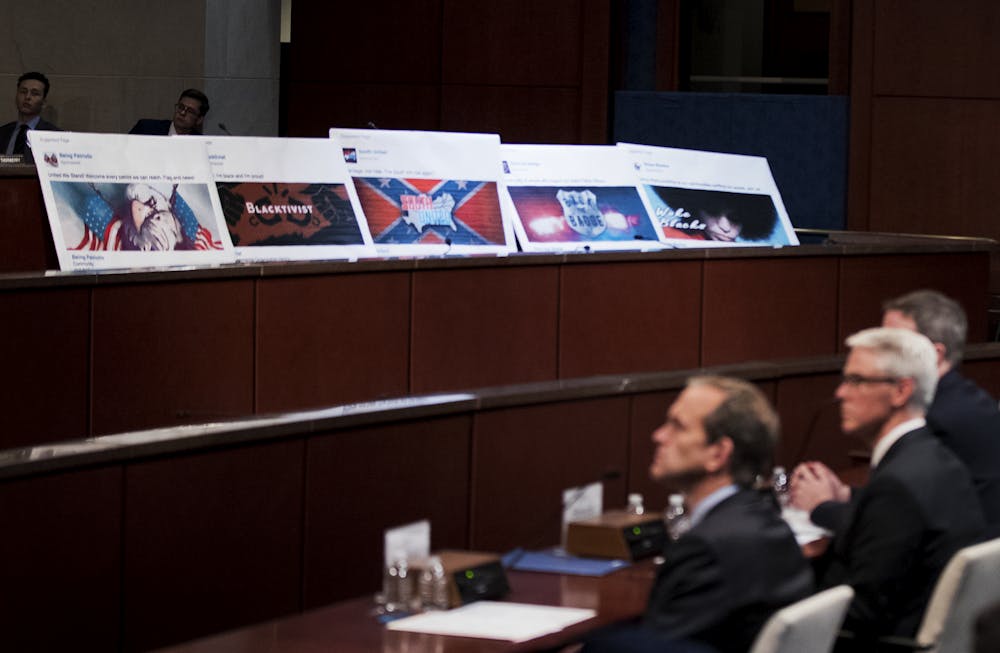
Facebook ads linked to a Russian effort to disrupt 
the American political process are displayed as 
representatives from Google, Facebook and Twitter 
testify before the House Intelligence Committee on Nov. 1. 
Manuel Balce Ceneta/AP Photo

The latter should be more than enough reason to reject calls for government censorship of fake news. After all, who’s to say a government that determines what’s “fake” won’t simply follow Trump’s lead, and suppress critical and truthful content under the guise that it’s fake?

Instead, social media networks could develop and implement algorithms for identifying and removing fake news by marshaling the same engines that spread fake news in the first place. These algorithms would not be administered by the government; rather, Facebook and other social media would be responsible.

Twitter has already made considerable progress flagging and removing accounts that spread Islamic State propaganda. There’s no reason to think that the same process can’t be applied to Russian bots seeking to inflame political discord and therein damage America’s political system.

Such self-regulation is in the best interest of these media companies. It would increase the confidence of their users in what they encounter online. It would also have the added benefit of keeping government regulators at bay.

In the end, the ultimate antidote to fake news and bots is the rationality of the human mind.
As John Milton famously urged in his “Areopagitica,” if you let truth and falsity fight it out in the marketplace of ideas, human rationality will most likely choose the truth. Regulating what can enter that marketplace could impair or destroy this process, by inadvertently keeping truth from public awareness.

Rational thinking’s ability to identify fake news is more than a Miltonian ideal: It’s been demonstrated in a carefully conducted 2015 experiment. When given a small financial incentive, the subjects were able to identify fake news as fake, even if the fake news supported the political views of the subjects.

Indeed, rationality is deeply implicit in democracy itself. You can’t have the latter without the former.
The Conversation

The key in combating fake news and kindred attacks on our body politic is to give our rationality maximum access to all information, including the truth. And in my view, this means resisting any attempts by government to limit the information that reaches us.

Paul Levinson, Professor of Communication and Media Studies, Fordham University

This article was originally published on The Conversation. Read the original article.

Friday, November 24, 2017

Why Net Neutrality Should Be Repealed

I think it's time to mention again why net neutrality should be repealed, and for that matter, the FCC should be put out of business. Both are violations of the First Amendment and its proscriptions on government regulation of media ("Congress shall make no law").

I've been making this point for a few years, already, but it never has had more relevance than in this day and age, with someone in the White House who would love carte blanche control over all media.

How much more evidence of the danger of government controlled media do we need?  Trump almost daily rants about how real media such as CNN are purveyors of "fake news," which, in Trump-speak, amounts to anything he finds unwelcome.  He just this week moved to prevent the merger of Time Warner and AT&T, unless Time Warner divested itself of CNN, which could well put the pioneering all-news cable network out of business, or at least hinder its operation.

The notion that if net neutrality is abolished, all of us will be prevented from reading and writing and watching what we want online is not true, anyway.  Everyone was doing just fine before net neutrality was adopted by the FCC just a few years ago, under Barack Obama's urging.  That was in June 2015.  Were any of deleterious consequences of no net neutrality - individuals or small companies being locked out of the Internet, or crippled by glacially slow service - in effect then?   They weren't, and that's because the anti-trust laws - collusion of huge corporations to the detriment of individuals - were in full effect, then, administered by the FTC (Federal Trade Commission, not unconstitutional like the FCC), and the FTC will continue to do that job if net neutrality is eliminated.

But even if net neutrality were desirable, the price we would pay by weakening the First Amendment would be far too high.  Our freedom of expression, and thereby our freedom, has never been under greater attack.  Now is the time to get keep governmental regulation as far away as possible from our essential media lifelines.   We shouldn't let the fact that Trump wants to do away with net neutrality blind us to the fact that such an action would be a good way of limiting his attempts to punish media not to his liking.


Monday, November 20, 2017

Why the Government Should Always Keep Its Hands Off Media

The news that the Trump administration is suing to block the merger of AT& T and Time Warner - presumably stemming from Trump's pique over CNN's truthful reporting of news about Trump, which he deems to be "fake news" (CNN has long been part of Time Warner) - is unsurprising, and sadly demonstrates a point I've been making for decades: the government should keep its hands entirely off media, including not bringing to bear anti-trust laws.

I was never much in favor of anti-trust laws, anyway - the marketplace is a better regulator of business than the government - but when applied to businesses that have nothing or not much to do with communication, they are not unconstitutional.   In the case of media, any attempt to regulate - whether its content, its corporate structure, any aspect of media - is a blatant violation of the First Amendment, and its provision that "Congress shall make no law ... abridging the freedom of speech, or of the press."

And even when well-intended, such anti-trust laws are unnecessary when applied to media.  As I argued in my 1998 article in The Industry Standard - "Leave Poor Microsoft Alone" (not my title) - all the handwringing over Microsoft dominating the personal computing industry back then was not needed, and ignorant of media evolution.   As I point out in my Human Replay: A Theory of the Evolution of Media, history has shown that we humans bend media to what we want as consumers, not what corporations may try to dictate.  And sure enough, as the hue-and-cry against Microsoft in the late 1990s was reaching a crescendo, Apple was already on the way to staging a comeback with their rehire of Steve Jobs - a comeback which reversed the dominance of Microsoft, and left Apple in the powerful position it still has today.

The bottom line of all this is the Founding Fathers were right in what they put in the First Amendment.  For democracy to function well, government should have zero control of media - zero, whether Trump, Clinton, Obama, anyone in between.  (Which, by the way, is why I'm also no fan of so-called net neutrality.)


Wednesday, July 5, 2017

What the Amelia Earhart History-Changing Photograph Says about the Power of Photography


I've been thinking all day about the newly uncovered photograph of Amelia Earhart and its upending of history, telling us she indeed survived that dive her plane apparently took into the Pacific Ocean in 1937.

We're told the photograph has not been altered - was found in a long-neglected file - and it coincides with what people who live in the Marshall Islands have long believed and having been saying. Experts have said her body proportions - from shoulder to hip - match photos we already have of Earhart.  That seems like more than enough for me to think this photograph has changed history.

But we already knew what the island inhabitants believed.  So the essence of this upending is that we believe the photograph is bonafide.  Were it not, it wouldn't matter what the experts said about the body dimensions, because all of that could have been deliberately woven into the photograph.

In this day and age of fake news, photo manipulation is a fact of life and media.   But that goes back to the very origins of photograph, as I explain in Fake News in Real Context.  Lincoln was a subject of photographic manipulation, during his life and after.

But the photo of Amelia Earhart, as far the experts tell us and therefore as far as we know, has not been manipulated.   Alteration of pre-digital photographs may not be as detectible as digital fakes, but, for the time being, I'm willing to believe the experts.

I won't be shocked if the photo turns out to be bogus.  But for now, I just love that 80 years of history has been changed by one registration on a photographic plate.  I've argued for years with critics who say a photo is no more real in the objects its captures than a painting.  But it obviously is.  Though it can be altered, its very essence is a capturing of what is in front of the camera as it actually is - unlike the painter's inextricably subjective vision - just like motion pictures and videos.  (See my 1997 book, The Soft Edge: A Natural History and Future of the Information Revolution, for more).   Today's news about Amelia Earhart, and the repercussions it has made for history, will from now on be the best example of this privileged relationship between photography and reality.


Sunday, May 7, 2017

Another Reason to Abolish the Unconstitutional FCC

I've called many times for the abolition of the FCC.  Its very existence is a blatant violation of the First Amendment, and its insistence that "Congress shall make no law ... abridging the freedom of speech, or of press".

And now we have another reason: the FCC plans to "investigate" Stephen Colbert's comment on The Late Show that Donald Trump is Vladimir Putin's "cock holster".

Over the years, there's has been general agreement, even among those who (wrongly) believe that some Federal regulation of communication is necessary, that political criticism, including satire and hyperbole, is precisely what the First Amendment was most intended and designed to protect.  How else can a democracy run, if comedians cannot take their best shots against government officials, including Presidents?   Does it matter in the slightest if such comedic sallies are crude or vulgar?  Of course not - crudity and vulgarity are ever in the eyes and ears of the beholder.   And the First Amendment makes no exceptions, period.

But we now have a President who, as evidenced in so many ways, is not interested in protecting our democracy and its democratic traditions.  We have a President who has denounced the New York Times and CNN as "fake news," due to their honest reporting of facts he does not like to see.  We have a President who is constitutionally illiterate - indeed, apparently illiterate in most uses of our language.

Should I be investigated because I wrote that?  If you believe that, then you're no better than Trump, and you have no understanding of democracy and its necessities.

We should not be surprised that the FCC in Trump's administration wants to go after a late-night comedian. But we should staunchly oppose that.  If ever there was a reason to abolish this unconstitutional agency, we have it now, before it becomes - in addition to all the damage it's done and attempted to do over the years - another weapon in Trump's hands.


Monday, March 27, 2017

Homeland 6.10: Fake News!

A scaldingly relevant episode 6.10 of Homeland tonight, with dialogue that was either prescient, overdubbed, or spoken in more recent realtime than usual for a TV series, in as much as Max point blank tells Carrie that O'Keefe is producing "fake news".  (Max's face is slightly off-screen, hence the overdub possibility.)

The fake news in question is the centerpiece of the episode.  We saw O'Keefe putting it together previously.  Its footage manipulated to look like the President-elect's son, killed in Afghanistan, was actually running away like a coward and was not a hero.   As such, this bears resemblances to what the GOP did to John Kerry with the notorious "swift boat" ads in the 2004 election, and Bowe Bergdahl's true story in Afghanistan, though the Kerry and Bergdahl stories have nothing else in common.

In Homeland, O'Keefe unleashes this caustic fake news at Dar's request, after the President-elect spurns his "advice" to appoint people to her cabinet who attacked her in the election, and tells him she intends to put his "ass in jail".   Not one to be bullied, Dar goes nuclear and launches O'Keefe.

In a sweet twist - though sweet is likely not the best word for this - Saul ends up being the only person who can help the President-elect now, courtesy of the video Max sent to Carrie, which shows O'Keefe and Dar talking.   This means Saul won't have to leave the country.

If I hadn't titled this review "Fake News," I might have gone for "The Education of the President-Elect," as she's certainly wised up now to what Dar is, and some of what's been going on.  She realizes that Dar is pulling Carrie's strings via Franny, and no doubt regrets that she didn't come to Carrie's aid when Carrie practically begged her for help.

Better late than never, and it will be fun to see Carrie, Saul, and the President-elect in an all-out war against the intelligence establishment on Homeland.  As to how this is reflected in the Trump administration - I'll leave that for another review.


And see also  Homeland on Showtime ... Homeland 1.8: Surprises ... Homeland Concludes First Season: Exceptional


Monday, March 20, 2017

Homeland 6.9: The Tide Begins to Turn

The tide finally began to turn - at least, a little - in tonight's riveting episode 6.9 of Homeland.

After weeks of things going from bad to worse for Saul, Carrie, and Peter, and Dar coming out on top, we finally get the Iranian guy leaving his phone on, as treacherous Dar turns him over to the Mossad as his payment for helping Dar.   Fortunately for our side, Carrie's at the other end of this open line, records what she's hearing, and this is enough to get the President-elect to see the truth about Dar - after she was about to hand him complete control of the CIA and who knows what else in her new administration.

And Peter, at top of his espionage game even though he's still physically disabled, pulls off the feat of getting Dar on the phone with the assassin who killed Astrid.   This puts Peter on the trail of this killer.

And, just for good measure, Max gets himself into O'Keefe's false-news purveying operation - which made me think, I sure wish we had someone like Max on the case vis-a-vis the combo of Russian hackers and right-wing zealots and Central European entrepreneurs all of whom had and still have a hand in spreading fake news and acrimony in reality, not in Homeland, in own country.

But not everything is going so well, especially not for Saul, who's future is now in the wringer with the Solicitor General telling the President-elect that the only way to get Dar is to bring him down for what happened in Berlin last year - the mess in which Saul is also implicated.

When Saul protests going down this road to Carrie, she's sympathetic, but tells Saul, next time don't schtupp a Russian mole, to which Saul, not missing a beat, replies, that's rich, coming from someone who did that to a suicide vest.   It was the best line of the evening, but Saul's quick rejoinder won't get him out of this - at least, not without Carrie fully on his side and with her head totally in the game.

Which means: should be some good episodes ahead.


And see also  Homeland on Showtime ... Homeland 1.8: Surprises ... Homeland Concludes First Season: Exceptional


InfiniteRegress.tv