
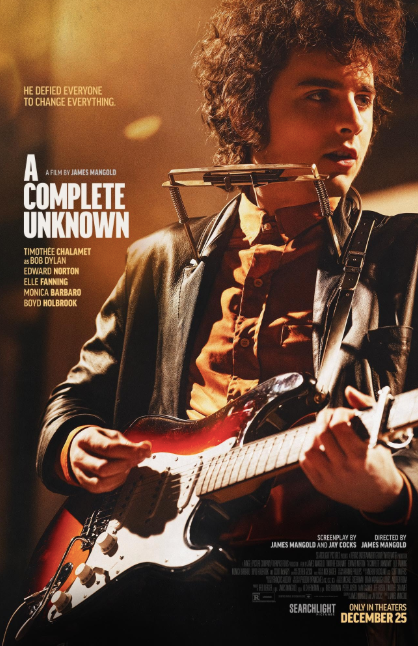
My wife and I just got back from seeing A Complete Unknown, the Bob Dylan biopic. We both loved it. The following is my take on the movie.
Dylan recently famously tweeted (on X) that Timothée Chalamet is "a brilliant actor so I’m sure he’s going to be completely believable as me. Or a younger me. Or some other me." Unsurprisingly, Dylan got it entirely right. Every biopic ever made is about someone inevitably a little or lot different from the subject of the movie. Not only can the actor not possibly look 100% like the subject -- unless they are the subject's identical twin, and the producer somehow managed to go back in time and talk the twin into playing the subject's part in the biopic -- but there's inevitably dialogue left out or changed, streets and buildings that don't look the same as the originals, etc, etc. Look, frankly, even a documentary is never entirely truthful. It may be more truthful than the biopic, but the director inevitably has to make easy and painful decisions to leave certain things out, etc, etc. In a phrase, all biopics and docu-dramas are alternate histories (and documentaries, too, just a little less so).
But A Complete Unknown is so good because it managed to get so many things right. Chalamet as Dylan and Edward Norton as Pete Seeger were letter and note perfect in the words they spoke, the songs they sang, and even what they looked like and how they moved. Monica Barbaro was not quite there singing as Joan Baez, whose rich mellifluous voice back then is unmatchable, but Barbaro hit all the notes well, and certainly captured Baez's attitude, energy, and intelligence with style. I don't know what Suze Rotolo at that age was like, even in video. She was inspiration for the part of Sylvie Russo in the movie, because Dylan (to his credit) in our current time didn't feel right about having her character by name in the movie, because she left the world in 2011 and couldn't give her consent to be portrayed in the movie -- but Elle Fanning did a fine job in the part. (The obvious explanation is Dylan wanted the name changed because some of the interactions with Dylan and Russo in the movie are at variance in some significant way with what really happened between Dylan and Rotolo.)
In addition to Dylan's songs, which were immensely enjoyable to see written, and see and hear performed, there was a symmetry, a kind of rhyme, in the movie, which I expect will stay with me for a long time. One of my favorite examples is Woody Guthrie's "So Long, It's Been Good to Know You". It starts off the movie, which begins in 1961, as Dylan comes to New York, and goes to see Woody Guthrie, who was already seriously ill (in reality, he'll live until 1967), and meets Pete Seeger (who had a wonderful cover of the song, solo, and earlier with The Weavers). At that point, it seems like the song is about Dylan and Seeger saying goodbye to Guthrie. But when the movie ends, with Dylan going the apostate electric way, the song is played again, and the goodbye is to the Dylan who has forsaken acoustic folk for an electric band with Al Cooper et al.
The title itself of this cinematic triumph underwent a transformative rhyme. Dylan is "a complete unknown" when he first crosses the Hudson and arrives in New York City and the movie begins. And of course the song that plays out the movie as Dylan commits to high voltage is "Like a Rolling Stone," in which "a complete unknown" is one of the many signature phrases.
The implication in the movie -- actually a little more than an implication -- is that Dylan did this because he wanted to be as famous as the Beatles. I don't know Dylan personally, and have no idea if that's true, but I do know that both kinds of Dylan -- "Blowing in the Wind," "The Times They Are A-Changin'," and "Masters of War" evolving into "Like a Rolling Stone," "Just Like A Woman," and "Positively Fourth Street" (I don't think the last two were in the movie) -- were equally works of genius in their own ways. And I also know, for whatever it's worth, that the lyrics Dylan wrote are in a class of their own, at the top of the best lyrics ever written, surpassing the timeless word-craft of Cole Porter, John Lennon and Paul McCartney.
There was one scene I found annoying in the movie. One of the highlights of the momentous Newport Folk Festival scene has Joan Baez singing "There But for Fortune," a huge hit for her, written by Phil Ochs. Dylan is shown offstage, not looking very happy. Maybe he's understandably nervous. Or maybe he's jealous. But the song isn't identified by Baez. And in fact there's no mention of Ochs anywhere in the movie. Whether an accidental oversight or a deliberate cut of something that was filmed ... who knows. It certainly doesn't make sense given the prominence of the song in that scene, not to tell the movie audience who wrote it.
I'm also sorry we didn't hear any of "God On Our Side" -- especially relevant on this day -- the most irrefutable anti-war song, pinpointing the hypocrisy and insanity of war, ever written.
But I guess that's just personal opinion, and I also think that, just like Dylan's songs, this movie will never grow old. It will be watched long into the future, after which people might watch Peter Jackson's documentary about The Beatles, and then Martin Scorsese's. But there's no need to wait for the future. My recommendation is see A Complete Unknown as soon as you can.
=============
One of the real people left out of the movie is Terri Thal, Dylan's first manager. Here's an interview Frank LoBuono did with her on his Being Frank podcast on May 30, 2024.
For more on the movie, see David Browne's piece in Rolling Stone.
=============


 I saw The Neon Demon - an original Amazon movie - late last night. It was listed as a thriller-horror - but that was enough to attract my interest, as well as short roles by Mad Men's Christina Hendricks and everyone's Keanu Reeves. I don't know if I'd call it either a thriller or a horror, though it had plenty of blood. Van Goughian nightmare might be a better label.