Chuck Todd interviews me about alternate histories
Showing posts with label Mary Shelley. Show all posts

Saturday, November 8, 2025

Frankenstein 2025: Unveiling the Real Monster


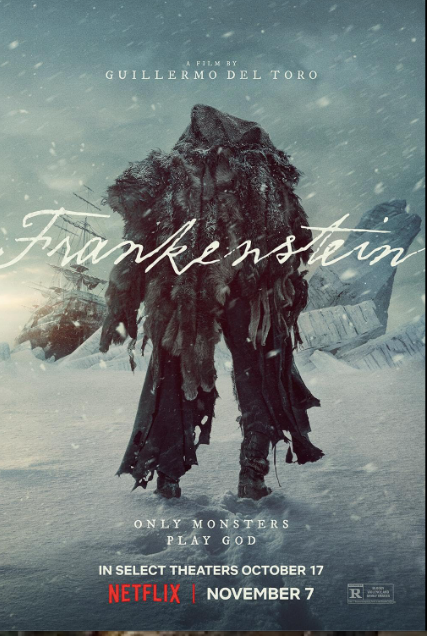
I just watched Guillermo del Toro's 2025 two-and-a-half hour take on Mary Shelley's 1818 Frankenstein on Netflix.  This year has been a great one for movies, and del Toro's Frankenstein continues that trend. 

Just about everyone knows something about this story, even if their main source of reference are the series of movies and remakes that were made in the 20th and 21st centuries, beginning in 1910 with Thomas Edison's 16-minute silent film .  Movie-making, of course, was primitive then, even in the one-hour talkie that really got the ball rolling in 1931, and these early Frankenstein movies almost seem cartoonish and comical. (There even was a 1948 Abbott and Costello Meet Frankenstein movie.)  After the first two talkies -- Frankenstein (1931) and The Bride of Frankenstein (1935) --  there was a very mixed resemblance to Shelley's novel in the thousand or so feature films, shorts, and TV appearances of Frankenstein's creation that followed, and to add insult to injury Mary Shelley's 75,000-word narrative has often been called a novella.  (I was President of the Science Fiction Writers of America 1998-2001, and SFWA has long defined a novella as 17,500-40,000 words).

The 2025 movie is masterfully filmed, making the movie both far more frightening and tender, at the same and different times, than any of the predecessors I've seen.  At times, the so-called monster seems more intensely human than most of the people around him, including the man who created him, and that makes his (the monster's) tale all the more memorable.  Although del Toro's movie has some differences with Shelley's novel, most notably in the ending, it feels as if Shelley was a consultant in the making of this movie.

One of the most impressive and important characteristics of Frankenstein's creation in Shelley's novel are the creation's nearly superpowers.  The exact reason for this is never quite explained, and the same is the case for the 2025 movie.  I'd always assumed it was the lightning, which not only jolted the stitched-together body parts into life, but literally energized the cells in the creation's body (actually, I really don't like calling him a monster) into a kind of durability verging on indestructibility.   I'm not sure if anyone else has made this point, but looked at in this way, Frankenstein's creation may well have inspired the creation of Superman.  Chances are the Jewish Golem inspired both.

The other aspect I really liked about the movie was the way it depicted the kindness and affinity Frankenstein's creation had for animals.  In Mary Shelley's novel he's an avowed vegetarian, and in del Toro's movie he's gentle with the creatures around him (unless they're wolves who are attacking him or the blind man).  The lesson here is that although he was created artificially (though the body parts and the lightning are certainly natural) he is indisputably a bonafide part of the greater natural world, maybe more so than his creator and his creator's (our) ilk.  We humans have to work hard at being a reliable citizen of the natural world.

And that may be the ultimate upshot of the novel and this movie, consistent with what has been remarked upon by readers and viewers for two centuries: the monster in this story -- if there is a monster -- is the creator not the creation.

===

Dedicated to the late Lisa Nocks, my student in the MA in Media Studies program at the New School for Social Research, then my teaching assistant at Fordham University, who wrote her Master's thesis on Frankenstein and a variety of articles on the subject including Frankenstein: in a Better Light


The novel is an expansion of the short story that won the Mary Shelley Award for Outstanding Fiction, 2023.  Get the novel here. Read the short story here, FREE.

Friday, September 25, 2020

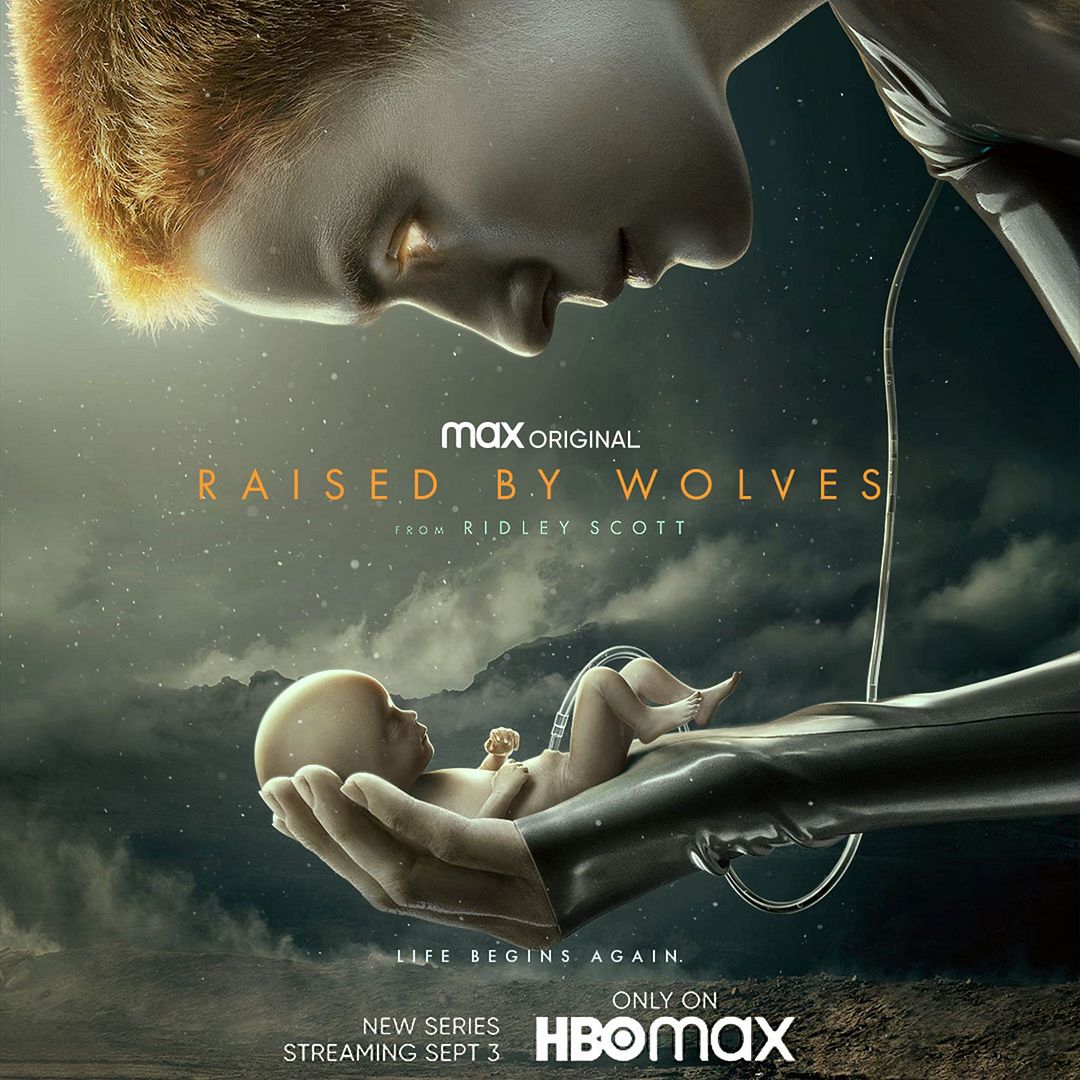
Raised by Wolves 1.8-9: Frankenstein and Motherhood

The story brought vividly home in Raised by Wolves 1.8 and 1.9, that androids can bear biological children, a hybrid of some sort of android and human, lifts this series into territory not even explored in a series as sophisticated as Westworld.   Of course, Westworld takes place on Earth, with a science a lot earlier in its development than what we see in Raised by Wolves, so I'm not criticizing Westworld on this account as much as noting the difference.  And that difference is about as profound as it gets.

A question I started addressing in the 1980s when I first began considering artificial intelligence was the connection between artificial intelligence and life.   Since the only intelligence that we know arose in living beings -- i.e.,  us, we humans - it struck me that an attempt to develop artificial intelligence truly worthy of the name without first understanding how intelligence arose out of our own DNA was "putting Descartes before the horse" (Mind at Large: Knowing in the Technological Age, 1988, p. 180; or see this if you don't want to read the book).   Yet most artificial intelligence, in science fiction as well as our real world laboratories, has proceeded on the basis of non-living circuitry.

In fiction, the monster created by Dr. Frankenstein -- colloquially known as Frankenstein, in Mary Shelley's 1818 novel of the same name -- can be considered the first modern android.  It is made of flesh and blood, and has a DNA-developed brain, so there is no reason he and his eventual almost-bride could not have had children -- indeed, it is Dr. Frankenstein fear of creating a species of monsters that gets him to abandon his project of giving the monster a mate.   Even in the Boris Karloff movies made over a century later, in which a bride of the monster is created, one catastrophe or another that befalls the "monsters" always preclude them from reproducing.  Which makes what was is happening in Raised by Wolves all the more remarkable.   

How exactly Mother, now on the way to being a completely biologically apt name for her, came to be impregnated is not completely clear, and she doesn't completely or even mostly understand herself.  She had virtual sex with her male human creator in a simulation.  Presumably this triggered a fetus that developed from what already was inside her, in contrast to the embryos that were implanted in her and we met in the first episode.

With only one more episode left this season, it will be fascinating to see where this -- "the future of humanity" -- goes.  It was good to see Father back to his senses, and all the children together, and Marcus get his comeuppance, though I hope he's not dead, he's too important and well-acted a character.  (It occurred to me as an outside possibly that possibly Marcus had sex with Mother at some point after he so nearly kissed her, that we didn't see.  Maybe that relates to that look on Mother's face that I talked about in my review last week.)   Not likely, I'll be definitely back here next week with some thoughts on the season finale.


See also Raised by Wolves 1.1: Fast Action and Deep Philosophy  ... Raised by Wolves 1.2-3: More than Meets the Eye ... Raised by Wolves 1.4-5: Halfway to Dune ...Raised by Wolves 1.6-7: The Look on Mother's Face


Monday, May 12, 2014

Penny Dreadful: Intelligent, Shocking, and Promising

Penny Dreadful, which debuted on Showtime last night, was quite good!

The setting is post-Jack-the-Ripper London - a newspapers headlines which asked "Is Jack Back?" made me want to say yes, in 24: Live Another Day - but this is a good time and place for a tense, exciting, harrowing story.   It's already being mined with the BBC's Ripper Street, which I found a little too talky.  In Penny Dreadful, there's so far plenty of gore and horror and full frontal male nudity to go along with the talk, and the talk is highly and scientifically intelligent.

At its best, we have Dr. Frankenstein (played by Harry Treadaway, first encountered on Showtime in Meadowlands), revealed as such as the end of the episode, explaining to Sir Malcolm why he has such contempt for knowledge pursued for its own sake.  This was a disquisition on behalf of technology, or the application of knowledge, in contrast to pure science, that was worthy of being published in a philosophy of technology journal somewhere.  (More about this issue in my 1988 book, Mind at Large: Knowing in the Technological Age.)

The acting is also outstanding.  Timothy Dalton as Sir Malcolm is brilliant, and Eva Green as Vanessa was compelling - her eyes stole every scene she was in.   It was also good to see Josh Hartnett on hand as a Buffalo Bill Cody kind of character, quick with the charm and the gun.

The plot looks promising - Malcolm assembling a team to find his daughter, who has apparently been taken by the evil beings in residence in the city.   The timing of the Frankenstein character is somewhat off - Mary Shelley's novel was first published in 1818 - but the character has become so iconic that he transcends the time of his creation.    And the "monster" - the assemblage of parts of dead bodies that Dr. Frankenstein brings to life - may not be such a monster, and in fact even smiles.

The next episode is on Showtime Anytime, and I'll no doubt watch it in the next few days, but I'll save the review for next week.


not quite as shocking, in the present day

#SFWApro

Monday, October 10, 2011

Boardwalk Empire 2.3: Frankenstein and Victrola

Nucky finally confronts Jimmy in Boardwalk Empire 4.3 - in Babbette's restaurant, where Nucky goes out to dinner with Margaret and another couple, and Jimmy is dining with the Commodore and the Governor.   The immediate cause of the confrontation - what gets Nucky to walk over to Jimmy's table, and throw the Commodore's plate of lobster thermidor on the floor - is Nucky's frustration at Margaret's ordering of the lobster, only to be told that the last dish with lobster had just been served a few minutes ago.  There ensues a great scene in which Nucky calls Jimmy on his shift in loyalties and Jimmy has to be restrained by the Commodore from getting physical.

The real source of Nucky's fury, of course, is the systematic attack on his livelihood being mounted by the Commodore and Jimmy.   Not only has he been thrown in jail and subject to investigation by the authorities, but his booze trade is in serious peril as the Coast Guard, now in the Commodore's pocket, is blocking Nucky's shipments from the sea.   Nucky even calls the Federal Attorney General - appointed by the corrupt President Harding whom Nucky helped get in office - only to be told that the Feds have no jurisdiction in state matters.

About the only bright spot for Nucky - other than Margaret - is the IRA leader's man Owen who is staying behind in America, and is eager to help Nucky.   Owen goes gun to gun with Richard, to stop a delivery of the Commodore's liquor, in another fine scene, in which neither man fires.  The two have a mutual respect, and it will be interesting to see how that plays out. 

Speaking of Richard, he's earlier referred to as "Frankenstein" by Al Capone, in town to give Nucky yet more bad news.  The reference was a bit of an anachronism - although the Mary Shelley novel was published a century before, and the character certainly famous in a literary sense, the movie that put the name of the Doctor and the face of the monster on the map was not made until 1931.  Thomas Edison had made a Frankenstein movie in 1910, and it was indeed made in his New Jersey studios, but it is highly unlike that Al Capone in the 1920s would have known anything about it.

Eddie Cantor and his rolling eyes were certainly around in the 1920s, and his visit to pregnant Lucy was a pleasure to see (and hear - great Eddie Cantor accent by Stephen DeRosa).  Lucy's story in this episode at least had something of a happy ending, as Van Alden buys her the VV-80 Victrola she's been yearning for.

And I'm yearning for the next episode of this fine period drama.

See also Boardwalk Empire 2.1: Politics in an Age Before YouTube  ... Boardwalk Empire 2.2: The Woman Behind the Throne

And see also Boardwalk Emipre on HBO ... Boardwalk Empire 1.2: Lines and Centers Power ... Boardwalk Empire 1.10: Arnold Rothstein, Media Theorist  ... Season One Finale of Boardwalk Empire


                 Special Discount Coupons for Angie's List, Avis, Budget Car, Garden.com, eMusic 


The Plot to Save Socrates


"challenging fun" - Entertainment Weekly

"a Da Vinci-esque thriller" - New York Daily News

"Sierra Waters is sexy as hell" - curled up with a good book


Enjoy listening to audio books? Get a free audio book copy of The Plot to Save Socrates - or any one of 85,000 other titles - with a 14-day trial membership at Audible.com ...


Sunday, October 5, 2008

Evolution of Science Fiction

Science fiction author Mike Brotherton re-posted this today, with some new text commentary: my 6+ minutes on the Evolution of Science Fiction from the 2002 History Channel special ... a whirlwind from Mary Shelley through the Golden Age through cyberpunk to the present ... with great pix including some scantily clad women from B movies thrown in ... (hey, I was just the narrator)...

Mike's post of the video, with his commentary ...

Or enjoy the vid right here...

Tuesday, February 5, 2008

The Sarah Connor Chronicles: 4: A Robot Primer

As the bad Terminator model inexorably gathers strength in Episode 4 of The Sarah Connor Chronicles, Sarah speaks of the Golem, and its relevance to her situation...

The Golem of Prague is a story of a 16th century rabbi who creates a human-like being from clay to protect the Jewish people. Various versions of the story have the golem doing its job, but sometimes turning on its creator and the people it was supposed to protect.

The Golem has become the template for every robot, android, or otherwise artificial being that has turned bad or against its creators. Mary Shelley's Frankenstein (1818) is the most famous. Rossum's Universal Robots - R.U.R. - appeared in Prague, of all places, in 1921. Karel Capek's play introduced the term "robots". They rebel against the human race and spell our demise.

Isaac Asimov struck a blow for the good robot with his "Three Laws of Robotics" in the 1940s. The First Law says a robot can never by action or inaction allow any harm to befall a human. Suffice to say that humans and robots in Asimov's worlds often manage to surmount this law and do all kinds of damage - which is why Asimov's robot stories are so riveting. (I recommend beginning with Asimov's first robot novel, The Caves of Steel, 1954.)

The Terminators embody all of these traditions. Sarah Connor's problem is that she needs beautiful Cameron, the good Terminator, to stop the bad Terminators from killing John in our present world. But if Sarah does this by preventing the Terminators from arising in the first place, then how will Cameron have been able to come back and help Sarah?

Time travels adds that additional delicious paradoxical element to the robot story.

See also: The Sarah Connor Chronicles 1 and 2 ... 3 ... 5 ... 6 ... 7 ... 8-9: Terminate with Puzzles, Surprises, and Soul


The Plot to Save Socrates


"challenging fun" - Entertainment Weekly

"a Da Vinci-esque thriller" - New York Daily News

"Sierra Waters is sexy as hell" - curled up with a good book


more about The Plot to Save Socrates...

Get your own at Profile Pitstop.com


Read the first chapter of The Plot to Save Socrates
.... FREE!

Thursday, October 11, 2007

Evolution of Science Fiction ... my 6-minute tour...


My infamous 6-minute tour on the history and evolution of science ... from The History Channel's 2002 Time Machine series...

From Mary Shelley through H. G. Wells, George Melies, Hugo Gernsback, Ray Bradbury, William Gibson ... I comment on all of them and more ... scientific romances, bug-eyed monsters, cyberpunk, and bio-tech science fiction ... with some really cool pictures as accompaniment...
InfiniteRegress.tv