Chuck Todd interviews me about alternate histories
Showing posts with label Phil Ochs. Show all posts

Monday, August 4, 2025

Podcast: Life & Death of a 20th Century Troubadour: Paul Levinson and Josh Meyrowitz about Phil Ochs


Welcome to Light On Light Though episode 414, the complete "radio documentary" on WFDU-FM from 1977 -- "Life & Death of a 20th Century Troubadour" -- in which Josh Meyrowitz and I discuss the life, death, and timeless impact of Phil Ochs and his music.


Check out this episode!

Sunday, March 2, 2025

Coming Soon: Complete 3-Hour "Life & Death of a 20th Century Troubadour" 1977 radio tribute to Phil Ochs (5-min Clip in this Post)


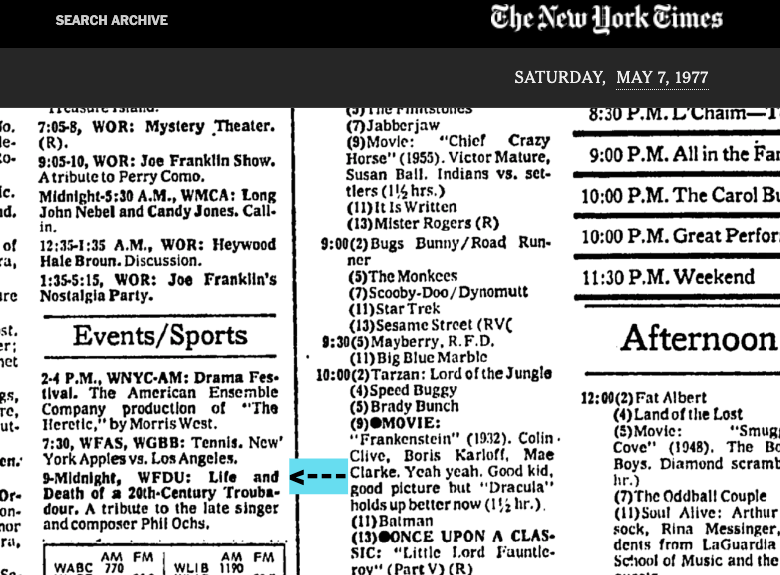
Joshua Meyrowitz and I did a three-hour special show back in 1977 on WFDU-FM Radio on Phil Ochs (a year after he died). Here’s its listing in The New York Times — Josh has found a tape recording of the entire show. I’ll have it up online soon, after we get it digitized. In the meantime, here's a 5-minute clip from the show (you'll hear my voice first):


Sunday, January 12, 2025

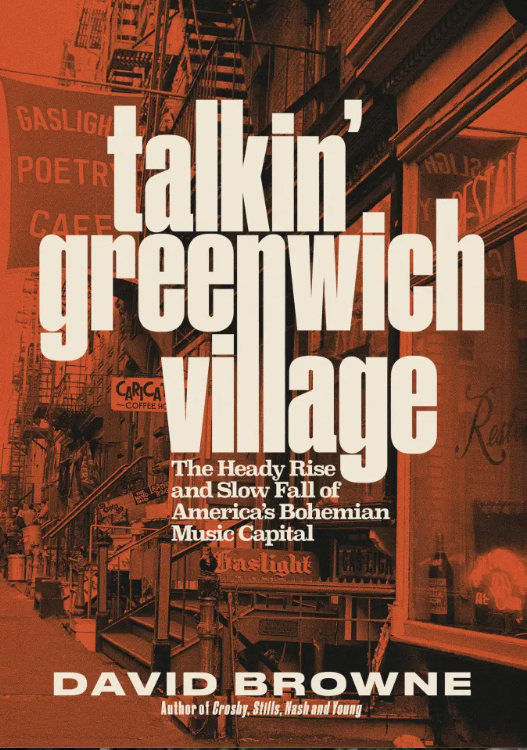
Review of David Browne's Talkin' Greenwich Village: Cornucopic Rainbow Biography


                                    more about the book here

If ever there was a time-travel ticket to a past and a place that you knew so well you could still see the sun glinting through the tree leaves, hear the din of the eateries as you walked by, and, most important, still hear the music that actually defied any given time or place, it would be David Browne's book, Talkin' Greenwich Village: The Heady Rise and Slow Fall of America's Bohemian Music Capital.  That's because Browne has a way of writing, an eye for detail, a penchant for commentary, that draws you in to fill the background you in one way or another actually experienced, or, what Marshall McLuhan called "cool".

Yeah, I sang doo-wop in Washington Square Park with my acapela group The Transits in the early 1960s, and then my folk-rock group The New Outlook a few years later (Ellie Greenwich and Mike Rashkow heard us uptown one Sunday afternoon in Central Park, and signed us to Atlantic Records, after changing our name to The Other Voices), but the way I really got to know the village was finishing up my BA in Journalism at NYU, then going a few blocks up to the New School for an M.A., then back to NYU for my PhD in the 1970s.  (I even managed to write three pieces for The Village Voice just before all that, my sum-total career as a music journalist.)

Turns out David Browne and I could have passed each other in the street -- David arrived to pursue his BA in Journalism at NYU in 1978, and I left, thankfully finished with school, in 1979 -- or bumped into each other going in and out of the diner southeast of the park.  But David stayed focused on the Village and its clubs and their music, to the present day, while I pursued music on the radio, MTV, iTunes, and anyplace I could hear it, and only came to the Village with my wife to eat in a great Italian restaurant near Houston Street, or go shopping at Balducci's.

And Talkin' Greenwich Village is one of the results of Browne's passion -- he's written more than half a dozen other books about popular music, and writes for Rolling Stone -- and delivers a cornucopia of vignettes, insights, and are what in effect mini reviews of dozens of artists.  You know, I always judge a book by how well it treats a subject I know something about.  My wife and I were/are devoted fans of Phil Ochs -- I consider his "The Crucification" right up there with the very best songs that Dylan wrote -- and Browne not only got everything right in his discussion of Ochs and his life in the Village (with an intermission in California) over the 1960s and 70s, until he took his own life the year my wife and I got married (we went to the Memorial Concert for Ochs that Browne also aptly describes), but I also learned something from his description of Ochs.  It's become hard-wired into Ochs's story that he was broken when Dylan did not include him in his Rolling Thunder tour.  But Browne provides a missing piece of the story, telling us how Ochs badgered Dylan, when Dylan was first beginning to put together the group that would tour.   Which means, it's not quite true that a callous or jealous Dylan simply didn't include Ochs on the tour.

But in addition to, I don't know, at least vignettes of 50 artists spread across 8 chapters and an Epilogue teeming with information -- Browne lists every interview he did for the book in its Bibliography -- he focuses on two artists, Dave Van Ronk, and the Roche Sisters (and, also of course, Bob Dylan), and makes them, in effect, centerpieces and guides to what Browne is telling us happened in these magical decades.  I only saw Van Ronk once (at the Phil Ochs 1976 Memorial  Concert at the Felt Forum) and the Roche Sisters only on YouTube.  But Browne's accounts of Van Ronk and of the Roches across the decades amount to mini but in-depth biographies of the two, and make Talkin' Greenwich Village irresistible reading just on their own.

But lest you think everything in this book is as serious as Ochs, or even Dylan, Browne also has a knack for the kind of detail that will make you chuckle, or even laugh out loud.  Seeking the name of a song on one of The Blues Project's just-recorded albums, the response to the person who's writing down the titles is "'What song? You mean Steve’s song?' To [Steve] Katz’s chagrin, 'Steves Song,' complete with a missing apostrophe, became the title."  Or, "when Orbison and Ronstadt huddled in his dressing room, [Jerry] Brown [then Ronstadt's boyfriend], waiting patiently outside, finally began pounding on the door: 'Let me in! I’m the governor of California!'''  Or, "the worst [performers in this Village venue] were booed or heckled. When asked if one contestant should be booted off the stage, [owner] Porco grumbled, 'No, I think we should shoot him.'”

Of course, no volume is perfect, and I'll tell you the one thing I missed in this New York Public Library of a book. I was a big fan of The Blues Project, and to this day I find myself humming or singing to myself "Cheryl's Going Home".  The song was written by Bob Lind (who wrote "Bright Elusive Butterfly of Love"), who does a pretty good job singing it.  But the Blues Project rendition, with those piercing guitar notes, and their interplay with organ, is something else.  Browne tells us almost as much about The Blues Project, Danny Kalb in particular, as he does about Van Ronk, the Roches, and Dylan.  But not a word about that elusive heart-breaker Cheryl.  I guess she was already home and out of sight.

But every page of this pulsating encyclopedia of whirling words is worth reading.  The fall of Greenwich Village and its clubs and taverns and whatever you want to call them brought tears to my eyes, because David Browne had made it seem like a beloved living organism, a mini gaia of music just several blocks long.  My only really lasting regret about this book is that it wasn't ten times longer.  As it was, it's 400 pages went by too quickly, because I just couldn't put the book down.

=========

Check back here at the end of the month for my upcoming interview with David Browne.

=========


                        in Kindlepaperback, and hardcover


Wednesday, December 25, 2024

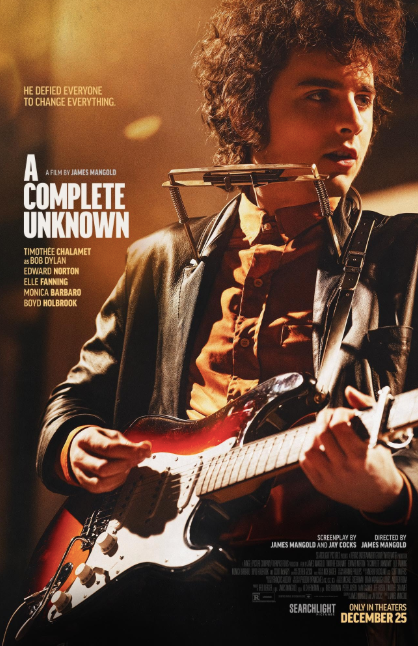
A Complete Unknown: A Nearly Completely Superb Bob Dylan Biopic, Slightly Alternate History


My wife and I just got back from seeing A Complete Unknown, the Bob Dylan biopic.  We both loved it.  The following is my take on the movie.

Dylan recently famously tweeted (on X) that Timothée Chalamet is "a brilliant actor so I’m sure he’s going to be completely believable as me. Or a younger me. Or some other me."  Unsurprisingly, Dylan got it entirely right.  Every biopic ever made is about someone inevitably a little or lot different from the subject of the movie.  Not only can the actor not possibly look 100% like the subject -- unless they are the subject's identical twin, and the producer somehow managed to go back in time and talk the twin into playing the subject's part in the biopic -- but there's inevitably dialogue left out or changed, streets and buildings that don't look the same as the originals, etc, etc.  Look, frankly, even a documentary is never entirely truthful.  It may be more truthful than the biopic, but the director inevitably has to make easy and painful decisions to leave certain things out, etc, etc.   In a phrase, all biopics and docu-dramas are alternate histories (and documentaries, too, just a little less so).

But A Complete Unknown is so good because it managed to get so many things right.  Chalamet as Dylan and Edward Norton as Pete Seeger were letter and note perfect in the words they spoke, the songs they sang, and even what they looked like and how they moved.  Monica Barbaro was not quite there singing as Joan Baez, whose rich mellifluous voice back then is unmatchable, but Barbaro hit all the notes well, and certainly captured Baez's attitude, energy, and intelligence with style.  I don't know what Suze Rotolo at that age was like, even in video. She was inspiration for the part of Sylvie Russo in the movie, because Dylan (to his credit) in our current time didn't feel right about having her character by name in the movie, because she left the world in 2011 and couldn't give her consent to be portrayed in the movie -- but Elle Fanning did a fine job in the part.  (The obvious explanation is Dylan wanted the name changed because some of the interactions with Dylan and Russo in the movie are at variance in some significant way with what really happened between Dylan and Rotolo.)

In addition to Dylan's songs, which were immensely enjoyable to see written, and see and hear performed, there was a symmetry, a kind of rhyme, in the movie, which I expect will stay with me for a long time.  One of my favorite examples is Woody Guthrie's "So Long, It's Been Good to Know You".  It starts off the movie, which begins in 1961, as Dylan comes to New York, and goes to see Woody Guthrie, who was already seriously ill (in reality, he'll live until 1967), and meets Pete Seeger (who had a wonderful cover of the song, solo, and earlier with The Weavers).  At that point, it seems like the song is about Dylan and Seeger saying goodbye to Guthrie.  But when the movie ends, with Dylan going the apostate electric way, the song is played again, and the goodbye is to the Dylan who has forsaken acoustic folk for an electric band with Al Cooper et al. 

The title itself of this cinematic triumph underwent a transformative rhyme.  Dylan is "a complete unknown" when he first crosses the Hudson and arrives in New York City and the movie begins.  And of course the song that plays out the movie as Dylan commits to high voltage is "Like a Rolling Stone," in which "a complete unknown" is one of the many signature phrases.

The implication in the movie -- actually a little more than an implication -- is that Dylan did this because he wanted to be as famous as the Beatles.  I don't know Dylan personally, and have no idea if that's true, but I do know that both kinds of Dylan -- "Blowing in the Wind," "The Times They Are A-Changin'," and "Masters of War" evolving into "Like a Rolling Stone," "Just Like A Woman," and "Positively Fourth Street" (I don't think the last two were in the movie) -- were equally works of genius in their own ways.  And I also know, for whatever it's worth, that the lyrics Dylan wrote are in a class of their own, at the top of the best lyrics ever written, surpassing the timeless word-craft of Cole Porter, John Lennon and Paul McCartney.

There was one scene I found annoying in the movie.  One of the highlights of the momentous Newport Folk Festival scene has Joan Baez singing "There But for Fortune," a huge hit for her, written by Phil Ochs.  Dylan is shown offstage, not looking very happy.  Maybe he's understandably nervous.  Or maybe he's jealous.  But the song isn't identified by Baez.  And in fact there's no mention of Ochs anywhere in the movie.  Whether an accidental oversight or a deliberate cut of something that was filmed ... who knows.  It certainly doesn't make sense given the prominence of the song in that scene, not to tell the movie audience who wrote it.

I'm also sorry we didn't hear any of "God On Our Side" -- especially relevant on this day -- the most irrefutable anti-war song, pinpointing the hypocrisy and insanity of war, ever written.

But I guess that's just personal opinion, and I also think that, just like Dylan's songs, this movie will never grow old.  It will be watched long into the future, after which people might watch Peter Jackson's documentary about The Beatles, and then Martin Scorsese's.  But there's no need to wait for the future.  My recommendation is see A Complete Unknown as soon as you can.

=============

One of the real people left out of the movie is Terri Thal, Dylan's first manager.  Here's an interview Frank LoBuono did with her on his Being Frank podcast on May 30, 2024.

For more on the movie, see David Browne's piece in Rolling Stone.

=============


I haven't written an alternate history as yet about Dylan, but here's one I wrote about The Beatles, in Kindlepaperback, and hardcover


I've always been partial to rhymes.  They're the velcro of the mind.
You can listen to my 1972 album on Bandcamp and Spotify.


The Weavers singing "So Long, It's Been Good to Know You"

Saturday, June 12, 2021

Podcast: Solar Eclipse, Politics, Online Learning, Origin of Covid, More


Welcome to Light On Light Through, Episode 181, in which "Captain" Phil Merkel interviews me about the recent solar eclipse, politics, Phil Ochs, online learning, origin of Covid, defense of Dr. Fauci, and much much more (including a shout-out to the Applebee's in Batavia, New York, near the end of the episode).


Check out this episode!

Monday, November 23, 2020

Dylan's Murder Most Foul: From Then to Now


I didn't think about November 22, 1963 much yesterday, as I usually do on one of the worst anniversaries of my and maybe your lifetime, because I was busy with all kinds of other things, including doing a little virtual concert at Philcon (a science fiction convention) of songs from my new album, Welcome Up: Songs of Space and Time, my first new album in almost 50 years.

But I was on my son Simon's Tumblr page today, scrolling back through his posts, and came upon this one from back in March.  The world has been so crazy since then and now, with Covid and the election, and I've been so immersed teaching online classes, writing, doing podcasts, and the like, that I didn't get a chance to listen to Dylan's "Murder Most Foul" until today.

It's the best Dylan lyric -- as in emotive power, tear up the street and rip up your soul, but maybe you can put it back together -- since, I don't know, "Hurricane"?  -- and, no, actually, "Murder Most Foul" is a lot more than that.  Because of its subject.  The story of our lives, or everyone's who was alive and cognizant in 1963 and all these years since.  The song is almost a couplet with Dylan's 2012 Roll On John, about another unfathomably unacceptable assassination, but a much shorter song, and almost a warm-up for "Murder Most Foul,"  which joins Phil Ochs' masterwork, The Crucifixion, as an extraordinarily insightful song about the event which in a single moment changed the course of history, inextricably and unalterably, for the worst. But "The Crucifixion" was at the moment, written back then.  And "Murder Most Foul" is about then, and now, and all time time in between.  About the end of the joy and innocence and optimism for the future that surged through the early 1960s, an extinction that the world has manifestly still not recovered from.   

I know I haven't.  I think about it often.  Even write about it in my science fiction.  It's reassuring that Dylan hasn't either. "Murder Most Foul" captures all of this and more with a lyric which, if you want to know where I'd place it, it would be among the best lyrics Dylan, the greatest lyricist of the 20th century, ever wrote. Plays upon words about playing songs and playing parts.  I may teach a course about this song someday. It even has a recondite reference to Daniel Keyes' "Flowers for Algernon," one of my all-time favorite science fiction stories.  But the killing of John F. Kennedy was too terrible to be fiction.  And Dylan caught it all.  In a gruff, plaintiff voice that floats halfway between speech and song, over a piano played by Fiona Apple that will pierce your heart.  And here in the 21st century, with a fifth of it almost gone, this song could well be one of the greatest of this century, too.

On a lesser but still significant note -- at least to me -- Dylan's song also scratches an itch I have had about songs about DJs that also goes back to the 1960s.  I even wrote a short story about that -- Sam's Requests -- and just a month or two ago created a Spotify songs-about-DJs playlist with that  theme.  Dylan's song eminently belongs there, containing a series of requests, that in some arcane, nearly endearingly inscrutable way reflect Dylan's commentary on the times, to Wolfman Jack, whom I actually worked with.  I just added Dylan's song to the playlist.  Yeah it belongs there, and in a permanent place in the thoughts of those of us who lived through that era-shattering day.

No, we never made it to the New Frontier, but we'll never stop trying.


                              a happier time

Further reading:


Bob Dylan sketch in Old Bear Studios

Saturday, May 30, 2020

Spaceship Earth: The Misunderstood Success


I don't often watch documentaries, and review them even less often, but Spaceship Earth is an exception, because it tells at least two highly significant stories: (1) the attempt to construct a totally self-contained environment or biosphere (Biosphere 2) on Earth, with human inhabitants, as a template for what could be sent out to our solar system and beyond in the future; and (2) the media misreporting of what Biosphere 2 accomplished.

The truth is that Biosphere 2 was unable to maintain total self-sufficiency.  At seventeen months into its two year 1991-1993 mission, oxygen was imported from the outside into the biosphere to combat the sharp reduction in oxygen from 20.9 to 14.2 percent of the biosphere atmosphere.  Obviously, this is not something that could have been done in the middle of a mission to Mars or anyplace off the Earth.  But the media were wrong to report this as evidence that the Biosphere 2 mission failed, or was some kind of publicity stunt rather than a scientific experience.  Apparently no one in the media read British philosopher Karl R. Popper (for example, The Logic of Scientific Discovery), and his widely accepted view that mistakes are the way that science learns and progresses.

The Hulu documentary, named after Buckminster Fuller's apt characterization of our planet as "spaceship Earth," does a fairly good job of reporting and assessing the above, relying on extensive current and historical in-situ interviews with most of the central players in the Biosphere project, including the Biosphereans themselves.   I know at least two people who provided support for Biosphere 2, Carl N. Hodges, an atmospheric physicist at the University of Arizona, who was not in the documentary, and Kathy Dyhr, Director of Public Affairs for Biosphere 2, who had a major role in the documentary.   I had long and riveting conversations with each of them in the mid-1980s, when Biosphere 2 was under planning and construction, and both were students at the Western Behavioral Sciences Institute pioneering online education program, where I was a faculty member and was first introduced to online education, which gave me the idea for Connected Education and which has become so important during our current Coronaviris pandemic.  These conversations, as well as my knowledge of how science works, and plain common sense, are what led me to conclude that the media assessment of Biosphere 2 was so wrong.

But why, then, did the media jump on the bandwagon of Biosphere 2 failure?  The documentary provides one of the two answers.  Steve Bannon - yes, that Steve Bannon - was brought in by financer Ed Bass to run the Biosphere managing company (Space Biosphere Ventures).  Apparently Bannon sought to make a name for himself by publicly and repeated denouncing the project (including destroying some of the crucially valuable data it had collected, according to the documentary).

The second reason is more endemic and intrinsic to the media and to us, its public.  As Phil Ochs pointed out so well in his song "The Crucifixion" (1966), we love to tear down, or see torn down, that which we have built up for adulation.  The idea that we could build here on Earth a habitat which with proper propulsion could take us to the stars was heady, intoxicating stuff.  When it failed to achieve that goal in at least one critically important way, the disappointment that resulted was enough for the media and many viewers to discard the entire project as an ambitious entertainment gambit that flopped.

But facts are stubborn things, and I expect the documentary to continue to bring the truth of Biosphere 2 out to the world and the future, which is that it was an important and major first step that taught us a lot about how we can get beyond this planet to the cosmo beyond.


Sunday, April 5, 2020

John G. McDaid: Found in Translation


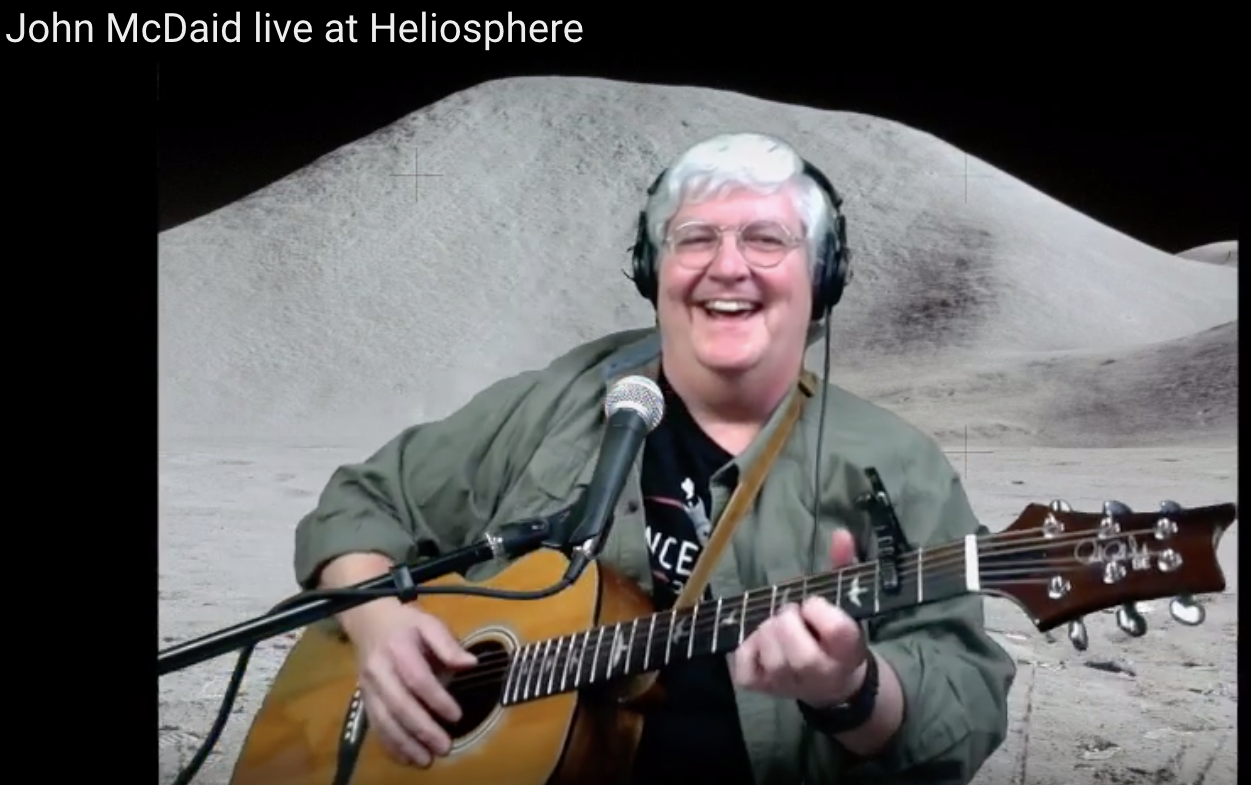
Let me introduce you to John G. McDaid.  He was my student in the MA in Media Studies Program at the New School for Social Research in New York City in the early 1980s.  I was delighted when his first professionally published science fiction story "Jigoku No Mokushiroku" (in Asimov's Science Fiction magazine) won the Sturgeon Award in 1995, right around the time one of my first published stories, "The Chronology Protection Case,"  in Asimov's older sister magazine, Analog, was nominated for the Nebula Award.   I was pleased when I began to see John start showing in Media Ecology Association conferences about a decade later, singing a variety of catchy songs.

But I had no idea, until John's Internet concert at HELIOsphere Beyond the Corona yesterday, about five hours before mine, what a superb songwriter and captivating singer John is.   What do I mean by superb songwriter?  Think Dylan, Phil Ochs, and a little Tom Lehrer humorous topicality thrown in.  His first song, "Lost in Translation" is one of my favorites, filled with Dylanesque rhymes, acerbity, and lines like "Mango Mussolini" (guess who that is).  Same for "Buy the Ticket".

But his next song, "Aaron Swartz," was really something.  Much in the tradition of Phil Ochs' "Joe Hill," McDaid tells the story of the Internet visionary and activist who was persecuted by Federal prosecutors to the point that he took his own life.   McDaid brings to this ballad a memorable mix of savvy, sensitivity, and anger.   His Tom Lehrer came out a song or two later, in "Check Out Time At The Owl Creek Hotel," in some of the lyric juxtapositions, and the song come to think of it also resonates with a combination of the Eagles' "Hotel California" and Netflix's Altered Carbon and its memorable character Poe.

I'm not going to say something about every song, because I want to leave you some surprises for the concert, which you can see and hear in its entirety below.  But I will say that "Love on the Moon" is some kind of masterpiece of angst and imagery, and itself worth the price of admission, which on Bandcamp is as much as you want it be.

Enjoy ...


Saturday, September 22, 2018

Joan Baez at the Beacon Theater


There are so many ways I could begin my review of Joan Baez's superb concert at the Beacon Theater tonight -
  • This is the second time in less than a week that Tina and I attended a farewell concert - Paul Simon's at the Prudential Center in Newark last week and Joan Baez's tonight.  In both cases, the concerts were so good that it's hard to believe these masters of music, voice, and lyrics are retiring from touring.  
  • Joan Baez, always current and trenchant, sang a powerful Woody Guthrie song about immigrants.   We couldn't help thinking about Joy Reed's interview of Jose Antonio Vargas at the Powerhouse Arena in Brooklyn Wednesday night.
  • One of Joan's last songs was Paul Simon's "The Boxer" - also one of the last encores that Paul Simon sang last week.  "I am leaving but the fighter still remains" was never more apt.
And all of those openers are valid.   And there is much more to be said about Joan Baez's concert tonight.  She said, after one song - a song her sister Mimi sang all the time - that it's hard to sing and cry at the same time.  At several times in the concert, I felt the same way about applauding and crying.  Especially after she sang Zoe Mulford's "The President Sang Amazing Grace".  (Yes, that's exactly what the song's about.)

Baez sang one of her masterpieces early on - "Diamonds and Rust," her parting reflection about Bob Dylan.  This was after opening the concert with a Dylan song.  She followed with a wonderful rendition of Phil Ochs' "There But For Fortune" - a lyricist who never received the recognition he deserved as someone right up there with Dylan.  And she sang several more Dylan songs, including the incomparable "A Hard Rain's A-Gonna Fall," which Baez linked to the state of the nation and world today.   After all these years, Joan Baez remains the best voice Dylan ever had.

And we do live in a world "where souls are forgotten," certainly by the White House and its minions.  Which means we need Joan Baez's voice more than ever.  I remain ever hopeful we can hear it again.

Tuesday, May 23, 2017

Review of Rob Sheffield's Dreaming the Beatles 1 of X: The Love Affair

I've always loved The Beatles.  First as a fan, always as a fan.  How much as a fan? Well, I was delighted to find a subscription to Sirius/XM  Radio in my new car, early this month, and I promptly tuned it to MSNBC. Until The Beatles channel checked in on May 18, and that's what I listen to when I'm driving now.  Even when I'm not driving - I just came in from my driveway, because I wanted to hear the end of "Baby You Can Drive My Car".  I'd probably still be there, if the urge to write this review had not been so strong.

Yeah, writing soon blended into my love of The Beatles.  First as a singer and songwriter, in the early 1960s through the early 1970s (produced at one point by Ellie Greenwich), and then as a writer of nonfiction and about two decades later of science fiction.  My first published article - "A Vote for McCartney" in The Village Voice in 1971 - took on the Voice's dyspeptic, tone-deaf critic Robert Christgau. who had savaged Paul's debut solo album, McCartney.  (Christgau had a habit of missing the forest - at some point, he also lashed out at Phil Ochs, a lyricist second only to Dylan, for his guitar playing).   My Loose Ends Saga - arguably my best-known science fiction (arguable in the sense that many people deny it) - has a time traveler faced with the choice of either saving John Lennon or stopping September 11.

So, I was primed to read Rob Sheffield's Dreaming the Beatles: The Love Story of One Band and the Whole World since 1963, but my son Simon, who edited at Rolling Stone and knows Sheffield, pushed me over the top this weekend when I was raving about The Beatles station.   My wife had already purchased the hardcover and the audiobook, and I knew I would love it - a perfect accompaniment to my own continuing love story with The Beatles.

Sheffield is a masterful writer on all kinds of levels.  He has a knack for spot-on record reviews in less than a sentence - noting "the brash aggression of 'And Your Bird Can Sing'" and "the hair-curling harmonies of 'I Don't Wanna Spoil the Party'".  He has an assumption that The Beatles were and are in a class by themselves, which, though it may seem obvious to true-believers, Sheffield turns into a galvanizing and even surprising organizing principle.  He has a photographic, watercolor eye, describing how Ringo's wife Maureen was  "freezing her ass off" on the roof in the Get Back concert in a way that makes you want to grab your coat and get your hat on a hot Spring day.

There's so much in this book, in fact, that I decided after reading just the first 11 pages, that it warranted more than a single review.  After all, The Beatles were and are about songs, which is a short form, but even if not, who says a book has to be reviewed all at once, in one big review?   So consider what you've been reading here as an introductory review, of just the Prelude and part of the next chapter of the book, and I'll be back with more, soon.   I'll likely have the whole book reviewed in the next weeks, maybe the next months.  It probably won't take years, but you never know.  (See my series of reviews of The Perversity of Things as an example of another series of reviews in progress.)

And that's it for now.  Get the book. (I'm sure I'll disagree with some of Sheffield's views but I disagree with some of everyone's except mine, and even I change my mind.)  I'm going to watch a little of MSNBC, and then get back in the car.

See also Dreaming the Beatles 2 of X: The Heroine with a Thousand Faces ... 3 of X: Dear Beatles ... 4 of X: Paradox George ... 5 of X: The Power of Yeah ... 6 of X: The Case for Ringo ... 7 of X: Anatomy of a Ride ... 8 of X: Rubber Soul on July 4 ... 9 of X: Covers ... 10 of X: I. A. Richards ... 11 of X: Underrated Revolver ... 12 of X: Sgt. Pepper ... 13 of X: Beatles vs. Stones ... 14 of X: Unending 60s ... 15 of X: Voting for McCartney, Again ... 16 of X: "I'm A Loser" ... 17 of X: The Split ... 18 of X: "Absolute Elsewhere... 19 of X: (Unnecessary but Brilliant) Defense of McCartney ... 20 of X: "All Things Must Pass" ... 21 of X: Resistance .. 22: The 70s Till the End ... 23: Near the Science Fiction Shop ... 24 of 24: The Last Two

And here's "It's Real Life" -- free alternate history short story about The Beatles, made into a radio play and audiobook and winner of The Mary Shelley Award 2023


Thursday, June 11, 2015

Bones Season 10 Finale: Rehearsals for Retirement?

Rehearsals for Retirement is the name of a great Phil Ochs' album - check it out some day, you'll see what I mean.  It could also have been title of tonight's season 10 finale of Bones.

In a nice twist, it turns out that Hodgins and Angela aren't leaving, but Booth and Bones are.  Or, at least, for the summer and likely some unknown period of narrative time on the series, perhaps most or all transpired before it resumes, since Bones is indeed slated to return in the Fall.

The story line of the two leaving does make sense, just as it did for Angela and Hodgins.  I mean, who wouldn't want to get away from dead bodies and  killers of various stripe, especially when you're parents of young children.   But there was always a suspension of this logic on Bones, even before Bones was married, because it's quite a stretch for a dyed-in-wool forensic anthropologist to actually get so hands-on involved in often literally bone-crushing murder cases.  She, after all, was not a coroner.  And yet she did, and it worked, beautifully.

And it still does. Which raises the question of why we may be seeing the rev up for its ultimate wind-down next season.   This is one of the intrinsic problems of all narratives.  Authors get tired and want to go do other things; same for producers; and networks don't like seeing the most minute decline in the ratings.  Never mind if the story still has juice and life.  In the end, the sad story is that all the stories we read and see on screens are not our stories - they are the creators', who have the ultimate power over the story's life and death.

I'm happy that Bones will be back next year.  It still, after all of these years, provides a unique story with unusual and memorable characters.   If I had a vote, it would never end.  But, hey, I'm just a fan, and if I want that kind of control the only chance I have of finding it is in my own writing.   So, I'll just be glad, for now, that we'll see our crew at work again in the Fall.

See also Bones 10.1: The Fulcrum Changes ... Bones 10.2: J. Edgar and the DNA Confession ... Bones 10.3: Meets Rush and a Dominatrix ... Bones 10.4: Brennan and Angela on a Bench in the Playground ... Bones 10.5: Two Jokes and Three Times ... Bones 10.6: A Thousand Cuts ... Bones 10.7: The A-Word and Quarks ... Bones 10.8: Daisy's Doula ... Bones 10.9: The Milgram Experiment and the Birds ... Bones 200: 10.10: Just like Bogey and Bacall ... Bones 10.11: Life after Death, and Sweets in Wonderland ...Bones 10.12: The Digital Revolution ... Bones 10.13: The Almost-Serial Killer ...Bones 10.14: meets La Parure ... Bones 10.15: Cards in Hand ...Bones 10.16: Hodgins' Money ... Bones 10.17-18: Bullies and Capital Punishment ... Bones 10.19: Do You Buy Booth's Gambling Addiction? ...Bones 10.20: Intimations of a New Jeffersonian ... Bones 10.21: Ten Years Isn't Enough

And see also Bones 9.1: The Sweet Misery of Love ... Bones 9.2: Bobcat, Identity Theft, and Sweets ... Bones 9.3 and NCIS 11.2: Sweets and Ziva ... Bones 9.4: Metaphysics of Death in a Television Series ... Bones 9.5: Val and Deep Blue ... Bones 9.6: The Wedding ... Bones 9.7: Watch Out, Buenos Aires ...Bones 9.8: The Bug in the Neck ... Bones 9.9: Friday Night Bones in the Courtroom ... Bones 9.10: Horse Pucky ... Bones 9.11: Angels in Equations ... Bones 9.12: Fingernails ... Bones 9.13: Meets Nashville, and Wendell ... Bones 9.14: "You Cannot Drink Your Glass Away" ... Bones 9.15: Hodgins' Brother and the Ripped Off Toe ... Bones 9.16: Lampreys, Professors, and Insurance Companies ... Bones 9.17: Spartacus in the Kitchen ... Bones 9.18: Meets Day of the Triffids ... Bones 9.19: The Cornucopic Urn ... Bones 9.20: Above the Law ... Bones 9.21: Freezing and Thawing ... Bones 9.22: Promotion ... Bones 9.23: The New Intern ... Bones Season 9 Finale: Upping the Ante

And see also Bones 8.1: Walk Like an Egyptian ... Bones 8.2 of Contention ... Bones 8.3: Not Rotting Behind a Desk  ... Bones 8.4: Slashing Tiger and Donald Trump ... Bones 8.5: Applesauce on Election Eve ... Bones 8.6: Election Day ... Bones 8.7: Dollops in the Sky with Diamonds ...Bones 8.8: The Talking Remains ... Bones 8.9: I Am A Camera ... Bones 8.10-11: Double Bones ...Bones 8.12: Face of Enigmatic Evil ... Bones 8.13: Two for the Price of One ... Bones 8.14: Real Life ... Bones 8.15: The Magic Bullet and the Be-Spontaneous Paradox ... Bones 8.16: Bitter-Sweet Sweets and Honest Finn ... Bones 8.17: "Not Time Share, Time Travel" ... Bones 8.18: Couples ... Bones 8.19: The Head in the Toilet ... Bones 8.20: On Camera ... Bones 8.21: Christine, Hot Sauce, and the Judge ... Bones 8.22: Musical-Chair Parents ... Bones 8.23: The Bluff ... Bones Season 8 Finale: Can't Buy the Last Few Minutes

And see also Bones 7.1: Almost Home Sweet Home ... Bones 7.2: The New Kid and the Fluke ...Bones 7.3: Lance Bond and Prince Charmington ... Bones 7.4: The Tush on the Xerox ... Bones 7.5: Sexy Vehicle ... Bones 7.6: The Reassembler ... Bones 7.7: Baby! ... Bones 7.8: Parents ...Bones 7.9: Tabitha's Salon ... Bones 7.10: Mobile ... Bones 7.11: Truffles and Max ... Bones 7.12: The Corpse is Hanson ... Bones Season 7 Finale: Suspect Bones

And see also Bones 6.1: The Linchpin ... Bones 6.2: Hannah and her Prospects ... Bones 6.3 at the Jersey Shore, Yo, and Plymouth Rock ... Bones 6.4 Sans Hannah ... Bones 6.5: Shot and Pretty ... Bones 6.6: Accidental Relations ... Bones 6.7:  Newman and "Death by Chocolate" ...Bones 6.8: Melted Bones ... Bones 6.9: Adelbert Ames, Jr. ... Bones 6.10: Reflections ... Bones 6.11: The End and the Beginning of a Mystery ... Bones 6.12 Meets Big Love ... Bones 6.13: The Marrying Kind ... Bones 6.14: Bones' Acting Ability ... Bones 6.15: "Lunch for the Palin Family" ...Bones 6.16: Stuck in an Elevator, Stuck in Times ... Bones 6.17: The 8th Pair of Feet ... Bones 6.18: The Wile E. Chupacabra ... Bones 6.19 Test Runs The Finder ... Bones 6.20: This Very Statement is a Lie ... Bones 6.21: Sensitive Bones ... Bones 6.22: Phoenix Love ... Bones Season 6 Finale: Beautiful

And see also Bones: Hilarity and Crime and Bones is Back For Season 5: What Is Love? and 5.2: Anonymous Donors and Pipes and 5.3: Bones in Amish Country and 5.4: Bones Meets Peyton Place and Desperate Housewives and Ancient Bones 5.5 and Bones 5.6: A Chicken in Every Viewer's Pot and Psychological Bones 5.7 and Bones 5.8: Booth's "Pops" and Bones 5.9 Meets Avatar and Videogamers ... Bad Santa, Heart-Warming Bones 5.10 ... Bones 5.11: Of UFOs, Bloggers, and Triangles ... Bones 5.12: A Famous Skeleton and Angela's Baby ... Love with Teeth on Bones 5.13 ... Faith vs. Science vs. Psychology in Bones 5.14 ... Page 187 in Bones 5.15 ...Bones 100: Two Deep Kisses and One Wild Relationship ... Bones 5.17: The Deadly Stars ...Bones Under Water in 5.18 ... Bones 5.19: Ergo Together ...  Bones 5.20: Ergo Together ... Bones 5.21: The Rarity of Happy Endings ... Bones Season 5 Finale: Eye and Evolution

#SFWApro


Neanderthal bones

InfiniteRegress.tv