Chuck Todd interviews me about alternate histories
Showing posts with label Hugo Weaving. Show all posts

Wednesday, December 22, 2021

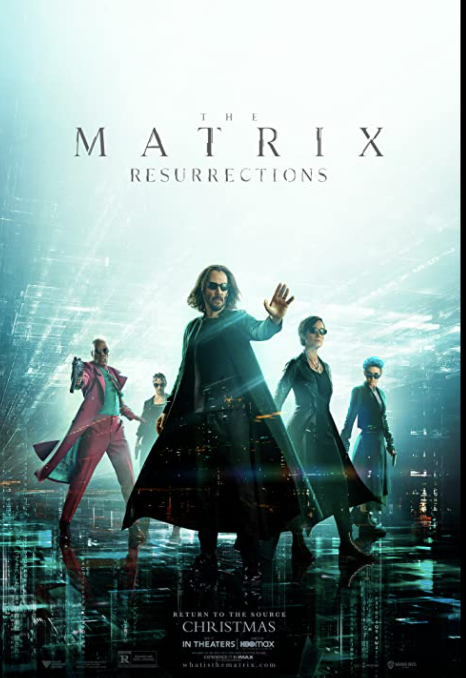
The Matrix Resurrections: Great Mix of Deep Philosophy and Fast-Moving Action


I just saw The Matrix Resurrections on HBO Max.  It may be the best Matrix since The Matrix -- that is, the first movie, so I'm saying Resurrections may be better than the two earlier sequels, certainly better than the third in the original trilogy, Revolutions.

One of the reasons I'm thinking this is how well the meta angle is handled in Resurrections.  We find Neo working as a programmer, whose great accomplishment was writing a computer game called "The Matrix".  He's sucked into a journey in which reality vs. fiction as an explanation for what is happening vie for our attention at every incandescent turn, and there are many of them.  

[Note: For once, or as a rarity, there WON'T be any big spoilers ahead ... ]

Let's talk about the acting.  Keanu Reeves as Neo and Carrie-Anne Moss as Trinity were excellent.  I was prepared to be annoyed at Yahya Abdul-Mateen II as Morpheus and Jonathan Groff as Smith, because their original incarnations by Laurence Fishburne and Hugo Weaving were so brilliantly, searingly memorable.   But the new actors for these crucial characters were quite good.  In the first three movies, Smith was for most part the more keenly acted and therefore more unforgettable character -- delivering such now immortal lines as, to Neo, "How can you speak if you have no mouth?" with perfect laser, razor precision --  and even though Groff is not quite as knife's edge as Weaving, his Smith will be somewhat memorable, too.

Among the new characters, by far my favorite was Neil Patrick Harris as The Analyst -- a big step up from Doogie Howser, MD but in a related medical profession -- and I very much liked the unpredictable villainous kindred relationship between him and Smith.  Both had a fair share of bon mots, and if I had to choose the most profound it would be The Analyst's observation that feelings make fictions real.  In addition to these lines that could have come from Plato -- who notoriously distrusted both feelings and art (see his Republic) -- we also get some good ultra-contemporary commentary from some of the characters.  I guess my favorite would be the Merovingian's, a returning character, who lashes out at both Facebook and Wikipedia in a tense, verge of bursting into action scene.  It's probably worth noting that Facebook didn't exist when we last saw Merv in Revolutions in 2003, and Wikipedia was just a tiny three years old, so his denunciation of these two social media giants is understandable, if not fair to Wikipedia, which has done far more good and much less damage than Facebook.

Without telling you anything more about the plot, I'll say it's plausible, exciting, and works well with its three predecessors.   The action and special effects were outstanding, as always, and the characters' awareness of the deep philosophic issues that underlie their exploits endows this movie with a refreshing intellectual heft.  I'd say The Matrix Resurrections is a triumph of a reboot, and one of the best now around in the burgeoning genre.





Sunday, August 25, 2019

Mortal Engines: Reasons to Praise It


I just saw Mortal Engines on HBO.  It was released here in the U. S. in December 2018, and received almost universal criticism from the usual group of myopic and tone-deaf self-appointed experts.  According to Wikipedia, "It was the biggest box-office bomb of 2018 (one of the 10 biggest of all time, as of August 2019)".

Unsurprisingly, I disagree - not with Wikipedia's statement of the movie's lack of success at the box-office, but with the critics.  In particular, I thought the Shrike story - the reanimated man and Hester - was one of the best of this kind.  The Shrike had a winning combination of insanity, obsessive violence, and tenderness, and Hester's love for him made a lot of sense, too.

And I liked Hugo Weaving's performance as the villain Valentine, whose character also made a lot of sense.  If you're going to be a power-mad conquerer, you might as well be consistent. That's certainly in tune with real-life current leaders who are not yet conquerers, but pretty clearly power-mad (as in Donald Trump).

One thing the movie did get its just recognition for was its special effects, which were indeed outstanding.   And the general ambience, a cross between Mad Max and Lord of the Rings, and suggestive of what James Blish's Cities in Flight might have been, had it been made into a movie, worked quite well, too.   (Peter Jackson was one of the main creative forces.)

But the sad thing about the combination of critical pans and poor box office is that it tends to put a kibosh on sequels.  I hope that Peter Jackson and others behind this powerful and entertaining movie ignore all of that, and get to work on the continuing the story (the movie comes from Philip Reeve's novel of the same name, and there are four in the series).  I'll certainly watch it, and even likely be able to talk my wife into seeing it on a big screen.


Wednesday, July 10, 2013

Cloud Atlas, Space Travel, and Souls

I saw Cloud Atlas tonight, and I must say my favorite part was at the very end, with its revelatory punchline about space travel.  This was not only satisfying but appropriate, because, after all, the movie does have "cloud" in its title.   Before the digital cloud there were and manifestly still are clouds above us in the real sky, and I take our capacity to get beyond them - now just to our solar system but someday far beyond - to be one of the most inspiring aspects of our existence and therefore of this movie.

There were other good things in the movie.   Speaking of digital, the neo-Seoul segment had lots of that, along with a powerful, exciting mini-story of clones and heroes that rang with the best of The Matrix, which is probably why the hero of this segment looked so much like Neo.

Speaking of which, Hugo Weaving played a major role in Cloud Atlas - actually, major roles, as did all of the major actors - and delivered some of his patented brilliant sheer evil, soulless bad guy, along with  a bad guy who may have turned to good guy in the neo-Seoul segment.   Tom Hanks also put in some fine performances, especially as the lead in the two farthest future segments, including the final one that finds his character along with Halle Berry's as grandparents on a planet far from Earth.   These two future segments also offered some fine future evolved English - I thought I heard the Hanks character say he needs to "cog" a situation, meaning he needs to understand it, for example - which gives Cloud Atlas a bit of Clockwork Orange resonance.

There was even some good comedy on hand in the final parts of the Cavendish segment - set in 2012 Britain - well played by Jim Broadbent and company.   Not every segment was too my liking, though.  For some reason, the music segment in 1936 Britain didn't ring as true as it should have, or maybe it's just that I'm not a big fan of suicide.   And although the 1848 segment had some moments, I found it slow going.

But all in all, Cloud Atlas deserves to be called a tour-de-force, not only because of the stories which were stunning, but because of the quiet way the lives all did seem to play - in the musical sense - so well together through history into the future.   This is no time travel movie, but that's ok.   Cloud Atlas tells us souls are inherently connected through time just by their very being.


#SFWApro

InfiniteRegress.tv