There was a science fiction story I read a long long time ago -- back in the late 1950s, I think, when as a kid I first began devouring science fiction -- "Enchanted Village" (1950) I think, by A. E. Van Vogt But I remember the story as as clear as day. An astronaut is stranded on a planet with a barely hospitable environment, and struggles to survive. He comes up with all sorts of strategies and fixes. [Spoiler follows for this story.] In the end, he's feeling great. But not because he's come up with ways to make the environment more comfortable for human life. He's in great shape because the environment has changed him into an alien life form happy as a clam in the hostile environment.
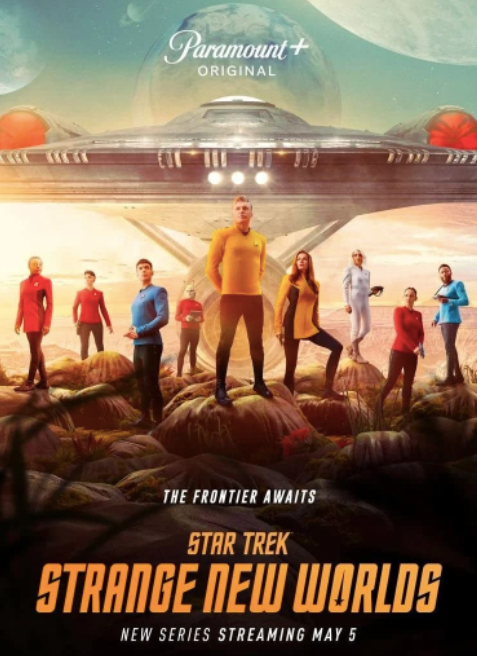
Strange New Worlds 1.3 does a fine job of recalling the essence of this story through the person of First Officer Chin-Riley, aka Number One.
[Spoilers follow...]
The Enterprise beams down a team to Illyria, a planet of humanoids who were outcasts in the Federation because they practiced genetic engineering. Before the episode is over, we learn that Number One is an Illyrian, and the centerpiece of their lives and explorations was to transform themselves not the planets they encountered. If you think about it, that's a pretty enlightened approach, certainly by our current environmental standards.
That story, in itself, would have been well worth watching. But we get more: we learn, at last, the backstory of Pike's Number One, as it was told to us in "The Cage" become "The Menagerie". And, while we're at it, we also learn that Security Chief La'an Noonien-Singh is a descendant of Khan Noonien-Singh! He was also a champion of genetic engineering -- which he unfortunately used for evil purposes -- which in turn is why the Federation took such a dim view of DNA re-arranging (in a nice historical tie-in to the Illyrian story).
Quite a story there, right? And just to round out a really stellar episode, we learn that Dr. M'Benga is keeping his critically ill daughter alive in transporter limbo. She's relatively fine, now, and he beams her into flesh and blood existence to visit with her, until he can somehow find a cure for her illness, maybe on some planet out there somewhere.
That's a great story, right there, in itself. This new series is just bursting with creativity about important issues, with sentient beings of all kinds striving for better lives. As I said last week, Star Trek: Strange New Worlds has the makings of a Star Trek series in league with TOS and TNG. After this third episode, I'm sure of it.
See you back here with my review of the next episode next week.
See also Star Trek: Strange New Worlds 1.1-1.2: Great Characters, Actors, Stories


 A common scenario in both science fiction and projections of what future science will do to help humans move out into the cosmos is terraforming: we use our technology to make an alien world more habitable, more comfortable, to humankind. This could include the moderating the temperature, increasing the oxygen, adjusting the gravity, that sort of thing.
