Chuck Todd interviews me about alternate histories
Showing posts with label Henry Ford. Show all posts

Tuesday, April 7, 2020

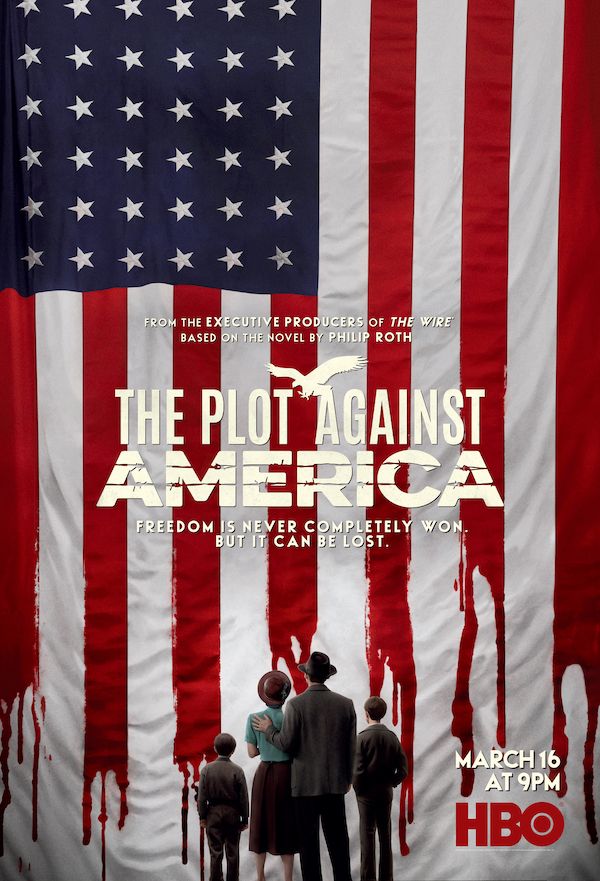
The Plot Against America 1.4: Close to Home


The Plot Against America 1.4 continued last night with its subtle and not-so-subtle indications of America moving towards a Nazi regime.

In many ways, I found the most chilling indication to be in the subtle category, barely more than a split second in Washington, DC, with President Lindbergh hosting German Nazi Foreign Minister von Ribbentrop.  Rabbi Lionel Bengelsdorf, sucking up to every Lindbergh sympathizer he can find, convinced that the alternate-history President is not an anti-semite, seeks a brief word or two with the President.  Lindbergh barely acknowledges the Rabbi, and walks away.  The only possible meaning of this is that Lindbergh does not want to be seen comfortably conversing with a Jew with such important leaders of the Third Reich around.  Bengelsdorf of course must know this, but he lies to himself and Evelyn and seeks a conversation with the Vice President and cabinet member Henry Ford.  The Rabbi gets not more than a few moments from the VP, and Evelyn gets a dose of invective anti-semitism from Ford.

It's tough to see who is in greater denial, the Rabbi or Evelyn.  After cursing out Ford, in Yiddish my grandmother would have been proud of, Evelyn accepts von Ribbentrop's invitation to dance, and certainly seems to be enjoying the dance.  Maybe she's putting on an act, but the fact that we can't be sure says it all about her and her external acceptance of Lindbergh, bordering on collaboration with the Nazis.

Back in New Jersey, the signs of the Nazi ascension in America are a lot less subtle.  Unsurprisingly in Philip Roth's vision, the FBI is a more-than-willing tool of Lindbergh and his vision.  My late father, shortly after he passed the bar and began to practice law, sought to join the FBI.  They turned him down - because he was Jewish, he always insisted an at least honest FBI guy told him.  I believed him, and still do.

If I'm giving the impression that this series hits close to home, that's exactly what it does.  The Plot Against America is an increasingly powerful piece of television, and more relevant than ever in this age.

See also The Plot Against America 1.1: Yet Another Alternate Nazi History, with Forshpeis ... The Plot Against 1.2: The 33rd President ... The Plot Against America 1.3: Corrosive Anti-Semitism


Sunday, October 8, 2017

Review of Doug Hill's Not So Fast: Worth Reading, Not Too Quicky

 photo Not So Fast_zpsdbrxn5pv.jpgI've had an advance reading copy on hand for quite some time of Doug Hill's Not So Fast: Thinking Twice about Technology, and I guess, given the title, who could object to my taking so long to read and review it?  But I've slowly been reading and reviewing two other books - Grant Wythoff's The Perversity of Things and Rob Sheffield's Dreaming the Beatles - and, anyway, now that I've finished Not So Fast, I can tell you two things about it:  I strongly disagree with its premise and just about every argument Hill makes in the book, and I recommend it.

Now, it's rare that I would recommend a book with which I disagree, but it happens.  Before I tell you why, let me tell you why I disagree with this book.   I'm a technological optimist.  Not because I'm ignorant of the many critics of technology Hill cites in his book, but because I've read them all and found them wanting.   The critic often thinks the optimist is ignorant, but the optimist can just as often be a critic of the critic.  In my case, though I don't preach the singularity or any kind of technological utopia, I think technologies help us fulfill our human goals on multiple levels.  I've been saying this since my doctoral dissertation, Human Replay: A Theory of the Evolution of Media (New York University, 1979), which was recently put up on Amazon.

Unfortunately, Hill overlooks the most reasonable pro-technological arguments, and relies instead on quasi-mystical futurists as his opponents.  And sometimes he misrepresents a seminal thinker such as Marshall McLuhan, for example, who didn't turn from pro-technology with the global village to critic of technology with discarnate man as Hill says.  McLuhan instead insisted that he never made value judgements, and indeed his global village had beds of roses with plenty of thorns.

So, why, then, am I recommending Hill's book?  Because I think it's important that we continue to discuss and strive to understand the nature and impact of technology, which is what Hill does in Not So Fast.  I also think it's important to draw into the discussion ancient philosophers such as Plato and Aristotle, and modern practitioners ranging from Edison and Ford to Steve Jobs.  (Indeed, I think touching base with such minds is so important that I frequently include them in my science fiction.)  It's also good to see outright critics of technology ranging from Jacques Ellul to Langdon Winner given such play, if only to offer avenues to students of all ages who are new to the game of fathoming technology.

But in the end, as the Nobel laureate biologist Sir Peter Medawar liked to say, what's most human about us is our technology, which means that to oppose it with a tone or implication of apocalypse amounts to despairing of the human condition itself.


Monday, January 16, 2017

Timeless 1.11: Edison, Ford, Morgan, Houdini, and Holmes (No, Not Sherlock)!

A crackerjack return of Timeless with episode 1.11 tonight, featuring our team at work at the 1893 Chicago World's Fair, and running into (in one way or another) Thomas Edison, Henry Ford, J. P. Morgan, Harry Houdini, and serial killer (though as is made clear several times, not known by that label then) H. H. Holmes.  And just for good measure there's a famous women from MIT, but I didn't catch her name.

Houdini has the most screen time, and it's put to good use, as he uses his budding talents to unlock a door to a room where two of our heroes are in peril, and lift a gun from the pocket of Flynn, now thoroughly a bad guy again, but at least consistent in his reasons.

There are lots of good scenes and glances, including the slight look from Lucy when Wyatt says goodbye to the MIT woman, with whom there is definitely a touch a chemistry.   The famous characters all look as they should, including Henry Ford, who looks much younger than we think of him, because he was indeed much younger back then, when he was working for Edison, and hadn't yet invented his first Ford.   (I'd show you some photos, but I have more television to watch tonight, and don't have the time to find and insert them.)

So our team, rent asunder back in ancient 2016, is now back together in 2017, though the ever-resourceful Flynn is tempting Wyatt to leave the fold.  And as we're just days away from Inauguration Day here in the United States, I can't help thinking, where is a time-travel team from the future when we need them?  Or who knows, maybe they were already here, and we're seeing the result...

See you here next week!

See also Timeless 1.1: Threading the Needle ... Timeless 1.2: Small Change, Big Payoffs ... Timeless 1.3: Judith Campbell ... Timeless 1.4: Skyfall and Weapon of Choice ... Timeless 1.5: and Quantum Leap ... Timeless 1.6: Watergate and Rittenhouse ... Timeless 1.7: Stranded! ... Timeless 1.8: Time and Space ... Timeless 1.9: The Kiss and The Key ... Timeless 1.10: The End in the Middle


Edison, Ford, and J. P Morgan play big roles in Chronica,
third novel in this time-travel trilogy

InfiniteRegress.tv