Chuck Todd interviews me about alternate histories
Showing posts with label Thomas Jefferson. Show all posts

Tuesday, October 1, 2024

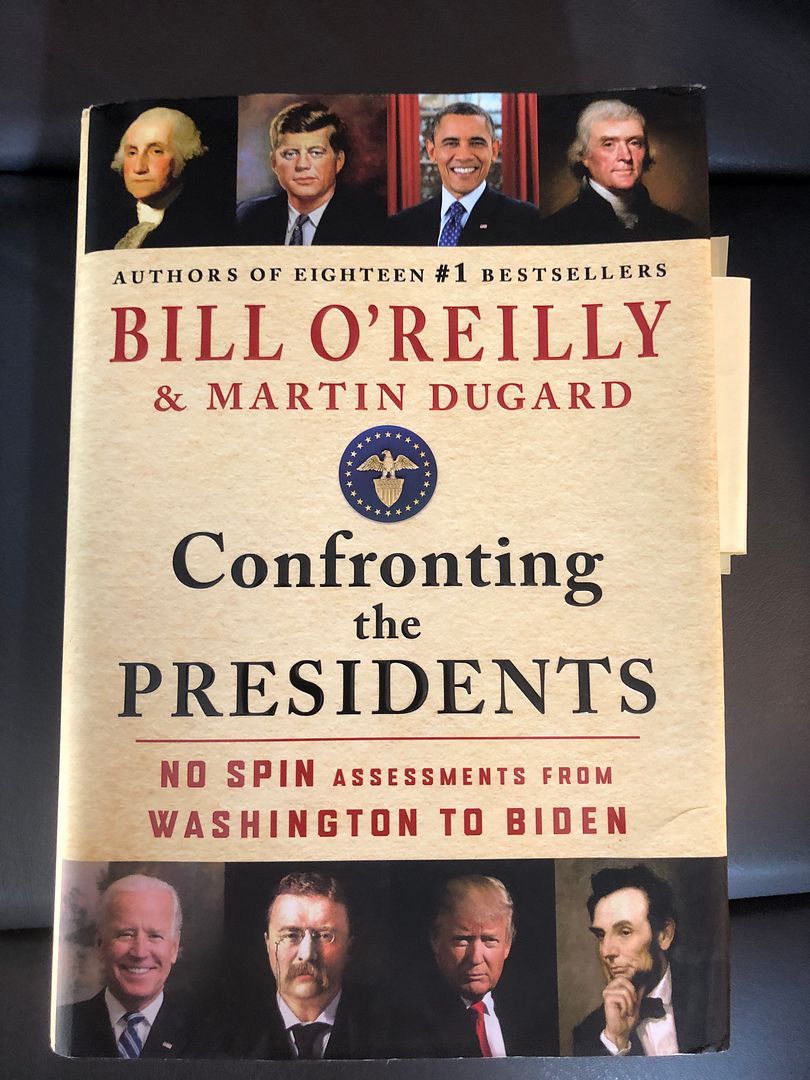
Confronting the Presidents: A Review of Bill O'Reilly and Martin Dugard's New Book


I started reading Bill O'Reilly and Martin Dugard's new 400+ page book on Friday.  I finished it last night -- Monday night.  That should give you an idea of how important and captivating Confronting the Presidents is. 

It is subtitled "No Spin Assessments from Washington to Biden".  But that obscures what the book actually is: assessments of US Presidents from Washington to Obama, co-written by O'Reilly and Dugard, followed by assessments of Trump and Biden written by O'Reilly, and assessments of Trump and Biden written by Dugard.  I'll explain near the end of this review why I think that distinction is crucial.

First, let me begin by saying I was on the O'Reilly's Fox show, The Factor, several times over 20 years ago (here's the video of my first appearance in January 2004), and four times on O'Reilly's No Spin News podcast several years ago.  We have strongly different political opinions, but I very much enjoyed our conversations.  O'Reilly has written numerous best-selling books, and O'Reilly and Dugard have a best-selling series (the "Killing" series about assassinations, attempted assassinations, killings of terrorists, etc), which I haven't read, but based on the writing in Confronting the Presidents, I expect that I eventually will, or at least read some of the books.

That writing is crisp, informative, and even exciting.   In part because most of it is in the present tense -- "At the start of Jefferson's second term, he is sixty-one years old.  He is no longer the young idealist...."  And in part because it has so many facts, big and little, that I didn't know and, after reading them in Confronting the Presidents, I think I should have known.  Like Theodore Roosevelt planning to run for a third term as president in 1919, before he died, and LBJ having a decades-long affair with Alice Glass, which Lady Bird knew about, and only ended when Alice left him because she was so furious about the Vietnam War.

We learn what each president ate for breakfast (right, I find that interesting), what kind of exercise they preferred, and how they died.  There's lots of humor in the book, but cradled in an underlying gravity and mortality.   And this is not because of what happened to Lincoln, Garfield, McKinley, and JFK, and almost happened to several others, but because as the authors make clear, the job of president, given the power to make one's dreams come true, is almost guaranteed not to be fulfilled, meaning your dreams will end up broken, their only chance being some future president may pick one up and carry it to victory in some more hospitable time.

Another salient point of history which I already knew as a media historian, and Confronting the Presidents makes abundantly clear, is that the intense polarization in our current world, (wrongly often blamed on social media, I would say), actually has been in the United States of America from the very beginning.  Editors of newspapers were prosecuted under the Alien and Sedition Act that John Adams signed into law, and O'Reilly and Dugard tell us that Alexander Hamilton wrote that Adams was "a mere old woman and unfit for president".

As a professor and lifelong student of communication and media studies, I was also glad to see that Confronting the Presidents notes that First Lady "Carrie" Harrison brought electricity to the White House but she and her husband Benjamin (1889-1893) were afraid of being electrocuted, radio began to have a big influence on politics in the 1920s, and of course TV took center stage in the 1960s.  (See my continually updated McLuhan in an Age of Social Media for how and when television gave way to the social media president.)

***

But this powerhouse book, brimming with fascinating, useful, and important information, concludes its confrontation of presidents with Barack Obama.   An "Afterword" briefly gives O'Reilly's and Dugard's assessments of Trump and Biden independently.  The reason for this change in format isn't given, but it must be because Trump's presidency may not be finished (he's currently running for a second term), and at the time the book was written, neither was Biden's (he had not yet withdrawn from the current election).

I'm making such a big deal about this because O'Reilly's assessments of Trump and Biden are the first in the book I strongly disagree with.  No mention is made of Trump's treatment of COVID, and the attack on the Capitol he instigated on January 6, 2021 is barely mentioned, as a political mistake, not the fundamental attack on our democracy that it was.  Even more incredibly, O'Reilly ranks Biden as the second worst president in American history (after James Buchanan).  

As I said at the beginning of this review, O'Reilly and I are on opposite sides of the political spectrum.  But I was nonetheless taken aback by what he said about Biden and didn't say about Trump because I found his joint assessments with Dugard about other progressive presidents like Obama and Clinton, and conservatives like Nixon, to be right on key.  

Obviously, Dugard was a moderating factor, and he had plenty to say in his own assessment of Trump about January 6, 2021 (because of this, he ranks Trump the worst president, one below Herbert Hoover).  Dugard also had some praise for Biden, and went so far as to say he hopes Biden wins in 2024 (the book was completed, again, before Biden withdrew from the race).

So what you'll get from Confronting the Presidents is a fair and balanced -- to use that Fox cliche -- assessment of every American President prior to Trump.  Then, for Trump and Biden, separate assessments from each author, which taken together accurately reflect the current polarization of this country.

I'm not sure what I would have suggested to the two authors prior to publication about how to conclude this book.  Maybe conclude with Obama with no Afterword.  Or maybe struggle to find some common ground as the authors did for every other president.  But I can say I recommend this book to anyone who'd like to have a handy, accessible guide to the people who have been at the top of our noble, imperfect experiment with democracy.


Saturday, October 22, 2016

Why Brexit and Waldo Won't Play as Trump in the U.S.

A lot of bitter-end Trumpists, clinging to any last hope they can find as their candidate goes under, cite Brexit as what will happen in the United States on Election Day.  If they were more literate, they might also find comfort in Black Mirror's science fiction episode, "The Waldo Moment," in which a cartoon character disrupts the political process in the U.K., and comes in second in a three-way heated campaign.   Indeed, Black Mirror creator and Waldo writer Charlie Booker has gone on record saying that Trump could well win.

Here's why I think not -

First, as far as Brexit is concerned, although the pro-Brexit "leave" vote was trailing the anti-Brexit "stay" vote in the lead-up to the U.K. referendum, the two were closer (just a few points in the polls) than Trump is now to Hillary Clinton in the United States (he's ten or more points behind in many states, including some swing states).

But those numbers aside, the electoral system in the U.K. is very different from what we have in the U.S.  In the U.K., everyone voted once, pro or against, Brexit.  The potential for surprise that goes against the polling is much greater in that kind of system than in the U.S., in which the Presidential election takes place months after the conclusion of a series of primaries.

Why is that important?  Well, not to be too cynical about it, but our U.S. system gives more people more time to come to their senses, and not vote their first impulses.   Indeed, Trump won the primaries because people were indeed voting their first impulses, which they didn't have all that much time to think over, and in the Republican Party were not all that antithetical to Trump in any case. But Americans including Republicans now have had lots of time to find out about Trump's treatment of women, his refusal to say he'll abide by the election results, and lots of other very disturbing factors not many people knew about during the primaries.

Nothing is impossible in elections.  But John Milton and Thomas Jefferson's belief that if truth is in the market place of ideas with all the falsity, sooner or later a majority of rational human beings will recognize it, seems to be at holding sway in the United States, where the truth about Trump has had time to get known.

We all have to vote, but I'm looking forward to watching Waldo where he belongs, not in the White House but on Black Mirror's darkly satirical television.


Wednesday, February 3, 2016

Why Money Doesn't Matter As Much As Some Think in Politics

I've been arguing for years about Citizens United - and its lack of baneful influence on our political system.  Which is to say -  I think that big money has not distorted or disrupted our elections or political process.

The best example, until now, has been the re-election of Barack Obama in 2012.  Big money did everything it could to stop him.  But it couldn't erase Romney's thoughtless comment about the "47%" not mattering, and the video recording of that comment likely helped him lose the election. YouTube beat big money.

This year, Bernie Sanders is doing pretty well - explicitly denouncing the role of money in politics provided by corporate giants.   Clearly, if that money were so unstoppable in its influence, Sanders wouldn't be where he is today.

And a statistic just released today shows another way in which money has had little if any lasting influence in the 2016 Presidential campaign thus far.  As indicated in the chart, shown earlier on MSNBC, Jeb Bush has far and away spent the most per vote received by any GOP candidate - which means he has spent the most amount of money, and received the last in return in voter support. Conversely, Trump has spend the least - and his low expenditures have given him a second place finish in Iowa in a crowed field.


Clearly, then, money is not a decisive factor.  Social media are apparently more decisive.  In Trump's case, his domination of Twitter brought him to second place (and the fact that it was second, not first, shows that social media have their limits, too -  see here for more).

I've always thought that, as John Milton and Thomas Jefferson pointed out, when truth and falsity are given access in the marketplace of ideas, people will recognize the truth and vote their self-interests. This is where social media find their limits, too - human rationality can recognize a lie, or bombast such as Trump's, whether presented in a high-cost ad or in a no-cost Tweet.  But the advent of social media means that, regardless of how much money may be spent to the contrary, someone, somewhere, will be able to express a fact or a view closer to the truth.   And with the mass media picking up more from social media, that fact will sooner or later be broadcast to millions.

Friday, November 14, 2014

The Unheralded Lesson of Mayor Butt's Election for Citizens United

It's always nice, and a fact crucial to the growth of our knowledge, when an event in the real world answers a hotly debated issue.   We got such a fact last week, when Tom Butt was elected Mayor of Richmond, California. He spent about $50,000 on a mostly door-to-door campaign.   In contrast, his opponent was financed to the tune of $3,000,000 by Chevron Oil in a massive media and advertising campaign.    Indeed, Chervon's spending like Goliath in this race had been cited by many progressive pundits as their worst nightmare come true about the Supreme Court's Citizens United decision in 2010, which held that corporations could contribute as much as they wanted in national elections, and the subsequent extension of this decision to local elections.

I'm a progressive, too, but I never had a problem with Citizens United, and in fact supported it as an important affirmation of the First Amendment, and its requirement that "Congress make no law ... abridging freedom of speech or press".   Opponents of Citizens United argue that the First Amendment protects the rights of people not corporations to communicate, and this set off a distracting discussion about whether corporations are people.   But that question misses the reality that communication is intrinsically a two-way street, with a receiver as well as a sender, and the First Amendment protects both parts of that equation from governmental interference or regulation.  What this means in plain English is that Americans have a right to receive information from anyone and everything - be it another person, a corporation, a bird chirping, a robot, or a tree falling in the forest. All of this comes under the public's right to know.

But what about the feared deleterious effect of big corporate spending on our elections, and therefore our democratic process?   I was never too concerned about that, either, because, like John Milton and Thomas Jefferson, I believe that human beings are fundamentally rational, able to separate truth from falsity, and make decisions that best serve their interests, most of the time.   And, indeed, I was glad that Barack Obama was re-elected in 2012 for at least two reasons.   First, as I said, I'm a progressive, and support most of his policies.   But, second, Obama's reelection showed that all the post-Citizens United spending on behalf of Republican candidates, including Romney, failed in its mission to unseat the President.

Still, one could argue that Obama is an anomaly, so charismatic a candidate that it didn't matter how much money his corporate-funded opponent - and already fabulously wealthy on his own - spent against Obama.   That's what makes the election of Mayor Butt so important. Impossibly overspent by Chevron Oil, Butt managed to win.    You could say Chrevon lost, with no ands, ifs, but a least one Butt about it.  (Ok, I had to be permitted at least one pun here.)

Progressives should be celebrating.  But I've seen little of that - at least, not for the right reasons. Rachel Maddow aptly cited Butt's election as a bright spot in the otherwise mostly grim election night last week.   But she failed to follow through on the logical import of Butt's election:  corporate spending need not buy elections.   Progressives can win, if we put up good candidates, who take courageous and clearly defined positions, and speak sense to the people.   Butt's election showed a packet of lies financed by millions of dollars loses to a statement of truth financed by just a sliver of that money.   In politics, money doesn't talk as loud as some thought.


Sunday, April 27, 2014

Chris Hayes on Showtime's Years of Living Dangerously Tonight

No one needs another show to watch on Sunday night these days.  In addition to Mad Men and Game of Thrones, which I watch and regularly review, there's also The Good Wife and Turn, which I watch and sometimes review, and Mr. Selfridge, which I watch and enjoy and usually don't review, because enough is enough.   On the other hand, to paraphrase the Victorian poet Robert Browning, one's reach on TV should exceed one's grasp, or what's a DVR for?   And Years of Living Dangerously, whose third episode is on tonight, is also On Demand.

I'm looking forward to Chris Hayes' contribution to this high-tech broadside on the need to wake up to the dangers of global warming.  Just to be clear, though I think Hayes is one of the brightest and most cogent voices on television, I don't agree with everything he says.  For example, I'm not too worried about the apocalypse to democracy thought to be engendered by Citizens United, seeing as how Obama - whom I voted for twice, and strongly support - handily won reelection in 2012, or two years after that much derided Supreme Court decision.   This confirms to me, once again, that Milton and Jefferson were right that people are inherently rational and vote their best interests - now in the 21st century, regardless of the mega-bucks spent on political advertising.

But Hayes and James Cameron and the all-star cast both in front of and behind the camera in Years of Living Dangerously are completely right that we need to do something about what is going on in the climate around us.   Look, even if all the evidence that the world is slowly heating up is wrong, wouldn't we be better off having some control over our climate and the temperature of the world?  To say, as do some Republicans, that the climate is in God's hands, misses the point that God or natural selection or whatever brought us here left us with minds and the capacity not to just accept the natural world around us but improve it, for us,  and most living denizens of this planet.   Surely, we're better off now than in ancient Rome, with its average lifespan of 20-30 years (45-47 for those who made it to the age of 10) - a result of science and medicine and its invention and application via human mentality.

The Scientific Revolution in the Renaissance was borne on the wings of the printing press (as I detail in The Soft Edge: A Natural History and Future of the Information Revolution).  Television in America, though it's had its moments with Nova and the original Carl Sagan Cosmos series and the reboot now on Fox, has by and large not risen to the task.   It's good to see Years of Living Dangerously and some of the best minds on the planet join the ranks.


Sunday, June 23, 2013

David Gregory vs. Glenn Greenwald: Lessons about So-Called Progressives

David Gregory asked Glenn Greenwald on Meet the Press today why Greenwald "shouldn't be charged with a crime" for publishing Edward Snowden's leaks about NSA snooping on American phone calls and Internet activities.   So this is how far we've come: a journalist doing precisely the job intended by the First Amendment, being a watchdog on the American government, is asked why he shouldn't be considered a criminal - and, most pathetically, by another so-called journalist.  John Adams, who signed the Alien and Sedition Acts that threw journalists into jail who criticized the President in the 1790s, would likely have approved of the question and answered it in the affirmative.  Thomas Jefferson no doubt would not.

But we shouldn't be surprised, and certainly not that this demonization of the press is going on in a Democratic, so-called progressive administration.   After all, Democrats as well as Republicans have sent our nation to war in Korea, Vietnam, Grenada, twice in Iraq, and once in Afghanistan, without the Declaration of War required by our Constitution.   We're on the road to doing that again in Syria.  And Democrats as well as Republicans have trampled on the First Amendment for almost a hundred years, fining radio and television stations for broadcasting "objectionable" content, and arresting reporters trying to do their job during Occupy Wall Street.

You have but to look at MSNBC, the so-called progressive voice, to see how far and badly we've come.   In prime time, only Rachel Maddow and Chris Hayes have been strongly and unambiguously supportive of Greenwald.  Lawrence O'Donnell, acknowledging the damage wiretapping did to Martin Luther King, Jr., says he's not too worried about the damage that can do today.   Chris Matthews is typically on all sides of this issue.

Only Ron Paul and Ran Paul - whom I wouldn't vote for because of their fiscal policies and positions on women's issues and immigration and other reasons - have come down hard on the right side of this issue.

Whatever happens, I hope no one votes for a Democrat as the lesser of two evils in the next election, because the evil they pose to our freedom and rights is too much to bear.   We can fight terrorists and totalitarians without becoming them ourselves.

See also The Fraudulent Hunt for Snowden

Wednesday, November 7, 2012

Lesson #2 of Obama's Victory: Money Can't Buy Elections

If meta-lesson #1 of Obama's historic victory last night is that statisticians like Nate Silver know what they're doing - see Hats Off to Nate Silver  - then lesson #2 is surely that money doesn't buy elections.

I've been making this point as soon as my progressive colleagues got into an uproar about the Citizens United decision.  So what if corporations could vent their spleens and bank accounts and hundreds of millions of dollars in backing their favorite candidates?  That wouldn't move me, in the slightest, to vote for them if I didn't already support them or their political positions.  Would it move you?

I think not.  Neither did Thomas Jefferson, who thought that as long as there was some truth out there in the playing field, human beings would be able to recognize it.  This came from Milton's Aeropagetica, and was a very profound and accurate view of human nature and mentality.  Applied to politics, it means that people can separate truth from falsity, and vote their self-interests.

Romney had an op-ed in The New York Times that said "Let Detroit Go Bankrupt".  True, he didn't write that headline, but neither did he howl in protest when the Times published his article that way.  And so, when he later denied that that was his intention - when he claimed he actually loved cars and wanted to save the American auto industry - anyone who was not already strongly in support of Romney, and was wearing blinders, saw right through that lie.   Jefferson and Milton called it right.  People, presented with a lie and the truth, saw through the lie.

The fulfillment of Jefferson's vision does not mean that money has no impact on elections.  It obviously can buy ads, and hire campaign workers.  But, in the end, as long as the truth is available in any corner of the country, it will get out.  Whether via a waiter who captures on his smartphone Romney's professed disdain for the 47%, or an op-ed in the New York Times, or Romney's statements all over the map, this way and that, about women's rights, the truth will come out.

So let the corps spend their money.   We don't need or want the government to regulate them or counter  their propaganda.  We can do it ourselves, jus fine, as we did last night.

Tuesday, March 6, 2012

Super Tuesday: Money Isn't Everythng in Politics

Mitt Romney outspent Rick Santorum better than ten to one in GOP primary states voting or caucusing today.   The result:  Santorum won in Tennessee, Oklahoma, and North Dakato;  Romney won in Massachussetts, Virginia, Vermont, and Idaho, and won by a whisker in Ohio.  And Gingrich, who also has spent much less than Romney, won big in Georgia.

Is this an example of money talks, everyone walks your way in voting booths across America?  Hardly.  Rather, these results show that people vote their hearts and minds, whatever media satuaration may say to the contrary.

Which I think is a very good thing, even though I would not vote for any of these candidates in any election.  But a defeat for money is a good thing for democracy in America.  I've been saying, ever since the outrcry against Citizens United, the Supreme Court decision which unleashed big spending and corporate financing of campaigns, that it's no big deal.   Because, as John Milton and Thomas Jefferson saw, as long as there's some truth in the field, no amount of falsity - in today's terms, false advertising - can drown it out.

Of course, people will differ on what they perceive to be truth.   I think the greater truth resides with the policies of Barack Obama as what America most needs.   But what we certainly don't need is a Presidential election determined by money, and  Romney's weak showing decisively says that's unlikely to happen.

Sunday, November 30, 2008

Excellent That Chris Matthews May Run for Senate

I just heard, again, on Wolf Blitzer's Late Edition on CNN, that MSNBC's Chris Matthews may run as a Democrat against Republican Arlen Specter for his Senate seat in Pennsylvania in 2010. Reports about this are flying all over the place.

I hope it's true. I live in New York, but I'd vote for Chris Matthews not only over Specter but just about anyone. I agree with most of Matthews' positions - his consistent opposition, from the beginning, to the war in Iraq, and his enthusiastic support of Obama are what most come to mind - but I also like the fact that, although he was once a Tip O'Neill staffer, and ran unsuccessfully for Congress in 1974, Chris Matthews is currently very much an outsider in politics.

We have long recognized that a life in politics is by no means a prerequisite for high office. Whatever we may think of Reagan and Schwarzenegger's governance - I certainly opposed a lot of Reagan's - there is no denying their effectiveness in office. Indeed, Renaissance men were among our leading Founding Fathers - in an age before xerox, Thomas Jefferson invented a way of automatically making a copy of a letter, as it was being written.

Matthews on television has been articulate and passionate. The main problem with his brand of Hardball is that he frequently interrupts and talks over his guests. That could be a big asset in the Senate.

Friday, October 10, 2008

Republican Suppression of Votes in Historical Context

America was founded amidst sharply different views of the democratic process. All of our Founding Fathers agreed with that we should be free of the British crown. But one group of Founding Fathers, led variously by John Adams, Alexander Hamilton, and George Washington, wanted to limit the people's power, in favor of a strong central government. In contrast, Thomas Jefferson, James Madison, and James Monroe saw tyranny, even in the form of an elected government, as the worst danger to our country, and wanted to limit the government's powers in favor of the people's, wherever possible.

The result was a profoundly mixed bag of government, with a House of Representatives elected by the people, and a Senate of appointed Senators. People voted for the electors who in turn selected the President. And the Bill of Rights was what Jefferson and his colleagues insisted upon as their price for agreeing to a strong central government.

The battle has continued, unabated, these past 200+ years. Adams and the Federalists disregarded the First Amendment in the Sedition Act of 1798, which Jefferson and the Democrats allowed to lapse when he took office in 1801. Senators are now elected by the people, but we still have an Electoral College.

Although Democratic and Republican Parties have both championed eras of reform in our history, it is pretty clear today that the Democrats are by and large more in tune with Jefferson and the Republicans with Adams.

That's why it is not surprising, but distressing, to see the Republicans doing what they can to limit and disqualify new voter registration. It's the same fear of the people the Federalists had. The Democrats are accused by Republicans of just the opposite - of giving people the right to vote when they don't meet formal qualifications.

Let's say, for argument sake, that both kinds of abuses have occurred - Republican attempts to prevent qualified voters from voting, Democratic attempts to get unqualified voters in the voting booth. Which poses the greater threat to democracy, which is the more serious abuse?

My guess is Thomas Jefferson would have said, in a democracy, err of the side of the people - when in doubt, let the people vote. I hope Democrats vigorously pursue this ideal, and don't let Republicans get away with voter suppression. We've come a long, long way in democratizing our country since 1789. Poor people, African-Americans, and women now have the right to vote. The election of 2008 is not the time to stop or go backward.

Sunday, September 28, 2008

Posting Financial Bailout Bill Online Big Step for Democracy

I just saw House Speaker Nancy Pelosi discuss some of the details of the Wall Street bailout bill - the one that most people think Senate and House Democrats and Senate Republicans will approve, but some House Republicans may not - and announce that the bill is available for everyone's scrutiny, the American people and well as elected Representatives and Senators, on the Web.

I want to take a moment to record the importance of posting this legislation on the Web. Regardless of what we may think of the bill - I think it's necessary to help the American people, to keep unemployment from burgeoning, etc - we are certainly taking a very significant step in democracy when such important, controversial, urgent legislation is so swiftly placed online for lawmakers and everyone else to see. (Bills are of course posted online all the time - but not with this speed, as they are almost literally being voted upon.)

Democracy has been intimately tied to modes of communication and dissemination of information ever since ancient Athens, and the view of its leaders that the best size for a direct democracy was no larger than the number of people who could gather in a stadium and hear a speaker, and each other speak. Our representative democracy in America was clearly created with newspapers as a bedrock - the reason that Jefferson thought a First Amendment and freedom of the press was so crucial.

Ever since the 1980s and the dawn of online communication, I and other media theorists have been urging that the Internet play a more crucial role in our democratic process. (See my The Soft Edge: A Natural History and Future of the Information Revolution and Digital McLuhan: A Guide to the Information Millennium.) Someday, we may well decide to have more of our decisions - such as this very bailout legislation - voted up or down by the people, via computer, not our representatives.

But in the meantime, the immediate putting of important legislation online for everyone to see is a big step in the right direction. The financial crisis is not good for America. But the placement of legislation that seeks to provide a remedy online for all to see certainly is.

PS - The bill is at financialservices.house.gov - but you may have trouble getting on the website to see it, since the site is being flooded with viewers. Whether in-person or online, congestion is always a problem.

Tuesday, September 2, 2008

St. Paul Police Trample First Amendment

Salon reported that well known journalist Amy Goodman of Democracy Now was arrested on the street in St. Paul, MN as she was attempting to cover the Republican convention, and charged with "conspiracy to riot." See the YouTube video below.

Goodman was objecting to the arrest of her producers Sharif Abdel Kouddous and Nicole Salazar, who had her nose bloodied by the police. Democracy Now later reported that all three were released, with charges still pending ...

But - when are Americans going to stand up and stop our police from abusing our journalists? The First and Fourteenth Amendment prohibit government officials of any kind from interfering with the work of the press - which means that the officers who arrested and (in the case of Salazar) brutalized these journalists are not only criminals but traitors, blatant violators of the Constitution, the Supreme Law of the Land.

In the darkest years of the 20th century - when Nazi Germany and the Soviet Union were riding high - America stood strong as a citadel and beacon of freedom. What has always separated democracies from dictatorships is the insistence in democracies that all points of view can be publicly expressed. Journalists, as Jefferson saw, are an essential part of this process.

I would like to think that the Republicans would be as outraged as Jefferson and anyone who believes in freedom about what happened in St. Paul today to Goodman, Kouddous, and Salazar.

I call upon the Republican Party to help bring those criminal police to justice.

Saturday, August 16, 2008

I'm a Progressive Libertarian

People often ask me how I would describe myself politically - actually, not so much people these days, as places such as Facebook, etc., when you're filling out their profiles. I don't like labels. But I've recently begun to list myself, when I can write in rather than a choose from a group of options, as a "progressive libertarian".

Here, for the blogospheric record, is why:

1. I'm a libertarian. I agree completely with Thomas Jefferson that the greatest threats to our freedom and well being come from government, democratically elected or not. Certainly Hitler and Stalin tragically proved that. I think the Constitution in general, and the Bill of Rights in particular, must be strictly adhered to. Of course, not all the Amendments are exactly the same in what their wording prohibits. The First Amendment's provision that "Congress shall make no law" abridging freedom of speech and press means just that - "no law," period - in contrast to the Second Amendment's provision that the right to bear arms "shall not be infringed," which I take as meaning laws regulating weapons are constitutional, as long as they do not "infringe" on lawful citizens who bear arms. The Fourteenth Amendment, and its provision that all limitations on the Federal government in the Constitution apply to the states, municipalities, etc., is also crucial.

So are other components of the Constitution. I believe it is ethically horrendous to send people to war without the Declaration of War required by the Constitution. The United States has gone to war that way in every war we have fought since World War II.

I also think that, in general, the government should keep its hands off commerce and business.* I disagreed with the anti-monopoly suits against Microsoft - why punish the organization most responsible for bring us the Web?

I want to see lower taxes for everyone, except millionaires and billionaires, whose taxes should be raised. Indeed, I'd recommend no income taxes at all for anyone or compay earning under a million dollars a year.

2. I'm a progressive. This means that I think some government activities are not only necessary but ethically mandated. I want the government to do all in its power to eradicate social injustice, and insure equal rights for women (including a woman's right to decide whether or not to become a mother), gays (including the right to marry), and all minorities and majorities. The government should also make sure that people have sufficient health care, and do not live in poverty. I also want the government to do what it can to support and stimulate science, research, and space exploration. Federal spending should be directed to all of these social, economic, and scientific imperatives.

Neither the Democratic nor the Republican Party has been too good on the libertarian issues in the 20th century. Neither is Barack Obama or John McCain.

But Obama is far more progressive than McCain. I voted for Obama in the New York primary, and will vote for him in November.

*Note added January 2, 2009: And what do I think is the best response of the government to the economic crisis that struck the United States in the Fall of 2008, and is getting worse at the beginning of 2009? Here is what I wrote in a comment, below, on December 29, 2008: "I see the government as an antibiotic: we're usually better off, when fighting infection, to let our body's immune system do the job. But if our lungs are filling with fluid from bacterial pneumonia, we'd better be taking antibiotics (=government intervention in the economy) soon." And I would emphasize that the antibiotic intervention should be as massive as possible, and the government should be ready to try a new course of antibiotics, as rapidly as possible, if the courses being administered do not work. And just as with any strong medication, once it has done its job, it should be withdrawn, in a careful, measured way, as soon as possible.

**Note added December 3, 2011:  See also A Progressive Libertarian in the Occupy Wall Street Age


13-minute podcast on this subject, which I recorded on January 2, 2009


Tuesday, July 8, 2008

Secret Service Owes America an Explanation for Violation of Librarian's 1st Amendment Rights at McCain Townhall Meeting

You've all likely read about this, and/or seen the video below (my student, Mike Plugh, first brought this to my attention):

A 60-year old librarian in Denver was carrying a sign with the message, McCain=Bush, as she waited to attend a McCain town hall meeting at the Denver Center for the Performing Arts (a public venue). Some guy in a beige jacket asks her to remove the sign. She refuses. An onlooker asks him why she's been asked to remove the sign. The beige jacket responds that he was "asked" to do this, "by representatives of the Secret Service." Soon after, a Denver policeman starts talking, and informs the librarian that she has two choices: keep the sign, and be issued a ticket for "trespass," or get rid of the sign, in which case she can continue to stand in line to attend the McCain town hall event. Carol Kreck, the brave librarian, takes the ticket. She's escorted off the public premises, and tells the camera that she's been told that, if she returns, she'll be arrested.

This is one of the most outrageous violations of the First Amendment I've seen in a long time. Not a case of allegedly indecent broadcasting, in which there is at least a confused (and unconstitutional) Federal Communications Act to back it up. Not a shield law issue, which, although profound in its threat to the First Amendment, is not a direct assault upon it.

No, this is about as straight-up an attack on the First Amendment as you can get - an attack on exactly what Jefferson and our Founding Fathers were protecting in the very First Amendment to our Constitution: the right of every citizen to express her or his political views, unobstructed by the government.

What's to be done?

1. The Secret Service owes America an explanation. If they indeed put the beige jacket and the Denver police up to harassing and preventing Ms. Kreck from exercising her First Amendment rights, then those in the Secret Service who did this should be fired and brought up on criminal charges.

2. If the beige jacket was lying, and was not told to do this by the Secret Service, then he should be brought up on harassment and other criminal charges.

3. The Denver police in either case were pathetic. If the Secret Service ordered them to harass Ms. Kreck, they should have refused to follow the order, and should be reprimanded for such ignorance of the First Amendment. If the Secret Service gave no such order, and they harassed Ms. Kreck on the basis of what the beige suit told them, then they should be fired.

It's time we started standing up for our rights.

Friday, June 13, 2008

Edward R. Murrow to Tim Russert

The outpouring of grief over Tim Russert's untimely death today, at age 58, shows both the high esteem and affection that Americans hold for television journalists who protect our interests as untiring champions of the First Amendment.

When Thomas Jefferson and our Founding Fathers made the press the crucial guardians of our government - the watchdogs whose job it was to report to the American people what their government was really up to - Jefferson must have the likes of Tim Russert, and his unceasing speaking of truth to power, in mind.

He was not only the moderator of Meet the Press since 1991 - by far the most memorable - but he was NBC News' Washington Bureau Chief. He was one of the few who spanned traditional network and cable news, with his CNBC/MSNBC interview show. And he made a great guest appearance on Homicide: Life On Street, playing himself as character Lt. Megan Russert's cousin.

There are less than a handful of television reporters and anchors who in their different ways defined their genre and their age. Edward R. Murrow, Walter Cronkite (who is still with us), and Tim Russert.

Friday, May 16, 2008

Obama Comes Back Tough and Eloquent Today on Bush/McCain

Barack Obama came out swinging today in a South Dakotan town hall meeting and subsequent press conference - tough, eloquent, intelligent response to Bush and McCain's slurs about Democratic "appeasement".

Among the highlights of what Obama said -

.The Bush administration, supported by McCain, is responsible for the strengthening of Iran - a consequence of the U.S. destruction of Iran's enemy, Iraq, and on the basis of weapons of mass destruction which were never found.

.American Presidents ranging from Kennedy to Nixon to Reagan were unafraid to sit down and talk with our enemies, because they understood that talk is not at all the same as appeasement.

.Hamas was strengthened by the Bush administration's pushing of elections in the Palestinian territories before those places were ready. And - it was McCain, not Obama, who called for talks with Hamas several years ago, before McCain adopted the Bush agenda.

.Obama also made a good, clarifying statement about the Second Amendment: he supports it, but also supports regulation of guns, which he sees as not in conflict with the Second Amendment. (I agree. Unlike the First Amendment, which says "Congress shall make no law" restricting press and speech, the Second Amendment says "the right of the people to keep and bear Arms, shall not be infringed". This means that regulation of guns is permissible under the Second Amendment, as long as that regulation does not infringe on the rights of law-abiding citizens to bear arms. In contrast, the First Amendment permits "no law" regulating speech of press. Obama didn't say all of this, but his position on the Second Amendment is consistent with it.)

.Obama challenged McCain to debate him about foreign policy, any time.

Such a debate will go a long way towards insuring Obama's substantial victory in November. Some parts of the world may indeed not yet be ready for Jeffersonian democracy, as Obama said today. But the United States surely is. Indeed, the time has never been better for presentation of rational arguments to counter the propaganda that has washed over our nation for nearly eight years - presentation of reason in response to distortion and misrepresentation, in response to McCain and Bush, as Obama did today.

Sunday, May 11, 2008

The Tudors and the Printing Press

Some wonderful, decisive moments in history have been brilliantly portrayed in the past few episodes of The Tudors on Showtime. I've currently seen 8 of the new season, thanks to Showtime On Demand.

My single favorite moment, being the media historian that I am, was Thomas Cromwell's introduction - to us as well as Archbishop Cranmer and George Boleyn - of a great "new weapon" for the Protestant reformers, in Episode 6: the printing press. This scene was right on in its portrayal of how monarchs such as Henry were able to harness the advantages of the press in their campaign to break free of Rome, and establish their national identities. (And James Frain superbly played Thomas Cromwell, as he does in every episode.)

As media historians such as Marshall McLuhan and Harold Innis explained back in the 1950s, and I elaborated upon in my 1997 The Soft Edge: A Natural History and Future of the Information Revolution, books printed in English and other national vernaculars in Europe helped crystallize a powerful sense of nationhood. Those few who were able to read were able to see words in their own languages rather than Latin. Public education arose primarily to teach children how to read. More and more people became literate, the Church weakened, and the rise of national states was off and running.

That, however, was only Part I of the story of monarchs and printers. In Part II, which we will not likely see this season, printers begin to break free of the monarchs, and print tracts and pamphlets that were critical of the monarchies. This led to crackdowns by the monarchs, and informed Thomas Jefferson and his insistence on a free press, and a First Amendment insuring it, in America.

Back on The Tudors, the other great moment of historical drama is the Pope's gradual declaration of cultural war on Henry VIII. You couldn't ask for a better actor than Peter O'Toole to play Pope Paul III, and his every word rings with resonance and almost cosmic authority. It won't be enough to overthrow Henry in England, but it's a pleasure to see on TV.


The Tudors
continues to be a feast for the historical intellect - and hey, the sex and romance and heartbreak are pretty good, too.

See also ...

Tooling Up for The Tudors and The Tudors: Transformations and Assassins ... John Adams Concludes, The Tudors Continues, The First Amendment Abides ... The Tudors Concludes and America Begins ...

and my reviews of all of last season's episodes, beginning here ...

and more on the printing press and the Protestant Reformation in my book, The Soft Edge ...

and ...


The Plot to Save Socrates


"challenging fun" - Entertainment Weekly

"a Da Vinci-esque thriller" - New York Daily News

"Sierra Waters is sexy as hell" - curled up with a good book


more about The Plot to Save Socrates...

Get your own at Profile Pitstop.com


Read the first chapter of The Plot to Save Socrates
.... FREE!

Wednesday, May 7, 2008

Obama Is Now Unbeatable for Democratic Nomination

A great night for anyone who loves to watch politics and election coverage on television - not to mention supporting Barack Obama.

Obama beat Clinton by 14% in North Carolina. Clinton won by a bare 2% in Indiana after a long, edge-of-your seat night which started with Clinton well ahead. These results will more than make up for the 12 delegates and popular vote lost by Obama in Pennsylvania. Obama will gain at least 15 delegates in North Carolina, and lose a total of 2 in Indiana - he'll be leading by at least 150 delegates again, and considerably closer to the finish line. With just a handful of primaries remaining, there's no chance for Hillary to overtake him.

These results show that Obama has indeed come back from the damage done to him by Rev. Wright. As he said in his victory speech in North Carolina tonight, he loves America. The people of North Carolina and Indiana, added together, believe him.

They also were responsive to his refusal to play games with our out-of-control gas prices. They approved of his rejection of the gas tax holiday gimmick, and his insistence on working for a real, long lasting solution. As Thomas Jefferson (also referenced in Obama's speech) believed, people are inherently rational, and can sort truth from false claims.

Hillary Clinton gave a good speech in Indiana, too. She ran an impressive campaign, even though she failed to capitalize on her momentum from Pennsylvania, and lost considerable ground. I continue to think that the best possible ticket for the Democrats would be Obama for President, and Clinton for VP.

But I think there's no doubt now that Obama will be the Democratic nominee for President. Tonight's impressive victory in North Carolina and near-victory in Indiana, added to the states and delegates and popular votes he has already won, make him unbeatable for the nomination.

He will also prevail over John McCain, the man of the past, in the Fall.

Sunday, April 27, 2008

Rev. Wright in Better Context in Bill Moyers PBS Interview

I just saw Bill Moyers' lengthy interview PBS interview with the Rev. Jeremiah Wright - Barack Obama's former paster, who has been the center of considerable controversy for his "God damn America" and other inflammatory statements.

I urge everyone to see it, because the sound bites that the media have presented, up until now, have taken Wright's comments seriously out of context.

Let's look at his "God damn America" sermon, as one example. Now, I think America is the most free country in the history of the world. Despite its many flaws, I feel happy and lucky to be living in the nation that Thomas Jefferson helped create. So those three words, taken on their own, were and are highly offensive to me.

But Rev. Wright did not say those just those three words in his sermon. He started that part of his sermon with a list of nations whose abuse of power, whose attempts to act like God, made them "fail". He mentioned Germany, Japan, Russia, and England (actually, the British Empire).

Then he got to America. He spoke of our massacre of Indians, our enslavement and auctioning of blacks, our enforcement of their poverty, poor education, second-class citizenship even after they were finally freed during the Civil War. And clearly, when you see that entire part of his speech, Rev. Wright is damning not America but those things that America did. And who would disagree with that? Who would say that there is not a crucial difference between America's finest ideals - "all men are created equal," as said in the Declaration of Independence - and the scourge of slavery and racism? Who would say that slavery and racism should not be damned?

Now, I might have put the phrasing a little differently were I making such a speech. I would have said slavery and racism are perversions of America, distortions of what is said in the Declaration of Independence, and God damn those destructive perversions of the beautiful American dream.

But that is nonetheless what Rev. Wright meant. That's clear when we see the whole passage and not just a clip.

The media, as a whole, have once again in this campaign done Americans a disservice by presenting small pieces of sermons out of context. Kudos for Bill Moyers and the Public Broadcasting Service for doing the right thing. As Jefferson the author of our Declaration of Independence foresaw, the free, open flow of information eventually brings out the truth.

PS added on Sunday (April 27) evening: I saw Rev. Wright's speech given to the NAACP in Detroit. I found it sage, inspiring, and highly entertaining.

Tuesday, April 15, 2008

John Adams on HBO: 6: Flawed President and Flawed Father

People sometimes ask me why I'm so critical of John Adams - the real person in history, not the superb HBO series - and the answer is the damage done to, and near death of, our democracy brought by the Alien and Sedition Acts, signed into law by Adams. This grim episode, and Jefferson's protest that these acts trampled on the Constitution, were vividly portrayed in this 90-minute episode that covered the whole of Adams' Presidency.

But the episode brought to light something equally lamentable about Adams - pertaining to his family not his country. Charles, the reprobate son, is disowned by John Adams. His son-in-law is turned away when in financial need. It's not that our culture was so different then. It's that John Adams could not overcome his stern New England upbringing, and give his son the love and emotional support, his son-in-law the economic support, that they needed. John Adams meted out punishment instead - just as he did to his country by jeopardizing the First Amendment and its protections.

It's a measure of how superb Paul Giamatti's performance is as John Adams, that we feel anything akin to sympathy for the second President and father at all. Giamatti is just perfect for summoning the pain and humanity that one hopes Adams felt for these actions. It convinced me enough that I called them "lamentable," rather than despicable, in the paragraph above.

As I've said in previous reviews of this series, this is history on television on an entirely new, breathtaking plane.

The series concludes with the next episode.

How about a series about Thomas Jefferson, played by the outstanding Stephen Dillane.

See also: John Adams on HBO: Good Founding Father, Bad President ... John Adams 3 and 4: Jefferson and Space Travel of the Soul ... 5. Jousting of Ideas ... John Adams Concludes

Further reading ...

The Flouting of the First Amendment - my 2005 Keynote Address at Fordham University, in which I talk about the vying opinions of John Adams v. Thomas Jefferson...

The Soft Edge: A Natural History and the Future of the Information Revolution - my 1998 book, with more details on this time in history, and the roles of Adams and Jefferson

And ...

InfiniteRegress.tv