Chuck Todd interviews me about alternate histories
Showing posts with label Shtisel. Show all posts

Tuesday, March 3, 2026

Tehran: Did the TV Series Trigger Trump To Do the Bombing?

In a feat of perfect timing, I finished watching the third season of Tehran the night before Trump announced the joint Israeli-US attack on Iran.   We know that Trump watches a lot of TV, and is very much influenced by it, choosing cabinet members based on their performances on cable news shows.  I wonder to what extent his ultimate decision to attack Iran was based on his viewing of the series named Tehran?

First, let me say that I saw all three seasons of the series in the past few weeks, and talked my wife into watching it, too.  It's an excellent series, which started out very well, and just got better and better. Apple TV+ and the Israeli TV broadcaster KAN 11 are part of the production team, and Tehran indeed has a lot of the flavor, power, and feel of Fauda, which is also an Israeli production.  It was also good to see Sasson Gabai back in action in Tehran, after his success in a very different kind of role in Shtisel.

The essence of Tehran is what kind of military back-up will Israel give its Mossad agents who are already widely embedded in Iran.  In the third season, in particular, we find agent Tamar Rabinyan (very well played by Niv Sultan) struggling to stop Iran from finally creating a nuclear weapon -- struggling to do this before Israel bombs the site, which would release damaging radiation (not as bad as a nuclear explosion, of course, but the "dirty" explosion would engender serious health risks).  All of this occurs as Iran is literally on the edge of developing nuclear weapons.

Was Trump watching this thrilling series, and that's what led him to make the decision to bomb Iran?  Well, the edge-of-your-seat season 3 finale of Tehran the series was aired on February 27, and the US started bombing Tehran the city on February 28.


Monday, March 29, 2021

Sunday, March 28, 2021

Shtisel 3: Cheesecake and Faith


The wife (froi) and I binge watched the third season of Shtisel on Netflix -- hey, it debuted on my birthday, March 25.  And, I was delighted to find, these nine new, long-awaited episodes also had a shout-out for me, with a fairly major family named Levinson.  Thank you, Shtisel!

And these episodes were immensely enjoyable!

[Spoilers hollow.]

Especially the ending, which had more happy endings than I've ever seen in a series before.  Kiva defies his father and goes to live with his wife Racheli.   Yosa'le defies his mother and says he will marry Shira Levi (not Shira Levinson, but I'm very happy for Yosa'le anyway).  Shulem may be able to reconcile with his brother. And, most important, Ruchama and her baby are both fine -- their faith beat the thousand-to-one odds.  With so many unhappy endings in our real world -- with Trump's defeat being a remarkable exception, a blessing! -- it was gratifying and timely indeed to see so much happiness at the end of Shtisel.

The language, the Yiddish, was also a joy to hear, as it always is.  Where else can you hear the word fakakta, as Nuchem, Shulem's brother, says his finances are.  And to stay with the same character, the same sentiment, and the same area of the body as metaphor, it was good to hear Nuchem tell his brother he's a shtick drek, as well as this being well deserved in this case.

And the food was gesmacht to the max.  That cheesecake from Brizel made my mouth water.  (Is Brizel a real place?  Hey, send me some of that cheesecake -- look at this great publicity I'm giving you.)  The lessons Shtisel so effectively conveyed, from the power of food to the power of art to the power of faith, are not only appealing but deeply memorable.

The acting was outstanding, too.   Doval'e Glickman as Shulem, Michael Aloni as Kiva, Shira Haas as Ruchama, and Sasson Gabay as Nuchem were all just perfect, and I also especially liked Daniella Kertesz as Racheli and Reef Neeman as Shira Levi.

The ending did tie up a lot of stories, but hey, there's always room for another season.  I'd drop everything else to see it, even if it doesn't debut on my birthday,


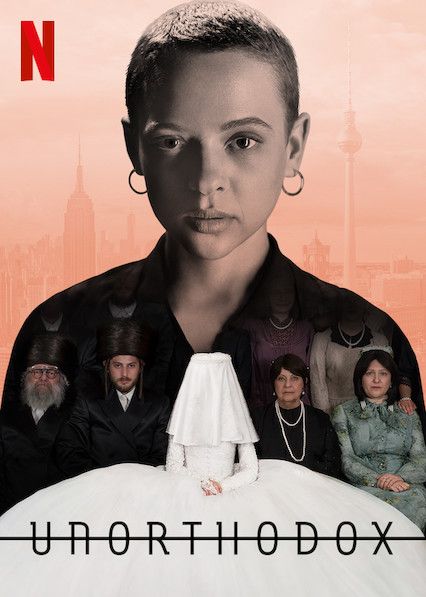
See also Unorthodox: Less and More than Shtisel

the first interstellar seder in space takes place in his novel


Sunday, April 12, 2020

Unorthodox: Less and More than Shtisel


How to start this review of Unorthodox?  If you liked Shtisel, you'll love Unorthodox.  Or maybe, if you loved Shtisel, you'll like Unorthodox.   The distinction gets at the intersections but significant differences between these two outstanding series.

Both Netflix series are wonderfully drenched in all manner of Yiddishkite, especially the language that my grandparents (born in Europe, moved to New York City) spoke fluently, my parents spoke on occasion in the hope that my sister and I would not understand it, but we both nonetheless learned a passing dollop of, and passed on to our children.  Both series deal with the bumping of Orthodox Jewish communities into the rest of the world, and their struggle to succeed in this world while maintaining their own identities.  Both have a superbly talented young star in Shira Haas.

But there the overlap ends.   Shtisel has much more humor along with its angst.   Unorthodox is usually cutting-edge serious.  Shtisel has 24 episodes in two seasons.  Unorthodox's complete single season consists of four episodes.  Shtisel tells multiple stories, all fictional.  Unorthodox tells a single story, of a young, pregnant wife (powerfully played by Haas) who gets on a plane to Berlin of all places to escape her orthodox Jewish community in Brooklyn.  And that narrative is based on a true story.

Come to think of it, art figures prominently in both series.  Painting plays a major role in Shtisel, as does music in Unorthodox.   In both cases, a central character has talent not exactly encouraged by Orthodox community.   I won't say anything more about the music in Unorthodox, except that the best episode features a breathtaking and determinative performance.

I will say, on behalf of Jewish Orthodox communities, that they arose and continue as a response to the very real discrimination and deadly attacks that Jews have been subject to over the years.  In a memorable scene, the rabbi in Brooklyn recounts how Jewish integration into the larger world didn't stop the Nazi holocaust.  As I said, there's far more suffering than humor in Unorthodox.

But you'll nonetheless be greatly uplifted if you watch it.

InfiniteRegress.tv