Chuck Todd interviews me about alternate histories
Showing posts with label Lee Pace. Show all posts

Thursday, July 13, 2023

Foundation 2.1: Once Again, a Tale of Two Stories


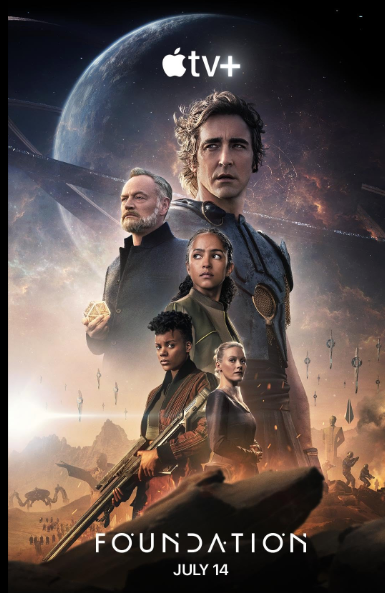
Foundation is back on Apple TV+ with the first episode of its second season.  Here's a review, with no big spoilers.

Here's what this first episode of the second season is most like: the first season of Foundation on Apple TV+.  Here's what it's significantly not much like: Isaac Asimov's novels, upon which this series is supposed to be based.  But you knew that, and I said that, already.  In fact, I just did, when I said the first episode of the second season is most like the first season.

And, to be clear. as I said in my reviews of the first season back in 2021, the dissimilarity of this TV series to Asimov's novels doesn't mean that it's all bad.  But nor can I help not being disappointed, not missing the trilogy that I read and loved three times, and the sequels which I read once and loved not as much but well enough.

Once again, my favorite part of the TV series are the Cleon clones and Demerzel -- Cleon wasn't cloned in the novels and Demerzel was very different, but their rendition in the TV series is often superb.  This continues in episode 2.1.  Lee Pace as Brother Day is once again a powerhouse.  Same for Laura Birn as Demerzel.  And Terrence Mann as Brother Dusk is simmering and outstanding, and Cassian Bilton as Brother Dawn is memorable.  All told, they tell an exciting, high intellect, high octane story vividly.  And, yeah, they're the bad guys (I guess).

The good guys, who are supposed to be Hari Seldon and the Foundation, are not nearly as impressive. Jared Harris is a great actor, but he's been put in a box in this TV series, and even when he screams and yells he barely breaks through.  And as for the rest ... Gaal and Salvor, well, I don't think I'd mind at all if they were almost unrecognizable from the characters with their name in the novels, if they'd been given a riveting story.  Instead, we get mental gymnastics and proclamations of profundity with not much substance or appeal.

But I'll keep watching, because I enjoy the clone story, and I still have some hope somewhere that the TV series will deliver some of what I most enjoyed in the novels.


See also Foundation 1.1-2: Mathematician, Man of the People, and Cleon's Clones ... Foundation 1.3: Clonal Science Fiction, Hari Seldon as V. I. Lenin ... Foundation 1.4: Slow Hand, Long Half-Life, Flipped Coin ... Foundation 1.5: What We Learned in that Final Scene ... Foundation 1.6: Folded Variations ... Foundation 1.7: Alternate History/Future ... Foundation 1.8: Divergences and Convergences ... Foundation 1.9: Vindication and Questions ... Foundation Season 1 Finale: Right Up There


Friday, November 19, 2021

Foundation Season 1 Finale: Right Up There

It's a little after 1am, Friday, 19 November 2021, a few miles north of New York City, as I write this.  I just saw the season 1 finale -- episode 1.10 -- of the Foundation series on Apple TV+.  It came on the screen at 12 midnight, as the day began.  Unlike Paramount Plus, which says a show (such as Star Trek Discovery) begins on a given day, but doesn't make it available on the East Coast until 3 in the morning of the stated day.  I just wanted to give a shout-out to Apple TV+ on that account.

And there are other, more profound accounts, when it comes to the Foundation series.  It says at the end of this episode that the series is based on the novels of Isaac Asimov (in the same size letters as the other major credits).  And that's why I started watching this series.  I had hopes, but I didn't expect all that much.  I saw on Reddit that there's a Soviet adaptation of Asimov's The End of Eternity, to this very day, still my favorite time travel novel, which I first read in the summer of 1959. I'll watch that, too.  It has English subtitles.  A series made in 1987, in the steep twilight of the Soviet Union.  I really doubt that I'll love it as much as the novel, but I'll watch it.

As I watched the first ten episodes of the Foundation series.  And it far exceeded my expectations.  I didn't enjoy them quite as much as I enjoyed the first novel in the Foundation trilogy, but then again, I loved and still treasure the second novel a lot more than the first.  And there were things that I loved in first season of this Foundation TV series, which bore vibrant, compelling fruit in the season finale.

[Spoilers follow ... ]

Like the triple Cleon clone story, a standalone masterpiece.   Day's willingness to bend and accept Dawn despite his differences; Demerzel killing Dawn anyway, in defiance of Day; and Day learning that his DNA was tampered with, possibly not likely even Dusk's, was brilliant drama.  And Demerzel, for whom killing seems to be all too easy, though she rips off her human face at the end, is a powerful piece of storytelling, even if it defies Asimov's laws of robotics (at least the first three laws, maybe not the zeroth law).  Given, however, that the clone story has almost nothing to do with Asimov's Foundation stories, I find that breach of Asimov permissible.  (Again, kudos to Lee Pace and Terrence Mann for their performances as Day and Dusk.)

Now as to the story that has much more to do with Asimov's writing:  I like that Gaal and Raych are Salvor's parents.  Makes sense, a nice way to tie Salvor to Hari, who is her grandfather.  And a nice way to set up the mentalism of the Second Foundation.   As to all the prior action that took place on Terminus and its environs, some of it was closer to Asimov, some of it was not, none of it was all that great, anyway, in my opinion.  But as I said before, Asimov's first novel was the least splendid in the original trilogy, so that's ok.

Making this first season of Asimov's masterwork, which I consider the best science fiction ever written, was difficult.   Making it as good as Asimov's masterwork was impossible.  The Foundation series first season succeeded in the first, and could never succeed in the second.  But it got up there, in that rarefied atmosphere, by offering an alternate history of Asimov's Foundation stories, and a story of the beginning of the dissolution of the clonal Emperor which is the best clone story I've ever read or seen.

So I'll take that, happily, and be back with reviews of the second season as soon as it begins, back on the screen at the stroke of midnight in New York, at the time of day it's supposed to be seen.


See also Foundation 1.1-2: Mathematician, Man of the People, and Cleon's Clones ... Foundation 1.3: Clonal Science Fiction, Hari Seldon as V. I. Lenin ... Foundation 1.4: Slow Hand, Long Half-Life, Flipped Coin ... Foundation 1.5: What We Learned in that Final Scene ... Foundation 1.6: Folded Variations ... Foundation 1.7: Alternate History/Future ... Foundation 1.8: Divergences and Convergences ... Foundation 1.9: Vindication and Questions

Coming Tuesday, 23 Nov 2021 -- a conversation with Cora Buhlert, Joel McKinnon, and me about the first season of Foundation.  If you're not familiar with their work, here's where you can get to know them:

Cora Buhlert's reviews of the first season of Foundation ... Joel McKinnon's Seldon Crisis podcast ... Joel's What I Like about the Show on Reddit.


Note added 24 Nov 2021:  And here is the interview:


Friday, November 5, 2021

Foundation 1.8: Divergences and Convergences

A towering, slowly moving like colossi in motion, powerful episode 1.8 of Foundation just up on Apple TV+, with new significant changes from Isaac Asimov's writing, and also replete with surprises even in the parts of this narration that were not in the original stories that appeared nearly a century ago.

I accounted for any and all divergences from Asimov in my review here last week: this TV series is an alternate history of Asimov's Foundation stories.  But that's not a blank check in terms of critical review.  The changes still have to work in my book for this story on the screen.

[Spoilers follow ... ]

The big one that screamed at me tonight is Hari wanting to plant the Second Foundation in his homeworld Helicon not Trantor.  This is a tough change for me to swallow or follow -- the Second Foundation being revealed on Trantor was one of my favorite parts of Asimov's writing, from Ebling Mis on forward. I guess I can learn to make Helicon work in the TV series.  But, then again, the Second Foundation on Helicon is at this point only Hari's aspiration, not a reality, so anything's possible.

What is pretty clear, by the conclusion of this episode, is that Gaal Dornick on the screen is not the Preem Palver come early I said she was last week, nor the Wanda Seldon others said she was.  She's traveling in suspended animation on a 100+ year trip back to her own world.  And ... hmmm, I guess that means she could end up being the equivalent of Preem or Wanda sometime in the future, after all.

The clone story, of which we saw only Brother Day, was excellent again.  To all who think Day is soulless or heartless, he did try to lend a hand to the old guy who was surrendering his life on the spiral walk.   I'm not saying he has much goodness in him, but he's capable of real empathy (portrayed by especially strong acting by Lee Pace)  Demerzel is, too.  But so far, she remains to me a very dislikable robot.

I'll conclude with another word about the Spacers.  As I mentioned when they first were mentioned in an early episode, they existed alright in Asimov's stories, but as people who lived and developed their culture on and among planets far out in space.  They did not have the power to "fold" space. That, as far as I recall, was the power the "spacers" plied in Dune.  What this means in the intertwining literary and cinematic histories of both the Foundation and Dune stories is that not only is Dune indebted to Foundation, but now there's a little vice versa.

And I'll be back here next week with my review of the next-to-last episode of this season.


See also Foundation 1.1-2: Mathematician, Man of the People, and Cleon's Clones ... Foundation 1.3: Clonal Science Fiction, Hari Seldon as V. I. Lenin ... Foundation 1.4: Slow Hand, Long Half-Life, Flipped Coin ... Foundation 1.5: What We Learned in that Final Scene ... Foundation 1.6: Folded Variations ... Foundation 1.7: Alternate History/Future ... Foundation 1.9: Vindication and Questions ... Foundation Season 1 Finale: Right Up There


Friday, October 1, 2021

Foundation 1.3: Clonal Science Fiction, Hari Seldon as V. I. Lenin

I said in my review of the first two episodes of the Foundation series on Apple TV+ last week that the relationship among the Cleon clone triumvirate -- Brothers Dawn, Day, and Dusk -- was fascinating, and "one of the best parts of the TV series not in the Asimov stories".  Tonight in episode 1.3 that relationship took up at least the first third of the narrative, and it was easily the best part of the episode.

It began at the beginning, with a revealing conversation between Cleon the First and Demerzel.  But it quickly pivoted to the day before Brother Dusk's death, or the day when he would become Brother Darkness and turned to dust by some kind of futuristic ray.  We see Brother Dawn from the previous episodes grown into a vibrant young Day, played of course Lee Pace. The former Day is now Brother Dusk, but more youthful than he was in the first two episodes.  And the clone baby Brother Dawn is held in Demerzel's arms.  All in all, a quite impressive and effective set piece of clonal science fiction.

The rest of the episode takes place on Terminus, and suffers from not being enough of the story.  It ended too quickly, and could have benefitted from the Vault being opened and Hari giving his holographic advice/appraisal of the situation.  Salvor Hardin's story seemed to stop in the middle.  Now, that might have worked if the 4th episode had been viewable, but it wasn't.

In fact, my favorite scene in the Terminus part of episode was the statue of Hari Seldon (left), which I noticed in one of the trailers for Foundation last month.  It's somehow reminiscent of the famous statue of V. I. Lenin (right), isn't it?  Which makes sense, given that Hari Seldon is to the Galactic Empire as Lenin was to the Russian empire.


Anyway, I'll be back with my audio podcast review of episode 3 later today, and of course a review of episode 4 next week.


See also Foundation 1.1-2: Mathematician, Man of the People, and Cleon's Clones ... Foundation 1.4: Slow Hand, Long Half-Life, Flipped Coin

Friday, September 24, 2021

Foundation 1.1-2: Mathematics, Man of the People, and Cleon's Clones


I've been saying on Twitter and Facebook and anyplace with an eye or an ear that I've been waiting most of my life to see Isaac Asimov's Foundation trilogy and then series on a screen.  That's surely a prescription for disappointment.  But I just watched the first two episodes of Foundation on Apple TV+ and I thought they were superb.  Not perfect, but more than enough to be not disappointed but thrilled.

First, let me say that, in general when I review a movie or TV series based on a novel or story I previously read, I try not to get tied up in comparisons.  The screen and the page are, after all, very different media, with different necessities of expression and portrayal.   But Asimov's stories are so incandescent, it's not possible to ignore them when thinking about the television series.

And I think the first two episodes of the series do capture the best parts of the Asimov stories.  The primacy of mathematics in predicting the broad currents of history, but not the actions of individuals, come through powerfully in the first two episodes.   Especially in the stunning ending of the second episode.

[Spoilers follow ... ]

That would be Hari Seldon murdered by his adopted son Raych, on the ship to Terminus.  I don't know if I liked that -- actually, I do know, I didn't -- and I'm not sure it was well enough motivated.   But it certainly was traumatically shocking, and amply demonstrated the unpredictability of individual behavior.

Cleon's clones, though, on the other hand, were somewhat predictable, certainly the cruelty of Brother Day.  But the relationship between the boy (Dawn), the old man (Dusk), and Day was interesting, even fascinating, and one of the best parts of the TV series not in the Asimov stories.  

I also really loved the scene on the ship to Terminus with Hari talking to the workers in the laundry room.  It was good and comforting to see the esoteric mathematician being such a true man of the people.  Seldon was never fleshed out on Asimov's pages, and Jared Harris did a fine job of doing that in the first two episodes.  As I was watching them, it occurred me to me that Foundation in these first two episodes was most like David Goyer's Da Vinci's Demons, which makes sense, since Seldon and Da Vinci were both geniuses who predicted the future. The trial of Hari was also effective, as it was in Asimov, evoking Galileo on trial for his life and ideas in the Vatican.

In addition to Harris,  Lou Llobell does a fine job as Gaal Dornick, who has an excellent expanded role in the TV series as not only a mathematician but a human being.  And Lee Pace is powerful and believable as the powerful Brother Day.   Robots played no role in the original Asimov trilogy, and an increasing role in the sequels.  I'm not sure what I think as yet of Laura Birn's Demerzel on the TV screen.

I'll tell you more when I review the third episode right after I see it next Friday early morning.  And here's my audio podcast with some further thoughts about the first two episodes:


See also Foundation 1.3: Clonal Science Fiction, Hari Seldon as V. I. Lenin ... Foundation 1.4:  Slow Hand, Long Half-Life, Flipped Coin ...  Foundation 1.5: What We Learned in that Final Scene ... Foundation 1.6: Folded Variations ... Foundation 1.7: Alternate History/Future ... Foundation 1.8: Divergences and Convergences ... Foundation 1.9: Vindication and Questions ... Foundation Season 1 Finale: Right Up There


InfiniteRegress.tv