Chuck Todd interviews me about alternate histories
Showing posts with label Stephen Hawking. Show all posts

Sunday, February 1, 2026

Hijack 2.3: On Counting on Actors Who Play Good Guys Not to Play Bad Guys


We find out lots of essential things in Hijack 2.3. 

[And there will be spoilers ahead .... ]

First and foremost: Of course Sam Nelson was not going to sacrifice any innocent person's life for anything he had planned for the train he had hijacked.   His threatening to sacrifice that man was just a ploy to get the people running the trains in Berlin to do what he needed them to do.

This raises, at least to me, the interesting question of can you predict what a character will do in a TV series or movie based on who the actor was, or more specifically, what characters the actor has previously played.  Even in The Wire, in which Idris Elba played someone high up in a drug cartel in Baltimore, he displayed a conscience and a heart.  That in itself was why I was sure that Sam, who was an honest man with a big heart in the first season of Hijack, wouldn't trade in an unthreatening person's life in the second season.

Of course, actors occasionally do switch from playing heroes to villains. Elba has indeed done that a few times.  Ronald Reagan played a bad guy for the first and last time in his acting career in The Killers.  He would go into politics after that, and become Governor of California and then President for two terms.  Not the greatest President, in my humble opinion, though almost any predecessor looks good in comparison to the current occupant.  I was surprised to see Eddie Redmayne play a villain in the brilliant  Day of the Jackal -- after his performance as Stephen Hawking in The Theory of Everything -- but he was charismatic in Jackal, and I saw, after a bit of research, that he's played lots of villains in his career.

Back to Sam, we also in the third episode of this second season find out that the reason he hijacked the train was to save his former wife from the brutal people who hijacked the plane in the first season, and in between the two seasons killed his son.  Lots of tension building up, and I'm looking forward to seeing what comes next.

See also Hijack 1: Don't Miss It! ... Hijack 2.1: A Tale of Two Vehicles ... 2.2: What Is Sam Nelson Really Up To?

Tuesday, October 17, 2023

podcast: Paul Levinson interviews Chris Cosmain about his Time Travel Novel 'Novikov Windows'


Welcome to Light On Light Through, Episode 356, in which I interview Chris Cosmain about his novel Novikov Windows and time travel. We also discuss how to succeed as a science fiction author.


Check out this episode!

Tuesday, September 26, 2023

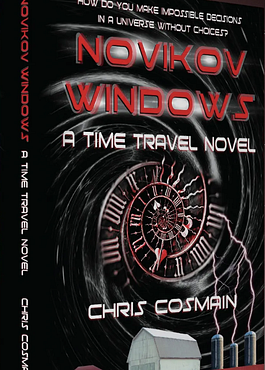
Review of Chris Cosmain's Novikov Windows

Novikov Windows


I'm going to here review a a very recently published, nearly 500-page time travel novel -- Chris Cosmain's Novikov Windows: A Time Travel Novel (that's the sub-title) -- I've just read, in two days.  That should give you an idea of how compelling I think this novel is.  

Because of that, I'm not going to give you any big spoilers in this review.  If you haven't yet read this novel, and doubt or would like further elaboration on any of the points I make below, my best advice is: read the novel.  (You can buy a copy over here.)

Now as to the narrative.  It has a 19th-century flavor.  In fact, important parts of the story take place back then.  But more than that, its style and pace feel as if it could have been written by H. G. Wells.  And it combines that ambience with all the mod-cons:  3-D printing, DNA and junk DNA, computers, and rockets all play a role.

I've said many times that I can't enjoy or take seriously any time-travel tale which ignores the paradoxes that time travel engenders, and gives the intellect (or at least mine) so much to deal with.  The one that comes up most often is the so-called grandfather paradox -- if I go back in time and accidentally kill my grandfather, before he sleeps with my grandmother, I wouldn't exist, so how have I gone back in time in the first place?  (By the way, that's not only so-called, but called in a way that's unnecessarily violent and sexist -- I can trigger the paradox by going back in time and obstructing either set of my grandparents from ever meeting.  The obstruction doesn't have to be death, and I don't need to divert one of my grandfathers, it could be one of my grandmothers.)  But Cosmain has a daring way of positing why this paradox would never arise.

Another favorite time-travel paradox is what I think of as the "where did it come from" paradox.  A man, somewhat older than me, who looks very familiar, knocks at my door with a package.  He advises me to open the package then walks away.  The package contains explicit instructions on how to build a time machine.  The instructions say it will take me ten years to build it, and after I build it, I need to travel ten years back in time and give myself the package.  So ... where did the package and its instructions come from in the first place?   That kind of paradox plays a crucial role in Novikov Windows.

Here are ten more specific elements I especially enjoyed in this novel (the enumeration reflects not where they appear in the story, but just the order I felt like putting them in):

1. Novikov Windows has one of the most ingenious time travel methods I've ever come across in a novel, story, movie, or TV series: the person or object is scanned down to the atomic level, the scan is sent back in time, in a device that recreates the person or object at the destination.

2. Vincent van Gogh makes an appearance. There's something about that Impressionistic Age and its love affair with light that just cries out time travel, isn’t there.

3. There's a refreshing, almost boyish, Tom Swiftian quality in the descriptions of the science and the tech necessary for time travel.  That's part of what I meant when I said H. G. Wells could have written this.

4.  The novel also has romantic passion ... deep kisses, deeper feelings, more.  That's why I didn't say the novel was Asimovian (my favorite science fiction author, but portraying love wasn't his strong suit).

5. Cosmain deals with the problem of not only traveling through time, but to the intended place.  You often don't find this in time travel stories.

6. The addition of new, important characters throughout the novel gives the characters we already know the need to explain to the new characters what's really going on, i.e., how the time travel works, its limits and specifications, which in turn provides us, the readers, another chance to understand this.  Yes, the science and effects of time travel in this novel are complex, but time travel that isn't is usually not worth reading.  And the time travel in this novel is something you likely haven't seen before, which also makes the story commendable, and worthy of Aristotle's advice to the teacher to teach the lesson three times: tell the students what you are going to teach them, teach them, then tell the students what you just taught them.  We all are students when it comes to time travel.

7. Speaking of education, we also learn some new words in this story, including the Australian larrikinism (rebelliousness) and the Japanese shouganai (a cross between the French c'est la vie and the Yiddish bashert).

8. Biology plays a major role in this novel (its author is a medical doctor), as indeed it should in a time travel story that transports living things across time. So does medical care.   If traveling in a plane can get you dehydrated, who can say what being scanned, sent back in time, and recreated would do to the body and mind.     

9. And time travel literally and figuratively becomes a bedfellow for these characters, often animating but also taking its toll, especially on the very composition of their families.

10. This story also has lots of nice little touches, including one involving Stephen Hawking and another the extinction of dinosaurs (well, that certainly doesn't seem nice, but you know what I mean, and it did leave our planet open for the success of mammals, including human beings).

I could go on, but I've already veered all too close to spoilers, and I don't want to spoil any of the fun for you.  Novikov Windows is a remarkable combination of hard science fiction, probing philosophy, ethical argument, and sheer adventure.  If you're not already a fan of time travel, chances are you'll become one after you read this novel.  If you are already a fan, this novel will go to the top of your list, and stay there as an accomplishment against which past and future time travel stories you may read will be judged.

====

My best-known time travel works:  The Plot to Save Socrates, Unburning Alexandria, Chronica (the Sierra Waters trilogy); The Chronology Protection Case; The Loose Ends Saga; Ian's Ions and Eons; Marilyn and Monet


And you can read my short story, "Slipping Time," free, any time!


Thursday, March 15, 2018

Thank You Stephen Hawking

Stephen Hawking was an inspiration to numerous people, so it's no surprise his work has had a pivotal impact on my own life and work.

The dream of most fiction writers - I'd assume, having not taken a formal poll - is to have their work made into movie.  So far, that's happened to me just once.  And it's because of Steven Hawking's work.

In 1994, Wired Magazine published a short article by me, Telnet to the Future, in which I argued that time travel was impossible.   Shortly later, I received a note from Jack Sarfatti, a physicist who believed the opposite.  But he acknowledged that none other than Stephen Hawking apparently agreed with me, having recently published about his "chronology protection conjecture," which allowed that, even were time travel physically possible, the Universe would not allow it, and would act in defense against its own unraveling by time travelers to stop any time travel from happening.

In my always slightly deranged mind, a science fiction murder mystery immediately suggested itself, and resulted in The Chronology Protection Case, which Stan Schmidt was good enough to publish as a novelette in Analog Magazine in 1995.  It's been nominated for the Nebula Award, been reprinted half a dozen times, and has been a required text in a writing class in the Midwest for a going on a decade now.

And Jay Kensinger made it into a high concept, low budget movie, which screens at science fiction conventions around the country, has been a finalist in several film festivals, and for the past two years has been available for free viewing on Amazon Prime.

If we ever come out with a new version - which we did in 2013 for the original movie made in 2002 - I'll be sure to thank Stephen Hawking - not just for inspiring this little movie, but for work and a life that has inspired millions and will no doubt continue to do so until the end of time.

Tuesday, March 28, 2017

Time After Time 1.5: You Can't and Can Change History

Time After Time was back with episode 1.5 last night - filmed at Silvercup's new Bronx studios, by the way, where I attended a great opening ceremony with Governor Cuomo speaking this past summer.

Changing the Bronx - bringing it back - is what Silvercup North is all about, just as changing history is what Time After Time is all about.  The very notion of time travel is about changing history.   Which is why Stephen Hawking talked about the chronology protection conjecture, and I wrote The Chronology Protection Case, basis of the movie you can see any time for free on Amazon Prime.

Now the theme of both, and of Time After Time 1.5, is that history - or the universe - won't let you change it.   So when John aka Jack the Ripper goes back to World War I in Paris to save his son, it turns out that H. G. doesn't have to go back in time himself to stop John - history, the universe, will do that all on its own.

Except when it doesn't.  Which, of course, can happen in a time travel story, since it's the writer, not really the universe, which/who is calling the shots in the story,  So I would say it's just a matter of time, to coin a phrase, until Wells or who knows who does manage to change something in history in Time After Time - whether in spite of or because of Wells' or John's interventions - just as Silvercup North has changed the course of the Bronx.

Meanwhile, the other story in Time After Time, which will somehow tie into the time machine and Wells, is the work of Brook and her brother. Tonight we saw her heal his wound with some kind of quick-acting DNA-relevant something or other.  That was not only cool, but promises some interesting gambits ahead.

I'm very much liking Time After Time, and looking forward to more.

See also Time after Time: H. G. Wells Back in Action ... Time After Time 1.3: The Red Heads ... Time After Time 1.4: "Mad as a Bag of Ferrets"


The Chronology Protection Case movie, now FREE on Amazon Prime

Thursday, November 14, 2013

The Chronology Protection Case released with new, extended ending

The Chronology Protection Case has been released on iTunes with a new, extended ending.

The 40-minute movie by Jay Kensinger, first released in 2002, is an adaptation of Paul Levinson's novelette "The Chronology Protection Case" - inspired by Steven Hawking's "chronology protection conjecture" - and first published in Analog Magazine in September 1995. The novelette was a finalist for the Nebula and Sturgeon Awards, reprinted five times - including in the currently best-selling Mammoth Book of Time Travel - and made into an Edgar nominated radio play.   The novelette is cited in Paul J. Nahin's A Writer's Guide to the Real Science of Plausible Time Travel as the only recent treatment in science fiction of Hawking's conjecture.

Kensinger directed, produced, wrote, and plays the role of Dr. Phil D'Amato in the movie.  D'Amato has appeared in two other novelettes by Levinson - "The Copyright Notice Case' and "The Mendelian Lamp Case" - and in three novels by Levinson, The Silk Code, The Consciousness Plague, and The Pixel Eye.

The extended ending in the 2013 release of the movie brings the story forward from 2002 to 2012, and was written by Levinson and Kensinger.  The 2002 release was shown at science fiction conventions around the east coast, including I-Con and Philcon.

A trailer follows.   More details about the movie on IMDB.


"The Chronology Protection Case" reprinted in
  • The Mammoth Book of Time Travel, ed. Mike Ashley, Robinson Books, 2013 
  • The Best Time Travel Stories of All Time, ed. Barry Malzberg, I-Books, 2003. 
  • Nebula Awards 32: SFWA's Choices for the Best Science Fiction and Fantasy of the Year, ed. Jack Dann, Harcourt Brace, 1998. 
  • Infinite Edge (online magazine), June-July 1997 
  • Supernatural Sleuths, ed. C. G. Waugh & M. Greenberg, ROC Books, 1996


#SFWApro


Paul Levinson and Jay Kensinger at The Chronology Protection Case premiere at I-Con (Stony Brook, NY), in 2002

Jay Kensinger explains how he re-cut The Chronology Protection Case.   And more here on how Paul came to write the original novelette, and how Jay came to make the movie.

InfiniteRegress.tv