Chuck Todd interviews me about alternate histories
Showing posts with label Plato. Show all posts

Friday, July 24, 2026

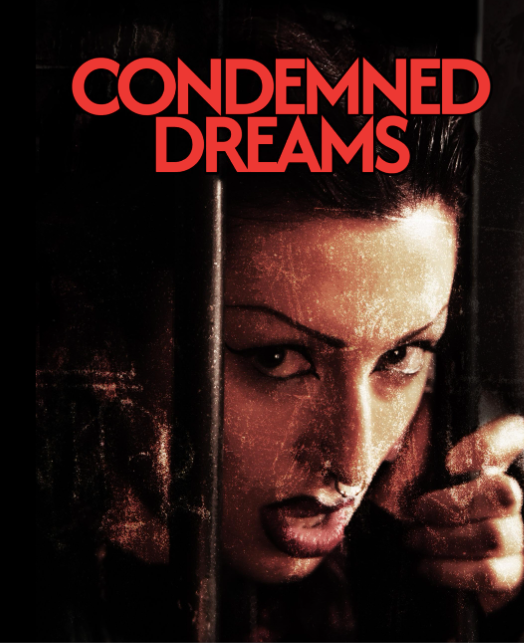
Condemned Dreams: Compellingly Relevant Truths

I just saw George Tsouris's Condemned Dreams.  The feature-length movie, now streaming on Amazon and Tubi, is billed as a philosophical horror movie.   And it's not that horror films cannot have philosophic depth -- see Frankenstein and Dracula -- but Condemned Dreams has and is much more.

It's the story of a woman, Shy, arrested and sentenced to death, because the government doesn't like her ideas.  As such, it's a needed and much welcome attack on the fascism that's currently in power in the United States (and in Russia, etc.).  And its story of the condemned Shy interviewed in her cell by a reporter as she awaits her sentence, has much in common with 1984, Waiting for Godot, and Plato's dialogue Crito about Socrates in his cell, awaiting his deadly punishment and visited by his friend Crito.

Now, as is well known even by a student who took an introduction to philosophy course, Socrates refuses Crito's offer of escape, explaining that he (Socrates) might criticise the state, but would never put himself above it and evade its sentence.  I've actually been disbelieving that that's what actually happened, ever since I first read Crito in my Intro to Philosophy course with Prof. Henry Magid at CCNY in the 1960s -- not believing that really happened, because I know had I been in Socrates's shoes, I would have taken Crito's avenue of escape in  a New York minute.  (I was so vexed by the decision Socrates made, I eventually wrote The Plot to Save Socrates.)

Shy (Soft Abilez) in Condemned Dreams gets no visit from an old friend.  Instead, Lauren (Catherine Parish), a reporter whose career is tanking, pays Shy a series of visits, and their discussion, along with Lauren's conversations with Detective Marshall (Brady Moldrup), one of the cops who arrested Shy, are the beating heart of this riveting movie.  We're treated to a discussion of how we evaluate the life we've lived (Shy laments "all the time I wasted -- I could have accomplished so much more"), the meaning and limits of freedom (I always liked the Millian libertarian view that everyone should be free to swing their arms as far and wide as they please -- as long as they don't hit someone else's nose), and the proper role of police in a democratic society (distressingly relevant, as I indicated above, to what ICE is continuing to do in our country).

If this sounds like a lot of conversation, there is, and as such Condemned Dreams would make a highly compelling, relevant play.  In the meantime, check out the movie, and if you're in the mood for more talk, come to the free online conversation that will occur on StreamYard tomorrow (July 25) at 11am (New York time), featuring George Tsouris, Catherine Parish, Rew Starr (Lauren's editor), as well as panelists Nick Zaino, Ken Holmes, Caleigh LeGrand, and Yours Truly, hosted by Samita Nandy.


Wednesday, December 22, 2021

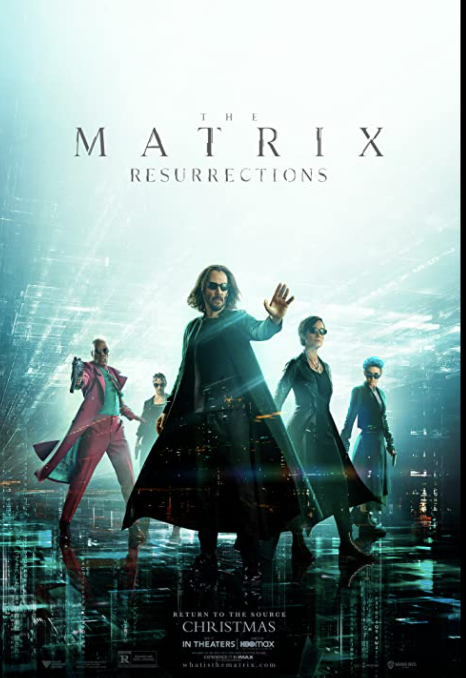
The Matrix Resurrections: Great Mix of Deep Philosophy and Fast-Moving Action


I just saw The Matrix Resurrections on HBO Max.  It may be the best Matrix since The Matrix -- that is, the first movie, so I'm saying Resurrections may be better than the two earlier sequels, certainly better than the third in the original trilogy, Revolutions.

One of the reasons I'm thinking this is how well the meta angle is handled in Resurrections.  We find Neo working as a programmer, whose great accomplishment was writing a computer game called "The Matrix".  He's sucked into a journey in which reality vs. fiction as an explanation for what is happening vie for our attention at every incandescent turn, and there are many of them.  

[Note: For once, or as a rarity, there WON'T be any big spoilers ahead ... ]

Let's talk about the acting.  Keanu Reeves as Neo and Carrie-Anne Moss as Trinity were excellent.  I was prepared to be annoyed at Yahya Abdul-Mateen II as Morpheus and Jonathan Groff as Smith, because their original incarnations by Laurence Fishburne and Hugo Weaving were so brilliantly, searingly memorable.   But the new actors for these crucial characters were quite good.  In the first three movies, Smith was for most part the more keenly acted and therefore more unforgettable character -- delivering such now immortal lines as, to Neo, "How can you speak if you have no mouth?" with perfect laser, razor precision --  and even though Groff is not quite as knife's edge as Weaving, his Smith will be somewhat memorable, too.

Among the new characters, by far my favorite was Neil Patrick Harris as The Analyst -- a big step up from Doogie Howser, MD but in a related medical profession -- and I very much liked the unpredictable villainous kindred relationship between him and Smith.  Both had a fair share of bon mots, and if I had to choose the most profound it would be The Analyst's observation that feelings make fictions real.  In addition to these lines that could have come from Plato -- who notoriously distrusted both feelings and art (see his Republic) -- we also get some good ultra-contemporary commentary from some of the characters.  I guess my favorite would be the Merovingian's, a returning character, who lashes out at both Facebook and Wikipedia in a tense, verge of bursting into action scene.  It's probably worth noting that Facebook didn't exist when we last saw Merv in Revolutions in 2003, and Wikipedia was just a tiny three years old, so his denunciation of these two social media giants is understandable, if not fair to Wikipedia, which has done far more good and much less damage than Facebook.

Without telling you anything more about the plot, I'll say it's plausible, exciting, and works well with its three predecessors.   The action and special effects were outstanding, as always, and the characters' awareness of the deep philosophic issues that underlie their exploits endows this movie with a refreshing intellectual heft.  I'd say The Matrix Resurrections is a triumph of a reboot, and one of the best now around in the burgeoning genre.


Monday, July 16, 2018

Why Trump Loves Putin

Blackmail has often been cited, sometimes along with gratitude for the help Russia gave him in the 2016 election, as the reason Trump so adheres to Putin, as seen again in the Helsinki press conference today.

That may well be, but I think the deeper reason is that Trump has an affinity to dictators - to people in power who don't need the votes of anyone to continue in office.  Though Trump often trumpets how he won the election of 2016 - including again today - he knows full well that he lost the popular vote and only is in office because of the quirks of the Electoral College.  And that must rankle him.

When he sees our allies in Canada and in Europe, he has contempt for them, because he knows full well that they can be swept out of office in the next election. As can he.

When he sees Putin, or the leaders of China, North Korea, and Turkey, he sees something quite different.   He sees people who have somehow managed to stay in power, in some cases decades already, without needing a single real vote.  He sees people who think of themselves as Plato's philosopher king, though who knows what any of them, especially Trump, actually know of Plato's work.

This means that Trump is neither stupid nor out of control.  And though he may be subject to blackmail, and though he may be grateful to Putin for what Russia provided to him in the 2016 election, I think that Trump's embracing of Putin reflects what he feels and desires in every ounce and the deepest part of his being: to stay in office, to do as he pleases, without the annoyances of the press or the need in his view to pander to voters, for as long as he pleases.

Possibly other politicians and even presidents in American history have felt the same.  But I'd say none as fanatically and irrevocably as our current President, and this is a far more serious threat to democracy than blackmail or gratitude could deliver.


Sunday, October 8, 2017

Review of Doug Hill's Not So Fast: Worth Reading, Not Too Quicky

 photo Not So Fast_zpsdbrxn5pv.jpgI've had an advance reading copy on hand for quite some time of Doug Hill's Not So Fast: Thinking Twice about Technology, and I guess, given the title, who could object to my taking so long to read and review it?  But I've slowly been reading and reviewing two other books - Grant Wythoff's The Perversity of Things and Rob Sheffield's Dreaming the Beatles - and, anyway, now that I've finished Not So Fast, I can tell you two things about it:  I strongly disagree with its premise and just about every argument Hill makes in the book, and I recommend it.

Now, it's rare that I would recommend a book with which I disagree, but it happens.  Before I tell you why, let me tell you why I disagree with this book.   I'm a technological optimist.  Not because I'm ignorant of the many critics of technology Hill cites in his book, but because I've read them all and found them wanting.   The critic often thinks the optimist is ignorant, but the optimist can just as often be a critic of the critic.  In my case, though I don't preach the singularity or any kind of technological utopia, I think technologies help us fulfill our human goals on multiple levels.  I've been saying this since my doctoral dissertation, Human Replay: A Theory of the Evolution of Media (New York University, 1979), which was recently put up on Amazon.

Unfortunately, Hill overlooks the most reasonable pro-technological arguments, and relies instead on quasi-mystical futurists as his opponents.  And sometimes he misrepresents a seminal thinker such as Marshall McLuhan, for example, who didn't turn from pro-technology with the global village to critic of technology with discarnate man as Hill says.  McLuhan instead insisted that he never made value judgements, and indeed his global village had beds of roses with plenty of thorns.

So, why, then, am I recommending Hill's book?  Because I think it's important that we continue to discuss and strive to understand the nature and impact of technology, which is what Hill does in Not So Fast.  I also think it's important to draw into the discussion ancient philosophers such as Plato and Aristotle, and modern practitioners ranging from Edison and Ford to Steve Jobs.  (Indeed, I think touching base with such minds is so important that I frequently include them in my science fiction.)  It's also good to see outright critics of technology ranging from Jacques Ellul to Langdon Winner given such play, if only to offer avenues to students of all ages who are new to the game of fathoming technology.

But in the end, as the Nobel laureate biologist Sir Peter Medawar liked to say, what's most human about us is our technology, which means that to oppose it with a tone or implication of apocalypse amounts to despairing of the human condition itself.


Sunday, February 9, 2014

Black Sails 1.3: John Milton and Marcus Aurelius

As I noted last week, Black Sails turns out to be an astonishingly literate series, literally.   Previously, the erudite Captain Flint cited Homer to good effect.   Last night, he brings Miranda - with whom he has a long term stable relationship - a copy of a book by John Milton.  Later, Miranda in turn recommends a tract by the stoic philosopher and Roman emperor Marcus Aurelius.

It's tempting to suppose Flint's gift to Miranda was Paradise Lost, given that all of the action is, after all, taking place in a paradise, which, moreover, is ever on the verge of being lost to libertine violence, personal and social, and which was again in high profile last night.  But given the politically libertarian philosophy of Flint and the better of the pirates, not to mention my own devotion to the First Amendment (to the point of thinking the FCC should be abolished), I'm going to go with the Milton being his Areopagitica, the brilliant polemic in favor of free speech and press which says that truth and falsity should be left to fight it out in the marketplace of ideas, where, given the rationality of human beings, truth will eventually win.  In this sage schema, the worst thing a government or anyone can do is censor, which might be well hobble the expression of truth and prevent it from entering the marketplace of ideas for its contest with falsity.

Indeed, Milton's Areopagitica was read by both Thomas Jefferson and John Madison, and undoubtedly figured in the very construction of our First Amendment.  So what better place to situate Milton's political masterpiece than in the new world, in colonial America, in the stirrings of what would become the U.S.A.

Aurelius's Mediations and his tenure as Roman Empire tells a related story.  A sage philosopher, the epitome of Plato's philosopher king, Aurelius tragically inserted his personal feelings as father into his philosophy about how to best serve, and named his son as Roman Emperor, ending the excellent tradition of picking the best person as successor.  The lesson, that power corrupts, and absolute power corrupts absolutely, is also one which we as well as our pirates would do well to keep in mind.

What makes Black Sails so remarkable is that it mixes this heady and powerful philosophy with lots of good and bad loving and action.  The series so far has mostly resisted the cliches of pirates in fiction, and we see that again in 1.3 with Flint's devoted relationship with Miranda, and Eleanor's strong sense of self and purpose.

After watching Black Sails last night, my wife and I saw Captain Phillips, the movie detailing what actually happened off the coast of Somalia in 2009, when pirates attacked Phillips' ship.  Superb acting by Tom Hanks as Phillips and everyone else in this movie.  But, whew, pirates have fallen a long way down since those halcyon, fictional days of Black Sails.

See also Black Sails: Literate and Raunchy Piracy


#SFWApro

Wednesday, December 12, 2012

"Author's Cut" Kindle edition of The Plot to Save Socrates with Extended Ending Published by JoSara MeDia

I'm delighted to announce that JoSara MeDia has just published a Kindle edition of my novel, The Plot to Save Socrates.

The Plot to Save Socrates was originally published by Tor Books in 2006, and was praised by The New York Daily News (" Da Vinci-esque thriller"), Entertainment Weekly ("challenging fun"), and reviews in dozens of other places.

This author’s cut of The Plot to Save Socrates not only restores a lot of my original wording, but an entire chapter near the end of the novel that features Hypatia of Alexandria.  The novel has a new, specially commissioned cover by Joel Iskowitz, who designed the cover for The Silk Code ebook, and whose designs have appeared on stamps around the world, US coins, and NASA murals.

I chose JoSara MeDia because this small, savvy publisher did such a good job with The Silk Code author's cut ebook brought out this past August. JoSara MeDia has published award-winning authors in multiple formats, including print, eBook, and enhanced eBooks in the form of iPad and Android applications. JoSara MeDia also works with non-profit organizations, such as the Texas State Historical Association, assisting them with strategies and solutions to get their content available in these multiple formats.


Praise for the novel...

"...challenging fun" - Entertainment Weekly

"Da Vinci-esque thriller" - New York Daily News

"...a fun book to read" - Dallas Morning News

"resonates with the current political climate . . . . heroine Sierra Waters is sexy as hell . . . . there's a bite to Levinson's wit" - Brian Charles Clark, Curled Up With A Good Book at curledup.com 

"a journey through time that'll make you think as it thrills ... so accessible, even those generally put off by sci-fi should enjoy the trip." - Rod Lott, bookgasm.com

"Levinson spins a fascinating tale ... An intriguing premise with believable characters and attention to period detail make this an outstanding choice... Highly recommended." - Library Journal,*starred review

"Light, engaging time-travel yarn . . . neatly satisfies the circularity inherent in time travel, whose paradoxes Levinson links to Greek philosophy." - Publishers Weekly

"A thinking person's time travel story... I felt like I was there." - SF Signal

 "This is a dazzling performance. . . .History as science fiction; science fiction as history." - Barry N. Malzberg 

"... quick-to-read, entertaining treatment of the problems inherent in time travel with style and flair" - Booklist

"There's a delightfully old-fashioned feel to The Plot to Save Socrates. . . . Levinson's cool, spare style reminded me of the writing of Isaac Asimov. . ." - Colin Harvey, Strange Horizons

"Paul Levinson's new novel is both very different from anything he has done before and very satisfying. . . . This, I think, is the first of Levinson's novels to deserve to be called a tour de force. Watch for it on award ballots." - Tom Easton, Analog: Science Fiction and Fact

"it's exciting to see a book as daring with both its ideas and its approach to narrative structure as this one hit the shelves . . . It's an absolute treat to sit back and be wrapped up in a story that gives a retro SF premise like time travel such a brilliant new kick, and it's doubly delightful to find the story as fun and entertaining as it is thought-provoking." - SF Reviews.net 

"proves that excellent entertainment can and ought to be intellectually respectable -- a glorious example to us all." - Brian Stableford

"...readers are sure to enjoy his take on the paradoxes of time travel" - BookPage 

"Intricately and intriguingly woven, lots of fun, and extremely thought provoking." - Stanley Schmidt 

"Paul Levinson has outdone himself: The Plot to Save Socrates is a philosophically rich gem full of big ideas and wonderful time-travel tricks." - Robert J. Sawyer

"as happens with Kurt Vonnegut's Billy Pilgrim . . . . the reader soon becomes unstuck in time . . . . Levinson presents one of the most unique books I've ever encountered. A highly recommended read." - Matt St. Amand 

"Paul Levinson brings both intellectual heft and affection for his delightfully depicted characters to this highly original story of time travel . . . bringing all of its threads together in an ending that is emotionally satisfying and extremely moving. The Plot to Save Socrates will provoke thought long after readers have finished the book, at which point many may want to pick it up and read it again, to savor its twists and turns." - Pamela Sargent, SFWeekly

"Fast-paced and full of plot twists." - Davis Enterprise (California)

"an elaborately-reasoned temporal tale - a novelized thought experiment whose logic and ideas Socrates would have approved of" - John Joseph Adams, intergalacticmedicineshow.com

"a philosophically rich, engaging time travel story . . . a charming portrayal of Socrates" - Fantasybookspot.com 

"a fun romp through 2500 years of Western history" - freshfiction.com

"I've never read anything like this before . . . The Plot to Save Socrates is highly, original, creative, and engaging. I enjoyed it from the first page." - Book.of.the.moment. at myspace.com/book_of_the_moment.com

"revels in the possibilities for paradoxes . . . . fresh and welcome" - Steven Silver's Reviews at sfsite

"frankly, he [Levinson] is one of my 'read on sight' authors . . . The Plot to Save Socrates is a tapestry of times and characters and philosophies, with an excellent look at history. . . ." - Jerry Wright, Bewildering Stories at bewilderingstories.com

"a very intelligently written novel . . . ." - GF Willmetts, at SFcrowsnest.com

"Paul Levinson handles a complicated plot and a multitude of characters in a manner that can only be described as masterful. . . . I highly recommend this book, and I won't be surprised if it wins several awards." - Scott M. Sandridge, specmusicmuse

"This book was a lot of fun, and surprisingly poignant at the end. (Yes, I'll admit I cried a little.) . . . I was worried this would be a fairly cold sci-fi book, where I never got to like any of the characters, but somehow by halfway through I found I really cared about them. I'm not sure how Levinson managed that . . . but somehow they all just got inside me." - Lady Amalthea, eharlequin.com

". . . a new metaphor for the literary tradition of time travel." - Robert Blechman, blogcritics.org

"Socrates has always seemed a rather dour and dull figure to me but Paul Levinson breathes new life into this time." - Debbie, ck2skwipsandkritiques.com

"an extremely engaging, entertaining story. . ." - Laurie Thayer, Rambles.net

"truly a thought-provoking, breathtaking, and highly entertaining novel." - Lysette Brodey, PerpetualProse.com

"The Plot to Save Socrates turns on its head Plato's report of Socrates' poisoning ..." - Gerry Elman, Esq., Stanford Alumni Blog

"Doppelgangers, deception, and the sheer amount of historical reference alone make this novel magnificant, but that is not all!... Paul Levinson has created a historical text for all ages, making the plot flow like wine and pleasing to even the most hesitant of readers." - Jenna A, luxuryreading.com 

"I was hooked by the second page." - Kanti Burns, Book Reviews and more

"A lively cast of historical figures populates this epoch-bending adventure, highly recommended especially for fans of alternate history novels!" - Midwest Bookreview


Enjoy listening to audio books? Get a free audio book copy of The Plot to Save Socrates - or any one of 85,000 other titles - with a 14-day trial membership at Audible.com ...


words by Paul Levinson, music by John Anealio, demo by John Anealio

Saturday, November 24, 2012

Foundation, Dune, and Laplace's Demon


The Invigoration of a Philosophic Issue in Science Fiction:  How Laplace’s Demon Finds a Stage in the Foundation and Dune Trilogies

by Paul Levinson

Note: An earlier version of this brief essay, then entitled “Fantasy and Science Fiction Rooted in Fundamental Concerns,” was first published in Media & Methods in 1979. I expanded and re- published it in 2009 on Google's Knol system, which was shut down a few months ago.  

Most educated people acknowledge - grudgingly, or happily, or somewhere in between - that science fiction is a very useful source of information about science.    So the proposition that a work of science fiction can be valuable in helping to teach children or adults about science is, I think, a rather easy proposition to prove. 

What I am going to be discussing in this essay is something a little different, and it stems from my experience over decades of reading and thinking about science fiction - which has convinced me that science fiction is also a great source of material to teach people about philosophy.  And actually this is a point of view I have had for decades.  I began thinking about it when I first read Isaac Asimov’s Foundation trilogy - that would have been in the late 1950s - and then in the late 1960s when I began reading Frank Herbert’s Dune series.   And so, what I’ll be discussing in this essay is  how those two great classic science fiction series in particular can help us better understand a very profound philosophic problem. 

I would say that there are probably hundreds - even thousands – of philosophic problems that science fiction can help us understand.    But for the purposes of this essay, I am going to confine my discussion to just one philosophic problem. It is a very rich and deep philosophic problem and it concerns the role and nature of knowledge in our lives.  This is something Plato wrote about in his discussion of the “Meno” paradox, in which Plato said that in order to know something we have to already know it - how could we know that what we have is knowledge if we did not already possess some basis to make that judgment, that is, if we did not already have some knowledge of that area?  Philosophers have been thinking about such questions about the role of past and present and future knowledge for millennia, but here I want to focus on an issue that a mathematician by the name of Pierre-Simon Laplace considered a few centuries ago. He asked a hypothetical question:  if  a super intellect, call it Laplace’s Demon,  had sufficient knowledge of everything that was going on in the Universe at a particular time, could it then predict everything that would happen afterwards?  In other words, if we had sufficient knowledge of initial conditions, could we then predict everything that would happen thereafter?  Laplace’s answer was yes.

Now I think most people would acknowledge that it is impossible even in science fiction to have a situation in which we have complete knowledge of everything presently in the Universe, or even in our world.  But in the two great series of novels that I mentioned – Isaac Asimov’s Foundation series and Frank Herbert’s Dune series – the proposition of what we can know and do in the future, given some valid knowledge of that future in our present, is given brilliant, riveting, and instructive exposition.  

Let us start with the Foundation trilogy. First of all, the Foundation trilogy comes from a series of shorter works of fiction that were published in Astounding Magazine in the 1940s, with the final piece published in 1950.  Asimov credited Astounding editor John Campbell with encouraging him to develop the stories, including suggesting important elements of the plot. The stories were collected into the Foundation trilogy, published by Gnome Press in the early 1950s. The trilogy has been reprinted many times, and Asimov later went beyond the original trilogy with some additional novels in the 1980s.  I am going to confine myself in this essay to the original trilogy: Foundation, Foundation and Empire, and Second Foundation.   

In those stories, Asimov sets out a proposition: a mathematician by the name of Hari Seldon is able to devise mathematical equations which summarize the important events in human life and society that are occurring at the time.  And having posited these “psychohistorical” equations, Asimov wants to investigate the extent to which Seldon and his successors can predict the future on the basis of these equations.  What makes the story wonderful fiction is it seems at first that the future can be predicted.  There are a series of developments in which the evidence at the time, a hundred or more years after the creation of the equations, seems to be going against what the equations are predicting - but at the end of each of those stories it turns out that the equations put people in just the right place at the right time, so Seldon’s original equations did indeed predict the future, and predict it successfully.  The equations are so good that they allow the heroes of these stories, the First Foundation,  to survive against overwhelming military odds.  As long as they are in the right place, at the right time, as projected by Seldon’s original equations, nothing can harm them.

But then things begin to go wrong.  A mutation arises – “The Mule” – who, as a result of being a mutation, has not been accounted for in Seldon’s equations.  (In his 1980s, novels, Asimov suggested that The Mule might have been an android – I prefer the original biological mutation genesis.)   The Mule is Asimov’s first indication that the future cannot be infallibly predicted.   And the episodes involving The Mule make for some of most exciting parts of the Foundation saga.

Fortunately for the good guys, it turns out that, at the very beginning, Hari Seldon/Isaac Asimov set up a special group of people who not only understood the import of the equations but were able to revise them as time progressed.  In fact, prior to the appearance of The Mule,  the First Foundation leaders really understand very little of the equations.  They just know that they have to get out of the way of events in history to let them happen as the equations predict.  But the second, more sophisticated group – the Second Foundation – has a “meta”-position in the saga. They are, in effect, Hari Seldon’s insurance policy, in case blindly following the equations does not work out the way the equations predict – which is exactly what happened with the unexpected appearance of The Mule.

And this, I think, brings home an extremely important point in the philosophy of knowledge, and its value in predicting the future.  The fact that human intervention is required, even in a situation in which equations seem to predict what is going to happen – human intervention to insure that those things happen – shows that there is no such thing as perfectly predicting the future.  Even accepting the premise that we could have a mathematics so sophisticated that it could encompass all human activities and therefore permit us to perfectly  predict the future – even with such a Laplace’s Demon realized - Asimov is saying in his Foundation trilogy that there is still an irreducibly open-ended quality to the future.  Which means that Laplace’s Demon is crucially less than a perfect prognosticator.

We might think of this as an open versus a closed system – an open Universe versus a closed Universe. This kind of territory is addressed not only in philosophy but in systems theory. 

But in a philosophy classroom, if you want to teach students to at least begin thinking about this particular kind of problem – if we have sufficient knowledge can we predict the future? – there is no better way than having them read the Foundation trilogy.  Like all great fiction, it puts abstract ideas into a setting that commands your emotional allegiance.

Now, Frank Herbert’s Dune trilogy – also started under John Campbell’s tutelage, and published as a series of novels beginning in the 1960s – is really a very different kind of story.  There are no equations in that universe – that is, no equations that enable people to predict the future.  What moves events in Dune are people who have the power to see the future - in particular, the hero of the original Dune trilogy, Paul Atreides, who becomes Muad’dib, whose combination of genetic make-up and exposure to a powerful spice, a certain kind of drug, gives him the capacity to see the future.  And so we once again have the question: if someone has the ability to see the future – this time not through devising and understanding of mathematical equations, but as the result of some kind of metaphysical, drug-related, genetically-based conditions – can that person be successful? Can he triumph over his enemies, right the wrongs in his world, and find personal happiness and satisfaction?

And once again, the answer in the Dune trilogy is similar to the answer in the Foundation trilogy, because at first Muad’dib does well with his ability to predict the future. He is able to foresee what his enemies may do and take appropriate actions to make sure those things do not happen.   But what then begins to happen, inevitably, is he not only sees certain things in the future not to his liking, but begins to see that if he tries to prevent those things from happening he will cause other bad things to occur.  And in the end, he is actually destroyed by his ability to foresee the future. He loves a woman by the name of Chani, and she is captured by one of the bad-guy groups, and they offer to give her back to him, and he loves her very much but he can foresee in the future that if he takes her back she in effect will be someone that he cannot rely on – she will not be the person that he previously loved, even though she seems, for all intents and purposes, to be that person.  And so Paul Muad’dib decides not to take Chani back – to let her die - and as a result, he winds up tearing himself apart. He is caught between the rock of his love for her and the hard place of his capacity to see the future. He wants with all of his soul to take her back but he can foresee that she is not going to be what she was.  Neither solution – taking her back or not taking her back – is acceptable.  So he walks off into the desert, a broken man.  Another victim of the capacity to have knowledge of the future.  A capacity which, in Dune, is almost a curse.

So what the Foundation saga does on a mass-societal level, the Dune stories do in a personal dimension.  But as for the philosophic question of what value does knowledge of the future have? – once again, in the Dune series, the answer provided is: it does not give you the ability to necessarily succeed.  Because whatever you might see in the future can put you in an untenable situation in the present where there is no way that you can succeed.

For people, then, who are interested in philosophic questions – students, teachers, everyone -  I  would  recommend the Foundation and Dune novels as vivid introductions to one of our most profound philosophic problems.   And they are more than introductions.  They are stages upon which this problem is acted out, upon which the ironies and paradoxes of predicting of the future are invested in dramatic characterizations which give them a compelling, almost flesh-and-blood appeal.

We can read, with great profit, Plato and Laplace and other philosophers on these and related subjects – which come under the headings of epistemology and cosmology, the nature of the Universe, and to what extent can it be determined.  But the science fictional setting gives us something unique.  As we come to identify with the characters and enjoy the stories, we internalize the philosophic issues in a way that makes them a permanent part of our thinking.  I became a philosopher, without realizing it, and wrestled with Laplace’s Demon the day that I first started reading the Foundation trilogy – when I was twelve years old. And the trilogy has never left me.

See also postcard from Isaac Asimov to me, 1979

podcast of this essay


Saturday, November 3, 2012

Fringe 5.5: "You Don't Even Know What You Don't Know"

"You don't even know what you don't know," Peter's captive Observer advises in Fringe 5.5, expressing the consumate disdain Observers hold for us lower cast humans.  The same Observer has the other great line of the night, explaining to Peter, Matrix-like, that "you think the black over your head is dark skies when it is really our shoe," in this superbly written, dark episode, which later actually does have a shoe of an Observer closing in on Peter's head.

But the deeper darkness of the show is the dark in Peter and Olivia's hearts over the loss of Etta, and the episode draws not only on Conrad's "Heart of Darkness," but Plato's "Meno" paradox, or a reversal of its axiom that that you can only know what you already know or have knowledge of, otherwise how could you know that you were really knowing anything?

Peter and Olivia each struggle with the darkness and their lack of knowledge in different ways.  Olivia's   new world is falling apart with her daughter gone, and Walter and she fear that she may lose Peter again.  In the end, an unambered videotape of Etta as a little girl brings Olivia back.

Peter's path is a little different.  The Observer's mocking him about his feelings for Etta pushes Peter to torture and kill the Observer - good - and also take the chip out the Observer's head and place it in Peter's.  Is that also good? The tech reveal of the episode is that part of the Observers' superiority is indeed tech - ala Borg - in the brain.  In this masterfully written episode by J. H. Wyman, not only philosophy reigns supreme, but The Matrix meets Star Trek.

What will the Observer tech due to Peter.  Will he be able to absorb the Observer powers and retain his humanity?  Will he be able to truly love Olivia, as he has up until now?

Fringe continues in its brooding brilliance towards finale.


See also Fringe 5.1: Paved Park and Shattered Memories ... Fringe 5.2: Saving Our Humanity ... Fringe 5.4: Ghosts of Fringes Past

See also Fringe Returns for Season 4: Almost with Peter ... Fringe 4.2: Better and Worse Selves... Fringe 4.3: Sanity and Son ... Fringe 4.4: Peter's Back, Ectoplasm, and McLuhan ... Fringe 4.5: Double Return ... Fringe 4.6: Time Slips ... Fringe 4.7: The Invisible Man ... Fringe 4.8: The Ramifications of Transformed Alternate Realities ... Fringe 4.9: Elizabeth ... Fringe 4.10: Deceit and Future Vision ... Fringe 4.11: Alternate Astrid ... Fringe 4.12: Double Westfield / Single Olivia... Fringe 4.13: Tea and Telepathy ... Fringe 4.14: Palimpsest ... Fringe 4.15: I Knew It! ... Fringe 4.16: Walter Likes Yiddish ... Fringe 4.17:  Second Chances ... Fringe 4.18: Broyled on Both Sides ... Future Fringe 4.19 ... Fringe 4.20: Bridge ... Fringe 4.21: Shocks ... Fringe Season 4 Finale: Death and Life

See also Fringe 3.1: The Other Olivia ... Fringe 3.2: Bad Olivia and Peter ... Fringe 3.3: Our/Their Olivia on the Other Side ... Fringe 3.5: Back from Hiatus, Back from the Amber ... Fringe 3.7: Two Universes Still Nearing Collision ... Fringe 3.8: Long Voyages Home ... Fringe 3.10: The Return of the Eternal Bald Observers ... Flowers for Fringenon in Fringe 3.11 ... Fringe 3.12: The Wrong Coffee  ... Fringe 3.13: Alternate Fringe ... Fringe 3.14: Amber Here ... Fringe 3.15: Young Peter and Olivia ... Fringe 3.16: Walter and Yoko ... Fringe 3.17: Bell, Olivia, Lee, and the Cow ... Fringe 3.18: Clever Walternate ... Fringe 3.19 meets Inception, The Walking Dead, Tron ... Fringe 3.20: Countdown to Season 3 Finale 1 of 3 ... Fringe 3.21:  Ben Frankin, Rimbaldi, and the Future ...Fringe Season 3 Finale: Here's What Happened ... Death Not Death in Fringe  

See also reviews of Season 2: Top Notch Return of Fringe Second Season ... Fringe 2.2 and The Mole People ... Fringe 2.3 and the Human Body as Bomb ... Fringe 2.4 Unfolds and Takes Wing... Fringe 2.5: Peter in Alternate Reality and Wi-Fi for the Mind ... A Different Stripe of Fringe in 2.6... The Kid Who Changed Minds in Fringe 2.7 ... Fringe 2.8: The Eternal Bald Observers ... Fringe 2.9: Walter's Journey ... Fringe 2.10: Walter's Brain, Harry Potter, and Flowers for Algernon ... New Fringe on Monday Night: In Alternate Universe? ... Fringe 2.12: Classic Science Fiction Chiante ... Fringe 2.13: "I Can't Let Peter Die Again" ... Fringe 2.14: Walter's Health, Books, and Father ... Fringe 2.15: I'll Take 'Manhatan' ... Fringe 2.16: Peter's Story ... Fringe 2.17: Will Olivia Tell Peter? ... Fringe 2.18: Strangeness on a Train ... Fringe 2.19: Two Plus Infinity ... Fringe the Noir Musical ... Fringe 2.21: Bring on the Alternates ... Fringe 2.22:  Tin Soldiers and Nixon Coming ... Fringe Season 2 Finale: The Switch

See also reviews of Season One Fringe Begins ... Fringe 2 and 3: The Anthology Tightrope ... 4: The Eternal Bald Observer ... 7: A Bullet Can Scramble a Dead Brain's Transmission ... 8. Heroic Walter and Apple Through Steel ... 9. Razor-Tipped Butterflies of the Mind ... 10. Shattered Pieces Come Together Through Space and Times ... 11. A Traitor, a Crimimal, and a Lunatic ... 12, 13, 14: Fringe and Teleportation ... 15: Fringe is Back with Feral Child, Pheromones, and Bald 
Men ...17. Fringe in New York, with Oliva as Her Suspect ... 18. Heroes and Villains across Fringe ...Stephen King, Arthur C. Clarke, and Star Trek in Penultimate Fringe ... Fringe Alternate Reality Finale: Science Fiction At Its Best


InfiniteRegress.tv