Chuck Todd interviews me about alternate histories
Showing posts with label Robert De Niro. Show all posts

Saturday, February 22, 2025

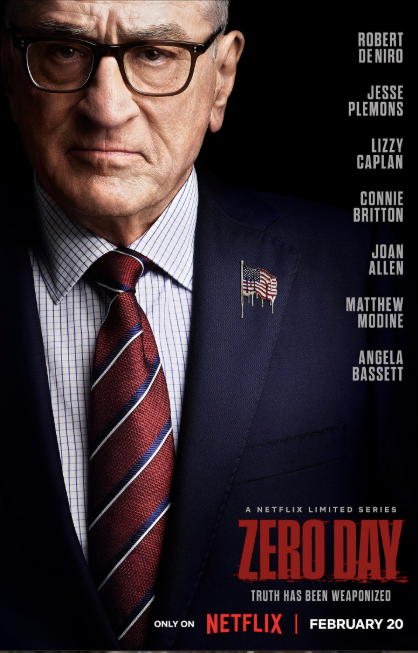
Zero Day: Thrilling Enough, But Not That Much Like Today


I binged the six-episode Zero Day that went up on Netflix.  Herewith my thoughts, with no major spoilers to warn you about [except in the very last paragraph].

First and foremost, the acting was outstanding.  I mean, with Robert De Niro, Lizzy Caplan, Jesse Plemons, and Connie Britton in major roles -- not to mention Matthew Modine and Angela Bassett with slightly less screen -- how can you go wrong.   From the point of view of the acting, every scene was a real pleasure to watch.

As to the story ... well, I've heard this limited series touted, in more than one place, as strikingly similar to what we've been seeing and hearing on our cable news stations, laptops, and social media these days.  Of course, any plot about a terrorist attack that kills lots of people, and the government veering towards fascist tactics to find the culprits, and stop this from happening again, resembles our times.  But actually, it resembles what George W. Bush and the Congress did with the Patriot Act after September 11 (mentioned in Zero Day) far more than it resembles today.  And that's because our current swerve towards fascism has nothing to do with a terrorist attack.  It stems from the voters of the United States electing to office a President whose every other pronouncement is out of Joseph  Goebbels's handbook.   So yes, although high-tech digital prowess and at least one billionaire are part of the action in Zero Day, the heart of the story is something else.

And that heart, which we've also seen in other movies and TV series on various screens, is a pretty good narrative, with affairs, difficult family relationships, politics reminiscent of what Jack Bauer had to deal with in 24 and prevalent in House of Cards, all done up nicely with a few real newscasters, a house on the Hudson, and of course the nation's capital.   So, if you're looking for a thriller brought to you by flat-out great acting and a decent-enough storyline, I'd recommend Zero Day.  But don't expect anything searingly relevant to what's actually going on today.  De Niro's character is named Mullen, and he gives a report to Congress in the last scene.  A nod to Mueller and the report he gave to Congress in Trump's first administration, right?  But that was long long time ago, in terms of the speed with we've slid and are still sliding into fascism right now.


Sunday, January 17, 2021

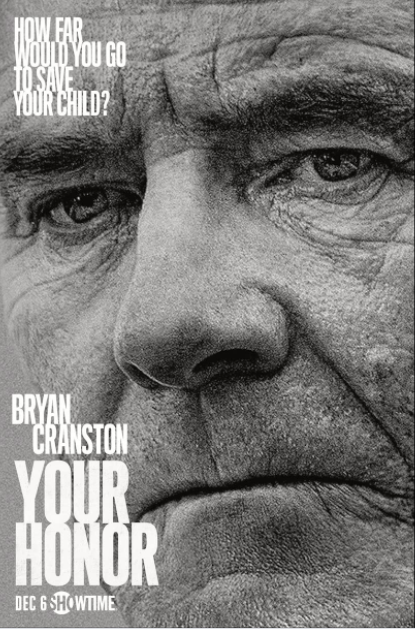
Your Honor 1.7: Cranston and Stuhlbarg Approaching Pacino and De Niro

Let me start off my review of Your Honor 1.7 by saying the scenes between Cranston and Stuhlbarg -- the Judge and the mobster -- were so good, they could have been between Pacino and De Niro.  Two outstanding actors acting their hearts and souls out in this one-of-a-kind drama, playing two fathers, one who wants at all costs to protect his son, the other wanting both revenge for the son who died and protection for the one who has just been arrested for murder.

The Judge again shows himself adept and quick-witted when the situation calls for it.  Why didn't you turn yourself in, Baxter asks the Judge.  I was going to, I was at the police station, the Judge replies, and then I saw you.  The best lies are the ones closest to the truth in these one-on-one situations, and the Judge was indeed in that police station, ready to bring in his son Adam.

I don't get Baxter's strategy in another scene, though,  Why not give Big Mo her $150,000 back?  Why say she has to eat it, and risk a war, right when he's trying to get his son Carlo out of justice's way, and get back to making the Judge pay?  He doesn't want to appear weak, I know, but he's not as smart as any of the lead mobsters in the Godfather or Goodfellas.

Adam, however, is as sharp as his father.   He doesn't believe the Judge's story.  He wisely has not told him that he and Fia are falling in love, and you know that's going to have a decisive role in how this brilliant series ends.  The Judge is a master strategist.  He managed to get Sarah off the Carlo case by feeding her single malts in the bar.  But he can't control everything, and it's still an open question of who will be left alive, who will be left out of prison, when this series concludes.

I'm very glad there are three more episodes.

See also Your Honor 1.1: Taut Set-Up ... Your Honor 1.2: "Today Is Yesterday" ... Your Honor 1.3: The Weak Link ... Your Honor 1.4: The Dinner ... Your Honor 1.5: The Vice Tightens ... Your Honor 1.6: Exquisite Chess Game


Monday, May 25, 2020

Joker: Fantasy and Canon


Checking in with a late review of Joker (2019), which the wife and I saw on HBO last night.

Let me stipulate several things:
  • Joaquin Phoenix was brilliant, inspired, incandescent, whatever superlatives you can find, in the title role.  He eminently deserved the Oscar he won for that.
  • I know a middling amount of Batman canon, but am no expert.
  • I thought the movie held together very well as movie, which means I disagree with, for example, the inanely critical review in the New York Times, as I often do.
I do have question about the ending, though.  And the fact that I have questions makes me think that maybe the movie would have been better ending before this ending.
Arthur Fleck, having actualized his impulses and become the Joker, is seen talking to his state-appointed shrink or social worker, but in a less dingy setting than at the beginning of the movie.  One explanation of this scene, which I'd like to think is correct, is that Fleck, after escaping the cops in what I was wish was the closing scene, is nonetheless apprehended at some time in the future, and is now in some kind of penitentiary serving a life sentence for his crimes (or is he maybe on death row?).

But there's an alternate explanation (which my wife wondered about, and now I'm thinking about it too).  We already saw, in the movie, that Fleck imagined making love and all the good things he did with his neighbor down the hall, Sophie.  This establishes that Fleck's fantasies played a major part in the narrative we see on the screen.  Is it possible that everything else we saw in the movie - Fleck's killing of De Niro's Murray Franklin (who, to me, is just as much Joe Franklin - believe it or not, I was once on his show, talking about my album, Twice Upon A Rhyme - as Murray is Johnny Carson), etc - were also just in Fleck's mind?   Or, at least more of the major sequences than just Sophie as girlfriend?

In at least one Batman movie, if memory serves, the Joker kills Bruce Wayne's parents.  In Joker, one of the myriad angry people with a clown face does the deed.   This suggests that Fleck did not make all of this up - another clown killing Bruce Wayne's parents is consistent with the historical Batman canon of his parents being killed.

In any case, I rate this movie as maybe a masterpiece, and, the more I think about it, the more I think that's right.


Wednesday, November 27, 2019

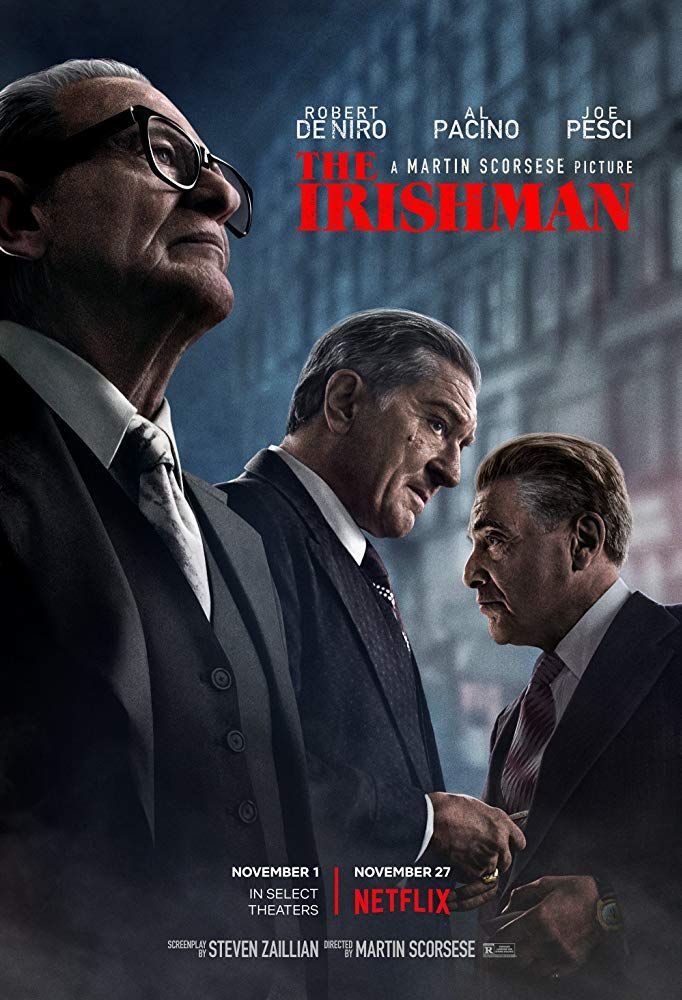
The Irishman: "It's What It Is"


"It's what it is" was an oft-repeated phrase in this three-and-a-half movie about who killed Jimmy Hoffa, and how.  And what this movie by Martin Scorsese certainly is, is something extraordinary, in the story it tells, and in the way it was directed by Scorsese, and acted by Robert De Niro, Al Pacino, Joe Pesci, and, for that matter, everyone else in the movie.

One big question is how true is the story Frank Sheeran tells us in the last days of his life.  Part of this story is how Sheeran killed Joey Gallo in 1972 in Umberto's Clam House in New York City.  Up until this movie, based on  Charles Brandt's 2004 book, I Heard You Paint Houses (which I haven't read), I had thought that four other gunmen (not Sheeran) had killed Gallo (see the Wikipedia entry on this). Since I wasn't there, I can't with certainty know who killed Gallo.  But if Sheeran did not kill Gallo, why should we believe that he killed Hoffa?

A somewhat lesser but still significant question is why Sheeran's daughter Peggy had such deep misgivings about her father, to the point of never talking to him again after Sheeran (presumably) killed Hoffa?  Why did she have those misgiving all those years?   Why her and not her sisters?  Based on the movie, the only answer I can think of is that Peggy had almost a sixth sense about her father, which is not very satisfying as even a component of such a momentous story.  (There was the scene of Sheeran crushing the hand of the man who pushed her in the grocery store - with Peggy looking on - but this doesn't seem sufficient for her life-long, growing abhorrence of her father.)

But there's an old saying to the effect of, though it may not be true, it's still a great story.  And that is manifestly the case for The Irishman.  And a lot of the story does make a perfect kind of sense.  Why did Russ (played by Pesci) talk Sheeran into killing Hoffa?  It was to protect both Sheeran and Russ, as Russ later explains to Sheeran.  If someone else had killed Hoffa, the mob would have been concerned, very concerned, that Sheeran might seek some vengeance.  As we heard early in the movie, being very concerned is a state that everyone takes very seriously.  With Sheeran pulling the trigger on Hoffa, the mob didn't have to be concerned about vengeance because, who could Sheeran take vengeance on, himself?

As for the acting, tour de force doesn't do justice to the three main players.  De Niro was absolutely masterful in voice and expression.  Pacino was the same - the way he says "phone" in his first conversation as Hoffa with Sheeran is just the right tone to establish Hoffa as a character in a world of his own.  And the same for Pacino's expression when Russ (Pesci) tells Hoffa that he may not be showing proper "appreciation".  Pesci delivers that line with a quiet strength and mob wisdom that typifies his character.  All three acted their characters over decades - the "de-aging" process enhanced this, but their acting brought the ages home.  My recommendation: all three actors should split the Oscar for best performance this year.  The supporting roles in the movie might be too short for supporting Oscars, but they were all memorable, ranging from Jesse Plemons as Hoffa's son Chuckie to Harvey Keitel as mobster Angelo Bruno.  (And shoutout to the inimitable Logan Crawford who plays a reporter.)

I have to also talk about the music.  I used to sing "In the Still of the Night" by The Five Satins with my doo-wop group in the late 50s/early 60s (I was just a kid), and it was great to hear that song at least three times in The Irishman.  The other music was right on key for the movie, too.

Scorsese is already lauded for Goodfellas and Casino, movies about the mob that were so good they come in just below The Godfather trilogy.  I'd put The Irishman just above those two, and I'm going to keep thinking about it.

I should also mention - it's one thing to see a movie on Netflix that would never be in a movie theater.  It's quite another to see a movie on Netflix, by one of the world's leading directors, with all-time great actors, that is playing in theaters in New York City right now.  The streaming revolution continues apace.


It started in the hot summer of 1960, when Marilyn Monroe walked off the set of The Misfits and began to hear a haunting song in her head, "Goodbye Norma Jean" ...


Thursday, August 1, 2019

Listen to the Way Pacino (Hoffa) Says "Phone"


This has to be one of the best trailers I've ever seen - for Martin Scorsese's new movie, The Irishman, due out on Netflix and select theaters this Fall.  It stars Robert De Niro, Al Pacino, and Joe Pacino.  It's about Jimmy Hoffa.  How could you go wrong?

But it looks and sounds to be even better than that.  Listen to way Pacino, playing Hoffa, says "phone" (about 28 seconds in).   Pacino's voice and phrasing, the way he bends words just right, like daggers (usually softly) in your heart, has always been one of his strongest suits.  But this "phone" is something else.  Beyond just right.  Sheer acoustic genius.

And De Niro has been subject to a new "de-aging process".   That's something to see, too.  This trailer is like a real window to the past - except the real is the Hoffa story, and the fiction is someone De Niro's current age playing him in a 2019 movie.

Pesci also is in fine form and voice.   I could listen to these three guys all night.   If the movie is anything as good as the trailer, it'll be one for the ages.  Look for my review here in the Fall.

Saturday, May 20, 2017

12 Monkeys 3.1-4: "The Smart Ones Do"

12 Monkeys returned tonight with the first four episodes of its third season, and they were superb indeed - in fact the best episodes in the series so far.

As usual, Jennifer has the best lines.  In response to the impresario in 1920s Paris who advises Jennifer that "no one understands time travel," an explanation for the small audience for her time-travel performance on stage, Jennifer replies that "the smart ones do".

And although this is self-serving - for me, you, Jennifer, everyone who understands and enjoys time travel (not to mention writes it) - her statement is true indeed, and applies abundantly to 12 Monkeys.   Jennifer is the very embodiment of that old truth that in crazy times, the crazy person might be the most sane - which Robert De Niro's character in The Deer Hunter also exemplified - and Jennifer's one step ahead in just about all the crucial junctures in 12 Monkeys.

Which is why she senses that Olivia is up to something no good  - or deadly, for the people Jennifer cares about - when Olivia spits out a plan to kill the Witness, after being locked up in a room with rats as per Ramse's instruction.

Jennifer, of course, can't literally see into the future - her correct sense of foreboding of what Olivia and Ramse are planning is just that, foreboding, and based on her unerring instinct and often razor-sharp logic.  So Jennifer can't literally see what Ramse is putting into motion.

And I gotta say, about Ramse, that although his motives were understandable, I didn't like what he had become, anyway.   I know he's tortured about having to kill his son - but he shouldn't have killed him. And he kills an innocent doctor in his attempt to kill Cassie, and would have killed her, too.  Cole had no choice but to kill him.  It was a sad scene, but Ramse for the most part deserved it.

And it was good to see Cole and Cassie together at the end.  I'm with Jones and the way she was smiling when she saw that.   Four fine episodes, and I'll be back with a review of what's up on the screen later tomorrow.

See also 12 Monkeys 2.1: Whatever Will Be, Will Be ... 12 Monkeys 2.2: The Serum ... 12 Monkeys 2.3: Primaries and Paradoxes ... 12 Monkeys 2.4: Saving Time ... 12 Monkeys 2.5: Jennifer's Story ... 12 Monkeys 2.6: "'Tis Death Is Dead" ... 12 Monkeys 2.7: Ultimate Universes ... 12 Monkeys 2.8: Time Itself Wants Time Travel ... 12 Monkeys 2.9: Hands On ... 12 Monkeys 2.10: The Drugging ... 12 Monkeys 2.11: Teleportation ... 12 Monkeys 2.12: The Best and the Worst of Time(s) ... 12 Monkeys 2.13: Psychedelic -> Whole City Time Travel

And see also this Italian review, w/reference to Hawking and my story, "The Chronology Protection Case"

And see also 12 Monkeys series on SyFy: Paradox Prominent and Excellent ...12 Monkeys 1.2: Your Future, His Past ... 12 Monkeys 1.3:  Paradoxes, Lies, and Near Intersections ... 12 Monkeys 1.4: "Uneasy Math" ... 12 Monkeys 1.5: The Heart of the Matter ... 12 Monkeys 1.6: Can I Get a Witness? ... 12 Monkeys 1.7: Snowden, the Virus, and the Irresistible ... 12 Monkeys 1.8: Intelligent Vaccine vs. Time Travel ... 12 Monkeys 1.9: Shelley, Keats, and Time Travel ... 12 Monkey 1.10: The Last Jump ... 12 Monkeys 1.11: What-Ifs ... 12 Monkeys 1.2: The Plunge ... 12 Monkeys Season 1 Finale: "Time Travel to Create Time Travel"

FREE on Amazon Prime

Available on Prime

Tuesday, October 6, 2015

Fear the Walking Dead Season 1 Finale: Water Water

Fear the Walking Dead concluded its all-too-brief first season last night, and although The Walking Dead will be starting its next season next week, I'll be missing Fear TWD and wishing it was continuing on television screen - beyond its webcasts - too.

The most significant development in this last episode for a year was the luxury ship off-shore, and its holding of some hope of distance from the walkers.   Ultimately, the question is whether the walkers can't be swimmers.  It certainly seems they can't - I mean, what kind of stroke could they do?  They lack the coordination to do any of the swimming strokes that at least I do at the pool.

But there's a further implicit question here: can the walking dead drown?  If not, then couldn't they just stagger into the water and out to any boat, in water over their head?  I suppose they could - but they would likely be swept away by any decent current.   I'm pretty sure we've already seen them swept away in river currents on The Walking Dead, and ocean currents would be much stronger.

Still, our human survivors finding impregnable safety on the water seems too easy a solution - though, hey, solution is something that comes from water, right?  Anyway, it'll be fun to see what's in store next year.

My other favorite part of this season finale was Nick telling his mother that he was more ready for the apocalypse than anyone else in the family, because was already somewhat out of his mind, and was coping with the insanity of being an outsider even when the world was relatively sane.   This was reminiscent of Robert De Niro's' character Michael in the excellent 1978 movie The Deer Hunter - Michael fares the best in the  insanity of fighting and getting captured  in Vietnam because he was already somewhat crazy at home.  It's impressive to see Fear The Walking Dead picking up on this profound and counter-intuitive aspect of human nature.

The Walking Dead does this too, but as I said as soon as I saw the first episode of Fear TWD, there's something about the greater proximity of this story to our reality that makes it more riveting to me.

See also Fear the Walking Dead 1.1: Great Beginnings ... Fear TWD 1.2: Tobias Leads the Way

#SFWApro


Friday, October 2, 2015

Limitless TV 1.2: Genghis Khan Gene

Limitless was a fine movie, released in 2011, starring Bradley Cooper as a guy whose intelligence is augmented to genius+ level by a drug NZT.   The movie was fast, funny, serious, and mainly featured Cooper's character Eddie Morra using his enhanced intellect to best a mobster, get back the love of his life, and turn the tables on a brilliant corporate exec played by Robert De Niro.

Limitless the television series, which debuted on CBS last week, shows signs in its first two episodes of being even better.  First and foremost, the series tells the story of Brian Finch, who also takes NZT, and his work with FBI, in particular with Agent Rebecca Harris, played by Dexter's Jennifer Carpenter.   The pace of the series is also fast and funny - Brian puts together a video compilation to help solve a crime, and puts in a little background music, because it's "cooler" - and takes on some cutting-edge issues, just the other side of the real into the realm science fiction (which makes sense, given that NZT is itself science fiction).   The story in episode 1.2, for example, features a virus designed to target descendants of Genghis Kahn, a prolific breeder.

But what makes this television series really notable is the way it integrates the movie.  The story of Eddie Morra - still played by Bradley Cooper, itself a real coup for television - indeed picks up on TV right where it concluded in the movie, with Morra a US Senator from the state of New York.   He supplies Brian with an injection that makes Brian immune to the destructive physical consequences of longterm NZT use, and proceeds to use that to run Brian.  But Morra's ultimate agenda is not yet clear in the TV series - which adds a layer of suspense and tension above the difficulties Brian has with his family and the FBI.

I can't recall a spinoff or sequel or remake ever set up or rolled out like this, and that alone would make me want to see how all of this develops.  But Limitless the TV series on its own is first-class viewing, and I'll be back with reviews throughout the season.  (Thanks to my Facebook friend Cie McCullough for calling my attention to the series.)

#SFWApro


all about genetically engineered viruses


Tuesday, July 16, 2013

Under the Dome 1.4: Good Night for Junior, Until ...

Episode 1.4 of Under the Dome last night offered a good opportunity for Junior, who finally begins to earn his father's admiration, in addition to the new sheriff's, with his cool, powerful handling of a potential mob scene of people who had to be kept inside the clinic until the resolution of the meningitis outbreak.

Junior in those circumstances was like the lead character in The Deer Hunter (1978 movie starring Robert De Niro), maladjusted in normal times, but those same intense traits made him a hero in crazy times, such as the war in Vietnam.  Junior is a psycho in "normal" times under the dome - though of course nothing can be completely or even mostly normal under the dome - but rises to the even crazier occasion of people pent up in the clinic, and masterfully talks them down.

All of this is going on with pretty Angie still chained in Junior's basement, and water gushing into it no less.   This is the underside of Junior - literally - a foundation of his insanity that he is unwilling to remove or change.

Fortunately for Angie, and in a good move for the story, Junior's father Big Jim finally hears Angie screaming at the end of the episode, and finds her in the basement.   Bad news for Junior, especially ironic because it happens right after Big Jim comes to see some value in his son, and even says he should consider a career in law enforcement.

What will Big Jim do?  Given what little we know about him, I'd say the thought might occur to him to kill Angie to protect his son.  On the other hand, he has even more motive to dispose of Rev. Coggins, and thus far has refrained.   Maybe he'll split the difference, and just not release her from the basement.

Meanwhile, Julia's antipathy to Barbie is growing to the point that she's barely grateful that he saved her life - almost as if she senses that he killed her husband.  But I'm still thinking that we'll see them in bed together - if not in this season, before the series is over.


#SFWApro

Sunday, January 2, 2011

Review of The Town: Nearly as Good as Heat

Continuing my reviews of some of the good movies of 2010, in this brief time of little on television,  I saw The Town last night, and thought it was good indeed.  Almost as good as Heat, which is among my top 20 favorite movies of all time, sometimes higher.

Ben Affleck delivers one of his best performances in years as Doug MacRay of Charlestown, Boston.  Doug is fearless and smart, and like De Niro's Neil McCauley in Heat, is into one last-jobism.  Indeed, I felt so strong a kinship between Affleck in this movie and De Niro in Heat that I said to my wife that Affleck in The Town is like an Irish De Niro (and in fact, MacRay and McCauley would both have ancestors in the Emerald Isle).

Like McCauley in Heat, who matches wits with Al Pacino's Lt. Hanna, MacRay attracts the obsessive interest of  FBI agent Frawley played by Jon Hamm of Mad Men.  Hamm is no Pacino - no one is - but puts in a fine, intense performance in The Town.

My favorite scene in Heat - and this is easily among my top 10 favorites scenes in any movie - is when Val Kilmer's Chris drives up to see Ashley Judd's Charlene, who has been soft-talked by Mykelti Williamson's Sgt. Drucker to give Chris up to the cops - or so we think.  Because in an incandescent moment, Charlene gives Chris a subtle warning sign from the window, and he drives away to safety.  I still wanna be like Val Kilmer in Heat when I grow up.

Now The Town has a scene that's so parallel to the above in Heat that it can be considered an homage.  MacRay calls Claire (well played by Rebecca Hall) with Frawley standing right beside her, urging Claire to turn MacRay in.   (Claire was bank manager and kidnapped in an earlier job by MacRay and the gang.  MacRay released her, went to see her - she didn't know then who he was - and the two just about fell in love.  Then Frawley told her who MacRay was.)   With every incentive to give up MacRay, Claire gives him a subtle heads-up.   It's a sweet moment.  MacRay was looking at Claire and Frawley through binoculars, so he knew what was up, but his smile when Claire came through for him was priceless.

Like Chris in Heat, but unlike McCauley in Heat, MacRay makes it to safety and out of The Town.   And this greatly improves on the one thing I never liked about Heat:  McCauley fell too easily to Hanna.   I was glad to see MacRay do much better against Frawley.

Note added January 4, 2011:  I didn't get a chance to mention the searing supporting role played by Pete Postlethwaite.  Like all his acting, what Postlethwaite did in The Town was unforgettable.  He passed away yesterday, but his memorable work will live on.


                 Special Discount Coupons for Angie's List, Avis, Budget Car, eHarmony, eMusic, Mozy, Zazzle


The Plot to Save Socrates


"challenging fun" - Entertainment Weekly

"a Da Vinci-esque thriller" - New York Daily News

"Sierra Waters is sexy as hell" - curled up with a good book

Friday, July 20, 2007

Mad Men Debuts on AMC: Cigarette Companies and Nixon Coming

Mad Men debuted on AMC television a few hours ago. My wife had seen a write-up of the show in The New York Times. A smart friend, Zach, mentioned it a comment on my "Barely Political Revolution" (Obama Girl) post in this blog. Matthew Wiener - a Sopranos Emmy winner for his producer work - is the Executive Producer. So we gave it a try - and we weren't disappointed. Not at all.

The show was quite good.

The setting is the New York City advertising world in 1960 - the "Mad Men" are Madison Avenue advertising men, which according to a squib on the show, was a name they gave to themselves.

Jon Hamm plays Don Draper, an advertising guy pretty close to the top of his game in his company. He looks like a young Robert De Niro, and dresses a lot like James Bond in his second and third movies. Not too shabby. His main problem is that one of the company's main clients is Lucky Strike Cigarettes - and this is a time when the Surgeon General and the media are first waking up to the real dangers of smoking.

The ambiance is superb and accurate. There's a high energy in this era, which I can still recall from when I was a kid. It somehow got sapped a little by everything that happened in the 1960s and after.

There's also a lot of smoke. Everyone smokes, all the time, including the doctors. Male chauvinism is rampant. And the music is spot-on perfect for the time and feel of the era.

The only possible error I caught was what looked like a sleek new IBM Selectric just brought into the 1960 office. But that revolutionary model - with no carriage - was introduced in 1961, in our reality. Well, maybe the typewriter in the office was some kind of test-run model...

But there was nothing else test-run about this show. The secretaries, clients - women as well as men - bosses and assistants are all vibrant and believable.

And Mad Men has an attractiveness all its own. It's certainly not like anything I've ever seen on the networks, and doesn't feel like an HBO or even an edgy off-beat Showtime entry. It has a pace and style that's somewhere between an Arthur Miller play and a Playhouse 90 production - meaning, good, and something you don't see too often if at all these days.

Affairs are simmering, and next week our hero may take on a new client - Richard Nixon, who may be running for President.

Cigarette companies and Nixon as clients - you gotta love it. I'll be watching.

See also reviews of other episodes: Mad Men 2: Smoke and Television ... Mad Men 3: Hot 1960 Kiss ... Mad Men 4 and 5: Double Mad Men ... Mad Men 6: The Medium is the Message! ... Mad Men 7: Revenge of the Mollusk ... Mad Men 8: Weed, Twist, Hobo ... Mad Man 9: Betty Grace Kelly ... Mad men 10: Life, Death, and Politics ... Mad Men 11: Heat! ... Mad Men 12: Admirable Don ... Mad Men 13: Double-Endings, Lascaux, and Holes

20-minute interview with Rich Sommer (Harry Crane) at Light On Light Through


6-minute podcast review of Mad Men


The Plot to Save Socrates


"challenging fun" - Entertainment Weekly

"a Da Vinci-esque thriller" - New York Daily News

"Sierra Waters is sexy as hell" - curled up with a good book
InfiniteRegress.tv