Chuck Todd interviews me about alternate histories
Showing posts with label trauma porn. Show all posts

Tuesday, October 25, 2022

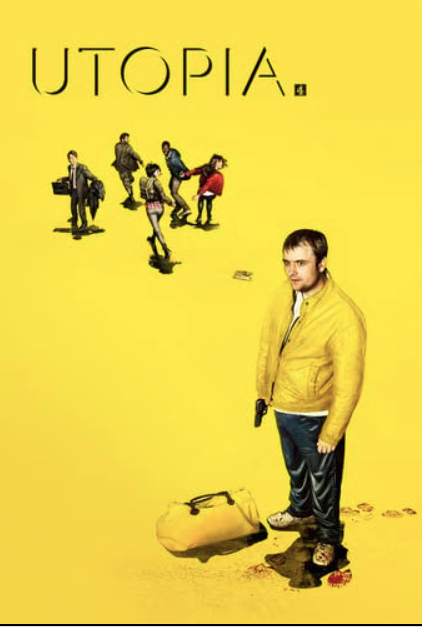
Utopia seasons 1 and 2 UK version: Vastly Better than the American version


I watched and reviewed the American version of Utopia -- the one season -- two years ago.  I thought it had its moments, was right for the occasion of the Covid pandemic, but also had several things I didn't like.  Now, two years later, I barely remember it.  Indeed, I wasn't thinking about it all until a friend, Mike Grynbaum, urged me to watch the 2013-2014 two-season British version.  He said the 2020 American version was terrible, but the British version was right up my alley.

He was right.  I thought the British version was superb on all kinds of levels.  And now that I've seen it, I think even less of the American version.

[Mild spoilers ahead ...]

The central theme of the tautly, harrowingly drawn British Utopia, that a group of scientists and government officials are putting into motion a plan to drastically prune the human species, is itself chilling.  But the specifics of their plan, to render 90% of human beings infertile. via a DNA mix distributed with a vaccine for a "Russian flu" that was itself a hoax -- well, that was truly downright frightening, especially because it was all too reminiscent of what some insane conspiracy theorists have been saying about the mRNA vaccines distributed to lessen the severity of the real and very lethal COVID-19 pandemic we're still attempting to tamp down to reliable manageable levels.  In fact, I couldn't help wonder, as I watched this series with something akin to horror, if some of the conspiracy theorists in our real world had been consciously or unconsciously influenced in their views about COVID-19 vaccines by what they may have seen in the British Utopia.

And the logic behind this plan was top-notch science fiction struggling with ethical conundrums.  The world is overpopulated.  One way of dealing with that is severely limiting reproduction.  That would be a remedy I wouldn't choose in a million years -- I would prefer figuring out better ways to live on Earth without plundering the planet, combined with getting off of Earth to other habitable planets (see my The Missing Orientation) -- but the suggestion has just enough plausibility that you can believe, as a viewer, that some half-crazed scientist and ruthless government officials might go for it.

Even more important for the narrative, that one of the good guys, physically attacked by purveyors of the plan, changes allegiances and works on behalf of the plan.  Indeed, one of the other great strengths of this story is not only how a hero becomes a villain, but how a villain becomes a hero, against the backdrop of a vast array of vivid, idiosyncratic, and therefore memorable characters who are intractably working for the good, bad, and everything in between.

If there was one thing I didn't care for in the British Utopia it was its partaking of the trauma porn which has become a veritable hallmark of  fantasy and science fiction since 2013-2014, ranging from House of the Dragon to The Peripheral, and even reaching as far as fiction verging on biopics such as Blonde.  The spoon and the eye -- you'll of course know what I mean if you've seen British Utopia -- were revolting to see, and not really necessary to see in such detail.

But that shouldn't get in the way of your seeing Utopia the way the series was meant to be seen -- and now that I've alerted you to the brutality, you can safely turn away from the screen for a few moments when you see that spoon coming.   

As I said at the beginning of this review, I've all but forgotten the 2020 American version. 

In contrast, the 2013-2014 British version is something I'll never forget.


Saturday, October 1, 2022

Blonde: Only the Acting Was Excellent


Just watched Blonde on Netflix. I'm sorry to say I found only the acting was excellent.

Let's talk about that excellence first. Ana de Armas as Norma Jeane delivered an Oscar worthy performance, conveying the 20% bravado/80% vulnerability that we think we know of Marilyn just perfectly. The voice, the facial expressions, and body language were so good, I could believe I was seeing Marilyn on the screen.

Adrien Brody as "The Playwright" aka Arthur Miller was also superb, not ever really understanding Marilyn, flattered and impressed not just by her beauty but more by her intelligence. Bobby Cannavale as "The Ex-Athlete" aka Joe DiMaggio also gave a strong, if somewhat obvious performance (not his fault, since he didn't write the dialogue). And Julianne Nicholson gave a memorable performance as Norma's mother.

As for the rest -- the story, the pace, the intensity of many of the scenes -- not so good at all. First, to be clear, I obviously know nothing of Norma/Marilyn personally. And I haven't read the "novel" by Joyce Carol Oates that Andrew Dominic's movie is based upon, so I can't say how true the movie was to the novel. (I put "novel" in quotes because the amount of truth in her accounting of Marilyn's life and death has been under debate since the book first was published back in 2000.) But whatever the source of this lurid accounting on the screen, I don't get why Miller and DiMaggio had to go nameless. (I would add that, at least here in the United States, the law says that the dead cannot be slandered.)

But namelessness is the least of this narrative's problems. Norma/Marilyn dies, according to the movie, either accidentally or deliberately taking too many pills and alcohol because she's devastated that someone, obviously not her father, who had been writing to Norma as her father for years, admits that he really wasn't her father? Unless that truly happened, that's a pretty lame reason, given what the movie previously shows us about Marilyn's surprising resilience, rescuing her time after time. Not to mention that someone with her intelligence, which was well portrayed in the movie, surely would have realized that the "tearful father" who communicated with Norma/Marilyn over the years but never showed up as he was promising to do, certainly was not her father.

And the scenes ... with the exception of most of the Arthur Miller segment, which at times had a real tenderness, the overall story was a continuing series of scenes, one after another, that were punches to the stomach and the soul.

Ok, I will admit that the closing scene did have a flash of perverse poetry, perhaps, with Marilyn posing and smiling at us, her audience, after she was gone. It felt like a cinematic embodiment of Bernie Taupin's words in the Elton John song, "Goodbye Norma Jean," about all the papers having to say was that Marilyn's body was found in the nude. Even in death, her body was exploited, with whether or not this was what she wanted never being known for sure.

But as for the rest, I suppose this is a question of personal taste, but the tableaus were just too unpleasant, viscerally revolting, even if the events they were portraying were necessary to see in any form in this movie. The John F. Kennedy fellatio scene was demeaning to everyone -- including the viewer -- not to mention that who knows if this actually happened. And while we're on the JFK-Marilyn relationship, why not show the famous "Happy Birthday Mr. President" iconic scene from Madison Square Garden, which was real and stunning?

So, though I'll take a chance and see any movie about Marilyn Monroe, only the acting and a sparse few scenes save me from saying I'm sorry I wasted my time on this trauma porn. 


InfiniteRegress.tv