Chuck Todd interviews me about alternate histories
Showing posts with label Edward Norton. Show all posts

Wednesday, December 25, 2024

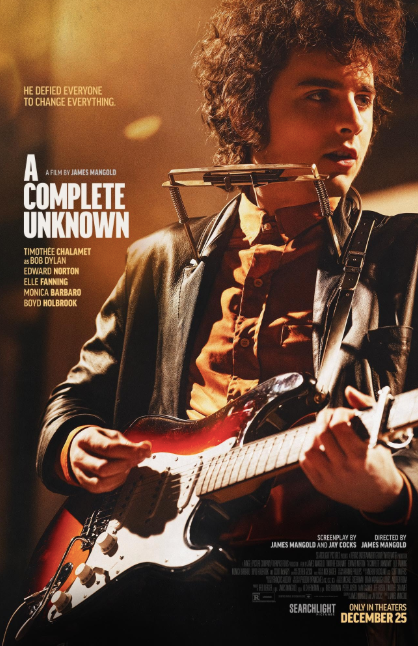
A Complete Unknown: A Nearly Completely Superb Bob Dylan Biopic, Slightly Alternate History


My wife and I just got back from seeing A Complete Unknown, the Bob Dylan biopic.  We both loved it.  The following is my take on the movie.

Dylan recently famously tweeted (on X) that Timothée Chalamet is "a brilliant actor so I’m sure he’s going to be completely believable as me. Or a younger me. Or some other me."  Unsurprisingly, Dylan got it entirely right.  Every biopic ever made is about someone inevitably a little or lot different from the subject of the movie.  Not only can the actor not possibly look 100% like the subject -- unless they are the subject's identical twin, and the producer somehow managed to go back in time and talk the twin into playing the subject's part in the biopic -- but there's inevitably dialogue left out or changed, streets and buildings that don't look the same as the originals, etc, etc.  Look, frankly, even a documentary is never entirely truthful.  It may be more truthful than the biopic, but the director inevitably has to make easy and painful decisions to leave certain things out, etc, etc.   In a phrase, all biopics and docu-dramas are alternate histories (and documentaries, too, just a little less so).

But A Complete Unknown is so good because it managed to get so many things right.  Chalamet as Dylan and Edward Norton as Pete Seeger were letter and note perfect in the words they spoke, the songs they sang, and even what they looked like and how they moved.  Monica Barbaro was not quite there singing as Joan Baez, whose rich mellifluous voice back then is unmatchable, but Barbaro hit all the notes well, and certainly captured Baez's attitude, energy, and intelligence with style.  I don't know what Suze Rotolo at that age was like, even in video. She was inspiration for the part of Sylvie Russo in the movie, because Dylan (to his credit) in our current time didn't feel right about having her character by name in the movie, because she left the world in 2011 and couldn't give her consent to be portrayed in the movie -- but Elle Fanning did a fine job in the part.  (The obvious explanation is Dylan wanted the name changed because some of the interactions with Dylan and Russo in the movie are at variance in some significant way with what really happened between Dylan and Rotolo.)

In addition to Dylan's songs, which were immensely enjoyable to see written, and see and hear performed, there was a symmetry, a kind of rhyme, in the movie, which I expect will stay with me for a long time.  One of my favorite examples is Woody Guthrie's "So Long, It's Been Good to Know You".  It starts off the movie, which begins in 1961, as Dylan comes to New York, and goes to see Woody Guthrie, who was already seriously ill (in reality, he'll live until 1967), and meets Pete Seeger (who had a wonderful cover of the song, solo, and earlier with The Weavers).  At that point, it seems like the song is about Dylan and Seeger saying goodbye to Guthrie.  But when the movie ends, with Dylan going the apostate electric way, the song is played again, and the goodbye is to the Dylan who has forsaken acoustic folk for an electric band with Al Cooper et al. 

The title itself of this cinematic triumph underwent a transformative rhyme.  Dylan is "a complete unknown" when he first crosses the Hudson and arrives in New York City and the movie begins.  And of course the song that plays out the movie as Dylan commits to high voltage is "Like a Rolling Stone," in which "a complete unknown" is one of the many signature phrases.

The implication in the movie -- actually a little more than an implication -- is that Dylan did this because he wanted to be as famous as the Beatles.  I don't know Dylan personally, and have no idea if that's true, but I do know that both kinds of Dylan -- "Blowing in the Wind," "The Times They Are A-Changin'," and "Masters of War" evolving into "Like a Rolling Stone," "Just Like A Woman," and "Positively Fourth Street" (I don't think the last two were in the movie) -- were equally works of genius in their own ways.  And I also know, for whatever it's worth, that the lyrics Dylan wrote are in a class of their own, at the top of the best lyrics ever written, surpassing the timeless word-craft of Cole Porter, John Lennon and Paul McCartney.

There was one scene I found annoying in the movie.  One of the highlights of the momentous Newport Folk Festival scene has Joan Baez singing "There But for Fortune," a huge hit for her, written by Phil Ochs.  Dylan is shown offstage, not looking very happy.  Maybe he's understandably nervous.  Or maybe he's jealous.  But the song isn't identified by Baez.  And in fact there's no mention of Ochs anywhere in the movie.  Whether an accidental oversight or a deliberate cut of something that was filmed ... who knows.  It certainly doesn't make sense given the prominence of the song in that scene, not to tell the movie audience who wrote it.

I'm also sorry we didn't hear any of "God On Our Side" -- especially relevant on this day -- the most irrefutable anti-war song, pinpointing the hypocrisy and insanity of war, ever written.

But I guess that's just personal opinion, and I also think that, just like Dylan's songs, this movie will never grow old.  It will be watched long into the future, after which people might watch Peter Jackson's documentary about The Beatles, and then Martin Scorsese's.  But there's no need to wait for the future.  My recommendation is see A Complete Unknown as soon as you can.

=============

One of the real people left out of the movie is Terri Thal, Dylan's first manager.  Here's an interview Frank LoBuono did with her on his Being Frank podcast on May 30, 2024.

For more on the movie, see David Browne's piece in Rolling Stone.

=============


I haven't written an alternate history as yet about Dylan, but here's one I wrote about The Beatles, in Kindlepaperback, and hardcover


I've always been partial to rhymes.  They're the velcro of the mind.
You can listen to my 1972 album on Bandcamp and Spotify.


The Weavers singing "So Long, It's Been Good to Know You"

Tuesday, December 27, 2022

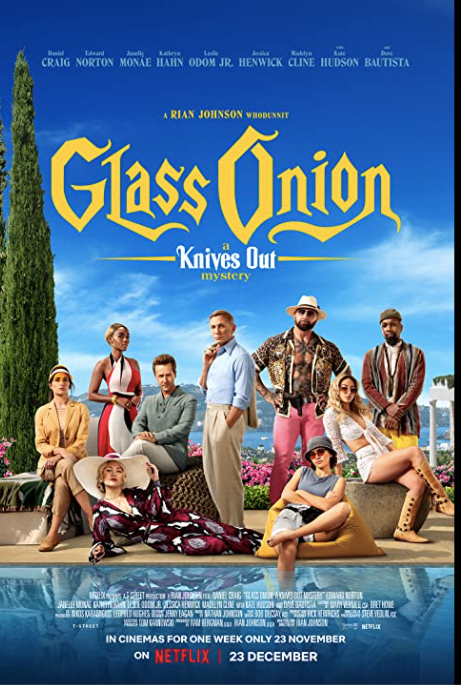
Glass Onion: A Knives Out Mystery: Hercule Poirot and Elon Musk


Glass Onion: A Knives Out Mystery was even funnier and more fun than Knives Out, which was plenty funny and fun.  Plus, Glass Onion was just brimming with social relevance, extending its satire of Agatha Christie to our real world at large.  All to the good -- given what our real world is like, we could use all the satire we can get our eyes and ears on.

[Spoilers ahead ...]

COVID is the first real calamity to receive this treatment.  I certainly wouldn't want to see an entire movie lampooning anything about the pandemic -- it's no laughing matter -- but the start-up of Glass Onion with the masks and the protective blast to the throat was just right.

Elon Musk, on the other hand, deserves all the satire anyone can lob at him.  And Miles Bron, who turns out to be the villain of the story, surely has elements of Musk, hawking a scientific miracle energy breakthrough, flaunting his billionaire wealth, and all the rest.  Social media in general get a good ribbing in this movie, too,

The acting was great.  Daniel Craig (as sleuth Benoit Black) and Ed Norton (as Miles Bron) have never given anything less than a top performance, at least as far as I know.  And the supporting cast were in fine form, too.  For some reason, my favorite was Madelyn Cline as Whiskey (hey, she was excellent in Outer Banks, too).

Of course, in a satire whodunnit, the mystery plot has to be tight and well resolved.  I won't give everything away, on the slim chance that you're reading this and haven't already seen Glass Onion.  But I will say Hercule Poirot would've approved.

Oh, and the music was good, too!  "Glass Onion" is always a pleasure to hear.  And it sounded fantastic at the end of this movie.  I'm thinking the producers of the movie did to the sound what Peter Jackson did for the Beatles in Get Back -- the Beatles never sounded better!

And while we're on the subject of music in this movie, Nat King Cole's "Mona Lisa" gets that same -- let's call it Peter Jackson -- treatment. Cole's uniquely warm voice, like "chestnuts roasting on an open fire," sounds like it's in the same room with us. Mona Lisa -- the Leonardo da Vinci painting -- makes a major appearance in the movie, a symbol of Bron's boastful greed -- as does an acoustic guitar alleged to be Paul McCartney's, which Bron strums for "Blackbird" to impress his guests. 

Okay, this review is about a movie, not its music, but as long as I'm into it, the Bee Gees' "To Love Somebody" sounded crystal clear beautiful, too, as did David Bowie's "Starman" (his "Star" is in Glass Onion, too, but I always liked "Starman" much more). And one last point, promise, about this music: it was fun to hear Toots and the Maytals sing "Take Me Home, Country Roads," but yeah, it made me wish I was hearing John Denver singing his song with co-writers Taffy Nivert and Bill Danoffin this supersonic mix. 

 All credit goes to Rian Johnson, who not only selected the songs, but wrote and directed this gem of a movie.

not the least bit funny ... well, maybe a little

It's Real Life

alternate reality about The Beatles on Amazon, and  FREE on Vocal

Monday, July 27, 2020

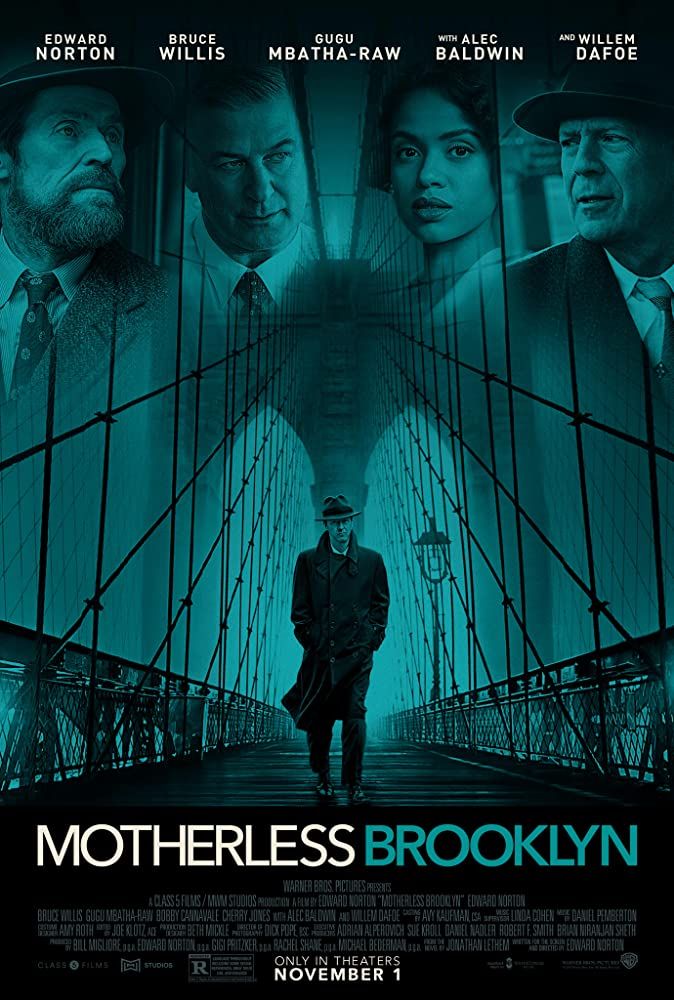
Motherless Brooklyn: Go Down Moses and Black Lives Matter


The wife and I just saw Motherless Brooklyn on HBO.  It's billed as an Edward Norton movie - he also starred in it - based on the Jonathan Lethem novel.  I didn't read the novel (I was busy writing the sequel to The Silk Code when Lethem's novel was first published in 1999).  But it's just as well.  As readers of my reviews in this blog may know, I like reviewing movies and TV series on their own terms, not on how they compare with the novels or short stories on which they may have been based.  I will say that my wife mentioned that she saw that the Norton movie departed from the Lethem novel in many major ways.

The story in the movie is about Robert Moses, the controversial, legendary builder, responsible for any number of highways in and around New York City (including the Long Island Expressway), bridges, and even Jones Beach. Moses was controversial because it was claimed he ran roughshod over and failed to provide for the poor communities near or over which he erected his great structures.  This accords with the focus and expansion of Black Lives Matter now, at long last happening, though Lethem's novel and even Norton's movie were created long before this happened.

In the movie, Robert Moses is renamed Moses Randolph, and unsurprisingly very well played by Alec Baldwin.  His antagonist is Lionel (nicknamed Brooklyn and long without a mother, hence the title).  Lionel is a detective whose boss is killed, likely because he crossed Randolph in some big way.  Also, Lionel has Tourettes, which makes for an especially memorable character, and gives Norton the opportunity to deliver an Oscar-worthy performance, which he does.  Gugu Mbatha-Raw plays Laura Rose, a pivotal character to Lionel and the movie, and she puts in a winning performance, too.

I also liked the less leading characters.  My favorite was The Wire's Michael Kenneth Williams, who plays a Mile Davis-type character (identified only as "The Trumpet Man") who uses his trumpet in more ways than one. Also, The Trumpet Man and Brooklyn have a conversation about the shared basis of extreme musical talent and Tourettes that is itself worth price of admission.

I should mention that The Wire is in my view sometimes the best series ever on television, and always in contention for that position, and one of the reasons is that its cast was so stellar.   But back to Motherless Brooklyn, it's a satisfying and altogether excellent movie, and I highly recommend it.


InfiniteRegress.tv