Chuck Todd interviews me about alternate histories
Showing posts with label John Ridley. Show all posts

Thursday, January 13, 2022

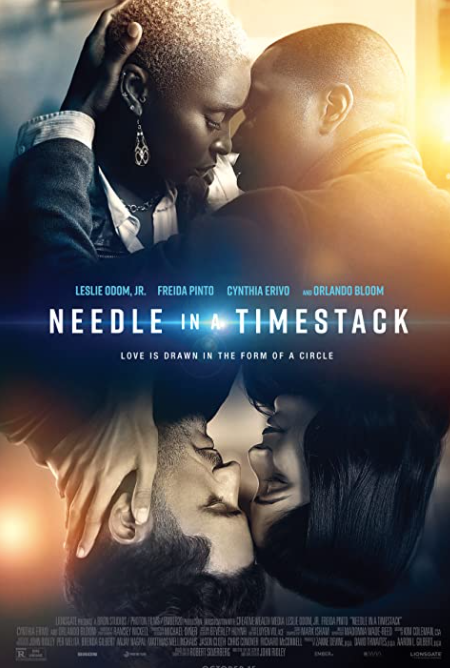
Needle in a Timestack: Find It


For some reason, I just saw something about Needle In A Timestack earlier this evening.  It's been streaming on something called Amazon Instant Video -- apparently since the end of this past October -- and it costs 99 cents to see.  It will be on Amazon Prime Video, presumably for free, on January 28.  Now, ordinarily I'd wait the two weeks and see it on Prime Video.  Readers of my reviews will know I'm a cheapskate.  But, by my reckoning, not only does time wait for no one, neither does time travel, or at least time travel narratives should not be obliged to wait. That, and the fact that the movie is based on a story by Robert Silverberg (which I haven't read), a great writer whom I not only admire but know fairly well, tipped the balance.

And I'm glad it did.  Needle in a Timestack is a thoughtful, high intellect movie, very much in the Philip K. Dick tradition.  Time can not only be traveled through via "jaunting" (a term made famous by Alfred Bester for teleportation in The Stars My Destination back in the 1950s), but at least one person can cause "phases" in time that can change everything in big or small ways, depending upon who gets caught up in the phasing.

Into this set-up we find Nick (superbly played by Leslie Odom, Jr.) in a less than totally happy marriage, with no kids and a cat rather than the dog he feels he'd like to have as a pet.  Part of his problem is he's pretty sure his wife Janine (well played by Cynthia Erivo) is still in love with her first husband and Nick's old friend Tommy (Orlando Bloom, always good to see).  I'm going to abstain from spoilers here, so the only thing more I'll say about the plot is Nick via shifting and jaunting goes through a variety of realities until ... [see the movie].

I will say, though, that I always have the greatest respect for time travel stories that stick to the logic and necessities of the presented structure of time and time travel.  Needle in a Timestack does that quite well.  For example, if someone is caught up in a "phase" shift, there's no reason that phasee will recall elements of the first timeline not present in the second.  Further, an organization that purports to be able to save memories via photos and videos from one timeline to another is bound to be not very effective, if not an outright fraud.

Another appealing aspect of this movie is the way it portrays a slightly into the future time.  These backgrounds provide a nice physical context for what is also a superior love story.  Given time, I'll predict that Needle in a Timestack (directed by John Ridley) will take its place along with Time Traveler's Wife as a very memorable time travel romance -- in this "phase," or any other.


Friday, May 15, 2015

American Crime Season 1 Finale: The Banality of So-Called Justice

American Crime ended is first season last night with its story of star-crossed lovers, Carter and Aubry, whose complicated love was too pure, too innocent, too compelling and beautiful to ever survive this gaggingly ugly and brutal world.   Carter dies from Russ's bullet  just as he's trying to call Aubry, no doubt to tell her he loves her, and Aubry's last thought before she dies of her own hand is maybe somehow Carter survived.

But we can the narrow indictment to something more specific than the world, and I don't mean just the hapless, tormented Russ, whom I'll get to in a minute.  It's the breathtaking cluelessness of the justice system - more destructive, in some ways, than mere corruption - which can't get anything right.  We've seen evil in police work on television before - The Shield would be an outstanding example - but never an exposition such as in American Crime of a system so rotten at every level.   The season ends without our knowing who did the initial killing, and certainly the authorities don't know.  They're good at nothing - not catching the criminals in the first place, not protecting the souls who come into their custody - except providing an effective training camp for further criminal acts.   I suppose this banal ineptitude afflicts most parts of our society, but it's especially grievous when it inhabits a system in which life and death is literally at stake.

Certainly the inanity prevails in the ease with which people can get guns in this country.  I knew the moment Barb bought the gun that its bullets would be used to kill Carter, though I thought she not Russ would pull the trigger.   But, in retrospect, Russ was always more broken than Barb, and it figures that his naive belief in the justice system (taking its word for it, to the end, that Carter killed his son) - unlike Barb, who was finally maybe glimpsing a deeper truth, and was pulling away from the system - would propel Russ to his act, pathetic for him, the ultimate voice of the deadly ignorant injustice for Carter and Aubry.

There are slender threads of hope, maybe Carter's sister and Aubry's mother hugging, now that Carter and Aubry can't, and perhaps realizing that they contributed to the deaths of Carter and Aubry, too. Maybe Hector, maybe Tony, but the odds are against them, as long as this sick system of justice continues.

America needs more shows like John Ridley's American Crime and its splendid acting (special kudos to Caitlin Gerard, Elvis Nolasco, Richard Cabral, Benito Martinez, Regina King, Timothy Hutton, and Felicity Huffman, but everyone was just brilliant) to strip the system bare, so we can see it for what it is.  The more I think about it,  American Crime is the best series on television in many a year. I'm glad there'll be more of it next season.

See alsoAmerican Crime, American Fine ... American Crime 1.7: The Truest Love ... American Crime 1.10: The Exquisite Hazards of Timing


a different kind of crime

#SFWApro


Saturday, April 18, 2015

American Crime 1.7: The Truest Love

Amidst all the lies, half-truths, betrayals, incompetence, and just plain evil that populates so much of American Crime - and in the case of the evil, especially some of the authorities - the one relationship that increasingly rings true and reliable is Aubry and Carter.

And never more true than in episode 1.7.   Carter is increasingly pressured by his sister to quit Aubry. But he just can't seem to do it, even though, as we've just seen, her instincts aren't the best, to say the least, for keeping the two of them out of trouble.   But Carter tells his sister that Aubry saved him. And, in his recollection, we see that was literally the case.

Meanwhile, Aubry is getting similar pressure to leave Carter from everyone around her.   In her case, there's a motive that the police are dangling in front of her: if she testifies against Carter, that would be her ticket to freedom.   For a moment, in the hospital, it seemed that she might be turning against Carter, though I couldn't believe it.   And I was gratified with that last scene, in which her horror story of what was done to her turns out to have her brother as the perpetrator.

So Aubry and Carter are the improbable rock of Gibraltar in this story, holding firm, for now, against the cesspool tempest of deceit that is daily hurled against them.  The question is how long can they endure it.   Optimist that I always am, I'm hoping they can, to the end - but the forces arrayed against them are powerful, indeed.

Although it's still not clear who committed this American crime, it's very clear that the police don't have a creditable witness against Carter.   Hector's obviously a complete liar, and the detectives know it.   The question is whether they'll allow the prosecutors to go ahead and use it.   Chances are they will - which is part of what I meant earlier about the authorities being reprehensible.

Not reprehensible, and indeed superb, to switch gears here, is the acting in this series.  Caitlin Gerard as Aubry and Elvis Nolasco as Carter are just outstanding - and, in episode 1.7 especially, delivered Emmy-worthy performances.   Richard Cabral as Hector is excellent, as is Regina King as Aliyah Shadeed (born Doreen Nix, Carter's sister), and I haven't even mentioned the big names such as Timothy Hutton and Felicity Huffman, who are putting in what will counted as among the best performances of their careers.   The other related stories, such as Alonzo and his family, are also searing and well acted.

John Ridley's American Crime is television at its hard-hitting, truth-searching, very best.

See also: American Crime, American Fine


a different kind of crime

#SFWApro

Friday, March 20, 2015

American Crime: American Fine

I thought it high time I checked in with a review of American Crime, the new ABC-TV series directed by John Ridley, who produced 12 Years a Slave.   In a word, the series is excellent - original, deep, superbly acted and plotted.  Well, that's more than one word, but they're all deserved.

In a very general way, American Crime is much like True Detective, the investigation of brutal murder(s) taking up an entire season.   In the case of American Crime, we have a married couple, the husband found murdered and the wife badly beaten and apparently sexually attacked.   They're white, and the suspects, quickly identified and rounded up by police in the first episode, are African-American and Hispanic.  The unfolding story reveals schism in the relationships of both sets of parents of the victims - as well as each set of parents to the other - as well profound differences in the suspects and their lives.   By the end of the third episode, we're giving some suspicions that the suspects may not be the perpetrators of the crimes.

Timothy Hutton and Felicity Huffman as parents of the slain Matt are outstanding, and put in what will be counted as among the best performances of their careers.   Hutton always had a large range, ranging from the comical to the cool, but his behind-the-eight-ball father in American Crime, struggling to the do the right thing in the face of a caustic wife and pressures from the parents of his son's wife Gwen, is  especially noteworthy and just masterful.

On the other side of this narrative,  Benito Martinez - whom I first got to know on The Shield - puts in a great performance as Alonzo Gutierrez, the father of one of the people arrested, a boy whose only crime seems to have been giving a car to known gang members.   Seeing Alonzo get chewed up by the legal system,  striving to keep his son out its legal claws but mostly failing because he doesn't fully understand what's going on, is a sight to behold as well as instructive about how minorities are treated when they get pulled in the criminal system in this country, whether or not through any fault of their own.   Just to underscore this point, we get a searingly memorable scene in the third episode in which his daughter Jenny, totally innocent, is almost drawn into this sick system herself - that is, she's almost arrested, when she has been doing nothing wrong.

Also memorable is Caitlin Gerard as Aubrey, drug addict and girlfriend of one of the incarcerated suspects, not dumb, but abused by life, literally thrown in a scrapheap after passing out and being sexually abused, and doing whatever she can to hold on.   We've seen characters like this on many a police drama over the years, but none quite as effective in this role.

If the first three episodes are any indication, we can expect all kinds of twists and turns and heartbreaks and maybe a sigh or two of relief in the episodes ahead, and I'm looking forward them all.


a different kind of crime


InfiniteRegress.tv